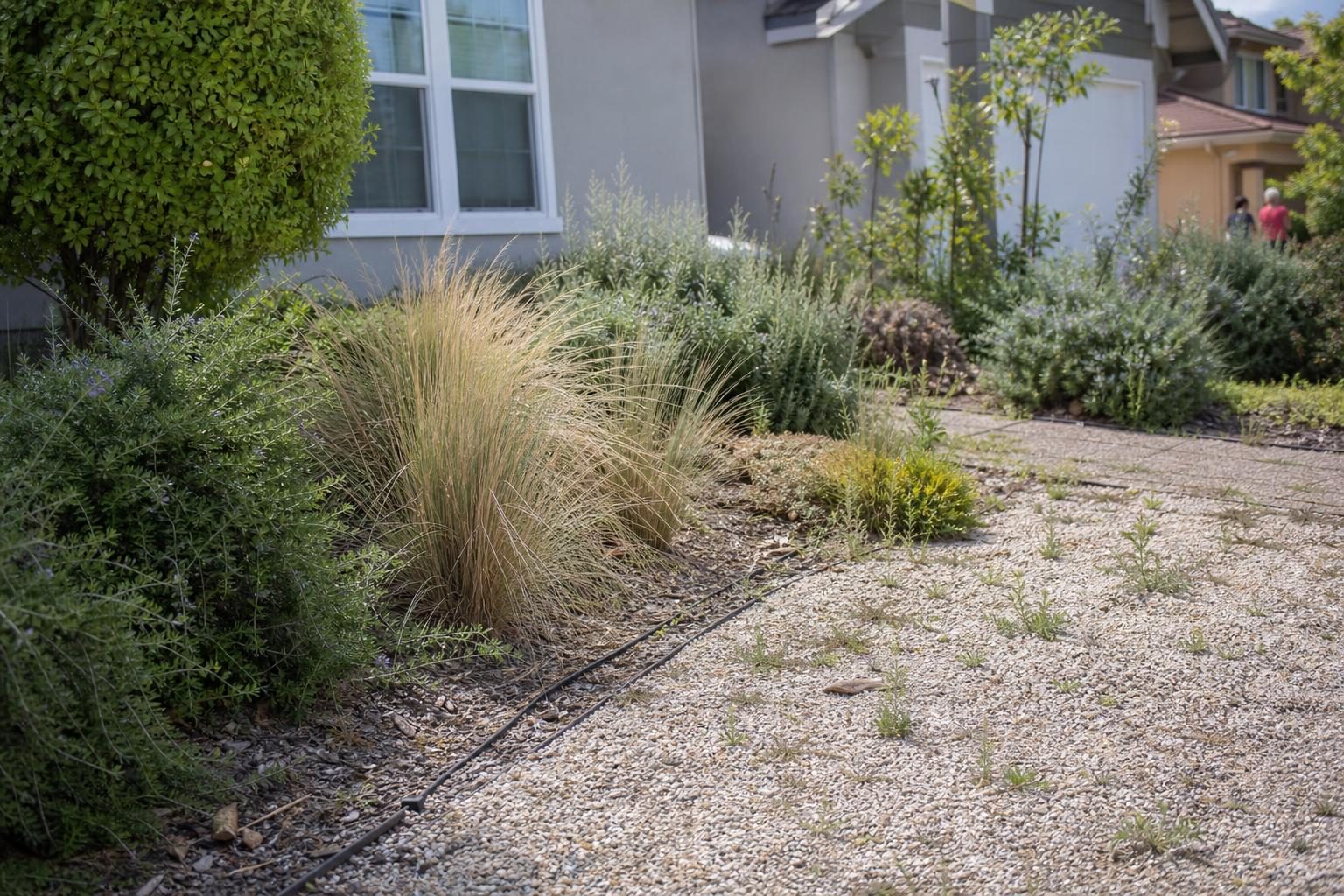
Low-maintenance landscaping fails most often because of planning shortcuts, not bad luck. Rock without a weed plan, plants that outgrow their space, no irrigation strategy and too many different plant types can turn an “easy” yard into a weekly chore. Avoiding a handful of common mistakes at the planning stage saves far more time than any product you can buy later.
Part of our Complete Yard Design and Planning Guide: layouts, ideas by yard type, phasing and budgets in one place.
Weed and groundcover mistakes
Assuming rock or gravel means no weeds
Rock beds still get weeds. Wind-blown seeds land in the dust and debris that collects between stones, and perennial weeds can push up from below. Landscape fabric slows weeds from below at first, but soil builds up on top of it over time and weeds root there anyway.
Do instead: remove existing weeds and their roots before installing anything, use enough rock depth (often 2 to 3 inches for small gravel), install solid edging, and plan on a quick weeding pass a few times a year. In many cases, dense planting with mulch suppresses weeds better than open rock.
Plant selection mistakes

Choosing plants for how they look in the pot
A shrub that looks right in a one-gallon container may be 6 feet wide in five years. Planting too close or choosing fast-growing plants for tight spots creates years of pruning.
Do instead: read the mature height and width on the plant tag and space for that size. Choose dwarf or compact varieties near walkways, windows and foundations. Accept that a new bed will look a little sparse for the first season or two.
Using too many plant varieties
A bed with fifteen different plants has fifteen different pruning times, water needs and pest issues. It also tends to look busy.
Do instead: repeat a smaller palette of five to eight reliable plants suited to your climate, sun and soil. Repetition looks intentional and keeps care simple.
Planting messy trees next to hardscape
Trees that drop fruit, seed pods, sap or heavy leaf litter over a patio, pool or rock bed create cleanup every week of the season. Debris caught in gravel is especially hard to remove.
Do instead: check what a tree drops and when before planting it near paved or rock areas. Place messy species where litter can fall into mulched beds, and keep trees far enough from walls and paving that roots will not lift them later.
Water and soil mistakes
Skipping irrigation planning
Even drought-tolerant plants need regular water while they establish, usually through the first one to two growing seasons. Hand-watering a large new bed in summer is the opposite of low maintenance.
Do instead: plan drip irrigation for beds and group plants by water needs so one zone does not overwater some plants while underwatering others. Add a smart or weather-adjusting controller if your budget allows. Our drip irrigation vs sprinklers guide explains which suits beds versus lawn.
Ignoring soil and drainage
Plants placed in compacted, heavy or waterlogged soil struggle and need replacement. Replanting is real maintenance.
Do instead: test or at least dig into your soil before planting. Loosen compacted areas, add organic matter to beds where appropriate, and fix standing water before planting. Our soil amendment vs topsoil guide helps you decide what your beds need.

Lawn and hardscape mistakes
Leaving awkward lawn shapes
Narrow strips, tight curves and lawn islands around trees take the most time per square foot to mow and trim. Grass along fences and walls also needs constant edging.
Do instead: keep lawn in simple shapes wider than your mower deck, or replace small, hard-to-mow areas with groundcover, mulched beds or hardscape. Add a mowing strip of pavers or concrete along beds so the mower wheel can run on it.
Choosing hardscape without thinking about heat and upkeep
Large areas of dark rock or hardscape in full sun can make a yard hotter and less comfortable. Some surfaces also need regular care: stamped concrete needs resealing, pavers need joint sand topped up, and gravel needs raking.
Do instead: balance hardscape with planting and shade. Compare the real upkeep of each surface, not just the installation price.
What “low maintenance” actually costs over time
Low maintenance usually means paying a bit more up front to spend less time later. Rough comparison of ongoing effort:
| Choice | Upfront cost | Ongoing care |
|---|---|---|
| Traditional lawn | Low to moderate | Weekly mowing in season, watering, feeding |
| Mulched beds with native or adapted shrubs | Moderate | Mulch top-up yearly, light pruning, early weeding |
| Rock or gravel beds with plants | Moderate | Occasional weeding and debris blowing |
| Artificial turf | High | Brushing, rinsing, infill top-up; replacement eventually |
| Patio or pavers | High | Sweeping, joint care or sealing |
Also budget for the first year. Many low-maintenance plans assume plants will be replaced if a few fail during establishment, mulch will settle and need a top-up, and the irrigation schedule will need adjusting after the first summer. Setting aside a small amount for these fixes keeps the plan on track instead of letting gaps fill with weeds.
For a broader plan, see our low-maintenance landscaping guide.

Questions to ask a landscaper before you commit
- How many hours per month will this design realistically need in each season?
- What are the mature sizes of the plants, and how far apart are they spaced?
- How will the beds be watered during establishment and after?
- What weed control is included at installation, and what will I need to do after?
- Is there a plant warranty, and what are its watering conditions?
Our list of questions to ask before hiring a landscaper covers licensing, insurance and contracts as well.
Frequently asked questions
Is rock really lower maintenance than mulch?
Rock does not break down, so it does not need yearly replacement. But it collects debris, still grows weeds and can hold heat. Mulch needs topping up but improves soil and is cooler for plants.
How long until a low-maintenance garden actually becomes low maintenance?
Expect more care in the first one to two years while plants establish and fill in. After that, a well-planned yard should need much less regular attention.
Should I put landscape fabric under everything?
Not usually. It can help under gravel paths, but under mulched planting beds it often blocks soil improvement and ends up with weeds rooting on top.