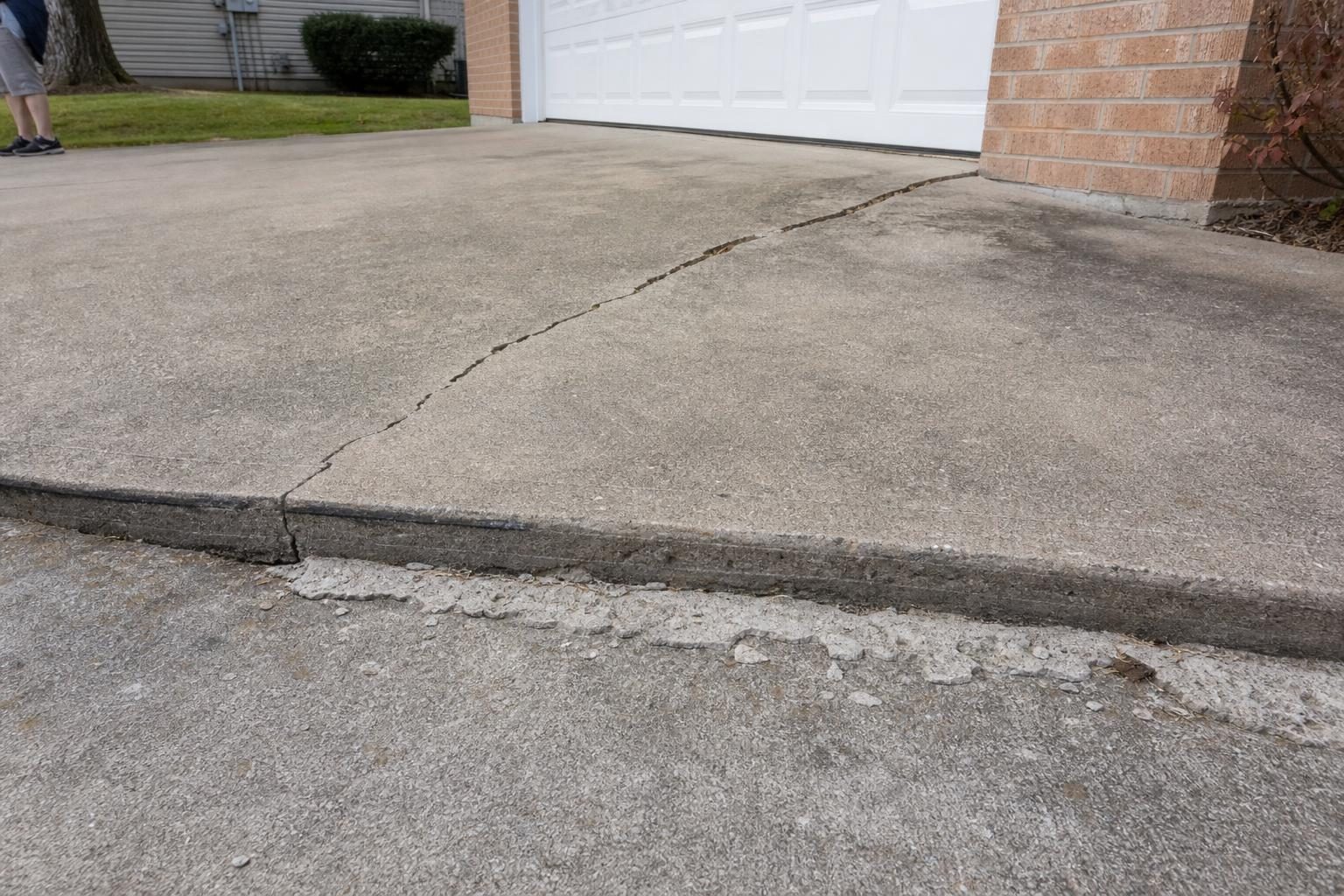
A concrete driveway needs attention when cracks are widening or shifting out of level, slabs have sunk or heaved, water pools or runs toward the garage, the surface is flaking or crumbling, or edges are breaking off. Thin, stable cracks are normal; movement, trip hazards, and spreading damage are the signs that repair or replacement should be on your list.
Part of our Complete Driveway Guide: types, costs, installation, repair and hiring in one place.
Here is how to read the warning signs, what usually causes them, and when to repair versus replace.
Cracks: which ones matter
Concrete shrinks as it cures, so most driveways crack somewhere. Control joints, the cut or tooled lines across the slab, are there to make cracks happen in straight, planned places. Not every crack is a problem.
Usually cosmetic
- Hairline cracks that stay narrow and level on both sides.
- Cracks running along or inside control joints.
- Fine surface “map” cracking (crazing) that does not go deep.
Worth watching or fixing
- Cracks wider than about a quarter inch.
- Cracks where one side is higher than the other.
- Cracks that are getting longer or wider season to season.
- Several cracks meeting in a spider pattern, often a sign of a weak or washed-out base.
For more on why cracks form, see why concrete driveways crack and how contractors control it.

Sinking, heaving, and uneven slabs
When soil under the slab settles or washes out, sections drop. Freeze-thaw cycles and tree roots can push sections up. Signs include:
- A lip or step at joints that catches feet, bikes, or snow shovels.
- A slab tilted toward the garage or house.
- Gaps opening between the driveway and garage floor, sidewalk, or street apron.
- Hollow sounds when you tap certain areas, suggesting a void underneath.
Uneven slabs are a trip hazard and often get worse as water finds its way into the gap.

Surface damage
Spalling and scaling
Flaking or peeling of the top layer is common in cold climates, especially where deicing salts are used or the surface was finished poorly. Once the top layer goes, the concrete below wears faster.
Pitting and exposed aggregate
Small pits or exposed stones suggest surface wear. It is mostly cosmetic early on but can lead to more water absorption.
Crumbling edges
Edges with no support underneath often break off, especially where cars drive near the side. This can signal a thin slab or poor base at the edges.
Stains
Oil, rust, and tire marks are cosmetic. They do not hurt the structure but can make a surface look older than it is.
Drainage warning signs
- Puddles that stand for hours after rain.
- Water running toward the garage or house instead of away.
- Soil washing out from along the edges.
- Ice patches that form in the same spots every winter.
Drainage problems are often the root cause of settling and cracking. Fixing the slab without fixing the water usually means the damage comes back. Downspouts that discharge onto or beside the driveway are a common source.
Repair or replace?
| Condition | Common fix | Rough cost idea |
|---|---|---|
| Stable hairline cracks | Clean and seal cracks; surface sealer | Low; often DIY-friendly |
| Wider cracks, no height difference | Professional crack filling with flexible sealant | Low hundreds for many driveways |
| Sunken sections, otherwise sound | Slab lifting (mudjacking or polyurethane foam) | Often several hundred to a few thousand dollars |
| Surface scaling, sound slab | Resurfacing overlay | Moderate; depends on area and product |
| One badly broken section | Remove and replace that section | Moderate; color match will differ |
| Widespread cracking, sinking, crumbling, or failed base | Full replacement | Often several thousand dollars or more |
Costs vary widely by region, driveway size, access, and the condition of the base. Use these only as a starting point.
Replacement usually wins when damage is spread across most of the driveway, the base has failed, the slab is near the end of its life, or repairs would cost a large share of replacement. Our guide on replacing an old driveway vs pouring new concrete walks through that decision, and how long a concrete driveway lasts helps set expectations for age.

What you can do now
- Seal small cracks with a concrete crack sealant to keep water out.
- Redirect downspouts away from the slab.
- Limit deicing salts, especially on newer concrete, and use products labeled safer for concrete.
- Apply a penetrating sealer every few years, depending on climate and product, to reduce water and salt absorption.
- Keep heavy loads off edges, such as large trucks, trailers, and dumpsters.
- Photograph problem areas to track whether they change.
Our concrete driveway maintenance and sealing guide covers routines in more detail.

A simple twice-a-year driveway check
Walk the driveway in spring and again in fall, ideally the day after a good rain. Look at the same things each time so changes stand out:
- Measure the width of any crack you are tracking and compare it with your last note.
- Run a straightedge or level across joints to check for new height differences.
- Note where water still stands and whether those spots have grown.
- Check the edges and the joint where the driveway meets the garage and street.
- Look at crack sealant and joint filler; reseal anything that has pulled away.
Catching a small change early is usually the difference between a sealing job and a slab replacement.
Questions to ask a contractor
- What do you think is causing the damage: base, drainage, roots, or age?
- Will your repair address that cause or only the surface?
- If replacing, what thickness, base depth, and reinforcement do you plan?
- How will you handle drainage and slope?
- Is removal and haul-away of old concrete included?
- Is a permit required for the street apron or curb cut?
- What warranty applies, and what does it exclude?
Frequently asked questions
Are cracks in a concrete driveway normal?
Yes, some cracking is expected. Narrow, stable cracks are mostly cosmetic. Cracks that widen, shift out of level, or multiply are worth addressing.
Can a sunken driveway be lifted instead of replaced?
Often, yes, if the slab itself is in reasonable shape. Mudjacking and foam lifting fill voids underneath to raise the slab. Badly cracked slabs are poor candidates.
How often should a concrete driveway be sealed?
Many homeowners reseal every few years, more often in harsh freeze-thaw climates. Follow the sealer manufacturer’s guidance.
Is resurfacing a good alternative to replacement?
Resurfacing can refresh a structurally sound slab with surface wear. It will not fix sinking, a failed base, or major cracking, which tend to show through.