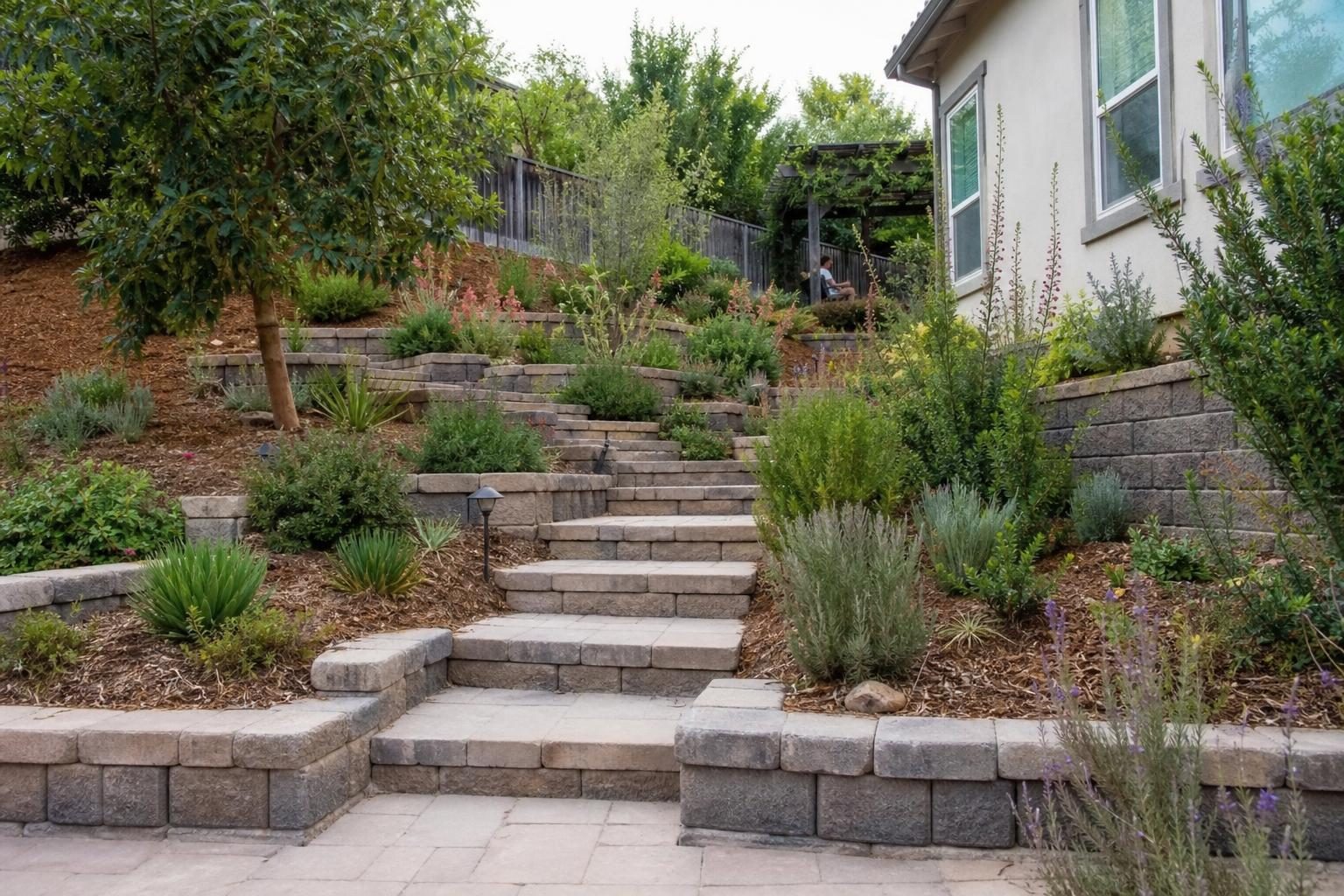
A sloped yard can become one of the most interesting parts of a property once you stop treating it like a flat lawn that tilts. The right idea depends mostly on how steep the slope is: gentle slopes can take planting and paths, moderate slopes often need terraces or steps, and steep slopes usually need engineered retaining walls or erosion control. Start by measuring the slope, then choose ideas that match it.
Part of our Complete Yard Design and Planning Guide: layouts, ideas by yard type, phasing and budgets in one place.
First, measure how steep your slope is
You can estimate slope with two stakes, a string, a line level and a tape measure. Drive one stake at the top and one at the bottom, tie the string level between them, then measure the horizontal distance (run) and the drop from the string to the ground at the lower stake (rise). Divide rise by run.
| Slope | Rise per 10 ft of run | Typical approaches |
|---|---|---|
| Gentle (under about 15%) | Under 1.5 ft | Lawn, planting beds, gently curving paths |
| Moderate (about 15% to 33%) | 1.5 to 3.3 ft | Groundcover, terraced beds, low walls, steps |
| Steep (over about 33%, or 3:1) | More than 3.3 ft | Engineered walls, erosion-control planting, professional design |
Slopes steeper than about 3:1 are hard to mow safely and are usually better planted with groundcover or terraced.
Five sloped yard ideas that work

1. Replace lawn with groundcover and shrubs
Mowing a slope is tiring and risky. Deep-rooted groundcovers, ornamental grasses and spreading shrubs hold soil better than turf and need far less care once established.
- Choose plants suited to your region and sun exposure, ideally natives or well-adapted species.
- Plant in staggered rows so there are no straight channels for water to run down.
- Use coarse shredded mulch, which knits together better on a slope than nuggets, or erosion-control blanket while plants establish.
- Use drip irrigation so water soaks in instead of running off.
2. Terraced beds
Terracing turns one slope into a series of flatter steps. It creates usable planting areas, slows water and can look striking.
Low terraces with walls under about 2 to 3 feet can often be built with landscape block, stone or timber. Taller walls, walls holding back a driveway or structure, or several stacked walls close together typically need engineering and a permit. Check your local rules. Our retaining wall planning guide explains height limits, drainage and material choices.
3. Steps and a path
If people need to get up or down the slope, give them a safe route. Steps also make a hillside feel like part of the yard.
- Common options are timber steps backfilled with gravel, stone slab steps, or paver steps with block risers.
- Keep risers consistent, often 5 to 7 inches, and treads deep enough to step comfortably, often 12 to 16 inches or more for outdoor steps.
- A path that switches back across the slope is easier to walk than one that goes straight up.
- Add lighting if the path will be used after dark.
4. A level patio or seating area
A small flat spot cut into a slope makes a great place for a bench, fire pit or a couple of chairs. Creating it usually means a retaining wall on the uphill side, or fill and a wall on the downhill side. The wall, not the patio surface, usually drives the cost.
A downhill-facing deck is another option where a wall would be very tall. Decks rest on footings rather than holding back soil, so on steep ground they can cost less than an engineered wall plus patio. Compare both before deciding.
5. Rock gardens and dry creek beds
Boulders and rock can stabilize parts of a slope and look natural. A dry creek bed lined with river rock can carry storm water down a slope along a planned path instead of cutting gullies. Use a mix of rock sizes and set larger stones partly into the soil so they do not roll.
Handle drainage before anything else
Every slope moves water. If the slope runs toward the house, drainage is the first priority. Signs of trouble include soil washing onto patios or walks, gullies after storms, wet basements or water pooling against the foundation.
Our erosion control guide and regrading vs retaining wall guide cover these decisions in more detail.
- Do not block the natural flow of water without giving it somewhere else to go.
- Walls need drainage behind them, typically gravel backfill and a perforated pipe, or water pressure can push them over.
- Consider swales, French drains or regrading if water heads toward the house.

Rough costs for common slope projects
Prices vary widely by region, soil, access and slope. These broad ranges are for planning only.
- Groundcover planting with mulch or erosion blanket: often a few dollars per square foot installed, more with irrigation.
- Timber or simple stone steps: often a few hundred dollars per step installed, more for stone slabs or paver steps.
- Segmental block retaining wall: often roughly $30 to $60+ per face square foot, more for engineered walls or stone.
- Dry creek bed: depends on length and rock size; often a few thousand dollars for a typical run.
Common slope mistakes
- Stripping the whole slope bare at once, leaving soil exposed to the next storm. Work in sections or cover bare soil right away.
- Building stacked walls too close together, so the upper wall loads the lower one.
- Using railroad ties or untreated timber for walls meant to last.
- Planting a slope and then watering with spray heads that run off before soaking in.
- Changing grading near a property line without checking where the water will go next door.

What to ask before hiring
- How will water move across the slope after the work?
- Does any wall need engineering or a permit?
- What drainage goes behind each wall?
- How will soil be held while plants establish?
- How will equipment and materials reach the slope?
Frequently asked questions
What is the cheapest way to landscape a slope?
Planting groundcover and shrubs with mulch or an erosion-control blanket is usually the least expensive option. Retaining walls are the most expensive.
Can I keep grass on a slope?
On gentle slopes, yes. On slopes steeper than about 3:1, mowing becomes unsafe and grass struggles to hold soil, so groundcover is usually a better choice.
Do I need a permit for a retaining wall on a slope?
Many areas require permits for walls above a certain height, often around 3 to 4 feet, or walls that support a structure or driveway. Check with your local building department.