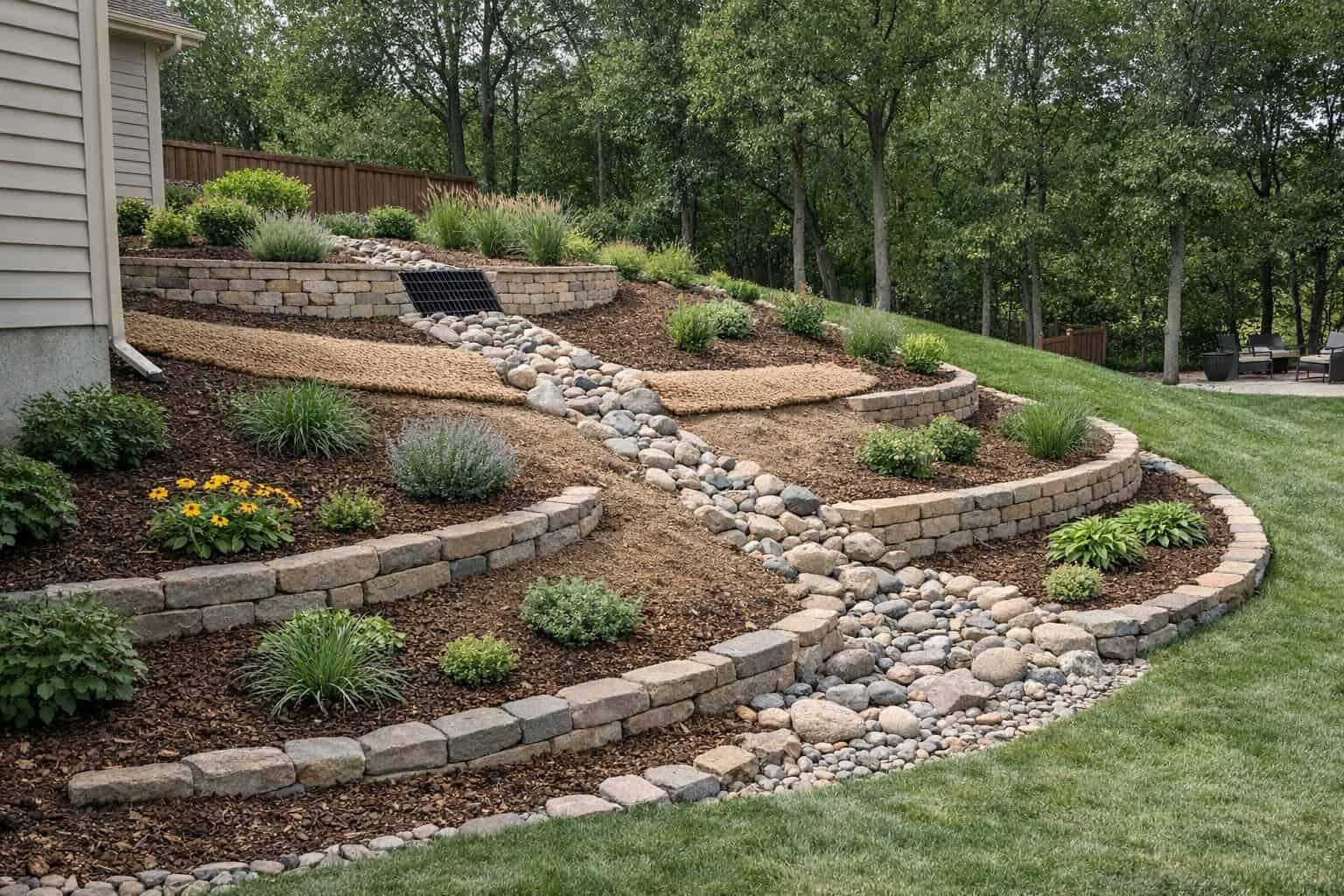
Erosion is more than a cosmetic landscaping issue. When soil washes away, homeowners can lose planting beds, expose roots, undermine hardscape, create muddy runoff, and place stress on slopes or structures. In some yards, erosion appears slowly as thinning soil and exposed areas. In others, it shows up quickly after storms as rills, channels, washed mulch, or sediment collecting where it should not.
The right fix depends on why the soil is moving in the first place. Water concentration, steep grade changes, poor vegetation cover, gutter discharge, bare soil, compacted surfaces, and neighboring runoff patterns can all contribute. That is why erosion control should be treated as a site problem first and a planting problem second.
Signs a yard may need erosion control
Homeowners often notice erosion after heavy rain, but the warning signs can appear well before that. Bare patches on a slope, exposed roots, washed-out mulch, sediment on walkways, low spots forming near runoff paths, and areas where water consistently carves channels through the soil are all common signals. If a retaining wall, fence, or patio edge is starting to look undermined, the issue may be more serious than surface damage.
When runoff is the main driver, the best starting point is often the broader drainage guide. If the yard has grade problems, the grading and yard leveling guide can help clarify whether reshaping the site should happen before adding stabilization materials.
Common residential erosion causes
In residential landscapes, erosion usually comes from concentrated water flow rather than one dramatic event. Downspouts may release too much water in one area. A patio or driveway may shed water toward a bed or slope. Soil may be left exposed after a project, with no planting or protective cover. In some cases, irrigation overspray contributes to surface loss over time. Steeper slopes and sparse root systems make these conditions worse.
Yards with repeated runoff often need a combination of solutions, not a single fix. For example, a homeowner may need better drainage collection, regrading, denser planting, and mulch or rock coverage together. Treating only the visible damage without redirecting the water usually leads to repeat failure.
Common erosion-control solutions
Solutions vary based on slope, soil type, drainage pattern, and severity. Planting deep-rooted ground cover can help hold soil in place. Mulch blankets or erosion-control matting may stabilize exposed surfaces while vegetation establishes. In tougher areas, contractors may use rock swales, channel lining, edging, small retaining structures, or grade reshaping to slow and redirect runoff.
Hardscape solutions are not always the first choice, but they can be necessary when the slope is steeper or when soil movement threatens surrounding structures. If wall construction is part of the plan, the retaining wall guide and the retaining wall material comparison can help frame the conversation.
How planting supports erosion control
Planting helps most when it is part of a broader stabilization strategy. Dense root systems protect the surface, reduce splash erosion, and improve soil structure over time. But planting alone may fail if water is still moving too fast across the site. Matching plant choice to exposure, moisture, and slope conditions is essential.
For homeowners who want a softer-looking fix, combining stabilization with a planting installation plan can make the final result look intentional rather than purely functional.
How much erosion-control work may cost
Costs depend heavily on site access, slope severity, drainage corrections, and how much material is needed to stabilize the area. A simple planting-and-mulch fix is very different from a project that includes trench drainage, grade changes, rock work, or structural support. As with most yard work, the labor behind the fix often matters as much as the visible materials.
When comparing estimates, ask contractors which part of the work addresses the cause, which part protects the surface, and how long the stabilization may take to fully establish. That is especially important when vegetation is part of the solution.
Questions to ask a contractor
- What is causing the erosion on this site, and how are you addressing that cause directly?
- Will the solution rely on planting, hardscape, drainage work, or a combination?
- How will runoff behave differently after this work is complete?
- What maintenance should be expected while the area establishes?
- Are there sections of the yard that need grading before surface stabilization begins?
Erosion control works best when it is treated as part of the whole landscape system. Homeowners who solve runoff, grade, and stabilization together usually get a cleaner-looking yard and a more durable result.
Leave a Reply