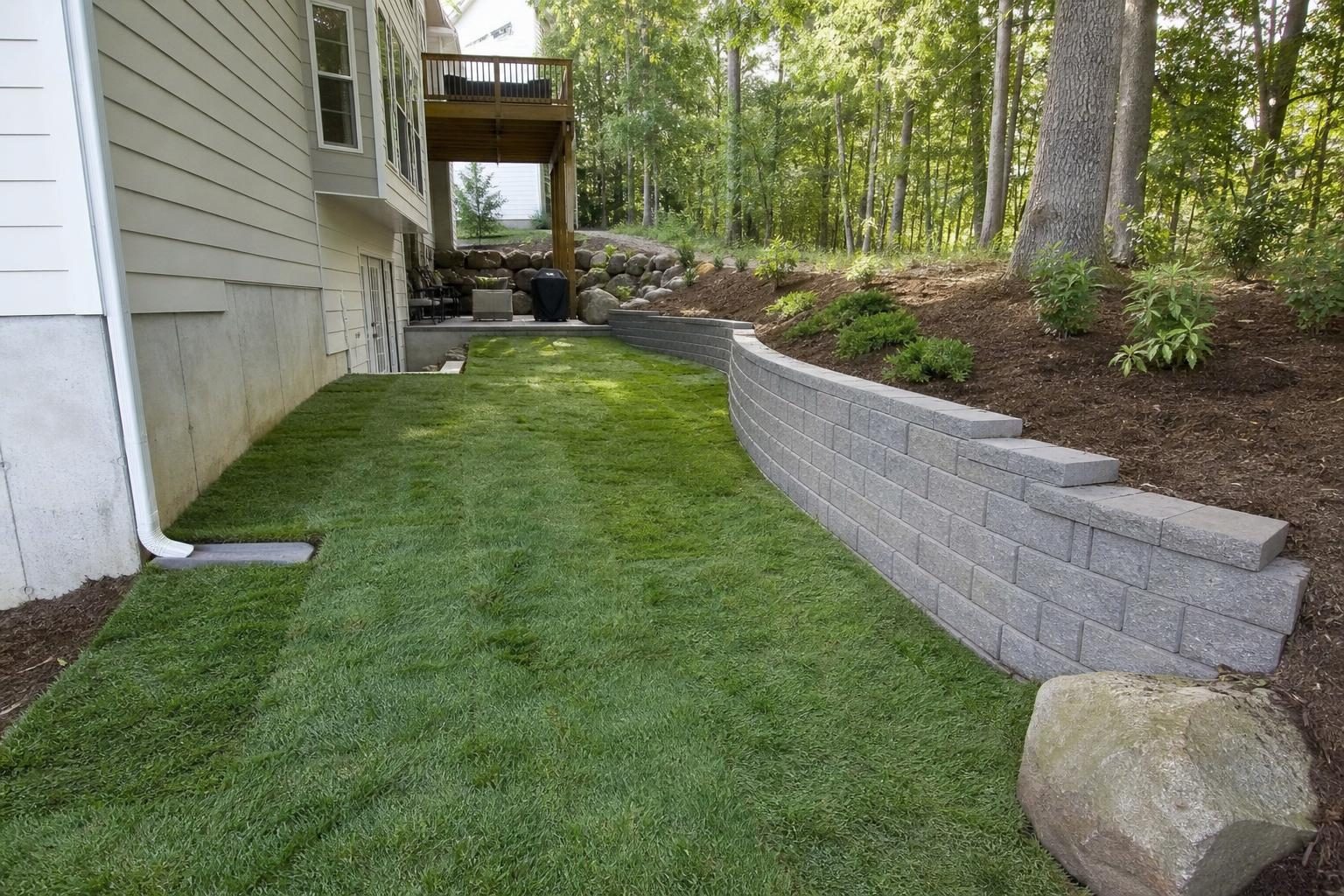
Choose regrading when you have enough horizontal room to spread a slope out gently. Choose a retaining wall when the slope is too steep or too tight to grade, or when you want flat, usable space that grading can’t give you. Regrading is usually far cheaper per square foot, while a wall buys you level ground and space at a higher price and with more engineering.
Part of our Complete Retaining Wall Guide: wall types, drainage, permits, costs and repairs in one place.
This guide is about slope and grade: making a hillside usable, stopping soil from creeping, or creating a flat area for a patio or lawn. If your main issue is water pooling or getting into the house, start with our guide to drainage vs regrading instead.
The core tradeoff: space vs cost
A slope needs horizontal distance to be stable. Regrading uses that distance. A wall replaces it with a vertical face.
For example, if you want to lower one part of a yard by three feet, a gentle mowable slope might need around 12 feet of run or more. A retaining wall can make that same three-foot change in roughly the width of the wall itself. If you have the 12 feet to spare, regrading usually wins on cost. If that space is your patio, driveway or property line, a wall may be the only practical answer.
Rules of thumb for slope steepness
- Gentler than about 1 foot of rise per 4 feet of run (4:1): comfortable to mow and walk.
- About 3:1: the steepest slope most homeowners can safely mow with a push mower.
- About 2:1: needs ground cover, erosion control blanket or planting instead of lawn.
- Steeper than 2:1: usually needs a wall, terraces or engineered stabilization.
These are general guidelines. Soil type matters: sandy soil holds a steep face poorly, and heavy clay can slump when wet.

When regrading is the better choice
- You have room to stretch the slope out to a stable, mowable angle.
- The elevation change is modest, often under two or three feet.
- You are happy with a gentle slope rather than truly flat ground.
- Budget is the priority and you want minimal long-term maintenance.
- The goal is directing surface water away from the house as well as smoothing the yard.
Regrading has no structure to fail, lean or crack. Once compacted and planted, it needs mowing and the occasional top-up, nothing more.

When a retaining wall is the better choice
- The slope is too steep to grade without running into a house, fence or property line.
- You want a level terrace for a patio, play area, vegetable garden or lawn.
- Soil is already sliding, slumping or eroding faster than plants can hold it.
- A driveway, walkway or foundation sits close to the base or top of the slope.
- You want a defined, finished look with clear edges.
Walls carry more risk if built poorly. A wall needs a compacted base, drainage gravel and a perforated pipe behind it, and taller walls need reinforcement. Many towns require a permit and engineered plans once walls pass about three to four feet, or when they support a driveway, building or another wall. See our retaining wall permit prep guide before you plan anything tall.
Cost comparison
Prices vary with region, soil, access, wall material and how much soil must be hauled in or out. Use these rounded figures to frame a budget.
| Factor | Regrading | Retaining wall |
|---|---|---|
| Typical cost | Roughly $1,000 to $5,000 for a typical residential area; larger or heavily reshaped yards can run $10,000+ | Roughly $30 to $150+ per square foot of wall face, depending on material and height |
| Space needed | A lot of horizontal run | Very little |
| Usable flat area created | Limited; you get a gentler slope | Yes, on the terrace above or below |
| Engineering and permits | Rarely, unless moving large volumes or near slopes | Often required above about 3 to 4 feet |
| Long-term maintenance | Mowing, occasional reseeding | Keep drains clear, watch for leaning or bulging |
| Failure risk | Erosion if left bare | Leaning, cracking or collapse if drainage or base is poor |
| Typical lifespan | Indefinite once stable | Decades if built correctly |
A short 2-foot block wall might cost a few thousand dollars, while a 5-foot engineered wall can run well into five figures. Our breakdown of what affects retaining wall cost explains the price jumps with height and material.

The middle ground: combining both
Many good designs use both. A contractor might regrade most of the slope to a gentle angle and add one short wall where space runs out. Another common approach is terracing: two or three short walls with planted steps between them instead of one tall wall. Short walls often avoid engineering requirements, are easier to build well, and look softer.
Even a wall project includes grading. The soil above and below needs to slope away from the wall so water doesn’t pool behind it or wash out its base.
How to decide, step by step
- Measure the elevation change. A string line, line level and tape measure will get you close.
- Measure the space available. How far can the slope run before hitting the house, fence, driveway or property line?
- Divide run by rise. If you get 3 or more, regrading is likely possible. Under 2, you probably need a wall or terraces.
- Define the goal. Do you need flat space, or just a stable, mowable slope?
- Check local rules on wall height, setbacks and grading near property lines.
- Get at least two opinions, ideally from a grading contractor and a wall builder, so neither one is selling only their own solution.

Common mistakes
- Building a wall without drainage behind it. Water pressure is a leading reason walls lean and fail.
- Using a wall to fix a water problem. If water is the real issue, a wall can make it worse by trapping it.
- Grading too steep to save space. A slope steeper than about 2:1 left as lawn tends to erode and is dangerous to mow.
- Ignoring what sits above the wall. A driveway, pool or structure near the top adds load and usually requires engineering.
- Redirecting water onto a neighbor. Both regrading and walls change runoff; many places restrict that.
What to check in an estimate
- The finished slope or wall height, in numbers.
- Base depth, drainage gravel, perforated pipe and outlet for any wall.
- Geogrid or reinforcement for walls over about three feet.
- Soil import or haul-off volume and who pays for disposal.
- Compaction method and number of lifts for fill.
- Permit, engineering and inspection fees, and who handles them.
- Surface restoration: sod, seed, erosion blanket or planting.
For a line-by-line checklist, see what a retaining wall estimate should include.
Estimate retaining wall and broader grading ranges
Use these calculators to compare a retaining wall range with a broader landscaping range before deciding whether the slope needs retaining, regrading, or both.
Retaining Wall Cost Calculator
Estimate retaining wall pricing with wall size, material type, drainage, and access assumptions.
Retaining wall cost estimate
- Wall face area
- –
- Low estimate
- –
- Mid estimate
- –
- High estimate
- –
- Estimated range per sq ft of wall face
- –
Landscaping Cost Range Calculator
Estimate a broad landscaping budget range for common homeowner project types before comparing quotes.
Landscaping cost estimate
- Estimated area
- –
- Low estimate
- –
- Mid estimate
- –
- High estimate
- –
- Estimated range per sq ft
- –
Frequently asked questions
Is regrading cheaper than a retaining wall?
Usually, yes, often by a wide margin. The exception is when regrading requires hauling large amounts of soil or rebuilding landscaping across a big area.
How steep can a slope be before I need a retaining wall?
As a general guide, slopes steeper than about 2:1 (one foot of rise for every two feet of run) are hard to keep stable as grass and usually call for a wall, terraces or engineered planting.
Can I build a retaining wall myself?
Short block walls under about two or three feet are a common DIY project if you build a proper base and drainage. Taller walls, or walls holding up driveways or structures, should be left to a qualified contractor.
Do I need a permit to regrade my yard?
Small grading jobs often don’t, but some areas require permits for moving large volumes of soil, grading near property lines, or changing drainage. Check with your local building department first.