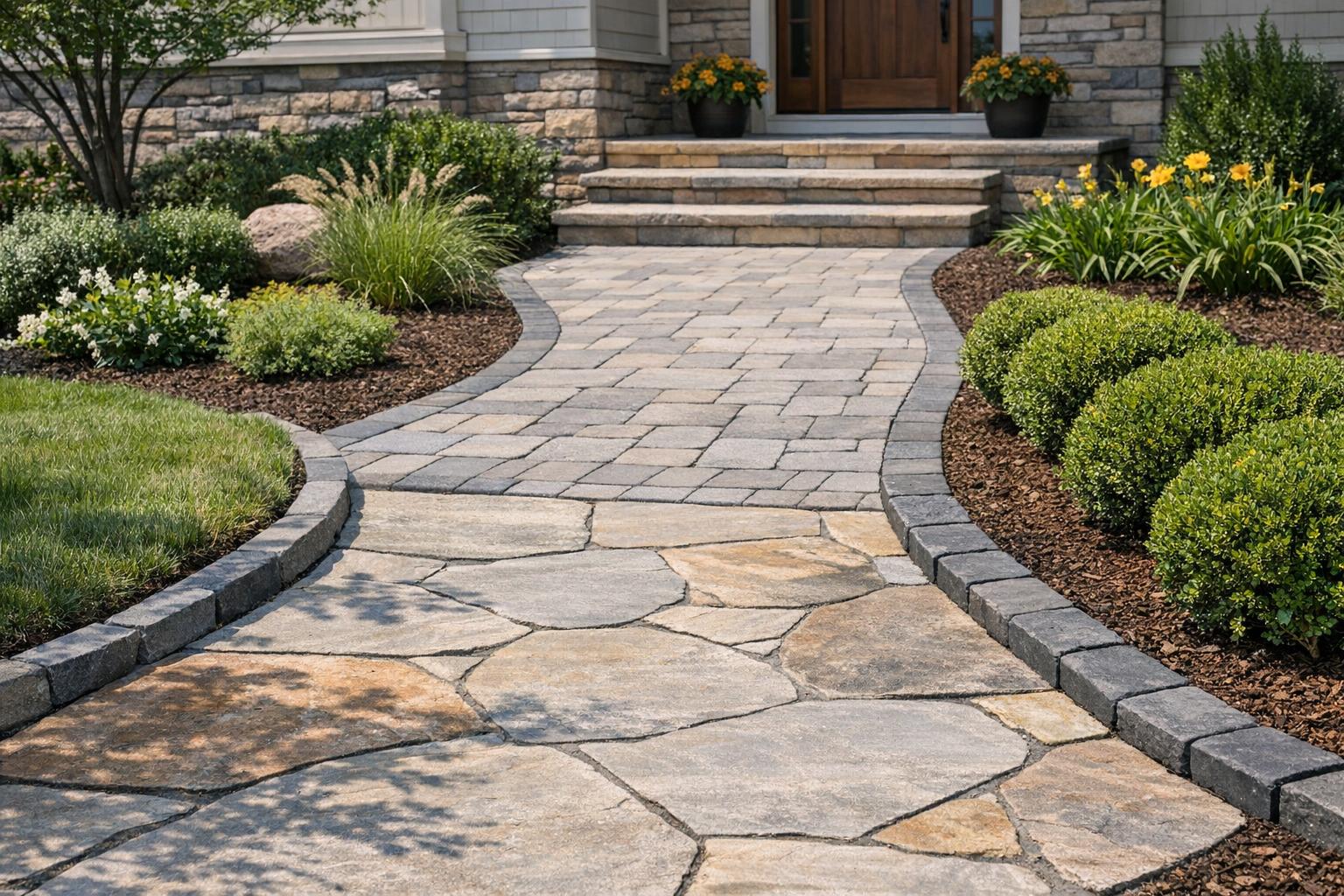
When you search for hardscape contractors near you, the most useful comparison isn’t price alone. It’s whether the company regularly builds the specific thing you need, how they handle base and drainage, and how clearly their estimate spells out the work. Patios, walkways, driveways and retaining walls each call for different skills and equipment, so start by matching the contractor to the project.
Part of our Complete Driveway Guide: types, costs, installation, repair and hiring in one place.

What hardscape contractors do
Hardscaping covers the built, non-plant parts of a landscape. Common projects include:
- Patios in pavers, natural stone, poured or stamped concrete.
- Walkways and steps connecting doors, driveways and outdoor spaces.
- Driveways in concrete, pavers or asphalt.
- Retaining walls and seat walls in block, stone or poured concrete.
- Outdoor kitchens, fire pits and other built features.
Some companies do all of these. Others focus on one, such as paver installers, concrete flatwork contractors or wall builders. Specialists are often the better fit for larger or technical jobs, while full-service firms help when a project combines several elements.
Match the contractor to the project
| Project | Typical specialist | Key skills to ask about |
|---|---|---|
| Paver patio or walkway | Hardscape or paver installer | Base depth, compaction, edge restraint, joint sand |
| Concrete patio or walkway | Concrete flatwork contractor | Thickness, reinforcement, control joints, finish |
| Concrete driveway | Concrete contractor | Base, thickness, apron, permits, curb cuts |
| Asphalt driveway | Paving company | Base, compacted asphalt thickness, edges, drainage |
| Retaining wall | Wall builder or hardscape contractor | Drainage, geogrid, engineering, permits |
| Mixed backyard project | Design-build hardscape firm | Coordination, grading, phasing |
For driveways specifically, see how to choose a paving company. For walls, our guide to comparing retaining wall contractors goes deeper.

How to find good local contractors
- Ask neighbors whose patios or driveways have held up for several years.
- Visit local landscape supply yards. Staff often know which contractors buy regularly and do clean work.
- Check online reviews for patterns, especially comments about communication and how problems were handled.
- Look at past work in person if you can, ideally projects a few years old.
- Verify licensing and insurance with your state or local licensing board where applicable.
What to compare between contractors

Experience with your exact project
Ask how many similar projects they’ve done recently and for photos with addresses or references. A great concrete company may not be the right choice for a natural stone patio.
Base and drainage approach
Most hardscape failures trace back to poor base preparation or drainage. Ask how deep the base will be, what material they use, how they compact it, and where water will go. Vague answers are a warning sign.
Estimate detail
Good estimates list dimensions, materials, base depth, drainage, excavation and haul-off, edging or joints, permits and cleanup. Our guide to what a hardscape estimate should include has a full checklist.
Warranty
Ask what’s covered, for how long, and what they’ll do if pavers settle or concrete cracks beyond normal hairline cracking. Manufacturer warranties on pavers or block usually cover the product, not the installation.
Communication and schedule
How quickly do they respond? Who is your contact during the job? When can they start, and how do they handle rain delays?
Typical cost ranges
Costs vary widely by region, materials, access, demolition and site conditions. These rounded installed ranges help set expectations:
- Concrete patio or walkway: about $8 to $18 per sq ft.
- Paver patio or walkway: about $15 to $35+ per sq ft.
- Natural stone patio: about $20 to $50+ per sq ft.
- Concrete driveway: about $8 to $18 per sq ft.
- Segmental block retaining wall: about $30 to $100+ per sq ft of wall face.
Expect higher prices for tight access, slopes, demolition, steps and curves.

Red flags to watch for
- A large upfront deposit with no clear schedule.
- A one-line estimate with only a total price.
- No mention of base, drainage or permits.
- Pressure to sign the same day for a “special price.”
- No proof of insurance.
- Unwillingness to share references or past work.
Questions to ask before hiring
- How long have you been building this type of project locally?
- Will your own crew do the work, or do you subcontract?
- What base depth and materials do you use, and why?
- How will you handle drainage and slope?
- Who handles permits and utility locates?
- What does your warranty cover?
- What’s the payment schedule?
What to expect once you hire
Most hardscape projects follow a similar sequence. The contractor calls in a utility locate, marks the layout with paint or stakes, and excavates to the planned depth. Base gravel goes in and is compacted in layers, then the surface material is installed: pavers set and cut, concrete formed and poured, or wall block stacked with drainage gravel behind it. Cleanup, joint sand or sealing, and any lawn repair come last.

Small patios and walkways often take a few days. Driveways and walls can take a week or more, and concrete needs time to cure before heavy use. Weather can push dates around, so ask how the contractor communicates delays. Plan for equipment on your lawn, some noise and dust, and a staging area for materials. Walking the finished work with the contractor before final payment gives you a chance to point out loose pavers, low spots or edges that need attention.
Check hardscape budget ranges
Use these calculators to compare patio, driveway, and retaining wall ranges before deciding which contractors should quote the work.
Paver Patio Cost Calculator
Estimate patio cost ranges using size, paver tier, prep complexity, and demolition assumptions.
Patio cost estimate
- Estimated area
- –
- Low estimate
- –
- Mid estimate
- –
- High estimate
- –
- Estimated range per sq ft
- –
Driveway Cost Calculator
Estimate driveway material plus labor ranges for gravel, asphalt, concrete, or paver installs.
Driveway cost estimate
- Estimated area
- –
- Low estimate
- –
- Mid estimate
- –
- High estimate
- –
- Estimated range per sq ft
- –
Retaining Wall Cost Calculator
Estimate retaining wall pricing with wall size, material type, drainage, and access assumptions.
Retaining wall cost estimate
- Wall face area
- –
- Low estimate
- –
- Mid estimate
- –
- High estimate
- –
- Estimated range per sq ft of wall face
- –
Frequently asked questions
Is a landscaper the same as a hardscape contractor?
Not always. Many landscapers focus on planting, lawn and maintenance. Hardscape contractors specialize in patios, walls and paving. Some companies do both, so ask what share of their work is hardscape.
How many quotes should I get?
Two or three detailed quotes are usually enough to compare scope and price without dragging out the process.
When is the best time to book a hardscape contractor?
Good contractors often book weeks or months ahead in spring and summer. Late fall and winter are good times to get estimates and plan for the next season.
Do I need a permit for a patio or walkway?
Often not for a simple patio, but driveways, curb cuts and taller retaining walls frequently do. Ask the contractor and check with your local building department.