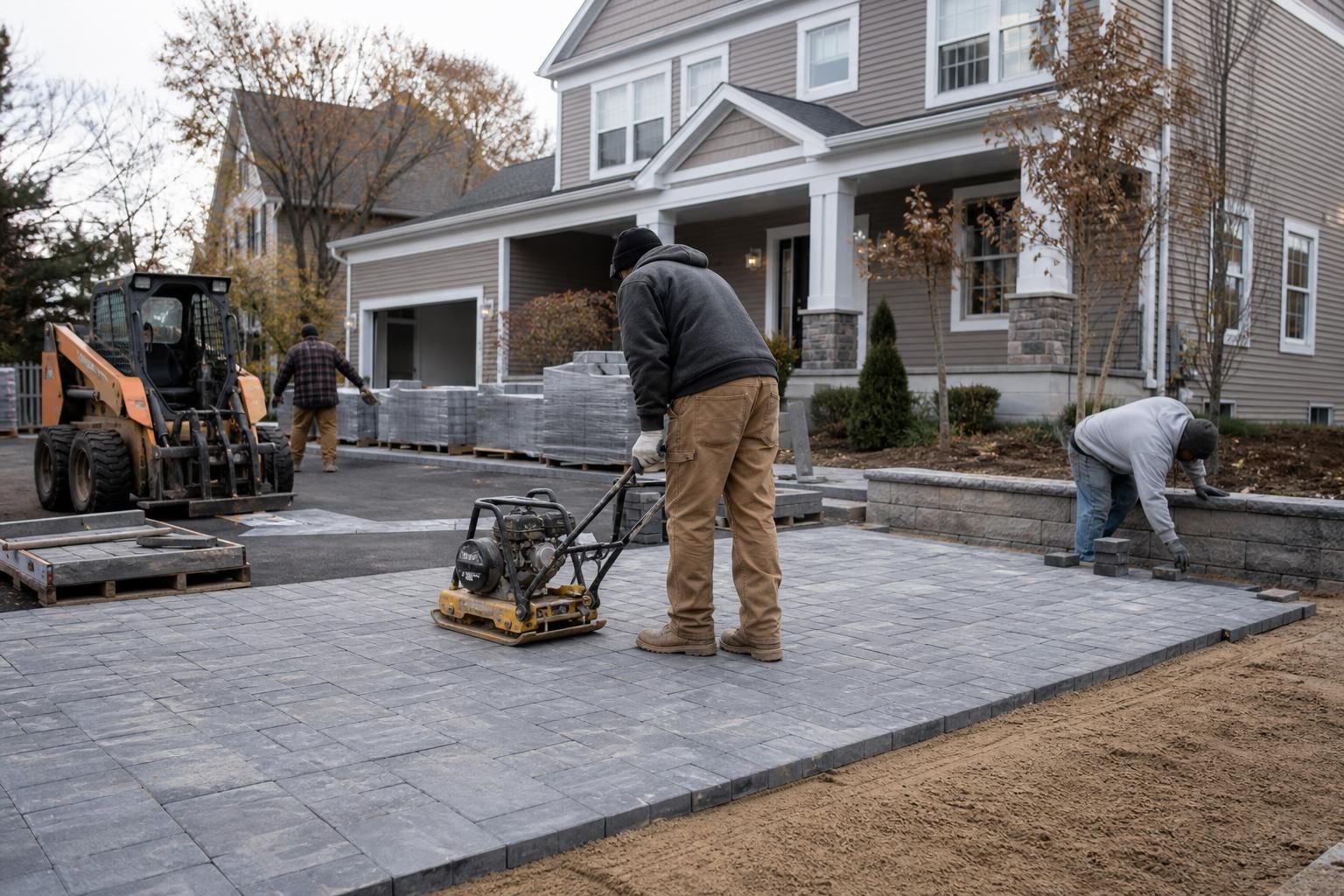
Homeowners often search for a paving company only after a driveway is cracking, a patio feels outdated, or drainage problems start showing up around the hardscape. The problem is that many quotes sound similar on the surface even when the actual prep work, material allowances, and drainage planning are very different.
Part of our Complete Driveway Guide: types, costs, installation, repair and hiring in one place.
This guide is built to help homeowners compare paving companies more intelligently. It focuses on the decisions that matter before work starts, including scope, materials, drainage, scheduling, warranty language, and the warning signs that a cheap bid may create expensive problems later.

Start with the project goal, not just the surface finish
A good paving conversation starts with what the project needs to do. A driveway has different traffic, base, edge-restraint, and water-management needs than a patio used mainly for entertaining. Even two patios may need different planning if one sits in full sun and the other sits against a house with drainage and elevation constraints.
- Decide whether the project is a replacement, an expansion, or a brand-new paved area.
- Clarify whether the paved area must handle vehicles, foot traffic, dining furniture, or a grill island.
- Write down any drainage, pooling-water, or slope issues you already see.
- Note whether you care most about appearance, maintenance, lifespan, or budget.
When homeowners skip this step, estimates stay vague and companies price different assumptions. That makes it hard to compare bids honestly.

What a paving company should evaluate before quoting
A paving company should inspect more than dimensions. The estimator should look at grade, access, demolition needs, soil stability, nearby structures, and where water currently moves during storms or irrigation. If the conversation stays limited to square footage and color choice, the estimate is probably missing important risk items.
- Existing base condition and whether removal is necessary
- Compaction needs and base-depth requirements
- Drainage direction and whether water will collect at doors, gates, or the garage
- Edge restraints, borders, or transitions to lawn, planting, or concrete
- Access for machinery, materials, and debris removal
On many properties, paving work also overlaps with broader landscape planning. If the patio is part of a larger outdoor-living upgrade, pages like What to Expect During a Patio Project and What Affects Patio Cost help clarify what should be coordinated before installation begins.
How to compare proposals without being fooled by a lower number
Estimate the driveway or patio budget before comparing bids
Use these planning calculators to test rough driveway and patio ranges before you compare contractor proposals. For the full tool library, open the landscaping calculators hub.
Driveway Cost Calculator
Estimate driveway material plus labor ranges for gravel, asphalt, concrete, or paver installs.
Driveway cost estimate
- Estimated area
- –
- Low estimate
- –
- Mid estimate
- –
- High estimate
- –
- Estimated range per sq ft
- –
Paver Patio Cost Calculator
Estimate patio cost ranges using size, paver tier, prep complexity, and demolition assumptions.
Patio cost estimate
- Estimated area
- –
- Low estimate
- –
- Mid estimate
- –
- High estimate
- –
- Estimated range per sq ft
- –
A lower paving bid is not automatically the better value. Many low quotes leave out demolition, export, thicker base prep, drainage work, border materials, cleanup, sealing, or realistic allowances for material waste. Homeowners should assume that any missing scope item will reappear later as a change order or a performance problem.
- Request an itemized scope that separates demolition, base prep, paving, edge work, and cleanup.
- Check whether the quote names the exact paving material and thickness.
- Ask who is responsible for drainage corrections if the new surface exposes water problems.
- Make sure disposal, haul-off, and final grading are listed in writing.
The strongest bids explain both what is included and what is specifically excluded. That protects both the homeowner and the contractor from later arguments.

Questions homeowners should ask before hiring
The best screening questions are practical rather than aggressive. Homeowners are not trying to trap the contractor. They are trying to understand how the job will actually be built and where quality problems usually start.
- What base preparation do you expect for this site, and why?
- How will you handle drainage at the edge of the patio or driveway?
- What material and pattern do you recommend for this specific use?
- What parts of the work are subcontracted?
- What site conditions would cause the price to change?
A contractor who can answer clearly and specifically is usually easier to trust than one who responds only with general claims about quality.
Red flags that usually mean the homeowner should keep shopping
Some paving-company warning signs appear before the estimate is even written. Homeowners should slow down if the contractor avoids written details, refuses to discuss drainage, cannot explain the base-build process, or pushes for an immediate deposit before the full scope is clear.
- No site-specific discussion of slope, runoff, or drainage
- No written estimate with material and prep details
- Pressure to choose a finish before construction assumptions are explained
- No recent examples of similar driveways or patios
- Promises that every problem can be solved cheaply once work starts

How to make the final decision
The winning paving company is not always the cheapest or the most polished salesperson. The right choice is usually the company that scopes the job accurately, explains how the site conditions affect the work, communicates clearly, and puts the important details in writing.
For homeowners, the goal is not just a nice-looking paved surface on day one. The real goal is a surface that drains well, feels intentional in the yard, and does not need early repairs because the contractor skipped invisible prep work. That is why the best hire decision happens before the first pallet of material arrives.