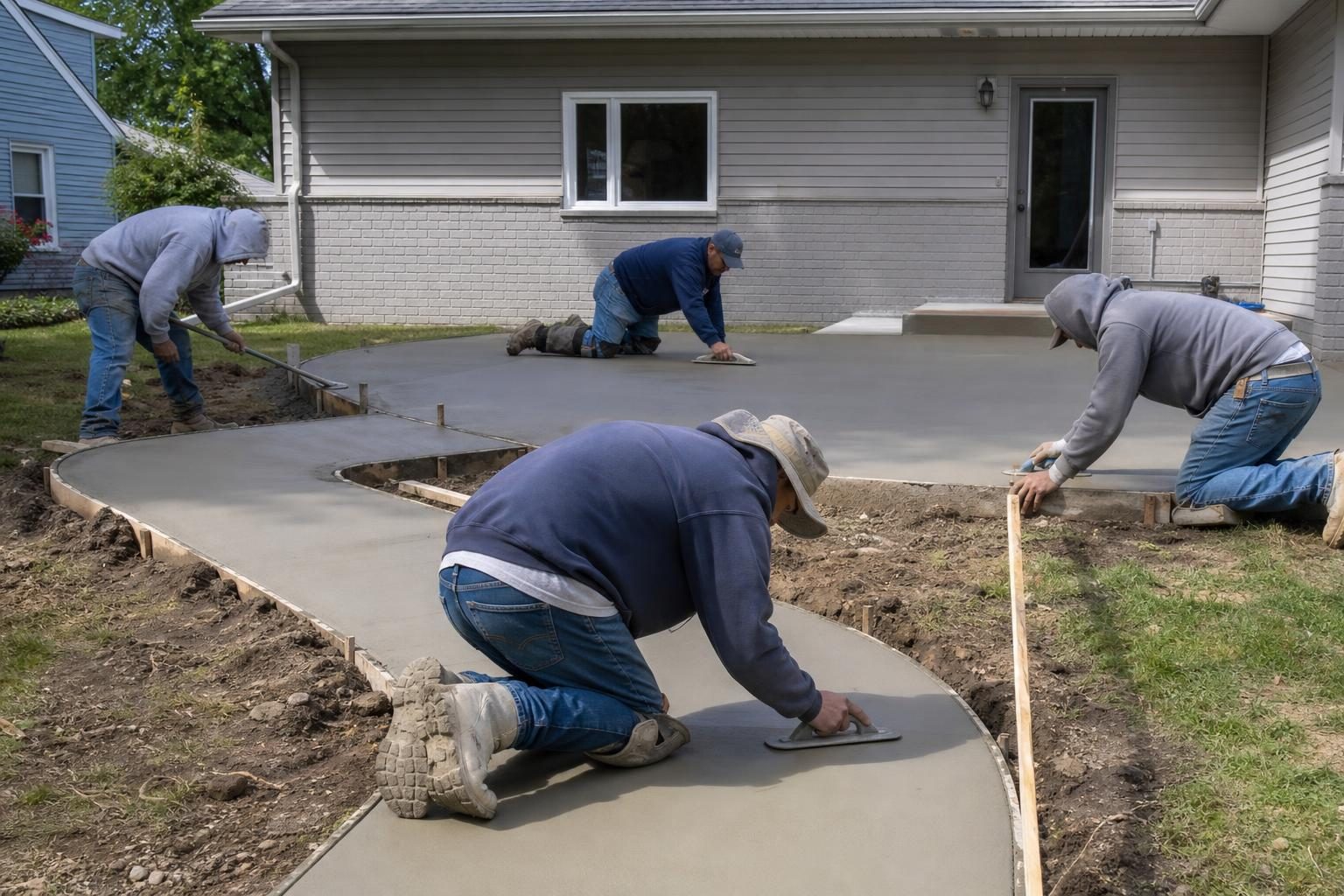
Homeowners searching for a concrete contractor are often trying to solve more than one problem at once. The visible problem may be a worn driveway, a patio project, or a walkway upgrade, but the real decision usually involves drainage, thickness, reinforcement, finish, access, demolition, and how the new surface connects to the rest of the landscape.
Part of our Complete Landscaping Cost and Hiring Guide: what projects cost, who to hire and how to compare quotes in one place.
This guide explains how homeowners can compare concrete contractors with a wider lens. It is useful whether the project is a driveway, patio, walkway, pad, or part of a larger front-yard or backyard remodel.
Know what kind of concrete contractor the project needs
Concrete is not one single service category. Some contractors focus on structural work, some on decorative flatwork, and some on residential hardscape installations that overlap with grading, landscape layout, and paving transitions. Homeowners get better results when they match the contractor to the actual job rather than searching only for the broad term ‘concrete contractor’.
- Driveways and vehicle surfaces need contractors experienced with load-bearing flatwork.
- Patios and outdoor-living spaces often need stronger design coordination and drainage integration.
- Walkways and entry paths require careful elevation control, transitions, and curb-appeal planning.
- Decorative finishes require a contractor who can show completed local examples, not just promise options.

What to review before asking for estimates
A homeowner does not need technical engineering knowledge before calling contractors, but some basic project clarity makes the estimate process much more useful. The contractor should know what the slab is for, how the area is used, and whether there are known drainage, cracking, or access issues on the property.
- Replacement versus new installation
- Decorative finish versus standard broom finish
- Drainage problems or areas that already hold water
- Vehicle weight or heavy-use expectations
- Whether nearby landscaping, irrigation, or retaining work may be affected
If the project overlaps with driveway work specifically, homeowners should also review Choosing the Right Contractor for a Concrete Driveway and Concrete vs Paver Driveway to understand how contractor fit changes by project type.
The parts of a concrete estimate that matter most
Run a quick concrete project cost check
These calculators help homeowners frame driveway and patio budgets before asking a concrete contractor to price site-specific prep, drainage, and finish details.

Driveway Cost Calculator
Estimate driveway material plus labor ranges for gravel, asphalt, concrete, or paver installs.
Driveway cost estimate
- Estimated area
- –
- Low estimate
- –
- Mid estimate
- –
- High estimate
- –
- Estimated range per sq ft
- –
Paver Patio Cost Calculator
Estimate patio cost ranges using size, paver tier, prep complexity, and demolition assumptions.
Patio cost estimate
- Estimated area
- –
- Low estimate
- –
- Mid estimate
- –
- High estimate
- –
- Estimated range per sq ft
- –
Many homeowners focus first on the total number, but the scope language is where the real quality differences show up. Good concrete estimates explain demolition, subgrade work, base preparation, thickness, reinforcement, finish, joints, cleanup, and curing expectations. Weak estimates jump straight to price and square footage.
- Existing concrete removal and disposal
- Base preparation and compaction assumptions
- Concrete thickness and reinforcement details
- Finish type, control joints, and edge treatment
- Drainage adjustments, adjacent grading, and cleanup
The estimate should also be clear about what is not included. Exclusions around drainage, staining, sealing, permit fees, or utility issues can materially change the real homeowner cost.
How to tell whether the contractor is planning for performance
Concrete quality problems often begin long before the pour. Poor subgrade prep, bad drainage, weak edge support, rushed finishing, and unrealistic cure expectations create long-term trouble even when the finished slab looks clean on the install day. Homeowners should listen closely to how the contractor describes the invisible parts of the job.
- Do they talk about compaction and base depth without being prompted?
- Do they explain how water will move away from the slab?
- Do they describe where joints belong and why?
- Do they discuss curing and when the slab can actually be used?

Questions to ask before signing
Good contractor interviews are practical. The homeowner is trying to understand how the contractor thinks, not force a perfect sales pitch.
- What usually causes concrete problems on projects like this one?
- How will you handle drainage or slope issues at this site?
- What traffic or use assumptions are you pricing for?
- What parts of the process happen on different days?
- What would cause a change order?
How this fits into broader landscaping planning
Concrete projects rarely live in isolation. A new patio may affect planting beds, irrigation, privacy screening, lighting, and circulation through the backyard. A new driveway may change curb appeal, runoff, or front-yard grading. That is why homeowners should treat the concrete contractor as one part of a larger landscape decision, not just a commodity installer.
The best hire is usually the contractor who understands both the concrete work itself and how that work fits into the property as a whole. That broader view is what keeps a concrete project from becoming a disconnected upgrade that creates new problems elsewhere in the yard.