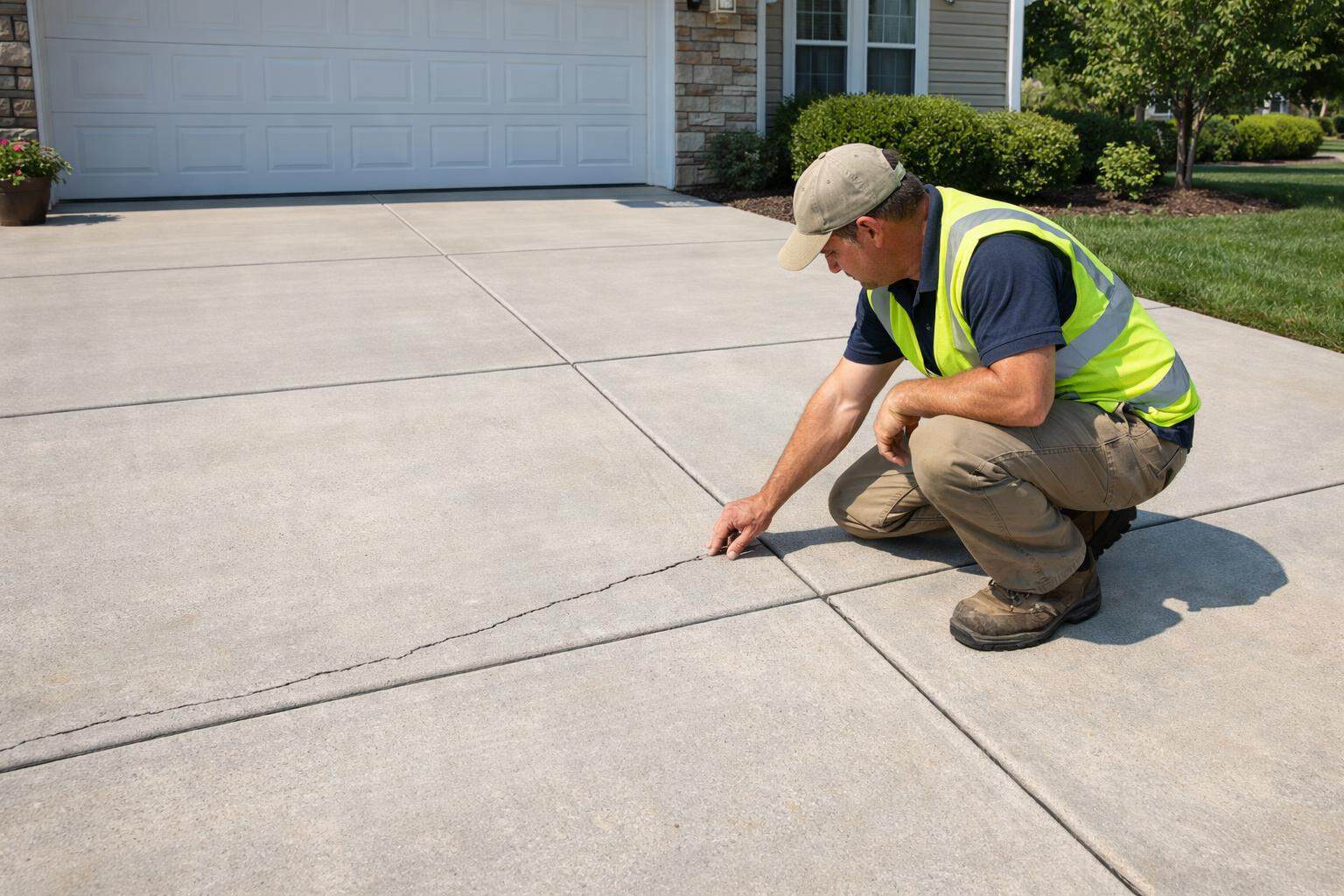
Concrete cracking worries almost every homeowner, but cracking by itself is not proof that a driveway was installed badly. Concrete naturally shrinks as it cures, responds to temperature change, and moves slightly with the ground beneath it. The real question is not whether cracking can happen at all. The real question is whether the driveway was built to control that movement in a predictable way.
Part of our Complete Driveway Guide: types, costs, installation, repair and hiring in one place.
Good contractors talk honestly about cracking because they understand the difference between expected movement and preventable damage. Homeowners should be cautious when someone promises a driveway that will never crack.

Why concrete cracks in the first place
- Moisture loss during curing causes shrinkage.
- Temperature swings expand and contract the slab.
- Soil movement can remove support beneath sections of concrete.
- Heavy loads stress weak or thin areas.
- Poor drainage softens the base and increases movement.
Some of these forces are unavoidable. That is why installation quality matters so much. Contractors are not eliminating physics; they are managing it.

How contractors control cracking
The most important crack-control steps happen before the concrete truck shows up. A stable base, consistent thickness, proper slope, and smart joint placement all help the slab behave the way it is supposed to.
- Compact the subgrade and base so the slab has uniform support.
- Pour the driveway at the right thickness for the expected traffic.
- Place control joints so shrinkage cracks form where planned.
- Maintain drainage so water does not undermine the slab.
- Follow sound curing practices instead of rushing the finish.
These are the kinds of details homeowners should ask about during the bidding stage. If a contractor glosses over them, that is useful information in itself.
What kinds of cracks are more concerning
Fine shrinkage cracks and controlled movement at joints are very different from wide cracks, vertical displacement, or recurring cracks near settled areas. When one side of the crack is higher than the other, or the same area continues to break down, there may be a support or drainage problem under the slab.
That is why it helps to look at crack pattern, location, and movement together instead of reacting to every visible line the same way.

Questions homeowners should ask
- How will you prepare and compact the base?
- Where will control joints go and how will that layout be decided?
- What thickness are you pouring for the vehicles that use this driveway?
- How will runoff be directed away from the slab?
- What cracking should be considered normal after installation?
If you are evaluating a bid, those answers are often more important than a vague statement about workmanship. They reveal whether the contractor is planning for performance or just talking about appearance.
Bottom line
Concrete driveways can crack because concrete is a rigid material exposed to shrinkage, temperature change, and soil movement. What separates a durable installation from a disappointing one is how well the contractor controls those forces with preparation, thickness, joints, and drainage. For a broader look at build quality, pair this article with our guide to driveway thickness and the full installation process.

Plan the Bigger Project
Concrete work is often just one part of a broader exterior upgrade. If you are still mapping out the full project, also read our landscaping services guide, questions to ask before hiring a landscaper, what to expect during a landscaping project, and our landscaping costs guide for homeowners.