
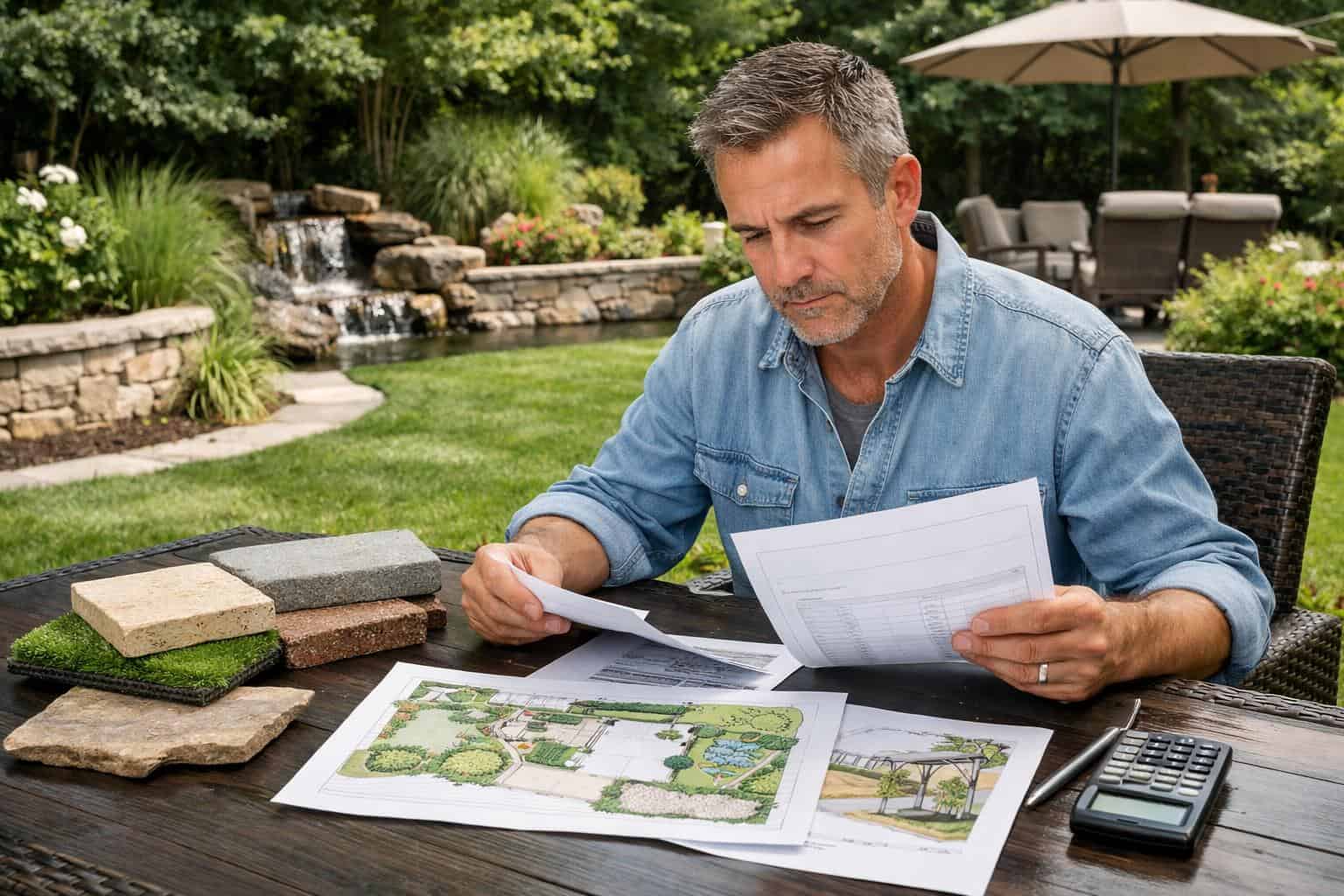
Landscaping costs anywhere from a few hundred dollars for a mulch and cleanup refresh to tens of thousands for a new patio, retaining wall and planting plan, and most of the price is labor, site prep and hardscaping. To get a fair price, define the scope in writing, compare quotes line by line and hire the right kind of contractor.
Quick answer: As rough national planning numbers, a curb-appeal refresh runs about $4–$15 per square foot of project area, a front or backyard redesign about $10–$32, and an outdoor living upgrade with a patio, walls and lighting about $18–$59. Single projects have their own ranges: a broom-finish concrete patio is about $6–$15 per sq ft, a paver patio $10–$30, a pressure-treated privacy fence $25–$45 per linear foot and a sprinkler system about $3,500–$8,000 for an average lot. Get three itemized written quotes, keep the deposit small and tie payments to finished milestones. Prices vary by region, access, soil and season.
What landscaping projects cost
A spring cleanup, a sod lawn and a paver patio are priced in completely different ways, so start with the typical range for each kind of project. The table gives rounded US installed ranges; each topic guide explains the numbers.

| Project | Typical installed range | Example project | Full guide |
|---|---|---|---|
| Driveway | Gravel $2–$6, asphalt $5–$12, concrete $6–$15, stamped $12–$25, pavers $15–$35 per sq ft | 600–700 sq ft broom-finish concrete: about $3,600–$10,500 | Driveway guide |
| Patio | Gravel $3–$8, concrete $6–$15, stamped $10–$25, pavers $10–$30, natural stone $15–$45+ per sq ft | 12-by-16-foot paver patio: about $2,500–$5,800 | Patio and paver guide |
| New lawn | Seed $0.10–$0.50, sod $1–$3, artificial turf $8–$15 per sq ft | Sod is several times the cost of seed, but usable in weeks | Lawn guide |
| Fence | Chain link $15–$30, pressure-treated privacy $25–$45, cedar or vinyl $35–$65 per linear ft | 150 ft of 6-foot pressure-treated privacy with a gate: about $4,100–$7,600 | Fence and privacy guide |
| Retaining wall | Segmental block about $25–$50 per sq ft of wall face; stone and poured concrete more | 40 ft long, 3 ft tall block wall: about $3,000–$6,500 | Retaining wall guide |
| Drainage | Buried downspout lines $10–$25 per ft; shallow French drain $15–$50 per ft | 60-foot shallow French drain to daylight: about $1,200–$4,000 | Drainage solutions guide |
| Irrigation | About $2,000–$4,500 for 2–4 zones; $3,500–$8,000 for 5–8 zones | Large or complex lots with 9+ zones: $7,000–$15,000+ | Irrigation system guide |
| Landscape lighting | About $100–$250 per installed low-voltage LED fixture | 12–20 fixtures: about $2,000–$5,000 | Landscape lighting guide |
| Tree work | Trimming $150–$450 small to $700–$2,000+ large; removal $200–$3,500+ by size; stump grinding $100–$400 | Crane removals often $2,500–$8,000+ | Tree care guide |
| Mulch | Shredded hardwood about $85–$125 per cubic yard installed | 400 sq ft of beds at 3 inches: about $320–$460 installed | Mulch guide |
Driveway pavers cost more than patio pavers because they need a deeper base and thicker units to carry cars. Irrigation and lighting are priced by zones, fixtures and runs rather than area; see what affects irrigation system cost and what affects landscape lighting cost.
Whole-yard budgets
When you are pricing a whole front or backyard rather than a single project, a per-square-foot planning number by project type is a better start. These ranges match the calculator below.
| Project type | Simple, easy access, value finish | Typical: moderate complexity, standard access and finish | What it usually includes |
|---|---|---|---|
| Refresh and curb appeal | About $4–$10 per sq ft | About $6–$15 per sq ft | Cleanup, edging, mulch, some new shrubs and perennials, minor lawn repair |
| Front or backyard redesign | About $10–$22 | About $15–$32 | New bed layout and planting, lawn work, a walkway or small patio, some grading |
| Full-property renovation | About $12–$30 | About $18–$44 | Front and back together: grading, drainage, planting, lawn, paths and some hardscape |
| Outdoor living upgrade | About $18–$40 | About $26–$59 | Patio, seat or retaining walls, lighting, possibly a fire feature, planting around it |
For example, a 1,000-square-foot backyard redesign of moderate complexity with standard access and finishes lands around $14,700–$32,200. Complex sites, difficult access and premium materials can roughly double the low-end rates.
Estimate your landscaping cost
Pick a project type and enter the area, complexity, access and finish level to see a low, mid and high budget range per square foot; it is a planning range, not a quote.
Landscaping Cost Range Calculator
Estimate a broad landscaping budget range for common homeowner project types before comparing quotes.
Landscaping cost estimate
- Estimated area
- –
- Low estimate
- –
- Mid estimate
- –
- High estimate
- –
- Estimated range per sq ft
- –
What drives landscaping cost

Two quotes for the “same” yard can be thousands of dollars apart, usually because each contractor assumed something different about the site. These factors move a landscaping price most.
- Labor. Often half or more of a hardscape or planting job. Hand-fitted stone, curves and steps take far longer than straight runs, and metro crews charge more per hour.
- Access. A wide driveway into the backyard lets a skid steer dig. A narrow side gate or stairs means wheelbarrows and hand digging, which can add a large share to the labor bill.
- Demolition and haul-off. Breaking out an old patio, pulling sod or removing shrubs and stumps costs labor plus disposal fees.
- Base and grading. Hardscape depends on a compacted gravel base and lawns on prepared soil. Clay, rock or buried debris adds digging and base depth. Grading water away from the house belongs in the budget from day one.
- Materials. Broom-finish concrete, pavers and natural stone sit at very different price points, as do container shrubs and specimen trees.
- Permits and engineering. Tall walls, drainage tie-ins, gas or electrical work and structures can need drawings, fees and inspections.
- Region. Labor rates, material supply and climate shift prices. National ranges are a starting point, not your local price.
- Season. Spring is the busy season in most of the country, so crews have less time for your bid. Fall and winter planning often gets better scheduling for hardscape, while planting has its own windows. See the best time of year to start a landscaping project.
Design and coordination are quieter costs. A yard with walls, drainage, lighting and irrigation needs someone to plan the trades, and that shows up as a design fee or a contractor’s markup.
Budgeting and phasing a landscaping project

Start with a whole-yard plan, even if you only build part of it this year, and budget a contingency, because rock, roots and old concrete turn up often. Holding back about 10–15% for surprises is a sensible planning habit.
A sensible phasing order
- Site work first. Drainage, grading, access, utility runs and any retaining walls. These shape everything that comes after.
- Major hardscape. Patios, walkways, steps, driveways and seat walls.
- Systems. Irrigation, lighting wire and conduit or sleeves under paving, ideally laid before the planting goes in.
- Planting, lawn and mulch. The finish layer, installed when the heavy work is done.
- Extras. Fire features, outdoor kitchens and decorative upgrades.
Phasing has a cost: each time a crew mobilizes, you pay for setup and cleanup again. Lay sleeves for future irrigation and lighting under any paving you install now. Our guide on how to phase a landscaping project covers what to do now versus later, and our list of landscaping mistakes homeowners should avoid shows what out-of-order work costs.
Budget decision checklist
- Have you listed the problems to fix (water, slope, erosion, privacy) before wish-list items?
- Does your all-in number include contingency, permits and any design fee?
- Does phase one leave the site ready for phase two, with nothing to tear out later?
- Have you priced the yearly upkeep of what you are building?
- Would a cheaper material in a less visible spot free up money for base and drainage?
Does landscaping add home value?

It can, but it is easy to overstate. The National Association of Realtors and the National Association of Landscape Professionals’ 2023 Remodeling Impact Report: Outdoor Features asked Realtors how much of a project’s cost a seller could recover. Estimates were highest for basic upkeep: about 217% of the cost for a standard lawn care program and about 104% for landscape maintenance. An overall landscape upgrade came in around 100%, a new patio about 95%, tree care about 87%, irrigation about 83% and landscape lighting about 59%. The same report says 92% of Realtors have suggested sellers improve curb appeal before listing.
These are Realtor estimates based on national survey costs, not measured sale prices, and your local market matters more. A few lessons hold up well:
- A neat, healthy, well-kept yard is the cheapest and most reliable value move.
- Fixing visible problems such as standing water, a leaning wall or a cracked walkway removes reasons for buyers to discount.
- Usable outdoor space, like a patio sized for the house, tends to appeal broadly. Highly personal or high-maintenance features rarely return their cost.
- If you plan to stay for years, build for your own use; resale return is a bonus.
Our guide to whether landscaping increases home value covers which projects buyers notice most.
Who to hire: designer, landscaper, hardscape contractor or design-build
Many homeowners call a landscaper when they really need a hardscape contractor. The right choice depends on whether the project still needs design, what it involves building and whether you want ongoing care.

| Who | Best for | How they usually charge | Watch-outs |
|---|---|---|---|
| Landscape designer or landscape architect | Whole-yard plans, slopes, drainage and multi-phase projects; drawings for permits or HOA | Design fee, hourly or flat; landscape architects for engineered or permit work | Design only; you still need an installer. Ask whether the drawings are yours to bid out. |
| Landscaping company | Planting, beds, lawn installation, small paths, cleanups, defined projects | Project price, sometimes with a separate plant warranty | Hardscape quality varies widely; check examples of similar work. |
| Hardscape contractor | Patios, walkways, retaining walls, steps, driveways, outdoor kitchens | Project price by area or wall face, plus demolition and base | Base depth, drainage and edge restraint must be in writing. |
| Design-build firm | Larger projects where you want one team accountable from plan to finish | Design fee, sometimes credited toward the build, then a project price | Plans may be tied to their crew, which makes competing bids harder. |
| Maintenance company | Mowing, treatments, cleanups, bed care, irrigation checks | Per visit, monthly or seasonal contract | Clarify what happens every visit and what is billed extra. |
If you can describe the finished project in writing, with dimensions and materials, a contractor can price it directly; if not, start with design. Our comparison of landscape designers vs landscaping companies goes deeper. The landscaping services guide explains what each service usually includes.
For patios, walls and driveways, look for hardscape contractors near you with finished work of the same type. For poured slabs, steps and walks, the concrete contractor guide lists what to check before you get estimates.

Permits, HOA rules and utility marking
Planting, mulch and lawn work rarely need permits. These often do, depending on your city or county:
- Retaining walls over a set height (often about 4 feet) or holding up a driveway or slope.
- Fences over local height limits, especially in front yards and on corner lots.
- Drainage that changes how water leaves your lot or ties into a storm system.
- Electrical circuits, gas lines for fire features and kitchens, and new backflow preventers for irrigation.
- Pergolas, decks and other structures, and in some towns large grading or tree removal.
HOAs often have their own approval process, which can take weeks. Before anyone digs, call 811 so public utility lines are marked; private lines, such as sprinkler pipes or wiring to a shed, are not included. Agree in writing who pulls permits and who pays for them. Our guide on whether you need a permit for landscaping projects lists the questions to ask early.
Finding and vetting landscaping contractors

Ask neighbors whose yards you admire, check recent reviews and look for finished work like yours. Then vet the short list:
- License. Rules vary by state; some license landscape contractors, others only require a business license. In California, for example, the Contractors State License Board lets you check a license before you hire.
- Insurance. Ask for a certificate of liability insurance, plus workers’ compensation where required.
- References. Call two or three recent customers with similar projects and ask about budget and how problems were handled.
- Who does the work. Ask who supervises the crew and which parts are subcontracted.
Questions to ask
- What do you see as the biggest risk or unknown on my site, and how would it change the price?
- How deep is the base, and how will water drain off every hard surface?
- What is your workmanship warranty, and what does it cover, such as settling, loose pavers or plant losses?
- How are changes priced and approved?
- When can you start, how long will it take and what happens if it rains?
Our full list of questions to ask before hiring a landscaper is a good printout for site visits. The guide to comparing landscaping companies near you helps match the company to the job.
Comparing landscaping quotes line by line

The Federal Trade Commission recommends written estimates and a written contract, and the lowest number is not automatically the best deal. Give every bidder the same written scope, with a sketch, dimensions and materials, then line the quotes up side by side.
What a landscaping quote must include
- Each item listed separately with measurements: patio square footage, wall length and height, linear feet of edging or drain, number and size of plants.
- Materials by name, brand, color and size, or a clear allowance if they are still to be chosen.
- Excavation depth, base material, compacted base thickness and edge restraint for hardscape; soil prep for lawn and beds.
- Drainage and grading: where water goes and what pipe or outlet is included.
- Demolition, haul-off, site protection and repair of lawn, irrigation or driveway damaged by equipment.
- Permits, utility marking, exclusions and unit prices for surprises such as rock or extra excavation.
- Schedule, payment milestones, warranty terms and plant guarantee.
Our guide to what a hardscape estimate should include goes item by item. The guide to comparing landscaping quotes shows how to normalize bids that are written differently.
How to read the gap between bids
A bid far below the others usually leaves something out, such as base depth, drainage, demolition or material quality, so ask the low bidder to price the missing items. A bid far above may include design or better materials, or the company may simply be busy. A good contractor can explain the price line by line.
Contracts, deposits and payment schedules
The contract is where the quote becomes enforceable. The FTC advises that it should include the contractor’s name, address, phone and license number, start and finish dates, the full scope and any verbal promises, and no blank spaces. If you sign at your home rather than at the contractor’s place of business, the FTC’s Cooling-Off Rule generally gives you three business days to cancel, and the contract should say so.

Deposits
Never pay the whole job up front. A modest deposit to hold your place on the schedule is normal, and some states cap it by law. California, for example, limits the down payment on most home improvement contracts to 10% of the price or $1,000, whichever is less. If a contractor wants a large share “for materials,” offer to pay on delivery.
A fair payment schedule
| Milestone | What has to be true before you pay |
|---|---|
| Deposit at signing | Signed contract with full scope, dates and license number; small amount |
| Start or materials delivered | Materials on site match the contract; layout marked and agreed |
| Mid-project | Major phase finished and inspected, such as base compacted or wall built |
| Final payment | Work complete, walkthrough done, punch list finished, permits closed, site cleaned |
Use written change orders, priced before the work happens, for every addition or substitution. With the final payment, ask for lien releases from major suppliers and subcontractors; in many states an unpaid supplier can lien your property even if you paid the contractor. Pay by check or card, not cash.
What to expect during the project

Most projects follow the same order: layout and utility marking, demolition, grading, drainage and base, hardscape, irrigation and lighting, then planting, lawn, mulch and cleanup. Expect noise, equipment on the lawn and material piles on the driveway. Ask where the crew will stage and how the lawn and sprinklers will be protected.
What a good job looks like
- Layout is marked with paint or stakes and walked with you before digging.
- Base is installed and compacted in layers, and you can see it before it is covered.
- Hard surfaces slope away from the house, and water has a clear outlet.
- Pavers have a solid edge restraint, walls sit on a compacted base with drainage stone and pipe, and plants are set at the right depth.
- The crew cleans up daily and leaves the site raked and swept.
When something goes wrong: fix, warranty or redo
A settled paver, a shrub that dies in the first season or a misaimed sprinkler head are normal punch-list or warranty items; put them in writing and let the contractor fix them. A patio draining toward the house, a wall leaning in its first year or a base thinner than the contract usually means partial tear-out and redo. Check the work against the written spec before the final payment. Our guide to what to expect during a landscaping project walks through each stage.

Red flags and landscaping scams
The FTC’s home improvement guidance lists the classic warning signs, and they apply to landscaping as much as roofing:
- Someone knocks on your door saying they are “in the area” or have leftover materials from a nearby job.
- Pressure to sign today to get a special price.
- Cash only, or full payment or a large deposit before work begins.
- No written contract, a one-line quote or blank spaces in the paperwork.
- No proof of license or insurance, or you are asked to pull the permits yourself.
- A price far below every other bid with no clear explanation.
If a dispute comes up, try to settle it with the contractor in writing first. If that fails, the FTC points homeowners to their state attorney general or consumer protection office.
Landscape maintenance service costs
When people look for lawn care and maintenance near them, they are usually buying one of four things: mowing only, a fertilizer and weed control program, both together, or full-service maintenance that also covers beds, pruning and cleanups. Rough US prices for a typical suburban lot:

| Service | Typical cost | Notes |
|---|---|---|
| Mowing, up to 1/4 acre | About $40–$60 per visit | $50–$75 up to half an acre; more with slopes and many beds |
| Mowing for a season | About $1,100–$1,800 (northern) to $2,000–$3,000 (southern) | Depends on how many weeks grass grows |
| Fertilizer and weed control program | About $300–$700 a year | Usually 5–8 rounds at $50–$100 each |
| Mowing plus treatments | About $1,500–$3,700 a year | Sometimes with a bundle discount |
| Full-service maintenance | About $2,500–$6,000+ a year | Mowing, treatments, aeration, cleanups, bed care |
| Spring or fall cleanup | About $150–$600+ | Heavy leaf cover and haul-away push it higher |
| Core aeration | About $100–$250 | Often paired with overseeding |
Our lawn care cost guide breaks these down by lot size and add-on. The landscape maintenance services guide explains what a maintenance proposal should spell out.
A yearly maintenance calendar
| Season | Typical tasks |
|---|---|
| Early spring | Cleanup, bed edging, pruning, first fertilizer and pre-emergent, irrigation start-up and check |
| Late spring | Weekly mowing begins, mulch refresh, planting fill-ins, light and timer checks |
| Summer | Mowing, weed control, watering adjustments, shrub shaping, grub check |
| Fall | Aeration and overseeding for cool-season lawns, leaf cleanup, final fertilizer, planting trees and shrubs |
| Winter | Irrigation winterizing where it freezes, dormant pruning, hardscape and wall inspections, planning next year’s work |
Problems homeowners run into

Homeowner forums, news reports and contractor trade articles describe the same problems again and again:
- Bids that are not comparable. Quotes come back far apart because one left out demolition, drainage or haul-off. With those items added back, the cheapest bid is often mid-range.
- Large deposits, then nothing. News investigations have covered landscapers who took big busy-season deposits and never started or finished. Small deposits and milestone payments limit the damage.
- Surprise change orders. Rock, buried concrete or poor soil led to extra charges never priced in advance. Unit prices and written approval before extra work prevent most disputes.
- Design fee confusion. Homeowners paid for a plan that was tied to one company’s crew or far over budget. Share your real budget and ask who owns the drawings.
- The cheapest job, done twice. Thin patio bases, walls with no drainage stone and lawns on unprepared soil looked fine at handover and failed within a few seasons.
- Ghosting. Promised quotes that never arrive, or crews that stop answering mid-project, are common peak-season complaints.
- Maintenance creep. Auto-renewing treatment plans or materials billed on top of a flat fee surprised people who thought everything was included.
Frequently asked questions
How much does landscaping cost on average?
There is no meaningful single average. As planning numbers, a curb-appeal refresh runs about $4–$15 per square foot of project area, a yard redesign about $10–$32 and an outdoor living upgrade about $18–$59.
What is hardscaping, and why does it cost more?
Hardscaping is the built part of a landscape: patios, walkways, walls, steps, driveways and edging. It costs more than planting because it needs excavation, a compacted base, heavy materials and skilled labor.
How do I find good hardscape contractors near me?
Start with referrals and finished local work you can see, check license and insurance, and get at least three itemized quotes on the same written scope.
How much deposit should a landscaper ask for?
A small deposit to reserve the schedule is normal. Some states cap it by law; California limits most home improvement down payments to 10% or $1,000, whichever is less. Avoid paying the full price or a large share before work starts.
Should I hire a landscape designer first?
Hire one for a whole yard, a slope, a drainage problem or a multi-phase plan, or if you want competing bids on one plan. A contractor can usually price a defined job, such as a simple patio, directly.
Landscaping cost and hiring guide library
Every guide on budgeting, hiring and managing a landscaping project, grouped by the decision you are making.
Budgeting and planning
- How to phase a landscaping project — what to build first so later phases don’t undo earlier work.
- Best time of year to start a landscaping project — how season affects bids, scheduling and planting.
- Does landscaping increase home value? — which improvements buyers notice and where homeowners overspend.
- Landscaping mistakes homeowners should avoid — common planning and sequencing errors that cost money later.
- Do you need a permit for landscaping projects? — which projects trigger city, county or HOA review.
Choosing who to hire
- Landscape designers vs landscaping companies — when to pay for design and when to go straight to a builder.
- Landscaping companies near me — how to compare services, pricing style and scope.
- Landscaping services guide — what each type of landscaping service usually includes.
- Concrete contractor guide — vetting contractors for driveways, patios, walks and steps.
- Landscape maintenance services — what a maintenance plan should cover and how to compare proposals.
Quotes and the project itself
- Questions to ask before hiring a landscaper — the questions that reveal how a contractor really works.
- What a hardscape estimate should include — the line items to check before signing.
- How to compare landscaping quotes — normalizing bids so you compare the same scope.
- What to expect during a landscaping project — stages, disruption, communication and the final walkthrough.