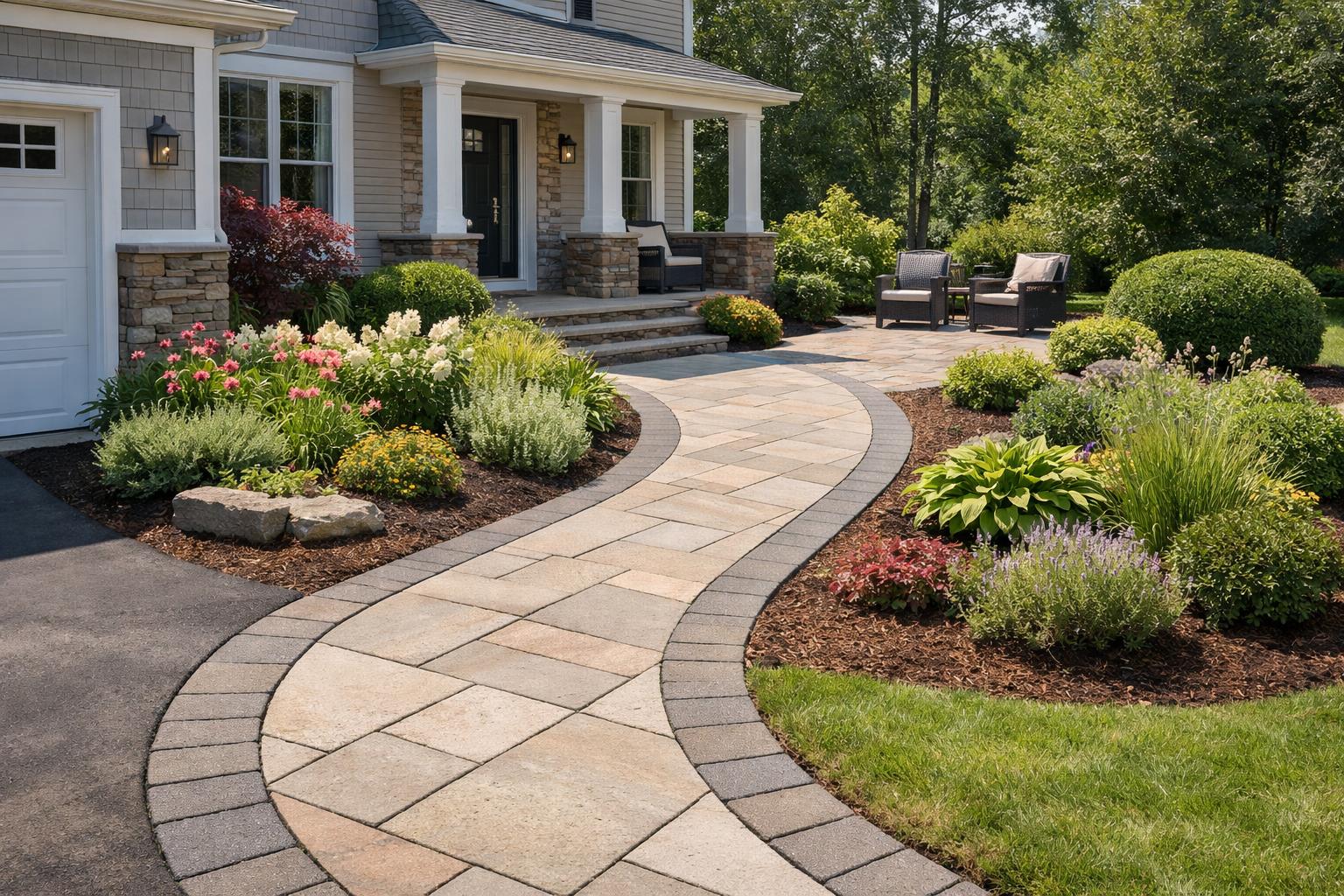
Homeowners usually get the best value by buying bulk materials like mulch, soil, gravel, and stone from a local landscape supply yard, plants from a nursery, and small quantities or bagged products from a home improvement store. The right source depends on how much you need, whether you can receive a delivery, and how much the quality of the material matters for the project.
Part of our Complete Yard Design and Planning Guide: layouts, ideas by yard type, phasing and budgets in one place.
This guide compares the main places to buy landscaping materials, what each does well, and how to avoid the common mistakes that cost extra money.
The main places to buy

Landscape supply yards
These yards sell mulch, topsoil, compost, gravel, decorative rock, sand, boulders, and often pavers and wall block. Bulk materials are sold by the cubic yard or ton, and they usually deliver. For anything over a few yards, this is typically the most economical source. You can also see the actual material in piles before you buy.
Nurseries and garden centers
Independent nurseries are often the best place for trees, shrubs, and perennials. Staff tend to know which plants do well locally, and plant quality and selection are usually stronger. Some offer warranties on plants, delivery, and planting services. Prices per plant can be higher than big-box stores, but survival is what matters.
Home improvement stores
Big-box stores are convenient for bagged mulch, soil, edging, landscape fabric, tools, and small paver projects. Bagged products cost much more per cubic yard than bulk, but they make sense for small jobs, tight access, or when you cannot store a big pile.
Stone and hardscape distributors
For patios, walls, and walkways, hardscape distributors carry wider selections of pavers, wall block, natural stone, and the base materials to go with them. Some sell mainly to contractors but will sell to homeowners. They can also advise on quantities and matching caps, edging, and adhesives.
Sod farms and suppliers
Sod is perishable, so buy it close to installation day from a sod farm or local supplier. Ask when it was cut and plan to lay it the same day.
Free and low-cost sources
Some municipalities offer free or low-cost compost or wood chips. Tree services sometimes give away chips. Quality varies, so look for contamination like trash or weed seeds before using it in visible beds.
Bulk vs bagged: when each makes sense
| Factor | Bulk (supply yard) | Bagged (store) |
|---|---|---|
| Cost per cubic yard | Lower, often much lower | Higher |
| Best for | Roughly 2+ cubic yards | Small beds, touch-ups, containers |
| Delivery | Dumped in one pile; delivery fee common | Carry home or pallet delivery |
| Handling | Wheelbarrow from pile to beds | Easy to carry and store |
| Consistency | Varies by yard and batch; inspect first | Fairly consistent |
| Cleanup | Pile can stain or damage driveway | Plastic bags to dispose of |
As a rough guide, one cubic yard is about 13 to 14 of the common 2-cubic-foot bags. If you need more than a couple of yards, price the bulk option including delivery before buying bags.

How to choose a supplier
- See the material. Visit the yard if you can. Mulch, soil, and stone vary widely between suppliers.
- Ask what is in the soil. “Topsoil” can mean screened native soil, a blend with compost, or fill. For planting beds, ask for a planting mix or screened topsoil with organic matter.
- Check minimums and delivery fees. Many yards have a minimum order or a flat delivery charge, and some charge more beyond a set distance.
- Confirm the unit. Mulch and soil are usually sold by the cubic yard; gravel and stone often by the ton. Ask the yard for its conversion.
- Ask about returns. Bulk material usually cannot be returned. Pallets, unopened bags, and unused pavers often can, sometimes with a restocking fee.

Getting quantities right
Ordering too little means a second delivery fee. Ordering too much leaves a pile you have to deal with. Measure length, width, and the depth you want in inches, then calculate cubic yards: length (ft) x width (ft) x depth (in) / 324. Add a small buffer for settling and uneven ground. Our mulch depth guide and gravel walkway depth guide cover typical depths.
Delivery tips
- Choose a drop spot close to where the material will be used, but on a surface that can handle the truck’s weight.
- Put down a tarp or plywood to protect the driveway, especially for dark mulch, which can stain.
- Check for overhead lines, low branches, and soft ground the truck should avoid.
- Be home for the delivery if you can, so the driver puts the pile where you want it.
- Ask whether your HOA or city limits how long a pile can sit on the street.

Should you buy materials or let the contractor supply them?
If you are hiring out installation, contractors usually prefer to supply materials. They often get trade pricing, know the right specification, and stand behind the result. Buying your own can save money on simple items like mulch, but it can shift responsibility: if the material is wrong or arrives late, that is on you, and some contractors will not warranty work using customer-supplied materials. We cover the tradeoffs in should you buy landscaping materials yourself.
Common mistakes
- Buying bagged mulch or soil for a large project and paying several times the bulk price.
- Ordering “topsoil” without asking what it contains.
- Using the wrong gravel: rounded pea gravel under pavers instead of angular, compactable base.
- Buying plants that are not suited to your sun, soil, or zone because they were on sale.
- Forgetting delivery fees when comparing prices.
Frequently asked questions
Is it cheaper to buy mulch in bulk or bags?
For more than about two cubic yards, bulk is usually cheaper even after delivery. Bags make sense for small areas or when you cannot receive a dumped load.
Can homeowners buy from contractor supply yards?
Most landscape supply yards sell to the public. Some hardscape distributors focus on contractors but still sell to homeowners; call ahead to ask.
Where is the best place to buy plants?
Local independent nurseries usually offer better selection, local advice, and healthier plants. Big-box stores can work for common annuals and perennials if you inspect each plant.
How do I avoid bad topsoil?
Look at it before ordering. Good planting soil is crumbly, dark, and free of rocks, trash, and clumps of clay. Ask whether it is screened and what it is blended with.