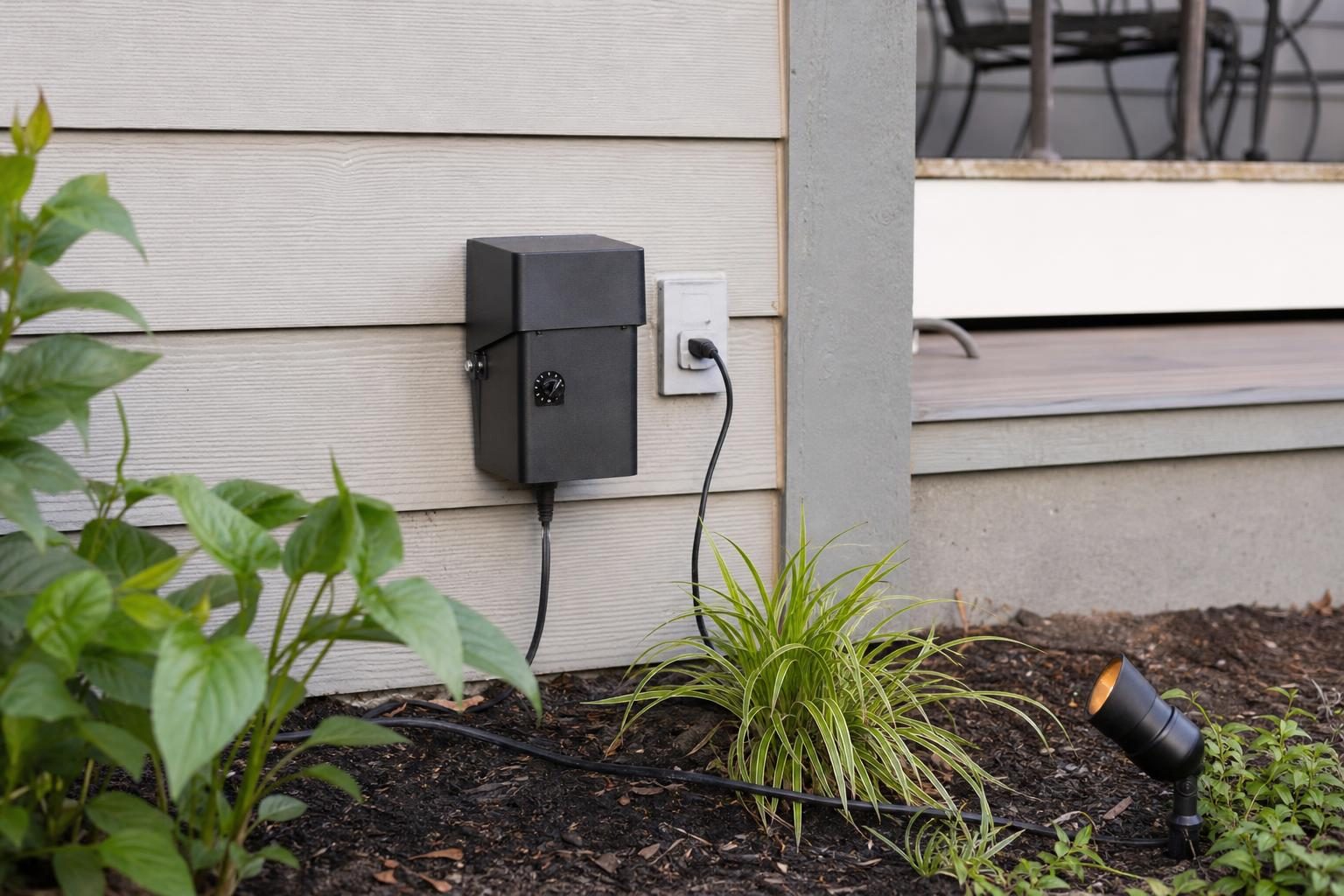
Professional landscape lighting installation usually costs about $100 to $250 per fixture for a mid-range low-voltage LED system, which puts a typical 12- to 20-fixture yard somewhere around $2,000 to $5,000. Premium brass fixtures, design-build lighting firms, smart controls, and hard-to-wire yards can push the same project to $6,000–$10,000 or more.
The per-fixture price bundles a lot: the fixture, the LED lamp, wire, connectors, a share of the transformer, and labor. This guide breaks down each piece, shows sample system budgets, and explains the installation details that decide whether your lights still look good in five years.
Quick answer: Budget about $100–$250 per installed fixture for good-quality low-voltage LED lighting, or $250–$500+ per fixture for solid brass and high-end design firms. A 12-fixture front yard often runs $1,800–$3,500; a 20-fixture front and back yard, $3,000–$6,000. Make sure the quote lists the fixture brand and material, transformer size, wire gauge, connector type, burial depth, controls, and warranty. Most long-term problems come from undersized transformers, long wire runs that leave the far lights dim, and cheap connections that corrode.
Part of our Complete Landscape Lighting Guide: fixtures, wiring, design, costs and upkeep in one place.
Cost per fixture installed
Most lighting contractors price by the installed fixture. The figures below are rounded US ranges for low-voltage (12-volt) LED work, including the fixture, lamp, wire, connections, and labor. They vary by region, contractor, and how hard your yard is to wire.
| Fixture type | Typical use | Rough installed cost each |
|---|---|---|
| Path or area light | Walkways, bed edges, driveway borders | $100–$250 |
| Spotlight or uplight | Trees, columns, house facade | $120–$300 |
| Well light (in-ground) | Uplighting from lawn or beds, low profile | $150–$350 |
| Wall wash or flood | Broad wash on walls, hedges, facade | $120–$300 |
| Step, deck, or hardscape light | Stair risers, wall caps, deck posts | $100–$300 (more if retrofitted into existing stone) |
| Tree-mounted downlight | “Moonlighting” from high in a tree | $200–$450 (ladder or lift work) |
| Bollard | Driveways, larger paths | $250–$900 |
Many contractors have a minimum job size, often around six to eight fixtures, because the transformer, trip charge, and setup cost the same whether you install five lights or fifteen. Some firms also charge a separate design fee or a nighttime demo, while others fold it into the job.
Sample system budgets (12–20 fixtures)
These examples show how fixture counts add up. Treat them as ballparks for planning, not quotes.

| Project | Typical layout | Mid-range installed | Premium installed |
|---|---|---|---|
| Front yard, 12 fixtures | 6 path lights, 4 uplights on facade and trees, 2 well lights at the entry | $1,800–$3,500 | $3,500–$6,000 |
| Front and back, 16 fixtures | Front package plus 4 lights on patio and a focal tree | $2,500–$4,500 | $4,500–$8,000 |
| Front and back, 20 fixtures | Paths, facade, two trees, steps, patio, fence or wall wash | $3,000–$6,000 | $6,000–$10,000+ |
What moves a project from mid-range to premium is mostly fixture quality (solid brass or copper instead of aluminum), a bigger stainless transformer with zone control, more design time, and difficult wiring such as boring under a driveway or retrofitting lights into an existing stone wall.
Not sure low-voltage is worth it over solar stakes? Our comparison of low-voltage vs solar landscape lighting covers brightness, lifespan, and where solar still makes sense.

Transformer sizing and cost
The transformer steps household 120-volt power down to about 12 volts for the lights. Sizing it is simple math, and getting it wrong is one of the most common problems with landscape lighting:
- Add up the fixture wattage. Most LED landscape lamps draw roughly 2–8 watts each. Fifteen fixtures at 5 watts is 75 watts.
- Load it to about 80% or less. A common rule is to keep the total under about 80% of the transformer’s rating, so 75 watts calls for at least a 100-watt unit.
- Leave room to grow. Many installers go a size up, often 200–300 watts for a typical yard, so later phases don’t need a second transformer.
Retail prices for a quality stainless 300-watt multi-tap transformer often run about $150–$450, and 600-watt units more. Multi-tap models offer 12, 13, 14, and 15-volt connections, which lets an installer send a little extra voltage down long runs so the far fixtures aren’t dim. The transformer plugs into a GFCI-protected outdoor outlet with a weatherproof in-use cover. If you don’t have one in the right spot, adding it is licensed electrical work and may need a permit. See whether your landscaping project needs a permit.
Fixture materials and LED options
Fixture materials
- Plastic and thin stamped aluminum: cheapest. Finishes bubble, threads strip, and water can get into the socket within a few seasons.
- Powder-coated cast aluminum: mid-range and fine for many yards, though scratches can let corrosion start.
- Solid brass, copper, or bronze: the most expensive, but they don’t rust, weather to a natural patina, and usually carry the longest warranties. In coastal, irrigated, or wet areas they often cost less over time because they don’t need replacing.
Replaceable LED lamps vs integrated LED
Fixtures with a replaceable lamp (often a bi-pin or MR16-style LED) let you swap the bulb, change brightness or beam spread, or upgrade later. The catch is heat: an LED lamp in a sealed fixture needs to be one the manufacturer has tested in that fixture, or it can run hot and fail early.
Integrated LED fixtures have the light source built in. They’re compact, sealed, and often efficient, and installers report good reliability from quality brands. But when the LED fails, you replace the whole fixture. Ask how long the LED module warranty runs and whether it’s longer than the fixture body’s.
Either way, ask for warm white light, around 2700–3000K, which flatters plants and stone and is closer to what lighting groups such as DarkSky recommend for limiting harsh light at night.
Wire, layout, and installation

Wire is a small part of the bill, but it decides how evenly the system lights up. Low-voltage power drops over distance, so a long run with many fixtures leaves the last lights dimmer than the first. Good installers manage this by:
- Using heavy enough cable. 12-gauge is common for shorter runs; 10- or 8-gauge for longer or heavier runs.
- Splitting the load. Several shorter runs, or a hub layout where fixtures branch from one central point, instead of one long daisy chain.
- Measuring voltage at the far fixture. A good installer checks with a meter and adjusts the transformer tap before leaving.
- Burying cable properly. Low-voltage landscape cable is commonly buried about six inches deep. Check your local code, and route it away from where you’ll edge or aerate.
- Sleeving under hardscape. Running wire under an existing walkway or driveway takes boring or trenching and adds cost. If you’re building a patio, lay conduit before the pavers go down. Our paver installation cost guide explains what to plan for during construction.
Connections matter as much as wire. Sealed, gel-filled or crimped-and-sealed connectors hold up far longer than the push-on pierce connectors included in many kits.
Smart controls and timers
- Photocell: turns lights on at dusk. Inexpensive, but the sensor needs a clear view of the sky.
- Photocell plus timer: on at dusk, off at a set time, such as 11 p.m. This is the most common setup.
- Astronomical timer: adjusts to sunset times through the year without a sensor.
- Wi-Fi or app-controlled transformer: schedules, zones, and phone control. Expect to pay a few hundred dollars more than a basic setup, and more for zone dimming or color-changing fixtures.
Separate zones are worth considering. Path and entry lights can run all evening, while the dramatic tree and facade lighting shuts off earlier.

DIY kit vs professional install
DIY kits with six to twelve lights and a small transformer often cost about $150–$500. Building your own system from quality individual fixtures and a good transformer typically lands around $60–$200 per fixture in materials. Low voltage is relatively safe to handle, and many homeowners do this successfully.
Where DIY usually goes wrong:
- The kit’s transformer is too small to add fixtures later.
- Pre-cut wire is too short, which leads to extra splices in the ground.
- Push-on connectors lose contact or corrode, causing flicker or dead lights.
- Lights end up lined like a runway, with fixtures every few feet.
A professional install is worth it when you want a design that lights the house and trees well, need long wire runs, have to cross under hardscape, or want a warranty on the whole system. New outlets should always be installed by an electrician.
Running costs and maintenance plans
LED systems use little power. As an example, 100 watts of fixtures running six hours a night uses about 220 kilowatt-hours a year. At typical residential electricity rates, that’s usually somewhere around $25–$50 a year.
Physical upkeep matters more. Fixtures get knocked by mowers, plants grow over lights, lenses cloud up, and connections loosen. Many lighting companies offer an annual or twice-yearly service visit to realign fixtures, clean lenses, trim around lights, replace failed lamps, and check voltage. Prices vary widely, so ask exactly what’s included, whether parts are extra, and whether they’ll service a system they didn’t install.
Problems homeowners run into

- Undersized transformer. Lights dim or the transformer shuts off when fixtures are added. The fix is removing fixtures, upgrading the transformer, or adding a second one.
- Dim lights at the end of a run. This is voltage drop from wire that’s too thin or too long, or from too many fixtures on one run. Heavier cable, a hub layout, or a higher transformer tap usually fixes it. In one forum troubleshooting case, swapping old, thin wire for new 12-gauge cable brought the far-end voltage from badly low back to normal.
- Corroded connections. Flickering or dead sections often trace back to a splice in the soil. Iowa State University Extension’s troubleshooting advice starts with checking that every transformer and fixture connection is tight, and notes that dim far-end lights can also signal a short.
- Glare. Bright, exposed bulbs aimed at eye level, or uplights shining into a neighbor’s window. Shielded fixtures, glare guards, lower wattage, and careful aiming solve most of it.
- Cut wires. Shallow cable gets sliced by edgers, aerators, and new plantings. Ask for a simple map of wire routes.
- Lights that come on at the wrong times. A photocell placed in shade or near a porch light can confuse the timer.
What a quote should list
Compare quotes line by line, not just by total. Our guide on how to compare landscaping quotes shows how. A good lighting quote lists:
- Fixture count by type, with brand, model or series, material, and finish.
- Replaceable lamp or integrated LED, plus wattage, beam spread, and color temperature.
- Transformer size, brand, location, taps, and spare capacity.
- Wire gauge, layout, burial depth, and any boring under hardscape.
- Connector type.
- Controls: photocell, timer, astronomical timer, or app.
- Whether a new outlet or electrician work is included.
- Warranty terms for fixtures, LEDs, transformer, and labor, listed separately.
- Whether a night walkthrough and aiming adjustment are included after installation.
Questions to ask a lighting contractor
- Can I see a night demo or photos of your finished work after dark?
- Will you measure voltage at the last fixture on each run?
- How will you prevent glare into my windows and my neighbors’?
- What does a service visit cost after the warranty period?
Red flags
- A quote with only a fixture count and a total, with no brands or materials listed.
- A transformer sized exactly to today’s fixtures, with no room to grow.
- No mention of wire gauge or burial depth.
- Pressure to light everything at once instead of starting with paths, steps, and the entry.
For fixture types and placement ideas, see our landscape lighting guide and our front entry landscaping ideas.
Frequently asked questions
How much does it cost to install outdoor lighting?
For low-voltage landscape lighting, most homeowners pay about $100–$250 per installed fixture, or roughly $2,000–$5,000 for a typical yard. Line-voltage (120-volt) fixtures such as wall sconces or post lights wired into the house cost more because they need a licensed electrician.
How many landscape lights do I need?
Many front yards look complete with 10–15 well-placed fixtures. Start with steps, paths, and the entry, then add a few uplights on the house and one or two trees. Lighting fewer things well looks better than lining every path.
What size transformer do I need?
Add up the fixture wattage and choose a transformer rated at least 25% higher, so the load stays near 80% or less. Most homes with LED fixtures do well with a 200–300-watt multi-tap unit, which leaves room to add more later.
Is a smart landscape lighting transformer worth it?
It’s worth it if you want separate zones, seasonal schedules, or phone control. For a simple dusk-to-11 p.m. schedule, a photocell and timer do the job for less.
How long does landscape lighting last?
Quality LED fixtures often last many years, and solid brass fixtures can last decades with occasional lamp or connector replacement. Cheap plastic and thin aluminum fixtures may need replacing within a few seasons.
Can I add lights to my existing system later?
Usually, if the transformer has spare capacity and the wire runs aren’t already at their limit. If not, a second transformer or a new run may be needed, which is why sizing up at the start saves money.