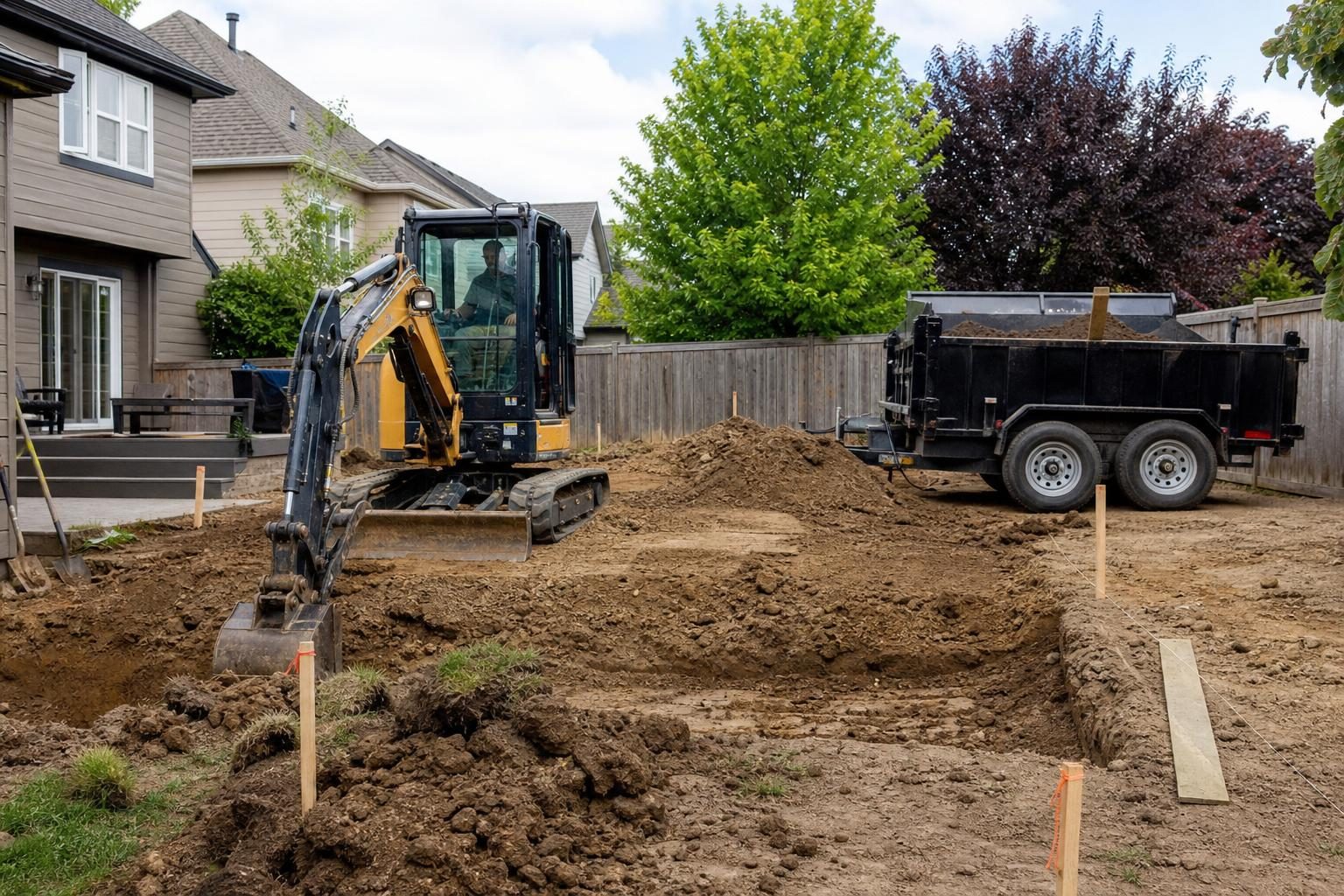
Homeowners usually do not search for excavation companies until a project becomes more complicated than planting and surface-level upgrades. Once grading, drainage correction, retaining walls, patio prep, trenching, or major demolition are involved, excavation becomes one of the most important early parts of the job.
Part of our Complete Yard Drainage Guide: diagnosing water, drains and swales, costs and repairs in one place.
This guide explains what excavation companies actually do before a landscaping project, how their work affects cost and scheduling, and what homeowners should clarify before hiring or approving excavation scope.
Estimate related drainage work before excavation starts
Drainage and excavation often overlap. Use this calculator to understand rough drainage ranges before deciding whether grading, trenching, or outlet work belongs in the scope.
Drainage Cost Calculator
Estimate drainage project pricing for swales, French drains, and catch basin style systems.
Drainage cost estimate
- Estimated treatment length
- –
- Low estimate
- –
- Mid estimate
- –
- High estimate
- –
- Estimated range per linear ft
- –

What excavation means in a landscaping context
Residential excavation is not just digging holes. In landscape work, excavation often means reshaping the site so the next trades can build correctly. It may involve demolition, trenching, export, grading, base preparation, slope correction, and access planning for later hardscape or drainage work.
- Grading areas for patios, walkways, and driveways
- Cutting and filling for retaining walls and steps
- Trenching for drainage, irrigation, or utilities
- Removing unsuitable soil, roots, old materials, or buried debris
- Preparing access and working room for installation crews
Why excavation work affects the whole project
Excavation is often where hidden site conditions become visible. Poor drainage, unstable base material, buried concrete, old roots, or unexpected elevation conflicts can all show up once the project starts opening the ground. That is why excavation scope can materially change both cost and timeline.
A homeowner who understands this early is less likely to panic when a contractor flags a legitimate site problem. The better question is whether the issue was identified and explained clearly, not whether the site remained simple.

What an excavation company should review before pricing
A serious excavation estimate should include more than machine hours. The contractor should look at access, soil conditions, disposal routes, nearby structures, runoff paths, and how the excavation work connects to the next phase of construction.
- Equipment access and protection of existing surfaces
- How spoil material or demolition debris will be hauled off site
- Existing grade and where water currently moves
- How far excavation extends beyond the visible finished area
- Whether shoring, compaction, or wall prep may be needed
For homeowners dealing with water management, this is also where guides like Drainage Swale vs French Drain and French Drain vs Surface Drain become useful. Drainage choices often change how excavation should be scoped in the first place.
Questions to ask before the work starts
Excavation can feel disruptive, so homeowners benefit from asking practical questions before machinery arrives. The best questions are about impact, sequencing, and restoration.
- What exactly will be removed, cut, or filled?
- How much of the yard will be disturbed beyond the finished project footprint?
- What happens if poor soil or buried obstacles are uncovered?
- Who restores surrounding grades or surfaces after excavation is complete?
- How does excavation timing affect the rest of the project schedule?

How to recognize a weak excavation scope
Excavation estimates become risky when they are priced like simple labor instead of site-preparation work. Homeowners should be cautious if the contractor cannot describe haul-off, compaction, grading intent, or the relationship between excavation and the finished installation.
- No explanation of what happens to spoils or demolition debris
- No clear tie between excavation and drainage or grade control
- No mention of compaction where later hardscape will be built
- No discussion of access damage, cleanup, or restoration
How homeowners should use this information
Excavation is a planning service as much as a digging service. Homeowners should treat it as the foundation of the finished landscape outcome. Good excavation work gives the rest of the project a chance to perform correctly. Poor excavation creates problems that show up later as settling, drainage failure, awkward transitions, and preventable cost overruns.
When homeowners understand what excavation really covers, they can compare scope more intelligently and avoid underestimating one of the most important early phases of a landscape project.