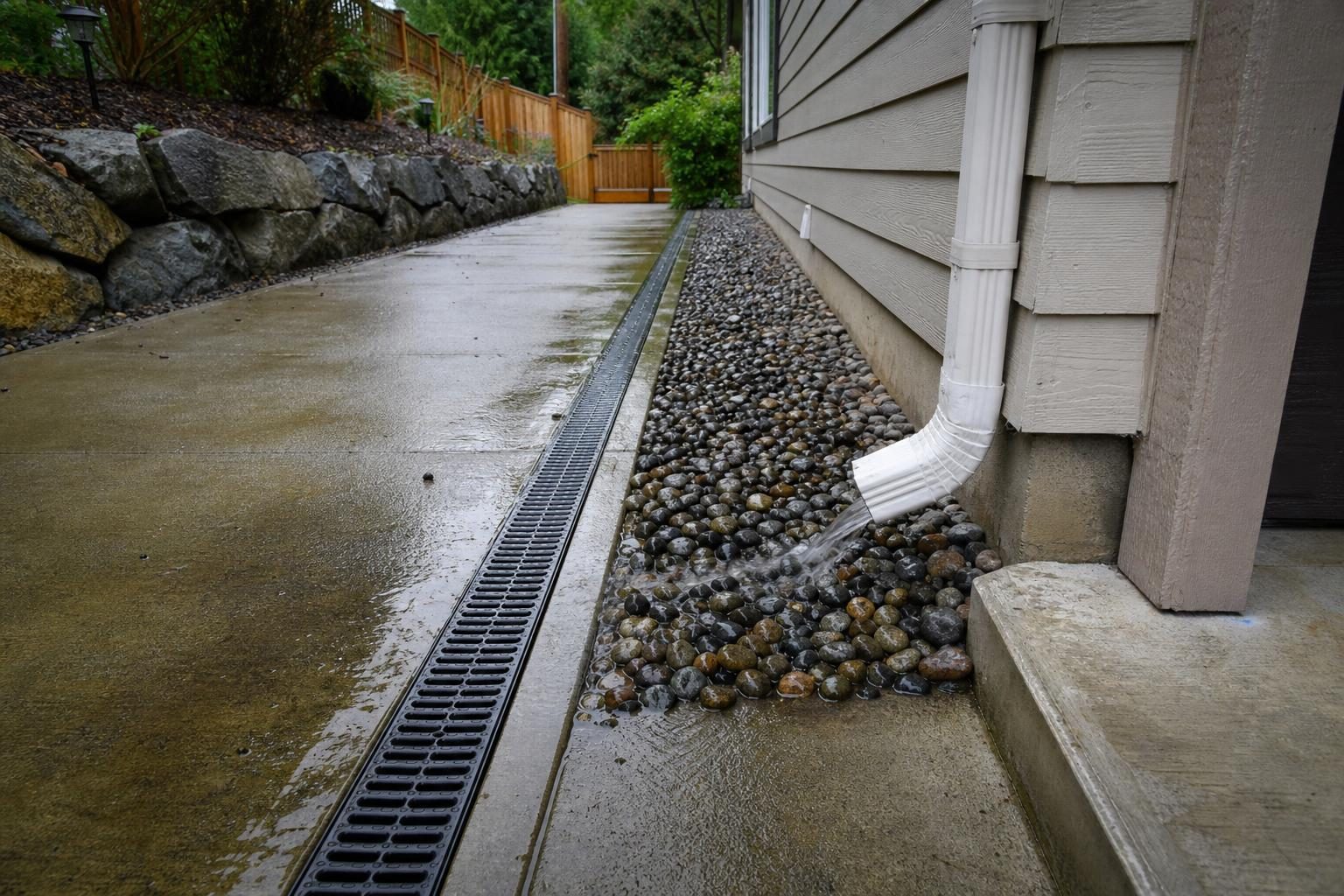
A surface drain collects water that is already standing or flowing on top of the ground, such as at a downspout, a low spot in the lawn, or the edge of a patio. A French drain collects water that is soaking through the soil, using a gravel-filled trench and a perforated pipe to intercept it before it reaches a foundation or soggy area. If you see puddles, start by looking at surface drainage; if the ground stays wet or water shows up in a basement or crawlspace, a French drain may be the better fit.
Part of our Complete Yard Drainage Guide: diagnosing water, drains and swales, costs and repairs in one place.
Many yards end up using both. Here is how each works, what they cost, and how to tell which problem you actually have.
How a surface drain works
Surface drains catch water at ground level. Common types include:
- Catch basins: a grated box set at a low spot, connected to solid pipe that carries water away.
- Channel or trench drains: long, narrow grated channels set along a patio, driveway edge, or garage door.
- Downspout extensions and buried downspout lines: solid pipe that takes roof water away from the house.
- Swales: shallow, grassed or rock-lined channels shaped into the ground to steer runoff.
The key is that water enters through a grate or flows along a shaped surface, then moves through solid pipe to a safe outlet such as a lower part of the yard, a dry well, or, where allowed, the street or storm system.

How a French drain works
A French drain is a trench, usually lined with filter fabric, filled with clean washed gravel and a perforated pipe near the bottom. Groundwater seeps into the gravel, enters the pipe through the holes, and flows by gravity to an outlet. The trench is often topped with more gravel or covered with soil and sod.
Because the pipe is perforated, a French drain is designed to collect water from the soil, not to carry large surface flows. Sending roof water directly into a French drain can overwhelm it and push debris into the gravel.
Side-by-side comparison
| Factor | Surface drain | French drain |
|---|---|---|
| Handles | Standing water and runoff on top of the ground | Water moving through soil |
| Typical uses | Downspouts, low lawn spots, patio and driveway edges | Soggy yards, high groundwater, behind retaining walls, along foundations |
| Pipe | Solid | Perforated, in gravel |
| Depth | Generally shallow | Often deeper, depending on the problem |
| Disruption | Usually less digging | Longer, deeper trenches |
| Rough cost | Often lower; small jobs in the hundreds to low thousands | Often higher; commonly several thousand dollars for longer runs |
| Maintenance | Clear grates and basins of leaves and debris | Keep outlet clear; can clog with silt over time |
Costs vary widely by region, length of run, depth, soil, access, and outlet options. Treat these as a sense of scale, not a quote. Our guide on drainage cost vs property protection helps weigh spending against risk.
How to tell which problem you have

Signs of a surface water problem
- Puddles form during or right after rain, then drain within a day.
- Water flows across the yard from a neighbor’s lot, driveway, or roof.
- Downspouts dump next to the foundation.
- Mulch or soil washes out along a path.
Signs of a subsurface water problem
- Ground stays spongy for days after rain, even without visible puddles.
- Water seeps into a basement or crawlspace through walls or floor.
- Moss, rushes, or other wet-soil plants spread in the lawn.
- Water seeps from the face of a slope or behind a retaining wall.
Walk the yard during a steady rain and again a day later. Where water comes from and how long it stays tells you a lot. Our guide to signs you need regrading is also worth a look, because sometimes the real fix is the slope of the ground itself.
When grading is the better answer
If soil near the house slopes toward the foundation, no drain will fully fix it. A common guideline is for ground to fall away from the foundation over the first several feet, but local codes and site conditions vary. Regrading, sometimes combined with a swale, often costs less over time than burying pipe to work around a bad slope. See drainage vs regrading for that comparison.

Common mistakes
- No real outlet. A drain has to discharge somewhere lower. A pipe that ends in flat ground just moves the puddle.
- Connecting downspouts to a French drain. Roof water belongs in solid pipe.
- Skipping filter fabric around French drain gravel in fine or silty soil, letting it clog.
- Too little slope on the pipe, so water sits in it.
- Sending water onto a neighbor’s property or into the street where it is not allowed. Check local rules.
- Treating a symptom. Adding a drain without addressing the source, such as a broken gutter or a leaking irrigation line.
What to ask a drainage contractor
- Where is the water coming from, and how did you determine that?
- Why this type of drain for this problem?
- Where will the system outlet, and is it allowed there?
- What pipe type, gravel, and fabric will you use? What slope?
- Are cleanouts included for maintenance?
- How will the lawn, beds, or hardscape be restored?
- What happens if water still collects after installation?
Our checklist on what a drainage estimate should include covers this line by line.
Estimate the drainage treatment range
Use this drainage calculator to compare rough ranges for swales, French drains, catch basins, and downspout extensions before choosing a solution type.
Drainage Cost Calculator
Estimate drainage project pricing for swales, French drains, and catch basin style systems.
Drainage cost estimate
- Estimated treatment length
- –
- Low estimate
- –
- Mid estimate
- –
- High estimate
- –
- Estimated range per linear ft
- –
Frequently asked questions
Can a French drain handle downspout water?
It is usually not recommended. Roof water arrives in large volumes and should go through solid pipe to an outlet. A French drain is meant to collect slower groundwater.
Is a surface drain cheaper than a French drain?
Often, because it tends to be shallower and shorter. But the cheaper option only saves money if it actually fixes the problem.
Do French drains need maintenance?
Yes. Keep the outlet clear, and flush through cleanouts if flow slows. In silty soils they can clog over the years.
Can I install a drain myself?
Short surface drains and downspout extensions are reasonable DIY projects. Long or deep French drains, work near foundations, and anything requiring a street or storm connection are usually better left to a professional. Always call 811 before digging.