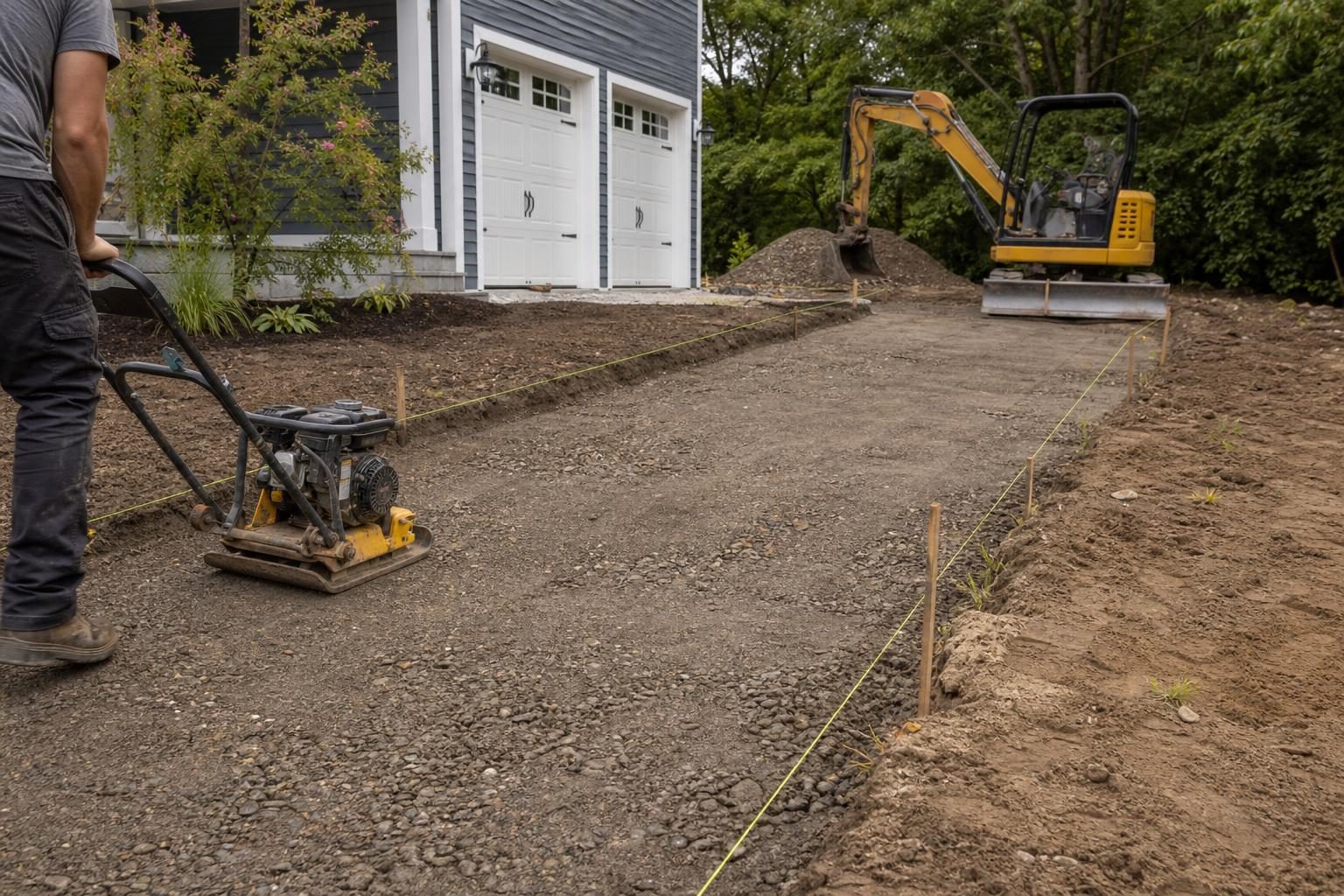
Most homeowners only see the day the concrete gets poured, but a driveway’s quality is mostly decided before the truck arrives and in the days after it leaves. A new concrete driveway is excavated, built on a compacted gravel base, formed and reinforced, poured and finished in a single day, jointed, and then cured. Most crews finish in three to five working days, and you can usually drive a car on it about a week after the pour.
Knowing the sequence helps you compare bids and spot shortcuts. If a contractor skims over the base, drainage, joints, or curing, that matters more than a polished sales pitch.
Quick answer: A concrete driveway installation goes in this order: layout and permits, demolition or excavation, a compacted gravel base, forms and reinforcement, the pour and finish (all on one day), control joints, and curing. Plan on about 3 to 5 working days on site. Light foot traffic is usually fine after a day or two, cars after about 7 days, and heavy trucks after about 28 days. Plain broom-finish concrete often costs around $6 to $12 per square foot installed, depending on region, site, and thickness.
Part of our Complete Driveway Guide: types, costs, installation, repair and hiring in one place.
Day-by-day timeline for a new concrete driveway
For a typical two-car replacement with no surprises, the work usually runs like this. Permits, inspections, and weather can stretch it out.
| When | What happens | What you should do |
|---|---|---|
| 1 to 4 weeks before | Site visit, layout, permit application, 811 utility marking, mix and finish chosen | Confirm the written scope, apron or curb work, and HOA approval |
| Day 1 | Old driveway broken out and hauled away, or new area excavated | Move vehicles to the street; mark sprinkler heads and lines |
| Days 1 to 2 | Subgrade graded and compacted, gravel base placed and compacted, forms set to slope | Ask to see the base depth and the form slope before the pour |
| Day 2 or 3 | Rebar or mesh set on supports, any inspection, then pour, finish, and curing | Stay off the slab and keep kids and pets away |
| Day 3 or 4 | Saw-cut joints if not tooled, forms pulled, cleanup, soil backfilled at edges | Walk the job and note any concerns in writing |
| Day 1 to 2 after pour | Concrete hard enough for careful foot traffic | Keep curing as instructed |
| About day 7 | Passenger cars allowed | Avoid turning wheels while stopped and parking on edges |
| About day 28 or later | Heavy trucks; most sealers can go on once the slab has dried | Schedule sealing; no de-icing salt the first winter |

Step 1: Layout, permits, and utility marking
The project starts with measurements, a slope check, access planning, and decisions about width, thickness, finish, and drainage. This is when a good contractor spots property-specific issues such as poor runoff, a grade change at the garage, tree roots, or an awkward transition at the street.
- Width: single-car drives are often 10 to 12 feet wide; two-car drives are often 18 to 24 feet.
- Drainage: the slab should slope away from the house and garage, commonly around 1 to 2 percent (roughly 1/8 to 1/4 inch per foot). Confirm the finished height at the garage door before anything is poured.
- The apron: the section where the driveway meets the street, plus any curb cut, is often controlled by the city or county and may need its own permit and inspection.
- Utilities and sprinklers: the contractor should request 811 utility marking before digging, and you should point out private lines such as irrigation, lighting, and septic.
Rules vary widely, so ask who pulls the permit and whether an inspection is required before the pour. HOA approval may also be needed for size, color, or finish. If you are still choosing a material, compare asphalt vs concrete driveways and concrete vs pavers cost first.

Step 2: Demolition, excavation, and base preparation
If an old driveway exists, it is broken up, removed, and hauled away. For new work, the area is excavated deep enough for both the base and the slab. Organic soil, roots, and soft spots should come out now. Scraping the surface and pouring on unstable ground is a shortcut.
When a driveway fails early, the cause is often here.
- Subgrade: the native soil is graded to the planned slope and compacted with a plate compactor or roller. Areas that pump or move underfoot should be dug out and replaced, not covered up.
- Base: a layer of crushed gravel, commonly about 4 to 6 inches deep after compaction, goes over the subgrade. Clay soils, wet sites, and frost-prone climates often call for more. It should be compacted in layers, not dumped and raked in one pass.
Step 3: Forms, thickness, and reinforcement

Forms are wood or metal boards staked along the edges. They define the shape, hold the concrete at the right height, and set the final slope, so they should be checked with a level or string line before the truck is called.
Thickness
- 4 inches is a common standard for driveways that see passenger cars and light SUVs.
- 5 to 6 inches makes sense for heavy pickups, RVs, boat trailers, or regular delivery and service trucks.
- Thickened edges, where the slab gets deeper along the sides or at the street, help where tires run near the edge.
Our guide to concrete driveway thickness goes deeper on that choice.
Reinforcement
Reinforcement does not stop concrete from cracking. It holds cracks tight and helps the slab carry loads if the ground shifts.
- Rebar: steel bars set in a grid, often 12 to 24 inches apart, on small supports called chairs so the steel sits near the middle of the slab.
- Welded wire mesh: it only helps if it ends up inside the slab. Ask how the crew keeps it lifted during the pour.
- Fiber: synthetic fibers mixed into the concrete help control early shrinkage cracking. On driveways it is usually used along with steel, not instead of it.
The concrete mix
Where driveways freeze and see de-icing salt, the National Ready Mixed Concrete Association recommends air-entrained concrete of at least 4,000 psi with about 6 percent air. The tiny air bubbles give freezing water room to expand. A Tennessee Concrete Association summary of the ACI 332 residential code points to 4,500 psi for driveways in the most severe freeze-thaw exposure. Ask what strength and air content will be on the delivery ticket.
Step 4: Pouring and finishing

Once the ready-mix truck arrives, timing matters. The crew places and spreads the concrete, then strikes it off with a long straightedge (screeding) to the height of the forms.
A common shortcut is adding extra water at the truck to make the concrete easier to spread. That weakens the surface, increases shrinkage, and makes scaling more likely. Industry guidance is to avoid jobsite water beyond what the mix allows and to use water-reducing admixtures if more workability is needed. It is fair to ask how the crew handles this.
After screeding, the slab is bull-floated to flatten it and bring a thin layer of paste to the top. Then the crew waits for the surface water (bleed water) to evaporate before finishing. Working that water back into the surface is a leading cause of flaking later. Edges are rounded with an edging tool, and the finish goes on.
- Broom finish: the most common choice. It gives good traction and is the easiest to repair.
- Exposed aggregate: the top paste is washed off to reveal the stones, giving texture and grip.
- Stamped or colored: decorative, but it costs more, needs more skill, and usually needs regular resealing.

Step 5: Control joints and curing

All concrete shrinks as it dries, and that causes cracking. Control joints are planned weak lines that make cracks form in straight, predictable places. Ready-mix industry guidance on joints in slabs on grade gives these rules of thumb:
- Space joints about 24 to 36 times the slab thickness. For a 4-inch slab, that is roughly every 8 to 12 feet, and generally no more than 15 feet.
- Keep panels close to square. A panel should be no more than about 1.5 times as long as it is wide, and L-shaped panels should be avoided.
- Cut or tool joints at least a quarter of the slab depth, so about 1 inch in a 4-inch slab.
- Add joints at inside corners, and use isolation joints where the driveway meets the garage slab, stoop, walkway, or street.
Saw-cut joints are usually made within hours to a day of the pour. Waiting too long lets random cracks form first. For more on what is normal, read why concrete driveways crack and how contractors control it.
Curing means keeping the slab moist and at a reasonable temperature so it gains strength evenly. Crews usually spray a curing compound right after finishing or cover the slab with wet burlap and plastic. Curing is part of the installation, not an afterthought, and a weak, under-cured surface is one of the most common causes of early scaling.
Step 6: The first weeks, sealing, and first winter
Concrete keeps gaining strength for weeks. Common guidelines, which your contractor may adjust:
The first winter matters most. Trade guidance is clear: avoid de-icing salts on new concrete, use sand for traction, and later use de-icers sparingly and rinse off the excess. Ask whether the first sealing is included in the price. For the long-term routine, see our concrete driveway maintenance and sealing guide.
Before the job is called complete, walk the driveway with the contractor, check drainage with a hose, and ask what cracking is normal and what the warranty covers.
- Foot traffic: after 24 to 48 hours.
- Passenger cars: after about 7 days. At first, avoid sharp turns and parking right at the edges.
- Heavy pickups, RVs, moving or delivery trucks: after about 28 days.
- Sealing: commonly after about a month, once the slab has dried. A breathable penetrating sealer (silane or siloxane) helps resist water and salt. Many people time it for a few dry days in late summer or early fall.
How much does a new concrete driveway cost?
Prices vary a lot by region, site access, soil, thickness, finish, and how busy local contractors are. As a rough US planning range:

| Item | Typical installed cost |
|---|---|
| Plain broom-finish concrete | About $6 to $12 per sq ft |
| Exposed aggregate or colored | About $9 to $16 per sq ft |
| Stamped concrete | About $12 to $20 or more per sq ft |
| Tear-out of an old driveway | Often adds about $1 to $3 per sq ft plus haul-off |
| Typical two-car drive, 400 to 700 sq ft, plain finish | Often about $3,000 to $8,000 |
Extra thickness, a city apron, poor soil, long haul distances, and decorative work all push the price up. Real quotes from local contractors are the only reliable figure. See what affects concrete driveway cost for the drivers, and if you are comparing materials, our asphalt driveway cost guide.

Weather limits
- Cold: concrete should not be poured on frozen ground, and freezing in the first days can permanently damage it. Late-fall pours that freeze while still saturated are a common cause of surface damage. Crews use blankets, heated water, or accelerators when it is cold.
- Heat and wind: hot, dry, windy days speed up evaporation. When the surface dries faster than water can rise to replace it, shallow plastic shrinkage cracks form. Early-morning pours, fog sprays or evaporation retarders, and immediate curing help.
- Rain: heavy rain on fresh concrete can ruin the finish. A good contractor reschedules rather than pours into a storm.
Problems homeowners run into
These come up again and again in homeowner discussions, consumer complaints, and trade guidance.
- Cracks in the first year: hairline cracks at joints are normal. Cracks that cut diagonally across panels, start at inside corners near steps or stoops, or open wide often point to joints spaced too far apart or cut too late, a missing isolation joint, or a poorly compacted base.
- Flaking and scaling after the first winter: the surface peels or pops off in patches. Common causes are salt used on the new slab, too little entrained air, water added at the truck, finishing with bleed water on the surface, or skipped curing.
- Low spots, ponding, or a slab too high at the garage: water sitting on the slab or running into the garage means the forms were not set to the right heights and slope. Once poured, the real fix is usually replacing the section, so confirm heights before the pour.
- A skipped base or reinforcement: concrete poured on loose soil, or mesh left lying on the ground, is invisible on day one and shows up as settling and broken panels later.
- Color mismatch: colored or stamped pours can look patchy, and sections poured on different days or from different loads may not match. Plain gray patches and additions rarely match an older slab exactly.
- Vague contracts: a quote that promises only “standard practices” is hard to enforce later, and many warranties exclude cracking entirely.
If your existing driveway already has some of these issues, see driveway repair options before assuming you need a full replacement.
Questions, red flags, and what the quote should say

Questions to ask a contractor
- How deep will the gravel base be after compaction, and how will you compact the subgrade?
- What thickness, reinforcement, concrete strength, and air content are you using, and why for my driveway?
- Where will the control and isolation joints go, and will they be tooled or saw-cut?
- What will the finished height be at the garage, and which way will water drain?
- How will you cure the slab, and what will you do if the forecast turns hot, cold, or wet?
- Does anyone on the crew hold the ACI Concrete Flatwork Finisher certification?
- What does your warranty cover, specifically regarding cracks, scaling, and settling?
Red flags
- No mention of a base, or plans to pour directly on native soil.
- A quote that lists square footage and price but not thickness, reinforcement, or joints.
- Mesh laid flat on the ground with no supports.
- Water added at the truck to “loosen it up.”
- Joints far apart, cut shallow, or left until days after the pour.
- Pressure to pour regardless of a freeze or storm forecast.
What the written quote should spell out
At minimum: square footage and thickness; demolition, excavation, and base depth; reinforcement and how it is supported; concrete strength and air content; joint layout; finish and sealing; permits and apron work; curing method; and warranty, payment, and weather-delay terms.
Use our checklist of what a concrete driveway quote should include and our guide to choosing the right contractor for a concrete driveway when you compare bids.
Frequently asked questions
How long does it take to install a concrete driveway?
Most residential driveways take about 3 to 5 working days on site: demolition or excavation, base and forms, the pour, and joints and cleanup. Add about a week before driving on it, and longer for heavy vehicles.
How thick should a concrete driveway be?
Usually 4 inches for passenger cars on a good base, and 5 to 6 inches for heavy trucks, RVs, or regular delivery traffic.
Does a concrete driveway need rebar?
Not always, but most benefit from some reinforcement, such as rebar, properly supported wire mesh, or fiber. It holds cracks tight and spreads loads, and it works best with a good base and correct joint spacing.
Why did my new concrete driveway crack?
Some hairline cracking is normal as concrete shrinks, especially at joints. Wide, uneven, or displaced cracks can point to base problems, joints too far apart or cut too late, missing isolation joints, or early heavy loads. Check your contract and warranty, and document cracks with dated photos.
Can I put salt on a new concrete driveway?
Avoid de-icing salts during the first winter. Use sand for traction instead. After that, use de-icers sparingly, rinse off the excess, and keep the slab sealed to reduce the risk of scaling.
Does a concrete driveway need sealcoating like asphalt?
Not in the same way. Concrete benefits from a penetrating sealer every few years, especially in freeze-thaw climates. Asphalt needs regular driveway sealcoating to protect its binder from sun and water.