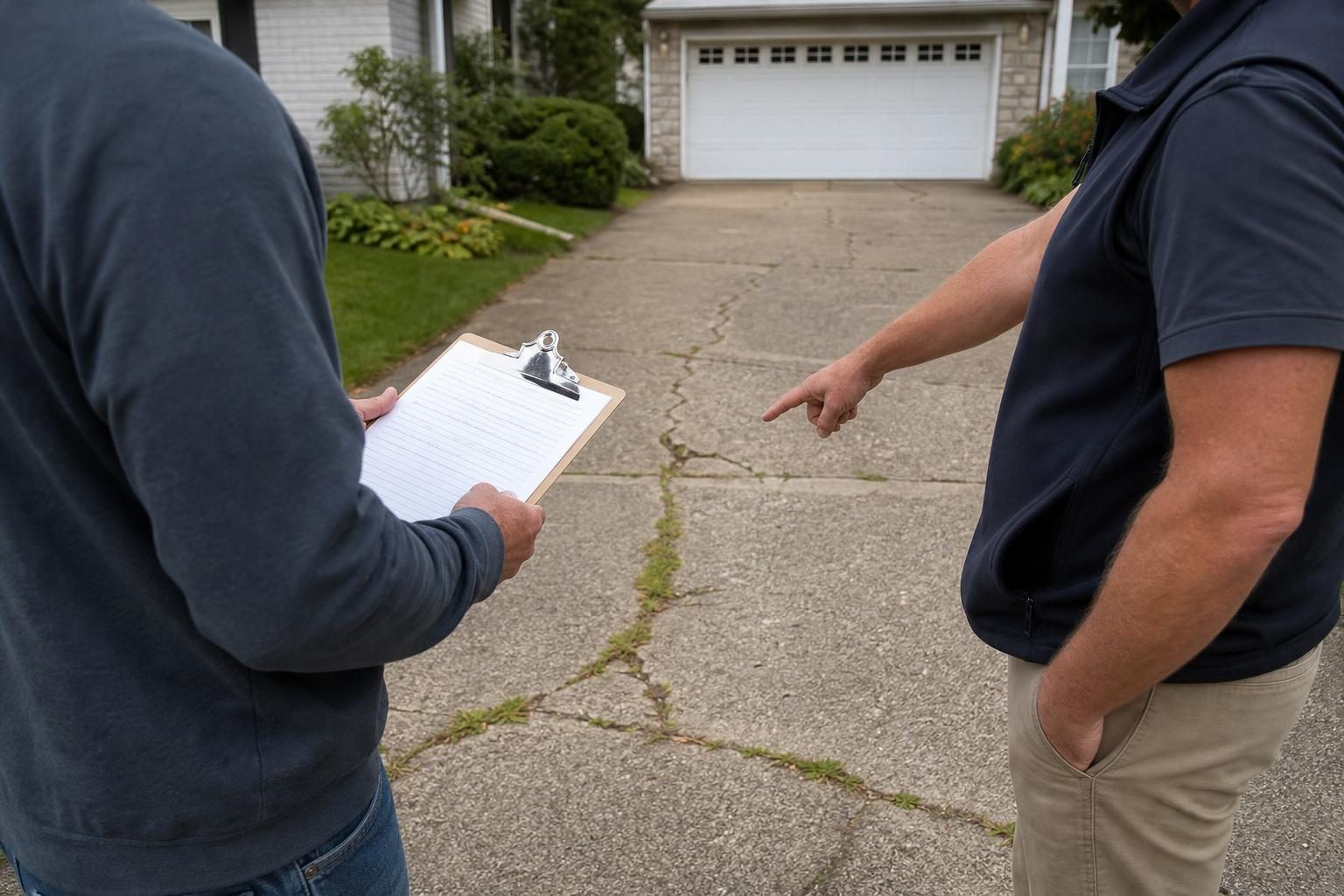
A good concrete driveway quote spells out the size, thickness, base, reinforcement, concrete strength, finish, joints, demolition and cleanup, along with the payment schedule and warranty. If a quote only lists a square footage and a total price, you can’t tell whether you’re getting a durable driveway or a thin slab on a weak base. Use the checklist below to compare quotes line by line.
Part of our Complete Driveway Guide: types, costs, installation, repair and hiring in one place.
Why a detailed quote matters
Two driveway quotes can differ by thousands of dollars and still look similar on paper. The difference usually hides in the parts you’ll never see once the concrete is poured: base depth, thickness, reinforcement and joint spacing. These are the details that decide whether a driveway lasts decades or cracks within a few winters.
Typical installed prices often fall somewhere around $6 to $12 per square foot for a standard broom-finish driveway on prepared ground, or about $8 to $15 when an old driveway has to come out first, with decorative finishes costing more. Prices vary a lot by region, access, demolition and site prep, so treat that as a rough reference. Our guide to what affects concrete driveway cost covers the drivers in detail.
The line items to look for

1. Exact dimensions and square footage
The quote should list length, width, square footage and any flares at the street or garage. This lets you check that every contractor is pricing the same driveway.
2. Demolition and removal
If you have an old driveway, the quote should cover breaking it up, hauling it away and disposal fees. Ask whether the price changes if the old slab turns out to be thicker or reinforced.
3. Excavation and grading
How deep will they dig, and how will they set the slope? A driveway should drain away from the garage and house. The quote should mention final grade or slope direction.
4. Base material and compaction
Look for the base type (usually crushed gravel), its depth after compaction, and how it will be compacted. Base depth commonly runs around 4 to 6 inches, with more in soft soil or cold climates.
5. Slab thickness
Four inches is a common minimum for passenger cars. Five or six inches is often recommended for heavier vehicles, RVs or weak soils, and at the apron where cars turn. See our guide to concrete driveway thickness for more detail.
6. Concrete strength and mix
The quote should state the strength, often given in PSI (many residential driveways use around 3,500 to 4,000 PSI). In freeze-thaw climates, ask whether the mix is air-entrained, which helps it resist scaling.
7. Reinforcement
Rebar, wire mesh or fiber reinforcement should be named, with spacing for rebar. Ask how mesh or rebar will be held up in the middle of the slab rather than lying on the ground, where it does little.
8. Control joints
Control joints give concrete a planned place to crack. The quote should say whether joints are tooled or saw-cut, and roughly how far apart. A common guideline is spacing, in feet, of no more than two to three times the slab thickness in inches, so roughly 8 to 12 feet apart for a 4-inch slab.
9. Finish
Broom finish is standard and slip-resistant. Exposed aggregate, stamped or colored finishes cost more. Our comparison of broom finish vs stamped concrete driveways explains the tradeoffs.
10. Curing and sealing
Look for how the concrete will be cured, whether a sealer is included, and when you can drive on it.
11. Permits, inspections and city work
Many towns require a permit, especially for a new curb cut or work in the public right of way. The quote should say who pulls the permit and whether fees are included.
12. Cleanup and restoration
Who restores the lawn or beds along the edges? Is backfilling the sides included?

Payment terms and warranty
A reasonable quote states the deposit, progress payments and final payment due on completion. Be cautious about very large upfront deposits. The warranty should say what’s covered (workmanship, structural cracking, scaling) and for how long. Most contractors won’t warranty hairline cracks, since some cracking is normal in concrete, but they should explain what they consider a defect.
Quote comparison checklist
| Item | What a good quote states | Red flag |
|---|---|---|
| Size | Dimensions and square footage | Total price only |
| Demolition | Removal, haul-off and disposal included | “Removal extra if needed” |
| Base | Material type and compacted depth | Not mentioned |
| Thickness | Inches, including apron | “Standard thickness” |
| Concrete | Strength and mix | No spec at all |
| Reinforcement | Type and placement | Not mentioned |
| Joints | Method and spacing | Not mentioned |
| Permits | Who obtains and pays | “Homeowner responsible” with no help |
| Warranty | Coverage and length in writing | Verbal only |

Common quote mistakes homeowners make
- Choosing the lowest bid without checking base depth and thickness.
- Assuming demolition is included.
- Not asking about drainage at the garage and along the edges.
- Forgetting the apron and city sidewalk sections may need separate permits.
- Not getting the start date and weather plan in writing.

Questions to ask before signing
- Who will be on site, and is any work subcontracted?
- What happens if you find soft soil or roots during excavation?
- How long until I can walk and drive on the new driveway?
- What maintenance do you recommend in the first year?
- Can I see a few driveways you poured several years ago?
For more on vetting the company itself, see our guide to choosing the right contractor for a concrete driveway.
Frequently asked questions
How many driveway quotes should I get?
Three is a practical number. It gives you enough to spot an outlier without spending weeks on site visits.
Why is one quote so much cheaper than the others?
Often it uses a thinner slab, less base, less reinforcement or excludes demolition and permits. Ask the contractor to spell out each item so you can compare like for like.
Should sealing be included in the quote?
Not always, but it should be stated either way. Some contractors seal at the end of the job; others recommend waiting until the concrete has cured.
Is a verbal quote good enough?
No. Always get the scope, price, payment schedule and warranty in writing before work starts.