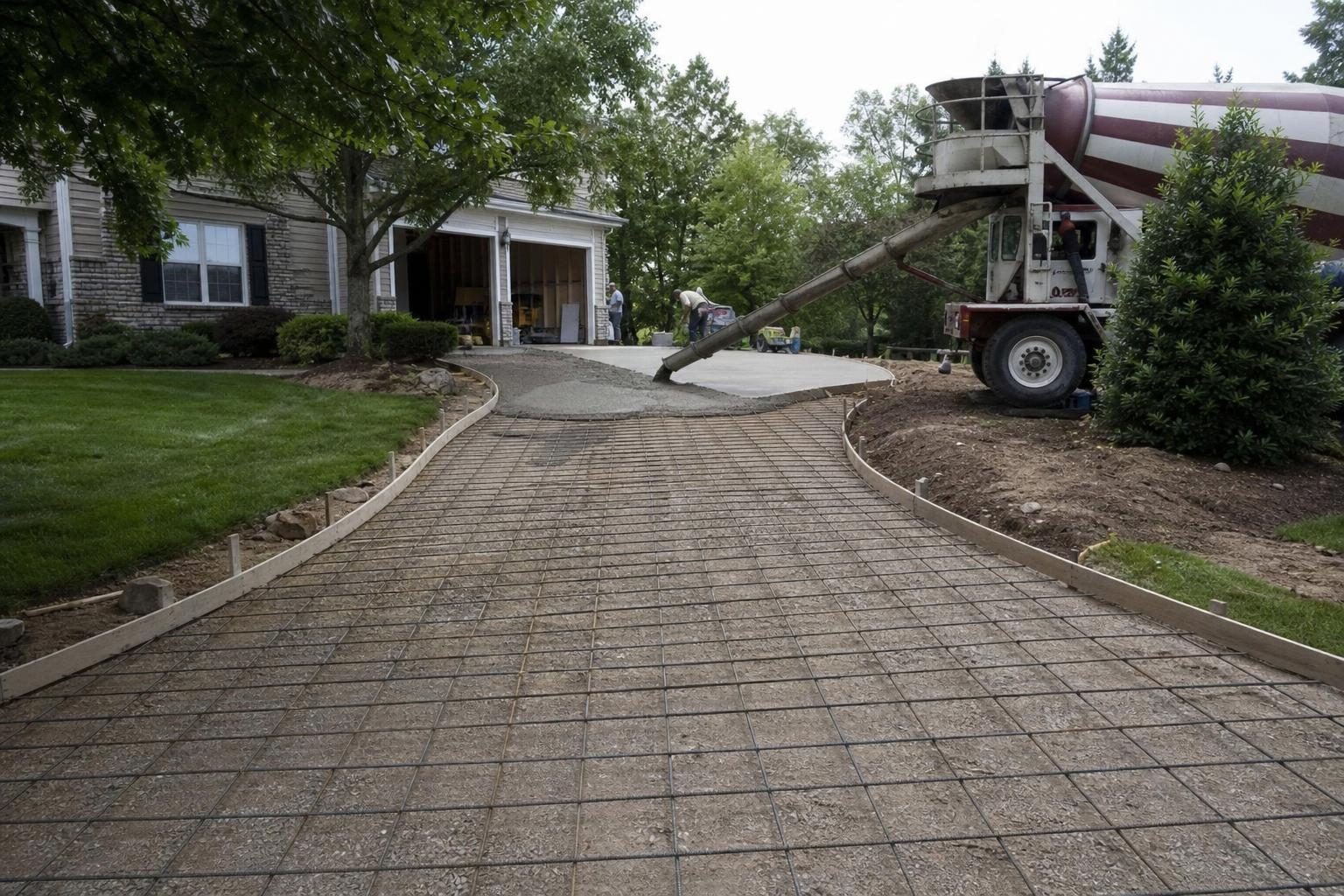
Concrete driveway cost depends mostly on size, whether an old driveway has to be removed, how much grading and base work the site needs, slab thickness and reinforcement, the finish you choose, and local labor and concrete prices. A plain broom-finished replacement often falls somewhere around $8 to $15 per square foot installed, while decorative finishes and difficult sites can push well beyond that, depending on region, access and soil.
Part of our Complete Driveway Guide: types, costs, installation, repair and hiring in one place.
Typical cost ranges
These ranges are for planning only. Concrete prices, labor rates and permit fees vary a great deal by area.
| Item | Typical range | Notes |
|---|---|---|
| Broom-finish driveway, installed | $8–$15 per sq ft | Standard thickness, good access, modest prep |
| Exposed aggregate or colored concrete | $12–$20 per sq ft | Extra materials and finishing labor |
| Stamped concrete | $15–$25+ per sq ft | Patterns, release colors, sealing |
| Old driveway removal and haul-off | $2–$6 per sq ft | Thickness, rebar, disposal fees |
| Extra base or grading | Varies widely | Soft soil, slopes, drainage corrections |
| Permit and inspection | $0–$500+ | Depends on town and curb or apron work |
For a typical two-car driveway of roughly 600 to 800 square feet, many homeowners see total bids in the mid four figures to low five figures. Your site may be very different.
The main cost drivers

1. Size and shape
Square footage is the starting point. Larger driveways cost more overall but often less per square foot, because mobilization, forming setup and minimum delivery charges are spread over more area. Curves, flares, turnarounds and multiple sections add forming time and cutting, which raises the per-foot cost.
2. Removal of the old driveway
Tearing out existing concrete or asphalt means equipment, labor and disposal fees. Thick slabs with rebar or wire mesh take longer to break up. Some contractors include removal; others list it separately. If you are weighing whether you need full replacement, our guide on replacing an old driveway vs pouring new concrete covers when overlays or repairs make sense.
3. Site preparation, base and drainage
Much of a driveway’s lifespan comes from what is under it. A good job includes excavation to the right depth, removal of soft or organic soil, and a compacted gravel base. Clay soils, fill dirt, high water tables or poor drainage may require more excavation, a thicker base, or geotextile fabric.
The slab must also slope to shed water away from the house and garage. Correcting grade, adding a trench drain at the garage, or rerouting downspouts adds cost but prevents bigger problems. Skimping here is one of the most common reasons driveways crack and settle early.
4. Thickness and reinforcement
Residential driveways for passenger vehicles are commonly 4 inches thick, with 5 to 6 inches often recommended for heavier vehicles, RVs, or weaker soils. Each added inch means more concrete. Reinforcement options include rebar grids, wire mesh and fiber additives; rebar adds the most material and labor. Our article on concrete driveway thickness explains how to decide.
5. Concrete mix and joints
Higher-strength mixes and air-entrained concrete for freeze-thaw climates cost somewhat more but improve durability. Control joints, cut or tooled at the right spacing and depth, help guide cracking to neat lines. These details do not add much cost when done right but matter a great deal for appearance. See why concrete driveways crack for more.
6. Finish and decorative options
- Broom finish: The standard, least expensive, with good traction.
- Exposed aggregate: Shows the stones in the mix; hides dirt and has good grip.
- Color: Integral color mixed in or surface-applied stains add material cost.
- Stamped: Mimics stone or brick; requires more labor, skill and periodic resealing.
- Decorative borders: A stamped or colored border around a broom-finish field is a lower-cost way to add detail.
7. Access, location and timing
If a concrete truck can pull right up, the pour is straightforward. Long distances, steep driveways or tight access may require a pump truck or wheelbarrows, which add cost. Local concrete prices, labor rates, permit rules (especially for the apron at the street) and seasonal demand all shift the final price. Cold or hot weather pours may need additives, blankets or curing compounds.
Add-ons that raise the total
Many bids grow because of work around the slab rather than the slab itself. Watch for these when budgeting:
- Street apron and curb cuts: Work in the public right-of-way often has its own specifications, permit and inspection.
- Walkways and side pads: Adding a path to the front door or a trash-can pad is cheaper during the same pour than later.
- Trench drains: Useful where the driveway slopes toward the garage, but they add materials and labor.
- Heated driveways: Embedded heating systems add significant cost and need electrical work.
- Landscape restoration: Regrading and seeding or sodding the edges after forms come out.
Ask each contractor to price these as separate line items so you can decide which ones are worth it.

How to keep costs under control
- Get at least two or three written bids with the same scope.
- Choose a broom finish with a decorative border instead of full stamping.
- Keep the shape simple where possible.
- Do not cut base preparation, thickness or joints to save money; those cuts show up as early cracks.
- Schedule outside peak season if your climate allows.
What to check in a driveway estimate
- Exact square footage and the layout, including aprons and walkways.
- Removal and disposal of existing material.
- Excavation depth, base material type and compacted thickness.
- Slab thickness, concrete strength, and type of reinforcement.
- Control joint spacing and method.
- Finish, color, sealer and curing method.
- Permit, inspections and who handles the city apron.
- Cleanup, lawn and edge restoration, and warranty terms.
Our concrete driveway quote checklist goes deeper on each item.
Frequently asked questions
Why is my driveway quote higher than online averages?
Online numbers rarely include removal, extra base, drainage work, permits, pump trucks or decorative finishes. Local labor and material costs also vary widely.
Is concrete cheaper than pavers for a driveway?
Upfront, a plain concrete driveway is usually cheaper than pavers. Pavers cost more to install but can be repaired in sections. See our concrete driveway vs pavers cost guide for details.
How long does a concrete driveway last?
A well-built, properly maintained concrete driveway can last several decades. Base quality, drainage, climate and maintenance have the biggest effect.
Does sealing a concrete driveway add to the cost?
Sealing adds a modest cost at install and again every few years. It is more important in freeze-thaw climates where de-icing salts are used.