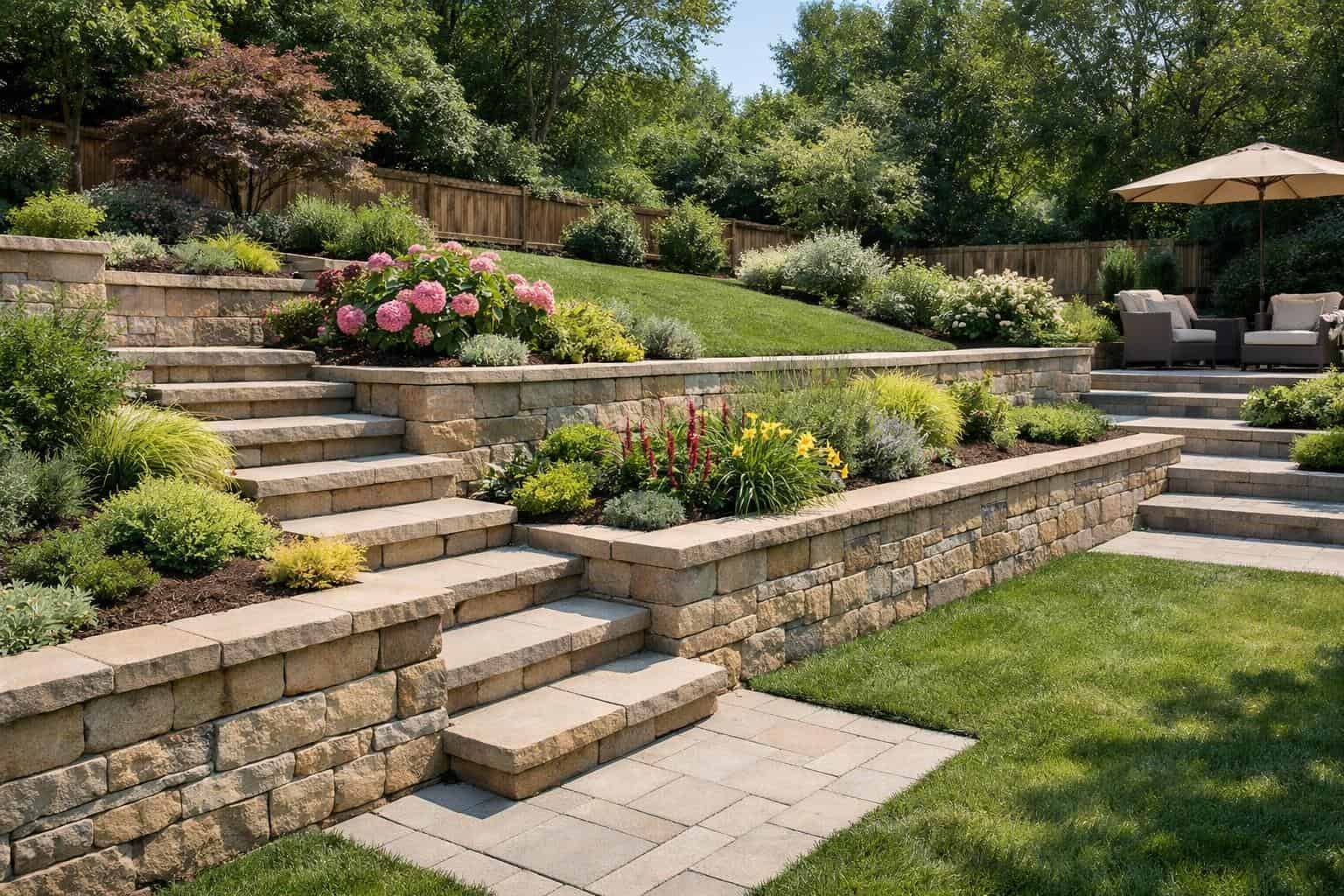
A retaining wall holds back soil where your yard changes level, so you can stop a slope from creeping, carve out a flat patio or lawn, or support a driveway edge. Segmental concrete block is the usual homeowner choice. Most residential walls cost roughly $25–$50 per square foot of wall face for block, $35–$65 for poured concrete and $45–$90 for natural stone. Whatever the material, what keeps a wall standing is the base, the drainage behind it and, on taller walls, reinforcement.
Quick answer: If you have room to lay a slope back gently, regrading is usually cheaper than building a wall. If you need flat space or the slope is too steep and tight, a segmental block wall is the most common residential choice: about $25–$50 per sq ft of face installed, so a 40-foot wall that stands 3 feet tall typically lands around $3,000–$6,500. Every wall needs a compacted gravel base, clean drainage gravel behind it and a perforated pipe with a real outlet. Walls over about 4 feet, or walls holding up a driveway, slope or structure, often need a permit and an engineered design, though local rules vary. Prices vary by region, soil, height and access.
Retaining wall types compared
A handful of wall types cover nearly every residential project, and they differ in how tall they can go, how they handle water and how long they last. The table gives rounded US installed ranges per square foot of wall face (length times exposed height), assuming normal drainage and access.

| Wall type | Installed cost per sq ft of face | Typical life | Strengths | Watch-outs |
|---|---|---|---|---|
| Segmental concrete block | About $25–$50 | Several decades when drained and built well | Modular, handles curves, steps and terraces; easy to repair a section | Taller walls need geogrid and a design from the block maker or an engineer |
| Poured concrete | About $35–$65, more for tall engineered walls | Several decades or longer | Clean modern look; strong for tall or loaded walls | Needs forms, a steel-reinforced footing, weep holes and usually engineering |
| Natural stone | About $45–$90 | Many decades | Organic look that blends into planting | Labor-heavy; price swings with stone type and how far it ships |
| Boulder | About $30–$80 | Many decades | Natural look for slopes and larger yards | Needs heavy equipment and room to work |
| Timber | About $20–$40 | Often 10–20 years | Lowest upfront cost for low garden walls | Rots in contact with wet soil; not a long-term answer for real grade changes |
| Gabion (wire baskets of stone) | About $25–$50 | Often decades, depending on the wire coating | Drains freely; modern or rugged look | Filling baskets is labor-heavy; needs a gravel footing |
Segmental retaining wall blocks
Segmental blocks are dry-stacked concrete units with a lip or pins that set each course slightly back into the slope. They come in many textures and colors, and a damaged section can be taken down and rebuilt. Small home-center blocks suit low garden borders; taller walls that need geogrid call for an engineered wall system with published design charts.
Poured concrete walls
A poured wall is cast in place on a reinforced footing. It gives a smooth face and holds a lot of load in little space, which is why it shows up beside driveways and on tight lots. Water cannot pass through it, so drainage gravel, a pipe and weep holes are essential. Our retaining wall block vs poured concrete guide compares them in depth.
Natural stone and boulder walls
Fieldstone, cut stone or boulders give the most natural look. Dry-stacked stone drains through its joints and is usually kept fairly low; boulder walls need an excavator and room to maneuver. Bids vary widely because so much depends on the stone and the skill of the person setting it.
Timber and gabion walls
Treated timbers are the cheapest way to hold a small grade change, but wood in wet soil eventually rots. Gabions drain freely and suit modern or rugged sites, but still need a gravel footing and partial burial like any other wall.
Wall or regrading? A decision checklist

A slope needs horizontal room to be stable; a wall replaces that room with a vertical face. If you have the space, regrading is usually much cheaper and has nothing to lean or crack. Our regrading vs retaining wall guide walks through the trade-off with examples.
- Measure rise and run. Use a string line and tape to find the height change and how far the slope can stretch before it hits the house, fence, driveway or property line.
- Divide run by rise. About 4 to 1 is comfortable to mow and 3 to 1 is the practical push-mower limit. At 3 to 1 or gentler, regrading is often possible; steeper than 2 to 1 usually needs a wall, terraces or engineered planting.
- Name the goal. Do you need truly flat space for a patio, play area or lawn, or just a stable slope that stops eroding? Our sloped yard landscaping ideas and erosion control guide cover options that need no wall at all.
- Check what sits above. A driveway, parking pad, pool, shed or more slope above the wall adds load and usually means engineering.
- Consider terraces. Two or three short walls with planted benches can be easier to build than one tall wall. Snohomish County’s retaining wall and terracing guidance suggests each bench be at least as wide as the wall below it, and many codes treat closely stacked tiers as one taller wall.
- Look for a water problem. If water pooling or running toward the house is the real issue, solve that first; a wall can trap water. Start with our drainage solutions guide.
- Plan the whole yard. Walls, grading and drainage come before patios, lawn and planting. Our retaining wall planning guide covers layout, height and sequencing, and the guide to phasing a landscaping project shows where the wall fits in a bigger plan.
Many good designs use both: regrade most of the slope, then add one short wall where space runs out. If the wall will create a level spot for a patio, our patio and paver guide covers what goes on top.
Height, permits and engineering

Height decides how a wall must be designed. Soil pressure rises quickly with height, so a 5-foot wall is a very different structure from a 2-foot border.
- The common threshold is about 4 feet, but it varies locally. The International Residential Code (section R404.4) requires an engineered design for walls that retain more than 48 inches of unbalanced soil, and for walls over 24 inches that also carry extra load. Many cities follow a similar 4-foot permit exemption, and Colorado State University Extension notes that many municipalities require engineered designs above 4 feet. Some places use 3 feet, and some measure from the bottom of the footing rather than the visible top of the ground.
- Load above the wall changes everything. A driveway, parking area, building, pool, fence or slope above the wall (called a surcharge) can trigger a permit and engineering even on a short wall.
- Location matters. Walls near property lines, easements, sidewalks or waterways often get extra review, and your HOA may need to approve.
- Utilities must be marked. Call 811 or confirm the contractor will, a few days before any digging.
Engineering for a residential wall often costs from several hundred to a few thousand dollars, plus permit fees and inspections. Our retaining wall permit prep guide lists the documents a building department usually asks for and how to confirm your local rules. Do not design a wall just short enough to slip under the limit if the site really needs more height.
Drainage, base and geogrid: what holds a wall up

Most retaining wall failures are water failures. Wet soil is heavier and pushes harder, and trapped water adds pressure of its own. The parts you never see after backfill decide whether a wall lasts.
Drainage behind the wall
- Gravel backfill. Clean, angular drainage stone directly behind the wall, at least 12 inches wide in Snohomish County’s guidance, lets water drop to the bottom instead of building pressure. Native clay should not be packed against the wall.
- Perforated drain pipe. A perforated pipe, commonly 4 inches, runs along the bottom of the drainage stone and slopes so water flows out by gravity.
- A real outlet. The pipe must discharge to daylight, a dry well or another approved outlet. A pipe that ends in the ground does little.
- Filter fabric. Non-woven geotextile between native soil and drainage stone keeps fine soil from clogging the gravel over time.
- Weep holes. Solid walls such as poured concrete need openings that let water escape; they must sit at a level where water can actually reach them.
- Surface water. Grade the soil above the wall so roof and yard runoff do not pour straight into the backfill, and extend downspouts away from it.
Base and footing
Block walls sit on a compacted crushed-gravel leveling pad, commonly about 6 inches thick, with the first course buried. A common rule of thumb is to bury about a tenth of the wall height, with a minimum of several inches, but the block maker’s or engineer’s specification governs. Poured walls need a reinforced concrete footing sized for the height and soil. Either way the base sits on firm, undisturbed or compacted soil, not topsoil or loose fill.
Geogrid reinforcement
Geogrid is a strong plastic mesh laid between courses and extended back into the compacted backfill, tying soil and wall into one heavy mass. Short gravity walls hold soil with their own weight and setback; taller walls, and walls with load above, usually need grid. Layers, spacing and length come from the manufacturer’s charts or an engineer. Grid also means more digging behind the wall, one reason tall walls cost more per square foot. All backfill should be compacted in thin layers; loose fill settles and leaves sags above the wall.
What a retaining wall costs
Contractors usually price walls per square foot of face, then adjust for drainage, reinforcement, access and extras. These ranges assume a typical site with normal drainage; high-cost metro areas can run well above them.

| Example wall | Wall face | Typical installed range |
|---|---|---|
| Garden border, block, 30 ft long x 2 ft tall | 60 sq ft | About $1,500–$3,300 |
| Backyard terrace, block, 40 ft x 3 ft | 120 sq ft | About $3,000–$6,500 |
| Same wall in poured concrete | 120 sq ft | About $4,200–$8,500 |
| Same wall in natural stone | 120 sq ft | About $5,400–$11,700 |
| Block, 50 ft x 4 ft, extra drainage work | 200 sq ft | About $5,600–$12,100 |
| Engineered block wall, 60 ft x 5 ft, tight access | 300 sq ft | About $11,000–$22,000, plus engineering and permit fees |
Estimate your retaining wall cost
Enter your wall’s length, average height, material, drainage and access to see a low, mid and high installed range per square foot of wall face; it is a planning range, not a quote.
Retaining Wall Cost Calculator
Estimate retaining wall pricing with wall size, material type, drainage, and access assumptions.
Retaining wall cost estimate
- Wall face area
- –
- Low estimate
- –
- Mid estimate
- –
- High estimate
- –
- Estimated range per sq ft of wall face
- –
What moves the price
- Height. Cost climbs faster than height: taller walls need a deeper base, more buried block, geogrid, more digging and often engineering.
- Drainage. Heavy runoff, springs or clay soil mean more stone, longer pipe runs or extra surface drains, adding roughly 10–25% to the rate.
- Access. If every block and ton of gravel moves by wheelbarrow through a side gate, labor climbs; tight access commonly adds roughly 8–18% to the wall rate. Our retaining wall access and staging guide explains why.
- Soil and excavation. Rock, roots, buried debris and soil that has to be hauled away all add cost.
- Load above the wall. Driveways, parking pads, pools and structures near the top need more reinforcement and engineering. If the wall supports a driveway edge, our driveway guide covers the paving side.
- Finish and extras. Premium block, caps, tight curves, steps, lighting, patio integration and replanting add material and labor.
- Soft costs. Engineering, permits, a survey near a property line and lawn or irrigation repair.
Together, tight access and complex drainage can raise the rate by nearly half, which is why a short wall in a hard-to-reach backyard can cost more than a longer one beside the driveway. Our guide to what affects retaining wall cost breaks down each driver, including ways to save without cutting the base, drainage or reinforcement.
Installation: what a good job looks like

A typical block wall takes a few days to a couple of weeks, depending on size, access and inspections. A good crew works in this order:
- Layout. The wall line is staked, utilities are marked and heights are confirmed.
- Excavation. The trench is dug to firm soil, wide enough for the base, wall and drainage zone, plus room for grid on taller walls.
- Base and first course. Crushed gravel is compacted and screeded level, and the buried first course is set dead level and straight; mistakes here show in every course above.
- Drainage. Fabric goes against the soil, the perforated pipe goes in at the base and runs to its outlet, and drainage stone rises with each course.
- Courses, grid and compaction. Each course steps back slightly. Grid is laid at the specified courses and pulled taut, and backfill is compacted in thin layers.
- Caps and finish grade. Caps are glued down, the drainage zone is topped with fabric and soil, and the ground above is graded to shed water.
- Inspection and restoration. Required inspections happen before anything is buried; lawn, irrigation and beds are repaired.
Installation red flags
- Blocks set straight on dirt or topsoil with no compacted gravel base.
- No buried first course, or a wall that leans out toward the yard instead of back into the slope.
- Native clay or excavated soil dumped behind the wall instead of drainage stone.
- A drain pipe with no outlet, or weep holes set above the ground they are meant to drain.
- A tall wall going up with no geogrid, or grid laid loose and short.
- Backfill pushed in all at once with no compaction.
Ask the crew to photograph the base, pipe and grid before they are buried; the pictures help if questions come up later.
Failure signs, repair or rebuild

A chipped cap or a stable hairline crack is usually cosmetic. Movement that keeps getting worse is not. Watch for:
- Lean toward the yard. Most block walls are built leaning slightly back; a wall tilting outward is a red flag, especially if the tilt grows.
- Bulging. A belly in the face, often around mid-height, means pressure behind the wall is winning at that spot.
- Growing cracks. Cracks wider than about a quarter inch, stair-step cracks, horizontal cracks or cracks that widen over time. Mark the ends with a pencil and date them.
- Water and soil through the face. Constant wet spots, soil washing out of joints or white mineral staining mean water is going through the wall instead of being drained around it.
- Trouble above and below. Ground sinking or cracking behind the top of the wall, fences or pavers above it tilting, or soil heaving at the base.
- Rot. Soft, crumbling timbers in a wood wall.
Our guide to the signs a retaining wall may be failing includes a triage table for judging how urgent each sign is.
Repair or rebuild?
Repair makes sense when the damage is local and the cause can be fixed: a clogged drain, a short section that settled or a few displaced blocks. The usual fix rebuilds the section on a proper base with new drainage stone and pipe; larger walls may get engineered anchors. Section repairs often cost a few hundred to a few thousand dollars.
Rebuilding makes more sense when lean or bulging runs along most of the wall, the base failed, the wall was too tall for its design or it is old timber. Full replacement commonly runs from several thousand dollars to well into five figures, plus demolition and haul-away, and often costs less than repeated repairs.
You can clear outlets, redirect downspouts and keep loads off the top, but never push a leaning wall back or dig behind it; a wall under pressure can give way suddenly. Call a structural or geotechnical engineer for walls over about 4 feet, walls holding up a driveway or structure, or any wall moving quickly.
Retaining wall maintenance calendar
A well-built wall needs little care; most of the work is keeping drains open and runoff pointed away. Snohomish County recommends inspecting walls at least once a year.

| Season | What to do | Why it matters |
|---|---|---|
| Spring | Walk the wall after the thaw; sight down its length for lean or bulges; check crack marks; confirm the pipe outlet flows after rain | Freeze-thaw and wet spring soil are when movement shows up |
| Summer | Keep sprinklers from soaking the soil behind the wall; trim vines and shrubs rooting into joints; reset loose caps with masonry adhesive | Overwatering behind a wall adds pressure; roots pry blocks apart |
| Fall | Clear leaves from outlets, weep holes and surface drains; check downspouts still discharge away from the wall | Clogged outlets before the wet season are a common cause of failure |
| Winter | Keep snow piles and heavy vehicles off the top; avoid piling salted snow against the face | Extra load and repeated wetting stress the wall and its face |
| Every few years | Photograph the wall from the same spots; check timbers for rot; look for erosion at the ends | Photos over time show whether movement is active |
Never add a shed, hot tub or parking pad above a wall that was not designed for it.
Hiring a retaining wall contractor

An experienced landscape or hardscape contractor is usually fine for short garden walls; for taller or loaded walls, hire someone who regularly builds engineered walls. Our guide to retaining wall contractors near me covers what to compare between local builders.
Questions to ask
- What do you see as the biggest risk on this site: water, soil, access or height?
- How deep will the base go, what material is it and how will you compact it?
- How will you handle drainage behind and around the wall, and where will the pipe outlet?
- Will you use geogrid or steel, and is the design from the block maker’s charts or a stamped plan?
- Does this wall need a permit here, who pulls it, and is engineering in your price?
- How does the wall tie into the patio, walkway, driveway or lawn grades around it?
- Can I see walls you built five or more years ago, and what does your warranty cover?
What a written quote must include
- Wall length, exposed height, buried courses and square feet of face.
- The exact block, stone or concrete spec, plus caps and corners.
- Base material and depth, and how it is compacted.
- Drainage stone width and height, pipe size and route, outlet location, fabric and weep holes.
- Geogrid layers and lengths, or rebar, and what design they follow.
- Excavation, soil haul-off, demolition of any old wall, and access or fence removal.
- Permits, engineering and inspections, and who pays for each.
- Restoration, exclusions such as rock or unmarked utilities, and allowances with stated rates.
- Schedule, payments tied to milestones, change orders, warranty, insurance and any required license.
Our checklist of what a retaining wall estimate should include goes line by line. When bids are far apart, the lower one often has less base, less drainage stone, no grid, no haul-off or no restoration.
Hiring red flags
- A one-line bid with a single price and no mention of drainage or base.
- Willingness to build a tall wall without a permit or engineering where your area requires them.
- Plans to backfill with the clay that came out of the hole.
- A large cash deposit before materials arrive.
- No written warranty, or pressure to sign on the spot.
Problems homeowners run into

Stories about walls that went wrong repeat the same few themes.
- Bowing after the first winter. A wall rebuilt with a drain at the bottom but no proper gravel backfill bulged within a season, and the builder stopped returning calls. Drainage stone, not just pipe, relieves pressure.
- Drains that never drain. One owner of a permitted wall found it leaning a fraction of an inch because the drain openings sat above the ground behind the wall, so water never reached them. The builder blamed the sprinklers.
- “The wall wasn’t in my contract.” After a collapse, a homeowner learned the builder considered the wall outside his scope. If a wall is part of a larger job, make sure the contract names it, its drainage and its warranty.
- Home-center blocks stacked too high. Small gravity blocks work for low borders, but people often keep stacking past what the block can hold without grid. Check the manufacturer’s height chart before you build.
- Insurance surprises. Policies often exclude gradual deterioration or poor construction, so a slowly failing wall may be entirely the owner’s cost. Check before work begins.
- Boundary disputes. Walls near a property line raise questions about ownership, upkeep and runoff. Get a survey and talk to the neighbor first.
Frequently asked questions
How much does a retaining wall cost?
Most residential walls run about $25–$50 per square foot of wall face for segmental block, $35–$65 for poured concrete and $45–$90 for natural stone, with tight access and complex drainage pushing toward the top or beyond. A 40-foot block wall 3 feet tall typically costs around $3,000–$6,500.
What are the best retaining wall blocks?
For low garden borders, small home-center blocks are fine. For walls that hold real grade, use an engineered segmental wall system with published design charts, pins or connectors, and geogrid compatibility. The right block is the one rated for your height and load, laid on a proper base with drainage.
How tall can a retaining wall be without a permit?
Often about 4 feet, measured from the bottom of the footing, if nothing heavy sits above the wall. Some cities use 3 feet, and walls holding up a driveway or slope can need a permit at any height. Ask your building department.
Can I build a retaining wall myself?
Short block walls of about 2 to 3 feet with no load above are a common DIY project if you build a compacted gravel base and include drainage stone and pipe. Taller walls, walls near structures or driveways, and anything needing grid or a permit are better left to a qualified contractor.
How long does a retaining wall last?
Well-built and well-drained block, stone and concrete walls can last several decades. Timber walls typically last about 10 to 20 years before rot sets in.
Do I need drainage behind a short retaining wall?
Yes. Even a short wall holds wet soil, and gravel plus a drained pipe cost far less than rebuilding a leaning wall.
Retaining wall guide library
Every retaining wall guide on the site, grouped by decision.
Planning and permits
- Retaining wall planning — purpose, height, materials, drainage and layout before you ask for bids.
- Regrading vs retaining wall — when a gentler slope beats building a wall.
- Retaining wall permit prep — height triggers, documents, engineering and inspections.
- Retaining wall access and staging — how equipment routes and material storage change price.
Materials
- Retaining wall block vs poured concrete — looks, drainage and complexity of the two main systems.
Costs and estimates
- What affects retaining wall cost — height, drainage, access, materials and soft costs explained.
- What a retaining wall estimate should include — the line items to check before signing.
Hiring and problems
- Retaining wall contractors near me — how to compare local builders and their bids.
- Signs a retaining wall may be failing — warning signs, triage and repair vs replacement.