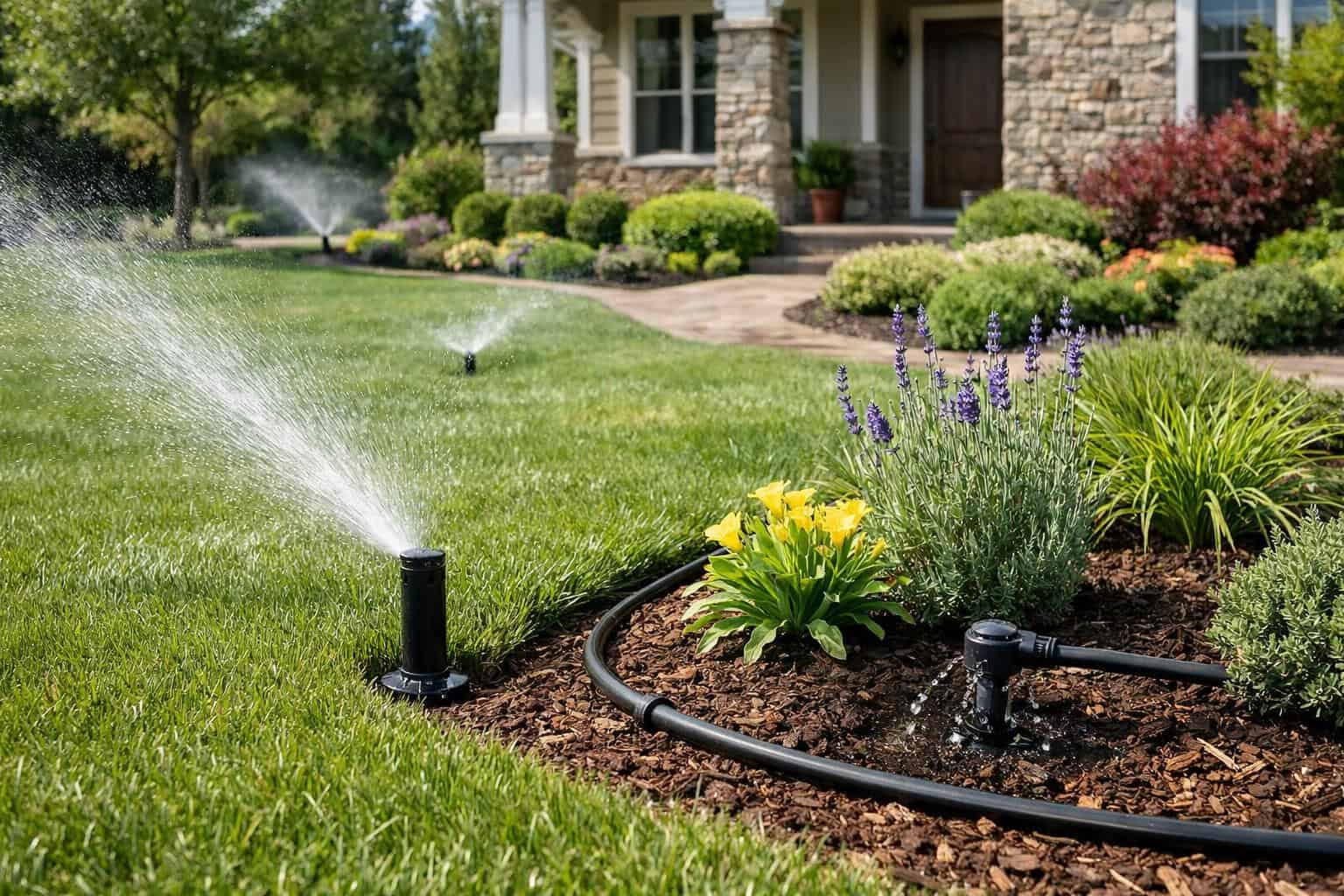
A good home irrigation system puts sprinklers on the lawn, drip on the beds and trees, and gives each kind of planting its own zone, run by a controller that adjusts to the weather. Built that way, it waters evenly, wastes little and lasts for decades. A typical in-ground system for an average suburban yard costs roughly $4,000–$7,500 installed, with small yards nearer $2,000–$4,000 and large or complicated lots well past $10,000.
Quick answer: Use spray heads for small and narrow lawns, rotors for large open lawns, and drip for beds, shrubs, trees and vegetables. Keep lawn and beds on separate zones and never mix drip and spray on one valve. Have the installer test your water pressure and flow before designing, space heads so each one reaches the next (head-to-head coverage), install the backflow preventer your water provider requires and choose a weather-based or soil-moisture controller. Plan on about $750–$1,500 per zone all-in for a spray system, or roughly $0.80–$1.60 per square foot of watered area, plus backflow and permit costs. In freezing climates, budget for a fall blowout and a spring start-up every year.
Irrigation system types compared
Most residential systems combine spray heads, rotors and drip lines on separate zones, tied to one controller. Soaker hoses on a hose timer are the cheap, temporary end of the same idea. The right mix depends on how much of the yard is lawn and how much is beds.

| Type | Best for | Strengths | Watch-outs |
|---|---|---|---|
| In-ground spray heads | Small, narrow or curved lawns; heads throw up to about 15 feet | Cheap per head, even coverage when spaced right, easy to see problems | Apply water fast, so runoff on slopes and clay; mist badly at high pressure |
| Rotors and rotary nozzles | Medium and large open lawns, slopes, clay soils | Fewer heads and trenches on big areas; slower application soaks in | Longer run times; need room to throw; cost more per head |
| Drip irrigation | Beds, shrubs, hedges, trees, vegetables, narrow strips | Water goes to roots with little evaporation or overspray; fewer weeds; dry foliage | Needs a filter and pressure regulator; clogs and cuts are hard to see |
| Soaker hose | Small gardens and new plantings watered by hand or a hose timer | Very low cost, no trenching | Uneven flow on long runs and slopes; short life in sun; no zoning |
| Hybrid system | Most yards with both lawn and beds | Each area gets the method that suits it, from one controller | More zones and design work; must be zoned correctly |
Sprinklers: spray heads and rotors
Spray heads pop up and throw a fixed fan of water a short distance. They suit front lawns, parking strips and odd shapes. Rotors turn slowly and throw farther, which is why big lawns need far fewer of them. Rotary nozzles fit on standard spray bodies and put water down more slowly, which helps on slopes and in clay where fast spray runs off before it soaks in.
Drip irrigation
Drip uses flexible tubing with emitters that drip at the soil, either one emitter per plant or inline tubing laid in rows under mulch. Colorado State University Extension rates drip at over 90 percent efficient, compared with roughly 50 to 70 percent for sprinklers, and lists the order of parts at the valve: backflow device, valve, filter, then pressure regulator. Drip is the default for beds; it is rarely the right choice for turf. Our drip irrigation vs sprinklers guide goes deeper on where each one wins.
Smart controllers, rain sensors and soil sensors
The controller matters as much as the heads. Weather-based controllers adjust run times from local weather data, and soil-moisture controllers skip watering when the root zone is still wet. EPA’s WaterSense program says replacing a clock timer with a WaterSense labeled controller can save an average home up to 15,000 gallons a year, and that up to half of residential outdoor water is wasted by overwatering. A simple rain or freeze sensor is an inexpensive add-on for any controller, and many water utilities offer rebates on qualifying controllers.
How to choose: a decision checklist

Answer these in order before you ask for bids. They decide the system type, the zone count and most of the price.
- Do you need a permanent system at all? In rainy regions, a lawn allowed to go dormant in dry spells plus drip for beds may be enough. In dry climates or with new sod, an automatic system usually pays off.
- How much is lawn and how much is beds? Sketch the yard and shade the lawn. Lawn gets spray or rotors; beds, trees and vegetables get drip. A yard that is mostly beds is mostly drip and costs less to trench.
- What are your water pressure and flow? Static pressure (psi) and available flow (gallons per minute) at the supply set how many heads can run at once. Low flow means more zones. Very high pressure needs a regulator. A well needs a pump check.
- What is your soil? Clay soaks water slowly, so it favors rotors, rotary nozzles and cycle-and-soak scheduling. Sand drains fast and needs shorter, more frequent cycles and closer drip emitters.
- How do sun, shade and slope split the yard? Full sun and shade, and the top and bottom of a slope, need different amounts of water and should not share a zone where you can avoid it.
- What do local rules say? Many cities set watering days or hours, require a permit and a specific backflow device, and require yearly backflow testing. Some allow drip on days when sprinklers are restricted.
- What else is changing in the yard? If a patio, wall, driveway, drainage fix or new lawn is coming, install or reroute irrigation first, while the ground is open.
- DIY or pro? Drip in beds and simple repairs suit handy owners. A full in-ground system with a main-line tap, backflow device and permit is usually a contractor job.
Irrigation and drainage are linked. A soggy corner can be a sprinkler problem, and a real grading problem can make the sprinklers look guilty. If water sits where it should not, read the yard drainage guide before changing the system. If the goal is to use less water overall, the low-water landscaping guide covers plant and lawn choices that shrink what irrigation has to do.
Layout and zoning basics

A zone is a group of heads or drip lines run by one valve. Good layouts start with what each part of the yard needs, not with how the old pipes ran. Our guide to choosing the right irrigation layout walks through the principles.
Rules for sound zoning
- One kind of water per zone. Lawn, shrub beds, trees and vegetables each get their own zones. Drip and spray never share a valve because they put down water at very different rates.
- One head type per zone. Spray heads and rotors, or different nozzle styles, apply water at different rates. Mixing them leaves wet and dry patches on the same schedule.
- Split by exposure. A shaded north lawn and a sunny south lawn should run on different schedules.
- Size zones to your flow. The designer adds up head flow for each zone and keeps it within what the supply delivers. Too many heads on one valve is a common cause of weak coverage.
- Leave room to grow. A controller with spare stations makes adding a zone later easy.
Head spacing and head-to-head coverage
Sprinklers put less water at the edge of their pattern, so each head is placed to reach the next one: head-to-head coverage. EPA’s Sprinkler Spruce-Up checklist names it as the way to avoid dry spots. Heads stretched farther apart to save a few dollars leave brown rings that longer run times only partly hide. Square or triangular spacing on open lawns, and part-circle heads along walks, beds and walls, keep water off pavement and siding.
Drip layout
Drip emitters go over the root zone, not just at the trunk, and more are added as plants grow. Colorado State suggests closer spacing in sand and wider spacing in clay, roughly 12 inches apart in sand, 18 in loam and 24 in clay for inline tubing. Tubing is usually covered with a layer of mulch; the mulch guide covers depth and type.
What an irrigation system costs
Installed price follows watered area, zone count, system type, digging conditions and controller. The ranges below are rounded and match the calculator on this page. Prices vary by region, soil, access and permits.

| Typical project | Rough installed cost | What moves the price |
|---|---|---|
| Small yard, about 2,500 sq ft, 3 spray zones, smart controller | About $2,200–$4,000 | Access, head count, lawn restoration |
| Average yard, about 5,000 sq ft, 5 lawn zones | About $4,100–$7,300 | Spray vs rotors, digging, controller |
| Average yard with drip beds, about 5,000 sq ft, 6 mixed zones | About $5,200–$8,800 | Bed area, number of drip zones |
| Large lot, about 10,000 sq ft, 9 lawn zones | About $8,000–$14,000 | Rotors vs spray, main-line length, boring under paving |
| Large, complex lot, about 12,000 sq ft, 10 mixed zones, rock or slopes | About $12,500–$21,000 | Hard digging, many beds, pump or supply upgrades |
| New drip zone for a 400–600 sq ft bed | About $350–$1,300 | Emitter count, controller station, mulch work |
| Converting an existing spray zone to drip | About $300–$900 per zone | Reusing the valve; adding filter and regulator |
| Smart controller upgrade on an existing system | About $250–$700 installed | Zone count, sensors, wiring |
| New backflow preventer | About $400–$1,200+ | Device type required locally, plumbing, testing |
| Repair visit | Trip fee or first hour often $75–$150, plus parts | Heads vs valves vs wiring vs pipe leaks |
As a rule of thumb, a spray system with standard digging works out to roughly $750–$1,500 per zone, or about $0.80–$1.60 per square foot of watered area. Mixed spray-and-drip systems run a little higher per square foot because of extra zones. The biggest swings come from:
- Zone count. Each zone adds a valve, wiring and its own pipe network. Low water flow forces more, smaller zones.
- Digging. Rock, heavy clay, roots, slopes, narrow side yards and boring under driveways and walks slow the crew. An established yard costs more than a new one because the crew works around plants and repairs turf.
- Supply and code. Backflow devices, permits, inspections and, sometimes, a larger meter or a dedicated irrigation meter where your utility offers one.
The guide to what affects irrigation system cost breaks down each driver and ways to keep the bill down.
Estimate your irrigation system cost
Enter your watered area and zone count, then pick spray, drip or mixed, a controller and digging difficulty to see a low-to-high installed range, a planning number to test quotes against, not a quote.
Irrigation Cost Calculator
Estimate irrigation pricing based on area, system style, number of zones, and controller choice.
Irrigation cost estimate
- Estimated area
- –
- Low estimate
- –
- Mid estimate
- –
- High estimate
- –
- Estimated zone allowance
- –
The calculator starts from about $0.55–$0.95 per square foot for spray, $0.45–$0.85 for drip and $0.70–$1.15 for mixed systems, adds $180–$320 per zone and a controller allowance, then adjusts for digging. Its controller line is the extra cost of a smart model inside a new install, which is why it is lower than a stand-alone retrofit. It does not include a backflow preventer, permits or water-supply upgrades, so add those from your local quotes.
Installation: what a good sprinkler job looks like

Most average yards take one to three days on site. The parts that matter most are hidden once trenches are filled, so ask questions while they are open. The guide to what to expect during an irrigation project walks through each day.
Signs of a well-built system
- A design from real numbers. Pressure and flow measured at the supply, and a drawing showing zones, heads and valve locations.
- Backflow protection and permits. The device type your water provider requires, installed at the right height and location, with the permit and any inspection or test scheduled by the contractor.
- Utilities located. An 811 locate request a few days before digging. Private lines such as lighting cable, dog-fence wire or power to a shed are not marked, so point them out.
- Sensible depth. Lateral lines are commonly buried about 6 to 12 inches and the main line deeper, often 12 to 18 inches, or whatever local code and frost practice call for. Pipe laid at the surface gets cut by aerators and edgers.
- Sleeves under paving. Pipe and wire crossing driveways and walks run through sleeves, ideally laid before the paving goes in. If a new driveway or patio is planned, coordinate the two.
- Head-to-head spacing on lawns, matched nozzles within each zone and part-circle heads along edges.
- Pressure regulation. Drip zones get a filter and a pressure regulator at the valve. Colorado State notes drip typically runs around 20 to 30 psi, far below most household pressure. Spray zones in high-pressure areas get pressure-regulating heads or a regulator so they do not mist.
- Testing and a walkthrough. Every zone run with you watching, arcs adjusted off pavement and siding, and a zone map left behind.
- Clean restoration. Trenches backfilled, compacted and topped, and settled trench lines touched up during the first weeks.
Red flags during installation
- Spray and drip, or spray and rotors, on the same valve.
- Heads spaced wide enough that you can see gaps on the plan.
- Drip connected with no filter or regulator.
- Trenches left unsettled or backfilled with rocks and clods.
Winterizing and spring start-up

Where the ground freezes, water left in pipes, valves and backflow devices expands and cracks them, and fall winterizing costs far less than spring repairs.
Fall blowout
Colorado State University Extension calls compressed-air blowout the only reliable way to clear a system; gravity drains leave water in low spots and on top of electric valve diaphragms. Its key points:
- Shut off the water to the system first, at the irrigation shutoff or stop-and-waste valve.
- Keep air pressure regulated, with a maximum of about 80 psi for rigid PVC and 50 psi for flexible poly pipe.
- Blow out one zone at a time, in two short cycles, and do not keep blowing air through a zone that is already dry; friction heats and damages pipe.
- Never blow air through a pressure vacuum breaker or reduced-pressure backflow device; the heat can melt internal seals. Drain those devices and leave their ball valves half open.
- Keep the controller powered through winter, and wear eye protection.
Many homeowners hire this out because a small shop compressor cannot move enough air. Drip systems can often be drained instead, with the filter and regulator brought indoors.
Spring start-up
- After hard freezes end, close drain valves and backflow test cocks, then open the supply slowly to avoid water hammer.
- Replace the controller battery, check the date and sensors, and load a spring schedule, which needs less water than summer.
- Run each zone. Look for heads that do not pop up, tilted or sunken heads, geysers, soggy spots and spray on paving.
- Clean drip filters and flush drip lines through their end caps.
- Book any required backflow test.
Common sprinkler problems, repairs and when to replace
Most sprinkler trouble is a part, not the whole system. EPA’s WaterSense program notes that leaks and broken heads can waste up to 25,000 gallons over a six-month watering season, so small problems are worth fixing fast.

| Symptom | Likely cause | Usual fix |
|---|---|---|
| Geyser or a head that won’t pop up | Broken head or nozzle, often from a mower or car | Replace the head; raise sunken heads on a riser |
| Brown rings or dry patches | Heads too far apart, clogged or mismatched nozzles, tilted heads | Clean and match nozzles, straighten heads; add heads if spacing is wrong |
| Fine mist and fog | Pressure too high | Pressure-regulating heads or a regulator |
| Weak spray on one zone | Too many heads for the flow, a leak or a partly closed valve | Find the leak; split the zone or reduce heads |
| Soggy spot or water pooling between cycles | Underground pipe or fitting leak, or the low head draining | Dig and repair; check-valve heads at low points |
| Zone won’t shut off, or a flooded valve box | Debris in the valve, worn diaphragm or failing solenoid | Clean or rebuild the valve; replace if it keeps leaking |
| Zone won’t turn on | Bad solenoid, cut wire or controller fault | Test solenoid and wiring; repair the wire splice |
| Water bill jumped | Hidden leak, stuck valve or overwatering schedule | Shut the irrigation supply and watch the meter; review the schedule |
Repair when the system covers well and one part has failed. Partially rebuild when the main line and valves are sound but zones mix lawn and beds, heads are spaced wrong or beds would be better on drip. Replace when leaks keep turning up across old, brittle pipe, pressure is poor in many zones, parts are obsolete, backflow protection is missing, or the landscape has changed so much that the old layout no longer fits. Buried pipe often lasts decades; heads and controllers wear out sooner. The guide to repair, replacement or a new system walks through the decision.
Irrigation maintenance calendar
| When | Tasks |
|---|---|
| Early spring | Start up the system slowly; run every zone; fix broken, tilted and sunken heads; clean drip filters and flush lines; replace the controller battery; schedule backflow testing if required. |
| Late spring | Set a spring schedule; adjust arcs around new plantings; add emitters for new shrubs; confirm the rain or soil sensor works. |
| Summer | Run each zone for a minute or two once a month and watch it; raise run times only as heat demands; use cycle-and-soak on slopes and clay; water early in the morning. |
| Early fall | Cut run times as days shorten; check heads after aeration or overseeding; trim grass and shrubs blocking spray. |
| Late fall | In freezing climates, shut off and blow out the system; drain backflow devices; bring drip filters and regulators indoors. |
| Winter | Keep the controller powered but off; plan any zone changes for spring. |

Watering schedules should follow the lawn, not the calendar alone. The lawn guide covers how much water different grasses need through the season.
Hiring an irrigation contractor

Drip in beds, head swaps and controller upgrades are realistic DIY jobs. A new in-ground system that taps the main line, needs a backflow device and permit, or crosses under paving is usually worth hiring out. Look for a company that diagnoses before it sells, holds any license your state requires, carries insurance and uses a certified backflow tester where required.
Questions to ask a contractor
- What pressure and flow did you measure, and how did that set the number of zones?
- How will lawn, beds, sun and shade be zoned, and which areas get drip?
- Will the lawn heads have head-to-head coverage? Can I see the layout?
- What can be reused from my existing system, and why not the rest?
- How will the work be coordinated with my planned patio, wall, lawn or drainage project?
- Who pulls the permit and handles backflow installation and testing?
- Trencher or vibratory plow, how deep, and how will the lawn be restored?
- Will you set the schedule, show me the controller and include a first-season check or winterizing?
What an irrigation quote must include
- Number of zones and what each one waters.
- Head, nozzle and drip types and counts per zone, by brand or model.
- Pipe material and sizes, burial depth and installation method.
- Valves, controller model, rain or soil sensors.
- Backflow device, permit, inspection and test, and who pays for each.
- Water-source connection and any meter or supply upgrades.
- Boring or sleeves under drives and walks, as allowances in feet and dollars.
- Lawn and bed restoration, cleanup, an as-built drawing and a written warranty on parts and labor.
Our checklist of what an irrigation estimate should include goes line by line, and the guide to comparing landscaping quotes helps you line bids up side by side.
Red flags in a bid
- “Install sprinkler system” and a total, with no zone or head count.
- No site visit or pressure test before pricing a new system.
- Lawn and beds on the same zones with no explanation.
- No backflow device where your water provider requires one.
- Restoration “as needed” with no detail, or a verbal-only warranty.
- Full replacement recommended without testing the existing zones.

Problems homeowners run into
Lawn forums, home-improvement boards and contractor discussions keep raising the same frustrations.
- Dry rings that never go away. Owners with brown circles between heads find that longer run times and nozzle swaps only stretch the system. The lasting fix is usually adding heads for head-to-head coverage, so bids that save a head with single-row “row coverage” deserve a hard look.
- Flooded valve boxes and zones that won’t shut off. After a new install, a valve box that is always full usually means a leaking valve or connection, while water after heavy rain can be normal.
- Mystery water bills. A cracked lateral or snapped head can waste thousands of gallons before anyone notices. Shutting the irrigation supply and watching the meter separates irrigation leaks from house plumbing.
- Lumpy lawns along trench lines. Upgrades that move pipe can leave seams and settled strips. Owners who spelled out restoration in the contract had fewer arguments later.
- Smart controllers that aren’t so smart. Wi-Fi controllers mounted where the signal is weak drop offline, and forecast-based rain skips can miss storms that hit only your street. Many installers still add a physical rain sensor.
Frequently asked questions
How much does it cost to install a sprinkler system?
Roughly $4,000–$7,500 for an average 5,000-square-foot yard with five zones, about $2,200–$4,000 for a small yard and $8,000–$14,000 or more for a large lot. Add backflow, permits and any supply upgrades your area requires.
Is drip irrigation better than sprinklers?
For beds, shrubs, trees and vegetables, yes: it puts water at the roots with far less waste. For lawns, sprinklers remain the practical choice. Most yards use both, on separate zones.
How many zones does a sprinkler system need?
It depends on your water flow and how many different watering needs the yard has. Small yards often need two to four zones, average lots five to eight and large lots nine or more.
Do I need a backflow preventer and a permit?
Most water providers require a backflow preventer on irrigation connected to drinking water, and many cities require a permit and yearly testing. Check with your water utility or building department.
Can I add drip to my existing sprinkler system?
Usually. Convert a whole zone to drip with its own filter and pressure regulator, or add a new drip zone if the controller has a spare station. Do not mix drip and spray on the same valve.
Irrigation guide library
Every irrigation guide on the site, grouped by decision.
Planning and design
- Drip irrigation vs sprinklers — where each method works best, costs, efficiency and converting spray zones to drip.
- How to choose the right irrigation layout — grouping lawn, beds and trees into zones that each have a clear job.
Costs
- What affects irrigation system cost — zones, system type, water supply, digging, controllers and code items that drive the price.
Hiring and the project
- What an irrigation estimate should include — a line-by-line checklist for comparing sprinkler and drip bids.
- What to expect during an irrigation project — design, 811 marking, trenching, testing and the final walkthrough.
Repairs and upgrades
- Irrigation companies near me: repair, replacement or new system — which problems need a service call and when a system is worth replacing.
More complete guides: the lawn guide for the grass your sprinklers serve, the yard drainage guide for water that ends up in the wrong place, and the patio and paver guide, where sleeves and reroutes are cheapest before the pavers go down.