Landscaping Services

Homeowner guides to landscaping service types, including hardscaping, planting, drainage, lighting, irrigation, and maintenance planning.

Start with the service type

Landscaping Services Guideposts

Use these guides to understand what each service includes before comparing providers or requesting quotes.

Core service explainers

Start here when you are still deciding what kind of landscaper or outdoor contractor you need.

Compare before you hire

Use these pages when two services or surface choices sound similar but lead to different scopes.

Hire smarter

Planning And Contractor Comparison

Use this hub when you are moving from ideas into estimates, bids, and contractor conversations.

Before requesting estimates

These guides help define scope and compare companies before the first site visit.

Budget with better assumptions

Cost Guides And Calculators

Use this hub to move from rough budget ranges into the details that usually change quotes.

Calculator starting points

Open the calculator hub or a cost guide when you need a quick planning range.

High-impact cost decisions

These pages help compare choices where price, lifespan, and maintenance tradeoffs matter.

Understand the build

Installation And Site-Work Pathways

Use these guides to understand sequencing, site prep, access, and the details that affect long-term performance.

Hardscape and site prep

These projects often depend on base prep, demolition, grading, drainage, and access.

Drainage and retaining work

Use these when water, grade, or slope stability is part of the project.

Choose materials with ownership in mind

Material And Finish Decision Paths

Use these guides when appearance, maintenance, replacement, and budget all affect the right material choice.

Surface and finish comparisons

Compare outdoor surfaces before committing to a driveway, patio, or lawn direction.

Landscape material planning

Use these pages when quantity, delivery, or long-term maintenance are the main concern.

Protect the investment

Maintenance And Ownership Next Steps

Use these guides to understand ongoing care, seasonal refreshes, and when maintenance points to a bigger fix.

Maintenance planning

These guides help compare recurring service, seasonal work, and refresh projects.

When upkeep becomes repair

Use these when repeated maintenance problems suggest drainage, surface, or material issues.

  • Front Yard Entry Layering Guide for Homeowners

    Front Yard Entry Layering Guide for Homeowners

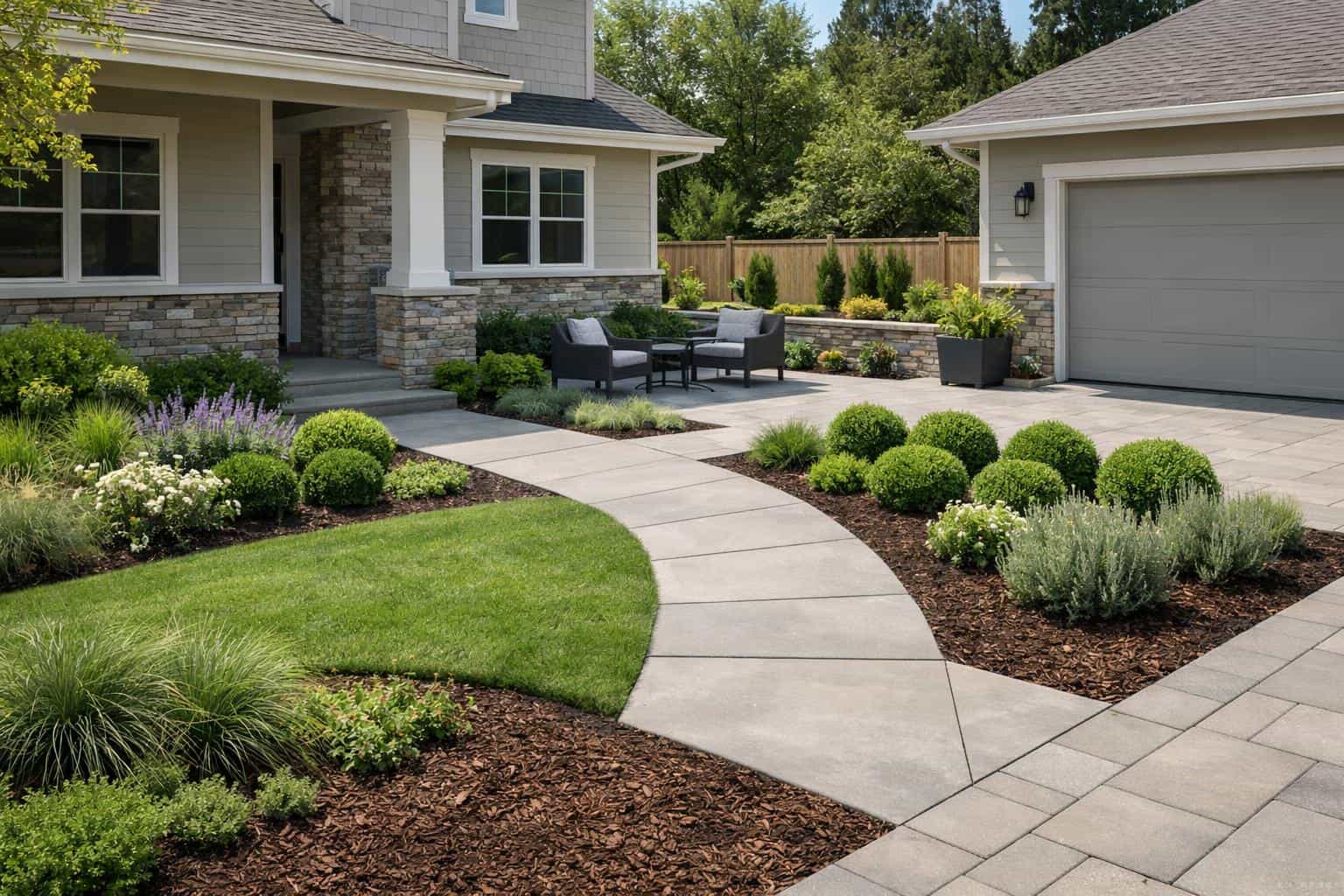
    Layering around the front entry helps the approach feel more dimensional and intentional, but only when the plants work together at the right scale. The best entry layering uses depth and repetition to support the walk to the door without making the space feel crowded.

    Use layers to frame the entry instead of filling every gap

    The strongest entry beds usually have a clear foreground, middle, and background rather than one dense mass of planting.

    Repeat forms to keep the entry calm

    Layering works better when it is organized by repetition and scale instead of by constant plant changes. Pair this with our Front Yard Entry Plant Repetition Guide for Homeowners if repetition is already part of the plan.

    Protect the step and walk experience

    The entry still needs to feel easy to read and comfortable to move through as the planting matures.

    What homeowners should remember

    The best entry layering adds depth and curb appeal because the planting supports one clear arrival experience.
  • Low-Maintenance Front Corner Bed Ideas Guide

    Low-Maintenance Front Corner Bed Ideas Guide

    Front corner beds often help anchor the whole front-yard layout, but they can become overplanted quickly. The best low-maintenance corner-bed ideas create visual weight where it is needed without turning the corners of the yard into bulky maintenance zones.

    Use the corner bed to support the larger composition

    The best corner beds usually reinforce the house shape, entry path, or front-yard outline rather than acting like isolated planters.

    Choose plants that can hold the corner without taking over

    A corner bed often needs one or two reliable anchors, not a crowded mix. Pair this with our Front Yard Anchor Plant Ideas Guide for Homeowners if the structure of the corner is still being decided.

    Keep the maintenance route practical

    The better the edge and spacing are handled, the easier it will be to keep the corner looking sharp over time.

    What homeowners should remember

    The best low-maintenance corner-bed ideas make the front yard feel more grounded without creating a constant upkeep issue.


  • Privacy Screening Near Patio Dining Area Guide

    Privacy Screening Near Patio Dining Area Guide

    Dining patios often need a different kind of privacy than lounging or open lawn areas. The best screening near a patio table protects the key sightlines and helps the dining space feel more comfortable without making the rest of the yard feel shut off.

    Protect the views that affect the table most

    Many dining areas only need privacy on one or two sides to feel much better during regular use.

    Keep dining circulation open

    Guests still need room to move chairs, pass behind the table, and connect to the rest of the patio. Pair this with our Backyard Dining Area Ideas Guide for Homeowners if the table layout itself still needs planning.

    Let the screen fit the mood of the yard

    A dining screen can be layered and soft or cleaner and more structured, but it should still feel like part of the whole backyard composition.

    What homeowners should remember

    The best patio dining privacy makes the table area feel calmer without turning the backyard into a closed box.


  • Front Yard Entry Plant Repetition Guide for Homeowners

    Front Yard Entry Plant Repetition Guide for Homeowners

    Repetition around the front entry can make even a simple approach feel much more designed. Using similar plant forms, colors, or masses near the entry often creates a calmer and more welcoming first impression than many isolated accent plants.

    Repeat plants to support the walk to the door

    The strongest entry repetition usually helps guide the eye toward the house instead of scattering attention around the bed.

    Keep the repeated forms scaled to the entry

    Repetition works best when the plant choices still match the width and style of the approach. Pair this with our Front Yard Entry Bed Ideas Guide for Homeowners if the bed itself still needs more structure.

    Use repetition to simplify, not flatten

    The goal is coherence, not monotony. Supporting layers and a few contrasting forms can still help the entry feel alive.

    What homeowners should remember

    The best entry repetition makes the front approach feel more intentional because the planting supports one clear design direction.


  • Low-Maintenance Entry Bed Refresh Guide for Homeowners

    Low-Maintenance Entry Bed Refresh Guide for Homeowners

    An entry bed refresh can make the front of a house feel noticeably better without requiring a full redesign. The best lower-maintenance refreshes simplify plant choices, sharpen the bed edge, and focus attention on the route to the door.

    Refresh the bed structure before adding more plants

    In many front yards, cleanup, edging, and selective plant replacement do more than adding a lot of new material all at once.

    Use fewer stronger planting moves

    Lower-maintenance entry beds often improve when the palette is narrowed and repeated. Pair this with our Front Yard Entry Bed Ideas Guide for Homeowners if the bed layout also needs more design direction.

    Protect the arrival route

    The bed should still support a clear and comfortable walk to the front door.

    What homeowners should remember

    The best entry bed refreshes make the front approach feel cleaner and more intentional without increasing the upkeep burden.


  • Privacy Screening for Corner Lots Guide for Homeowners

    Privacy Screening for Corner Lots Guide for Homeowners

    Corner lots create a different privacy challenge because more of the yard may be visible from the street or neighboring angles. The best screening strategies still preserve openness and curb appeal while reducing the exposures that matter most.

    Choose which exposures need the most screening

    Not every visible side of a corner lot needs the same treatment. Often the better result comes from screening the most exposed activity areas while letting other edges stay lighter.

    Support privacy without losing curb appeal

    Corner-lot planting still has to feel like part of the front-yard design. Pair this with our Corner Lot Front Yard Landscaping Ideas Guide if the full frontage is being reconsidered.

    Let the lot geometry guide the screen shape

    Because corner lots read from more than one direction, the best screen often works as part of a bigger composition rather than a single straight line.

    What homeowners should remember

    The best corner-lot privacy screens improve comfort without making the property feel heavy or overplanted from the street.


  • Front Yard Repetition in Planting Guide for Homeowners

    Front Yard Repetition in Planting Guide for Homeowners

    Repetition is one of the simplest ways to make a front yard feel more designed. Repeating forms, colors, or plant types helps the eye understand the yard as one composition instead of a string of unrelated decisions.

    Repeat the right things, not everything

    Repetition works best when a few plants or forms are used consistently enough to create rhythm without making the yard feel rigid.

    Use repetition to unify separate beds

    One of its biggest advantages is helping disconnected planting areas feel like part of the same plan. Pair this with our Front Yard Shrub Grouping Ideas Guide for Homeowners if you are also refining the structure of the beds themselves.

    Balance repetition with variation in scale

    A yard still needs depth and contrast, but repetition usually gives that variation a clearer framework.

    What homeowners should remember

    The best front-yard repetition strategies make the planting feel more cohesive because the design starts to speak with one voice.


  • Low-Maintenance Foundation Bed Guide for Homeowners

    Low-Maintenance Foundation Bed Guide for Homeowners

    Foundation beds often become higher maintenance than they need to be because plant size, spacing, and material choices are made for immediate appearance instead of long-term upkeep. A lower-maintenance foundation bed should still look intentional while staying easier to manage.

    Start with the mature size problem

    Many foundation beds become work-intensive because shrubs quickly outgrow the available space and need constant correction.

    Use a cleaner palette with stronger repetition

    Fewer dependable plants often perform better than a bed full of small mixed choices. Pair this with our Foundation Planting Ideas Guide for Homeowners if the visual layout still needs more structure.

    Keep the bed easy to edge and clean

    The more practical the bed is to maintain, the more likely it is to keep looking intentional over time.

    What homeowners should remember

    The best low-maintenance foundation beds make the house feel more grounded without creating a constant pruning problem.


  • Privacy Planting Between Neighbors Guide for Homeowners

    Privacy Planting Between Neighbors Guide for Homeowners

    Privacy planting between neighbors often works best when it solves the real view issue without turning the shared edge into an overgrown barrier. The best screens balance comfort, maintenance, and space limitations in a way that still suits the lot.

    Screen the actual view problem first

    Not every lot line needs the same density. Many homeowners get a better result by focusing on windows, patios, or seating views that matter most.

    Choose a screen that fits the lot depth

    The available width near the property line often decides whether a layered screen or a tighter planting strategy makes more sense. Pair this with our Layered Screening vs Single-Row Hedge Guide for Homeowners if you are still comparing approaches.

    Think about long-term neighbor reality too

    A screen should still be maintainable and not create avoidable disputes over crowding or overhang.

    What homeowners should remember

    The best neighbor-line planting gives homeowners more comfort while still fitting the scale and constraints of the actual property edge.


  • Front Yard Low Border Plant Ideas Guide for Homeowners

    Front Yard Low Border Plant Ideas Guide for Homeowners

    Low border plants can make a front yard feel more finished by clarifying bed edges and creating a cleaner transition between lawn, path, and planting. The best choices stay low enough to keep the edge readable while still adding texture and rhythm.

    Use low borders to reinforce the bed shape

    The strongest border plants help the planting composition read clearly from the curb rather than adding one more competing layer.

    Keep the edge easy to maintain

    Lower plants often work well because they preserve sightlines and reduce trimming around paths and lawns. Pair this with our Front Yard Bed Edging Ideas Guide for Homeowners if the bed outline is also being refined.

    Repeat rather than scatter

    Repeated low forms usually create a stronger edge than lots of mixed small plants.

    What homeowners should remember

    The best low border ideas make the front yard feel calmer and more deliberate because the edges read more clearly.