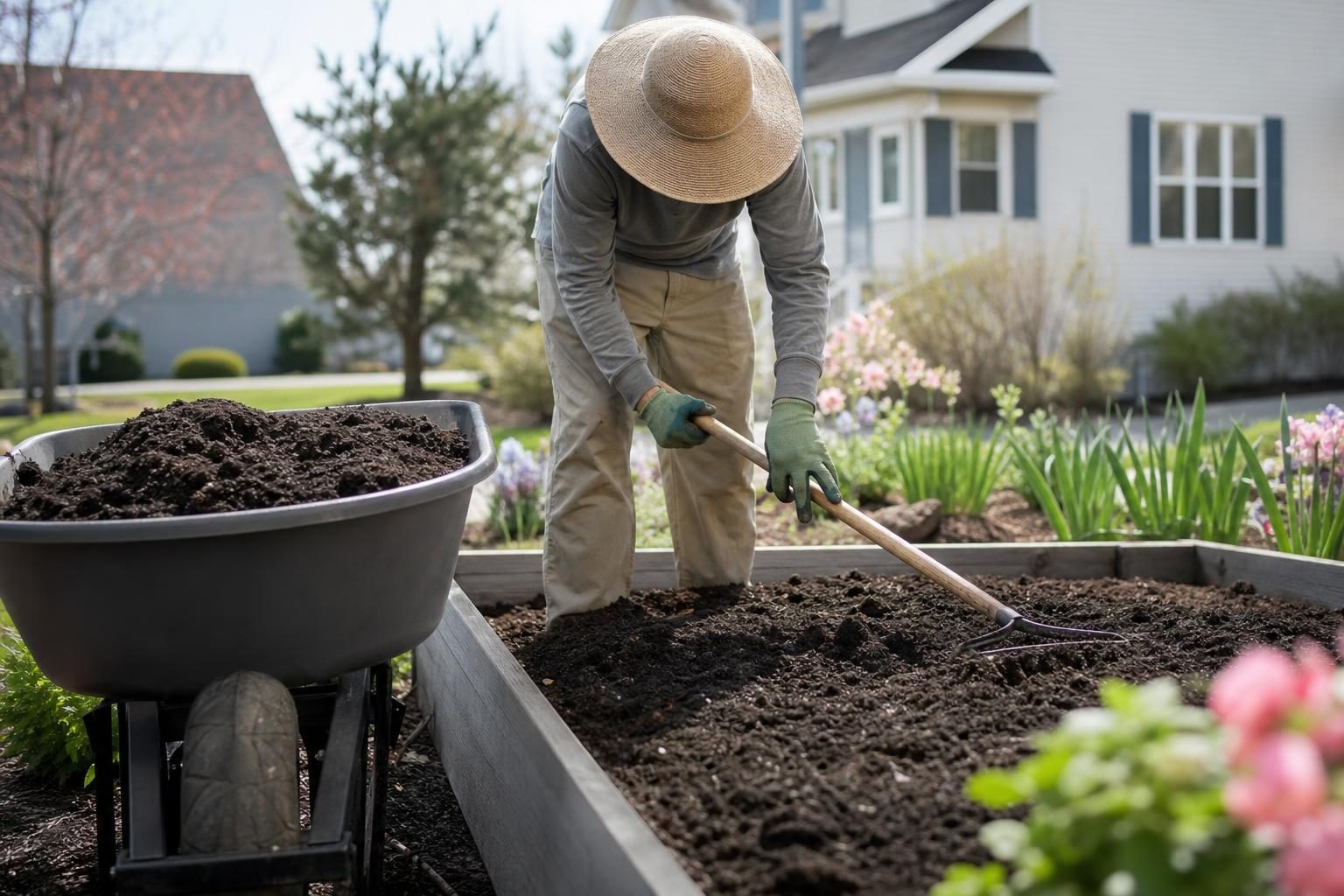
Use soil amendments when you already have enough soil but it drains poorly, is compacted or lacks organic matter. Use topsoil when you need more soil: to fill low spots, build up grade, create raised beds or cover subsoil left behind by construction. Many yards need both, with topsoil to set the level and compost or other amendments mixed in to improve it.
Part of our Complete Mulch Guide: types, how much you need, prices and care in one place.
What is the difference?
Topsoil is the upper layer of soil, sold in bulk or bags to add volume. Quality varies a lot. Some is screened loam with good organic content; some is little more than fill dirt from an excavation site.
Soil amendments are materials mixed into existing soil to change its structure or fertility. The most common is compost. Others include aged manure, leaf mold, peat or coir, gypsum for some sodic soils, lime or sulfur to adjust pH, and sand in specific, carefully proportioned blends.
In short: topsoil adds soil, amendments improve soil.
| Question | Soil amendment | Topsoil |
|---|---|---|
| Main purpose | Improve structure, drainage, nutrients or pH | Add volume, raise grade, fill low spots |
| Typical application | 1–3 inches worked into the top 6–8 inches | 2 inches to a foot or more, depending on need |
| Rough bulk cost | Compost often $30–$70 per cubic yard | Screened topsoil often $25–$60 per cubic yard |
| Delivery and spreading | Less material, less labor | Large volumes can mean heavy delivery and labor |
| Best for | Existing beds and lawns with poor soil | New construction, regrading, raised beds |
Prices vary by region, product quality, delivery distance and order size. Delivery fees can be a big share of the cost on small orders.

When you need amendments
- Heavy clay that stays wet, cracks when dry and is hard to dig. Compost improves structure over time.
- Sandy soil that dries out fast and will not hold nutrients. Organic matter helps it hold water.
- Compacted soil from foot traffic or equipment. Aeration plus compost helps roots and water move again.
- Poor plant growth where a soil test shows low organic matter or a pH out of range for your plants.
Amending works best in a defined area, such as new planting beds or before laying sod. For an existing lawn, topdressing with a thin layer of compost after core aeration is a gentler option.
When you need topsoil
- After construction, when the builder left subsoil, rubble or compacted fill.
- Low spots in a lawn where water collects or mowing scalps.
- Regrading to slope soil away from the house.
- Raised beds and berms that need volume.
- New lawns where the existing layer is too thin; four to six inches of decent soil under sod or seed is a common target.
If you are reshaping the yard, our grading and yard leveling guide explains how soil fits into that work.

Test before you buy
A basic soil test from your local cooperative extension service or a lab is usually inexpensive and tells you pH, nutrient levels and often organic matter content. It prevents guesswork, such as adding lime to soil that is already alkaline.
You can also do simple checks yourself:
- Squeeze test: Moist soil that forms a sticky ribbon is clay-heavy. Soil that falls apart is sandy.
- Drainage test: Dig a hole about a foot deep, fill it with water, let it drain, refill and time it. Water that lingers many hours points to drainage or compaction problems.
- Dig and look: Note how deep the dark, crumbly layer goes before you hit pale, hard or rocky subsoil.
How to buy good topsoil
Bulk topsoil is not standardized, so look before you order. Ask to see the pile or a sample. Good topsoil is dark, crumbly, smells earthy and has few rocks, roots, or bits of trash. Ask whether it is screened, whether it is a blend with compost, and where it came from. Weed-filled or contaminated soil can create problems for years.
Avoid dumping a thick layer of new topsoil directly on top of compacted clay. The sharp change in texture can cause water to sit at the boundary. Mix the first few inches of new soil into the existing surface so the layers blend.

How much to order
Multiply area in square feet by depth in feet, then divide by 27 to get cubic yards. For example, a 20 by 10 foot bed at 3 inches deep (0.25 feet) needs about 50 cubic feet, or roughly 2 cubic yards. Order a little extra for settling. For more on quantities, see what landscaping materials cost.
Common mistakes
- Buying cheap “topsoil” that is actually fill and then wondering why plants struggle.
- Adding sand to clay in small amounts, which can make it denser rather than looser.
- Over-applying compost or manure, which can raise nutrient levels too high, especially phosphorus.
- Burying tree root flares or raising soil against siding when adding topsoil.
- Skipping a soil test and applying lime, sulfur or fertilizer by guesswork.
What to check in a landscaper’s estimate
- Whether the bid specifies topsoil, compost or a blended mix, and the source.
- Volume in cubic yards and the planned depth.
- Whether existing soil will be tilled or loosened before new material is added.
- Delivery, spreading, grading and haul-off of excess material.
- Whether a soil test is included or recommended.

Deciding whether to buy materials yourself? Our guide on buying landscaping materials yourself vs through a contractor covers the tradeoffs. For bed prep, see the garden bed and planting installation guide.
Estimate topsoil volume and cost
Use these soil calculators to estimate the volume and rough delivered or installed cost range before deciding whether topsoil belongs in the scope.
Soil Calculator
Estimate how much soil you need for filling beds, topdressing, or adding planting depth.
Soil estimate
- Area
- –
- Area (alternate unit)
- –
- Cubic feet
- –
- Cubic yards
- –
- Rounded-up cubic yard recommendation
- –
Topsoil Cost Calculator
Estimate topsoil quantity and a rough delivered or installed cost range for lawn and bed prep.
Topsoil cost estimate
- Estimated cubic yards
- –
- Material estimate
- –
- Delivery and labor estimate
- –
- Low total
- –
- High total
- –
Frequently asked questions
Can I just put compost on top instead of topsoil?
For improving existing beds, yes; a layer of compost worked in or used as topdressing is often better than topsoil. For filling holes or raising grade, compost alone settles a lot, so topsoil or a topsoil-compost blend is better.
How much topsoil do I need for new sod?
A common target is four to six inches of good soil under sod. If you already have that, amending it may be enough.
Is garden soil the same as topsoil?
Not usually. Bagged garden soil is often a blend of topsoil with compost or other organic material, designed for beds rather than filling large areas.
How often should I amend garden beds?
Many gardeners add an inch or so of compost each year or two, guided by plant performance and periodic soil tests.