
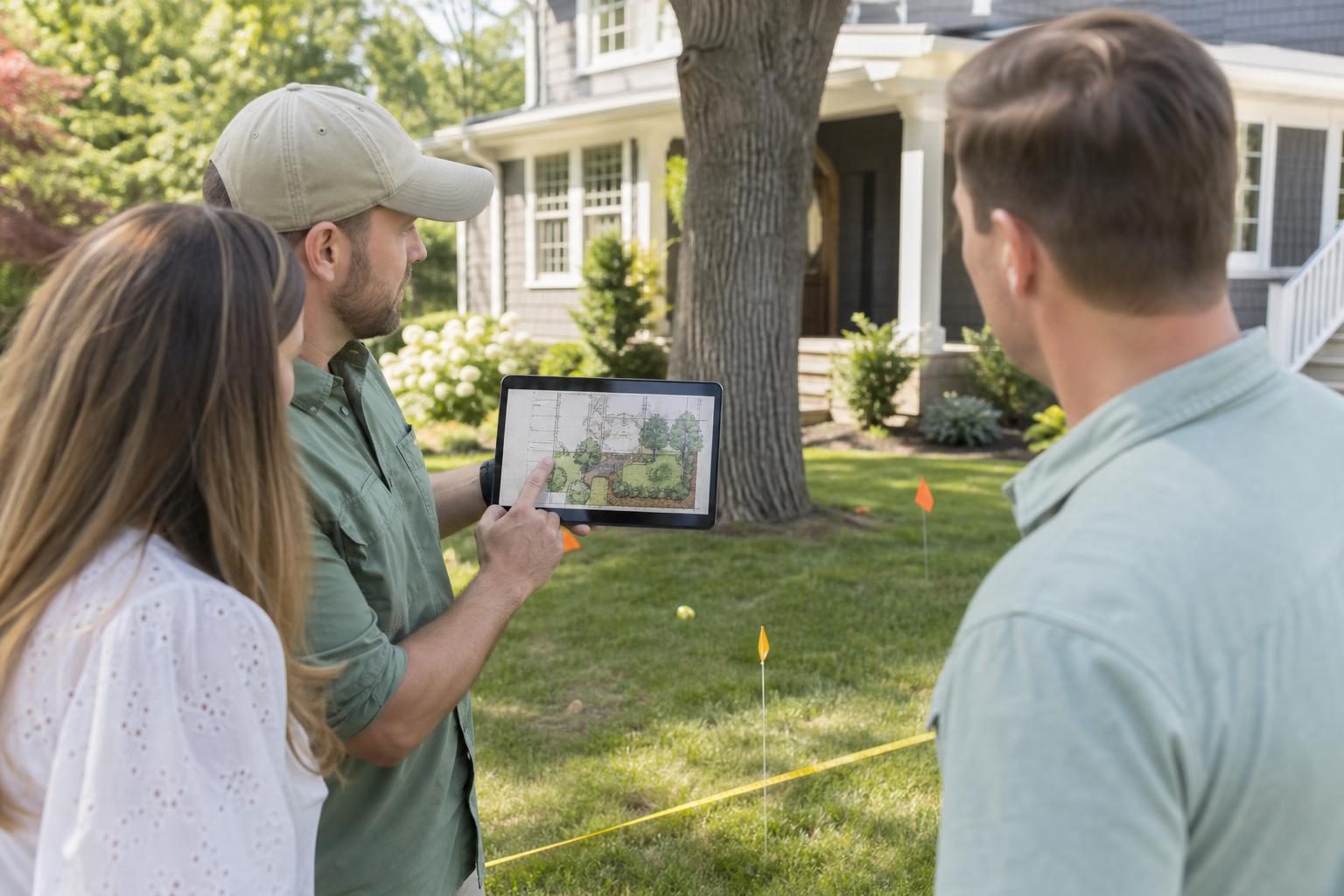
You need a landscape designer when the main problem is figuring out what to build: layout, grading, plant choices, and how the pieces fit together. You need a landscaping company when you already know what you want and need it installed or maintained. Many homeowners use both, either separately or through a design-build firm that handles the plan and the installation under one contract.
Part of our Complete Landscaping Cost and Hiring Guide: what projects cost, who to hire and how to compare quotes in one place.

What each one actually does
Landscape designer
A landscape designer creates a plan. Depending on the project, that can include a site analysis, concept sketches, a scaled layout drawing, a planting plan, material selections, and sometimes lighting or irrigation layouts. Designers range from independent designers and nursery-based designers to licensed landscape architects, who are typically required for some public or complex projects and may handle engineering coordination, grading plans, and permit drawings.
Landscaping company
A landscaping company builds and maintains. That might mean installing patios, walls, lawns, irrigation, and plantings, or providing mowing, pruning, and seasonal care. Some companies offer basic design help as part of a sale; others build strictly from a plan you provide.
Design-build firm
A design-build firm does both. You pay for design, often with a credit toward installation if you proceed, and one company is responsible for the finished result.
Side-by-side comparison
| Factor | Landscape designer | Landscaping company | Design-build firm |
|---|---|---|---|
| Main output | Drawings, plant lists, specifications | Installed work or maintenance | Plan plus installation |
| Best for | Complex or whole-yard projects, phased plans, getting competitive bids | Clear, defined projects | Homeowners who want one point of responsibility |
| How you pay | Hourly, flat fee, or percentage | Project price or service agreement | Design fee plus construction price |
| Bid flexibility | Plan can be bid by several installers | You compare companies directly | Usually built by the same firm |
| Risk to watch | Design that exceeds your budget | Scope gaps when there is no plan | Less price competition on install |

When a designer is worth paying for
- Whole-yard or multi-phase projects, where decisions in one area affect drainage, access, or layout elsewhere.
- Sloped or problem sites that need grading, walls, or drainage planned together.
- You want competitive bids, because a detailed plan lets several contractors price the same scope.
- Planting design matters to you, including seasonal interest, mature sizes, and water needs.
- Permits or HOA approval require drawings.
Design fees vary widely by region and scope. A simple consultation may cost a few hundred dollars, a planting plan for one area perhaps several hundred to a couple of thousand, and a full-property master plan from a landscape architect can reach several thousand dollars or more. Compared with a five-figure installation, a good plan often pays for itself by preventing rework.

When you can go straight to a landscaping company
- The project is defined: replace a lawn, build a simple patio, add a walkway, install irrigation.
- The site is flat and drains well.
- You already have a clear picture of materials and layout.
- You need ongoing maintenance, not a new design.
Even then, get a written scope with dimensions and materials so quotes are comparable. Our guide on how to compare landscaping companies covers what to look for.
How to choose and vet a designer
- Review a portfolio of built projects, not just renderings.
- Ask what is included: number of site visits, revisions, drawing types, and whether they help during installation.
- Confirm credentials if you need a licensed landscape architect for engineering or permit work.
- Share your real budget at the start, so the design is buildable for that amount.
- Ask whether drawings are yours to bid out, or tied to their own installation crew.

How to choose and vet a landscaping company
- Check licensing and insurance as required in your state.
- Ask for references on projects similar to yours.
- Confirm who supervises the crew day to day.
- Make sure the quote lists materials, base depths, drainage, and cleanup.
- Ask how changes are priced and approved.
Our list of questions to ask before hiring a landscaper can serve as a script. For patio-specific decisions, see patio designer vs patio contractor.
A simple way to decide
Ask yourself three questions:
- Can I describe the finished project in writing, with dimensions and materials? If yes, a landscaping company can likely price it directly. If no, start with design.
- Does the project involve grading, drainage, walls, or several connected areas? If yes, a plan reduces the risk of costly rework.
- Do I want to compare several installers on the same scope? If yes, a standalone designer’s drawings make that possible. If you would rather have one firm accountable from start to finish, consider design-build.
It is also common to start with a short paid consultation, which can clarify whether you need full drawings or just a few decisions made before calling installers.
Common mistakes
- Hiring a designer without sharing a budget, then receiving a plan you cannot afford to build.
- Skipping design on a sloped or complex yard and paying for rework later.
- Comparing contractor bids that each assume a different scope.
- Expecting a free design from an installer to be as thorough as a paid plan.
- Assuming a designer’s plan includes engineering for retaining walls or drainage when it does not.
- Changing the design mid-installation without a written change order, which makes it hard to know what the final price will be.

To see how design and installation fit into the overall timeline, read our backyard renovation planning guide.
Frame the project size before choosing help
Use this calculator to estimate a broad landscaping range before deciding whether design planning, installation pricing, or both should come first.
Landscaping Cost Range Calculator
Estimate a broad landscaping budget range for common homeowner project types before comparing quotes.
Landscaping cost estimate
- Estimated area
- –
- Low estimate
- –
- Mid estimate
- –
- High estimate
- –
- Estimated range per sq ft
- –
Frequently asked questions
Is a landscape designer the same as a landscape architect?
No. Landscape architects hold a state license and typically have formal training in engineering-related site work. Designers may be very skilled but are generally not licensed for that scope.
Do landscaping companies offer free design?
Some include basic sketches with a bid. These are usually less detailed than a paid plan and tied to that company’s installation.
Can I use a designer’s plan with any contractor?
Often yes, if your agreement allows it. Ask before signing.
Is design-build more expensive?
Not necessarily. You may lose some price competition on installation, but you gain one point of responsibility and fewer handoff gaps.