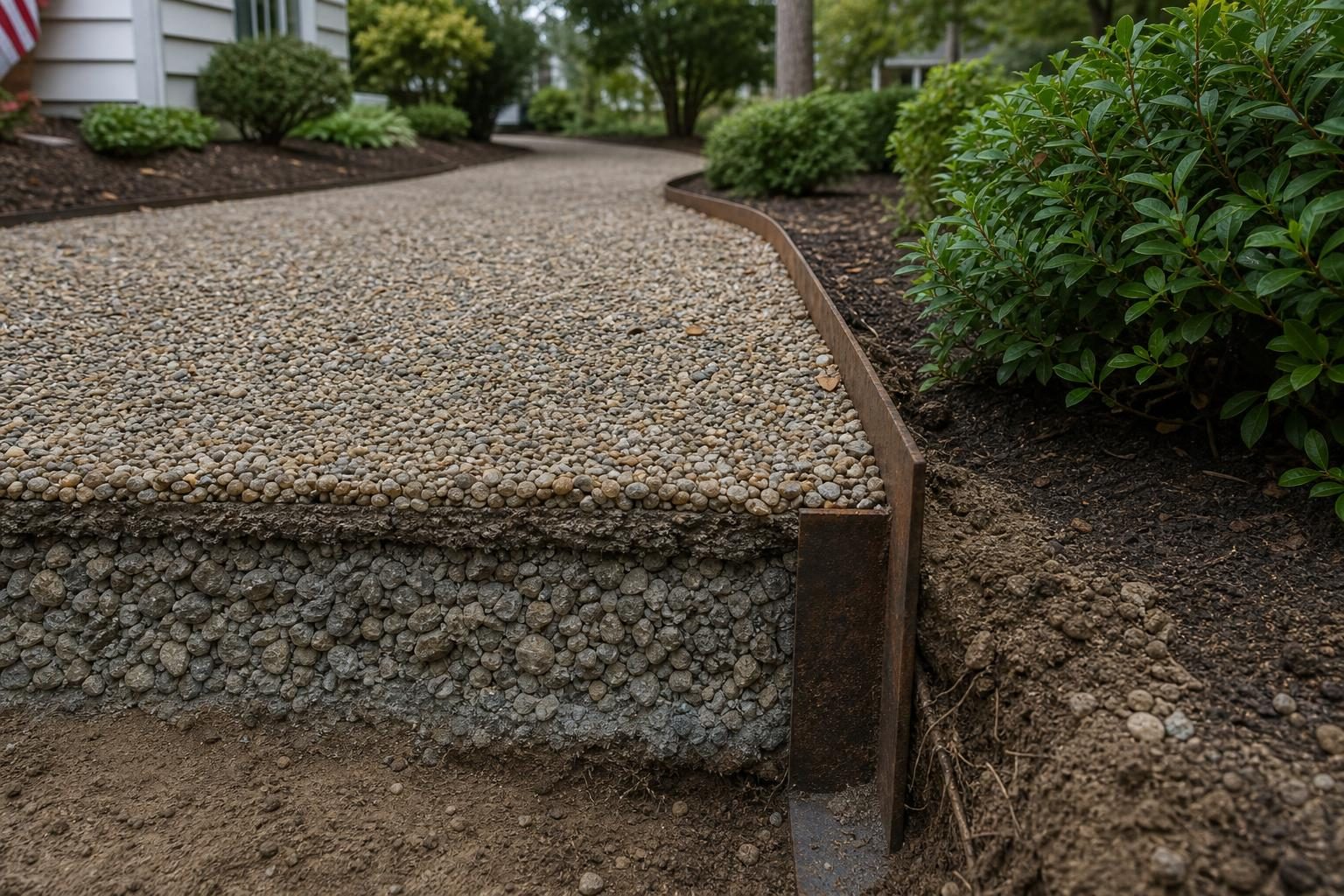
A typical gravel walkway needs about 4 to 6 inches of total depth: roughly 2 to 4 inches of compacted crushed-stone base and about 2 inches of surface gravel on top. Firm, well-drained soil and light foot traffic can get by at the shallower end, while soft clay, wet ground, or paths that carry wheelbarrows and mowers need a deeper base.
Part of our Complete Patio and Paver Guide: materials, costs, installation, repair and hiring in one place.
Depth is only part of the story. The type of gravel, how well the base is compacted, and whether the path has edging matter just as much for a walkway that stays firm.
The layers of a gravel walkway
- Subgrade. The native soil, excavated and compacted. Remove sod, roots, and loose topsoil, since organic material settles and rots.
- Optional fabric. A woven geotextile over soft or clay soil helps keep base stone from sinking into the mud. Over firm soil it may not be needed.
- Base layer. Angular crushed stone with fines (often sold as crusher run, road base, or a local equivalent). It compacts into a firm, load-bearing layer.
- Surface layer. The gravel you see and walk on.
- Edging. Steel, aluminum, plastic, stone, or paver edging holds everything in place.
Recommended depth by situation
| Situation | Base layer | Surface layer | Total excavation |
|---|---|---|---|
| Light foot traffic, firm well-drained soil | About 2 to 3 in | About 1.5 to 2 in | About 4 in |
| Typical front or backyard path | About 3 to 4 in | About 2 in | About 5 to 6 in |
| Clay, soft, or poorly drained soil | About 4 to 6 in, plus fabric | About 2 in | About 6 to 8 in |
| Wheelbarrows, mowers, garden carts | About 4 to 6 in | About 2 in | About 6 to 8 in |

These are common working ranges, not code requirements. In cold climates with frost heave, or anywhere the soil holds water, err toward the deeper end.

Why the surface layer should not be too deep
More gravel on top is not better. A thick layer of loose surface gravel feels like walking on a beach, shifts underfoot, and is hard to push a wheelbarrow through. Two inches or less of surface stone over a firm base is usually more comfortable. If the path feels soft, the base, not the surface, is usually what needs work.
Keeping the depth over time
Gravel paths slowly lose surface stone to foot traffic, rain, and snow shoveling, and some of it ends up in the lawn. Plan to rake the path level a few times a year and top it up with a thin layer of matching stone every year or two. If ruts or puddles keep forming in the same spot, the base there has likely settled or is staying wet; dig out that section, add and compact base stone, then resurface rather than piling on more loose gravel.
Choosing the right gravel
For the base
Use angular crushed stone that includes fines. The sharp edges lock together and the fines fill gaps when compacted. Avoid round river rock or pea gravel for the base; it rolls instead of locking.
For the surface
- Decomposed granite or crushed stone with fines: compacts into a firm, smooth surface. Good for accessibility and wheeled carts.
- Clean crushed stone (roughly 3/8 to 3/4 inch): drains well and stays put better than round stone.
- Pea gravel: comfortable and attractive, but round stones shift and migrate. Use solid edging and keep it thin, or consider a stabilizing grid.
Our patio and walkway materials guide compares gravel with pavers and concrete if you are still choosing a surface.

How much gravel to order
To estimate cubic yards for each layer: length (ft) x width (ft) x depth (in) / 324.
For example, a 40-foot path that is 3 feet wide needs about 1.5 cubic yards for a 4-inch base and about 0.75 cubic yards for a 2-inch surface. Add roughly 10 percent for compaction and waste. Many suppliers sell stone by the ton, so ask them to convert; the weight per yard varies by material.
For where to source it, see our guide on where to buy landscaping materials.
Step-by-step installation
- Lay out the path with stakes and string or marking paint. Widths of about 3 feet work for one person; about 4 feet lets two walk side by side.
- Call 811 before digging.
- Excavate to your total depth, keeping a slight slope or crown so water runs off rather than sitting on the path.
- Compact the subgrade with a hand tamper or plate compactor.
- Install fabric if the soil is soft or clay-heavy.
- Set edging so its top sits just above the finished surface.
- Add base stone in lifts of about 2 inches, dampening and compacting each lift.
- Spread the surface gravel and rake it level. Compact it if the material has fines.

Cost expectations
DIY gravel paths are among the least expensive walkway options, with cost mostly in stone, edging, delivery, and tool rental. Professionally installed gravel walkways commonly cost more per square foot than DIY but well below pavers or poured concrete. Excavation, haul-off of soil, edging type, and access all move the price, and regional rates vary. Our walkway and pathway installation guide compares options and process in more detail.
Common mistakes
- Laying gravel directly on grass or topsoil.
- Skipping compaction, which leads to ruts and soft spots.
- Using pea gravel as the base.
- Making the surface layer too thick.
- No edging, so stone spreads into lawn and beds.
- Building the path lower than surrounding soil so it becomes a drainage channel.
Estimate gravel quantity and cost for a walkway
Use these gravel calculators to connect walkway dimensions and depth with rough tonnage, material, delivery, and installation ranges.
Gravel Calculator
Estimate gravel volume and tonnage for paths, drainage areas, or decorative stone coverage.
Gravel estimate
- Area
- –
- Area (alternate unit)
- –
- Cubic feet
- –
- Cubic yards
- –
- Estimated tons needed
- –
- Rounded-up purchase recommendation (0.5 ton)
- –
- Rounded-up purchase recommendation (full ton)
- –
Gravel Cost Calculator
Estimate gravel tonnage, delivery, and installation cost ranges for stone coverage projects.
Gravel cost estimate
- Estimated tons
- –
- Material estimate
- –
- Delivery and labor estimate
- –
- Low total
- –
- High total
- –
Frequently asked questions
Can I put gravel directly on dirt?
You can, but it will sink, rut, and mix with soil over time. Removing organic soil and adding a compacted base gives a much firmer, longer-lasting path.
Do I need landscape fabric under a gravel path?
Fabric helps on soft or clay soils by keeping base stone separate from the soil. It does not stop weeds that sprout from seeds landing on top of the gravel.
How deep should pea gravel be on a walkway?
Keep pea gravel to about 1.5 to 2 inches over a compacted base. Deeper layers shift and feel unstable underfoot.
How do I keep a gravel path from washing out?
Use angular, compactable stone, add solid edging, slope or crown the path so water sheds off, and address any runoff flowing across it upstream.