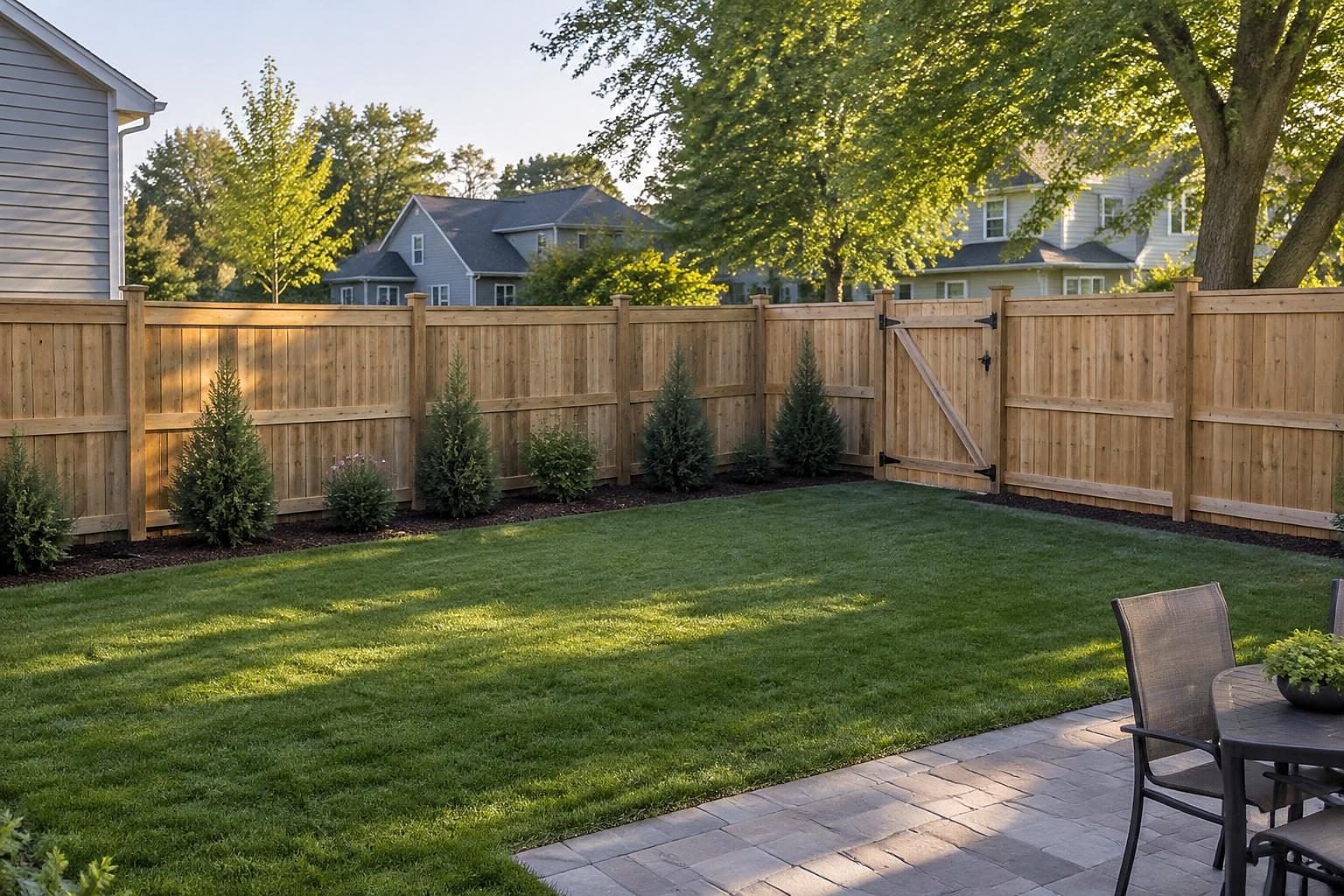
For most backyards, the best privacy fence is a 6-foot wood fence when budget comes first, quality vinyl when you want the least upkeep and plan to stay, and composite or horizontal slats when looks matter most. Chain link, aluminum and picket fences contain pets and mark a boundary but don’t block views on their own. Whatever you choose, the posts, your local height rules and your property line decide whether the fence is still straight, legal and friendly with the neighbors ten years from now.
Quick answer: Rough installed prices are about $15–$30 per linear foot for 4-foot chain link, $25–$45 for a 6-foot pressure-treated wood privacy fence, $35–$65 for cedar or vinyl privacy, $35–$70 for aluminum and $50–$90 for composite. A typical 150-foot backyard run with one walk gate lands around $4,100–$7,600 for pressure-treated wood and $5,600–$10,600 for cedar or vinyl. Most towns cap back-yard fences at about 6 feet and front-yard fences at 3–4 feet, but rules vary, so check your city or county, your HOA and your property line before anyone digs, and call 811 to have buried utilities marked.
Fence materials compared
Eight options cover nearly every US residential fence. Prices are rounded installed ranges on reasonably flat, diggable ground, including posts, footings, hardware and labor. They vary a lot by region, so use them to sanity-check bids, not as quotes.

| Fence type | Typical height | Installed cost per linear foot | Privacy | Typical lifespan | Upkeep |
|---|---|---|---|---|---|
| Pressure-treated pine (board or panel) | 6 ft | About $25–$45 | Full | Roughly 10–25 years, limited by posts | Stain or seal every 2–5 years |
| Cedar privacy | 6 ft | About $35–$65 | Full | Similar to treated pine; boards often outlast posts | Stain, or let it weather to gray |
| Vinyl privacy | 6 ft | About $35–$65 | Full | Often 20–30+ years for quality product | Wash once or twice a year |
| Composite privacy | 6 ft | About $50–$90 | Full | Long; panels don’t rot | Wash; no stain |
| Horizontal slat (cedar, composite or aluminum) | 5–6 ft | About $40–$120+ | Near full, depending on gaps | Depends on material and span | Wood needs stain; metal and composite little |
| Wood or vinyl picket | 3–4 ft | About $20–$45 | Little | Like the matching privacy material | Like the matching privacy material |
| Chain link (galvanized or vinyl-coated) | 4–6 ft | About $15–$30 (4 ft); $25–$45 (coated or 6 ft) | None, partial with slats | Decades for the framework | Very low |
| Aluminum ornamental | 4–5 ft | About $35–$70 | None | Decades | Very low |
Wood: pressure-treated pine and cedar
Wood is the most common privacy fence. Pressure-treated pine is the budget option, but it’s often sold wet and shrinks, twists and checks as it dries. Western red cedar costs more, moves less and resists decay, though only its heartwood does. Many builders pair cedar boards with treated or steel posts, because cedar posts rot quickly in wet soil. Style matters too: side-by-side boards open gaps as they shrink, board-on-board overlaps hide them, and shadowbox alternates boards on each side of the rail so air passes through. Our wood vs vinyl privacy fence comparison covers species, styles and lifetime cost in detail.
Vinyl
Vinyl privacy fence panels need little more than washing, and good product lasts decades. Thin posts and rails, weak UV protection and unreinforced bottom rails are behind most complaints about cracking, yellowing and wind blowouts, so get the brand, product line and wall thickness in writing.
Composite
Composite blends wood fiber and plastic. It looks more like wood than vinyl, never needs stain and doesn’t rot, but it’s heavy and usually the priciest privacy option. Many systems use metal posts, which ends post rot too.
Horizontal slat fences
Horizontal boards look modern and make a narrow yard feel wider. Long horizontal boards sag more than vertical ones, so good builders shorten the spans between posts or add a midspan stiffener, choose stable boards and leave small gaps for movement.
Chain link with privacy slats
Chain link is the cheapest way to contain a dog. Slats woven into the mesh add partial privacy, but they can drift, bow in hot sun and leave a ragged top line unless they lock into a bottom track, and they add wind load. Ask for them as a separate line on the quote.
Aluminum, picket and living screens
Aluminum is nearly maintenance-free, follows slopes and is a common pool fence, but it’s see-through. Picket fences are mostly front-yard boundary fences, often limited to 3 or 4 feet. Evergreen screens take years to fill in but can block views above fence height; see living privacy screens below.
How to choose: privacy, pets, pools, HOA and wind

Work through these questions in order. Most homeowners are down to one or two materials by the end.
- What are you trying to block or contain? Sit where you usually sit and note what you see. A 6-foot fence won’t block a second-story window; a tree or pergola near your seat will. To contain a dog or mark a line, a cheaper open fence may do.
- What do the rules allow? Height limits, permits and HOA standards can rule out materials, colors and heights before you collect quotes.
- Do you have pets? Jumpers need 5 to 6 feet with no climbable rails on the outside. Diggers need a buried wire apron or kick board. Stepped panels on a slope leave gaps small dogs slip through. Our pet-friendly backyard guide covers the rest of the yard.
- Is there a pool or hot tub? Pool barriers have their own rules, covered below.
- How windy is the site? A solid 6-foot fence acts like a sail. Shadowbox wood, a lattice top, closer posts, deeper footings or reinforced vinyl rails reduce leaning and blowouts.
- How much upkeep will you really do? If you won’t stain wood every few years, choose cedar and let it gray, or go with vinyl, composite or aluminum.
- How long will you stay? Under about eight to ten years, wood usually costs less overall. Over a longer stay, quality vinyl often catches up because there’s no staining bill.
- Is a fence the right tool at all? In a small yard, a short screen beside the patio can beat a perimeter fence. The outdoor privacy solutions guide compares fences, screens and layout changes.
Pool fences
The US Consumer Product Safety Commission’s Safety Barrier Guidelines for Residential Pools call for a barrier at least 48 inches high, no more than 4 inches of clearance at the bottom (2 inches over grass or gravel), openings too small for a 4-inch sphere, and vertical pickets no more than 1¾ inches apart where horizontal rails sit close enough to climb. Gates should open outward, away from the pool, and be self-closing and self-latching, with a low latch release on the pool side near the top of the gate. Many states and towns write similar or stricter rules into code, so check before choosing a style.
HOA approval
Get written HOA approval for material, color, height and style before you sign a contract. A fence built without it may have to come down.
Height limits, permits and property lines

Fence rules are local and vary more than most homeowners expect. Your city or county sets them, your HOA can add to them, and some states have boundary-fence laws on top.
Height limits
A common pattern is about 6 feet in back and side yards and 3 to 4 feet in front yards, with lower limits near street corners so drivers can see traffic. Some towns allow 8 feet in back, and many count a lattice topper in the height.
Permits
Many towns require a permit for any new or replacement fence; others only above a set height, and some not at all. Height and placement rules apply either way. Our guide to landscaping permits explains how to find your local requirements. Agree in writing on who pulls the permit.
Property lines and surveys
Don’t rely on an old fence, a hedge or a guess. Find the corner pins, or order a survey; it usually costs a few hundred dollars. Many homeowners set the fence a few inches inside their line so they can maintain both sides. Utility or drainage easements may also restrict building along a back line.
Good side out, and the neighbors
Many codes and HOAs require the finished side to face neighbors or the street, with posts and rails on your side. Board-on-board and shadowbox look finished from both sides, which sidesteps the question. Some states presume neighbors share boundary-fence costs; California’s Good Neighbor Fence Act also requires 30 days’ written notice. Others have no such rule. A short written agreement on cost, style and which side faces whom prevents most disputes.
Call 811
Fence posts are exactly the kind of digging that hits gas, power and fiber lines. The free 811 call-before-you-dig service asks you to request marking a few business days ahead. 811 doesn’t mark private lines such as sprinklers or landscape lighting, so flag those yourself.
What a fence costs
Two common runs, before old fence removal and permit fees:

| Fence | Per linear foot | 100 ft, no gate | 150 ft + one walk gate |
|---|---|---|---|
| 4 ft galvanized chain link | $15–$30 | $1,500–$3,000 | About $2,500–$5,000 |
| 6 ft pressure-treated wood privacy | $25–$45 | $2,500–$4,500 | About $4,100–$7,600 |
| 6 ft cedar privacy | $35–$65 | $3,500–$6,500 | About $5,600–$10,600 |
| 6 ft vinyl privacy | $35–$65 | $3,500–$6,500 | About $5,600–$10,600 |
| 4–5 ft aluminum | $35–$70 | $3,500–$7,000 | About $5,700–$11,700 |
| 6 ft composite | $50–$90 | $5,000–$9,000 | About $7,800–$14,400 |
These are planning ranges that vary by region, season, soil and access, and published cost guides disagree widely. The fence installation cost guide breaks down every material, gate type and price driver.
Gates
Gates are priced separately: about $200–$500 for a chain link walk gate, $300–$900 for a wood or vinyl walk gate, $400–$1,200 for aluminum, $1,000–$3,000 or more for a double drive gate across a 10- to 12-foot opening, and $5,000 and up for an automated driveway gate. If a drive gate is part of driveway work, our driveway guide helps you plan the two together.
What moves the price
- Height. Going from 6 to 8 feet, where allowed, often adds roughly a quarter to a third.
- Old fence removal. Usually about $3–$8 per foot, more when old posts sit in large concrete plugs.
- Slope. Stepped or racked panels take more labor. The sloped yard guide covers grading options.
- Rock and roots. Many contracts charge extra per hole for rock, core drilling or roots. Stumps on the fence line may need stump removal first.
- Corners, gates and style. Heavier corner and gate posts raise the per-foot cost of short runs. Board-on-board and lattice tops add material.
Installation: what a good fence job looks like

Almost every fence complaint traces back to the posts. Boards and panels are the easy part.
Post depth and size
Penn State Extension’s fence planning guide describes line posts set roughly 3 feet deep, with larger corner and gate posts around 4 feet, and deeper in sandy or chronically wet soil. Post spacing is usually 6 to 8 feet, closer for horizontal boards or windy sites. Wood posts should carry a ground-contact rating on the tag; above-ground lumber looks the same but rots far faster when buried.
Concrete vs gravel footings
Both work when done right; what matters is drainage at the base. For concrete, best practice is gravel under the post end, then concrete brought slightly above grade and crowned so water runs off. Concrete that stops below ground forms a cup that holds water against the wood, a classic cause of posts rotting off at grade. Tamped gravel drains well and suits wood line posts, but gives less support, so corner and gate posts generally get concrete. Steel posts behind wood boards avoid post rot altogether.
Frost line
Where the ground freezes, frozen soil can grip a post and lift it a little each winter, leaving a wavy top line. Frost depth ranges from a few inches in the South to 4 feet or more in northern states; your building department publishes the local number. Footings should reach below it, and holes wider at the bottom resist lifting better than carrot-shaped ones.
Slopes
On a hill, panels are stepped (level sections dropping like stairs) or racked (rails angled to follow the ground). Stepping leaves triangular gaps at the bottom; racking only works on gentle slopes with materials designed for it.
Gates
Gates fail first on cheap installs. A good gate hangs on a heavier, deeper post in concrete, with a diagonal brace running from the bottom hinge corner up to the latch side and hinges sized for its weight. Wide wood gates often get steel posts. It should close and latch without lifting.
Red flags during installation
- Posts set in shallow holes, or concrete that stops below the soil surface.
- “Treated” posts with no ground-contact tag.
- Gate posts no bigger or deeper than line posts.
- No 811 locate marks on the ground before digging starts.
Problems, repairs and when to replace

Most fence failures start at the posts or the gate, so find the cause before patching boards.
Leaning posts
Leaning usually means a shallow hole, poor tamping, wet soil or too much wind load. A few posts can be reset or braced with a steel post mender. If a whole run leans, the posts were undersized or too shallow, and resetting the line is the real fix.
Rot
Wood rots first at the ground line and where boards touch soil or mulch. Probe each post base with a screwdriver; soft wood means that post is near the end. When rot shows up post after post, replacement usually beats chasing failures one at a time.
Gate sag
A sagging gate is usually a moving gate post, then a missing or backwards brace, then loose hinges. Check the post first by pushing it. Anti-sag cable and turnbuckle kits help on smaller gates; wide gates usually need a better post.
Vinyl damage and neighbor disputes
Vinyl panels that pop out in wind can often be reseated; repeated blowouts point to weak rails or shallow posts. Cracked vinyl needs matching parts from the same product line. Disputes over a fence built over the line, facing the wrong way or too tall are settled by a survey and the local code, and are best prevented by talking before you build.
Repair or replace?
Repair when damage is limited to a few boards, panels or posts. Replace when many posts are soft at grade, the line waves from frost heave, or the fence no longer fits your needs. A replacement usually has to meet today’s height and placement rules.
Maintenance and staining calendar
Keep water, soil and plants off the fence, and keep wood finished. A US General Services Administration technical guide to exterior stains notes that a single coat of semitransparent stain may last about 2 to 4 years and a two-coat system up to about 8, with sunny south-facing, coastal and cold high-altitude exposures wearing faster. Most wood fences land at re-staining every 2 to 5 years.

| Material | Spring | Summer | Fall | Winter | Finish schedule |
|---|---|---|---|---|---|
| Pressure-treated wood | Check posts at grade; tighten loose boards and gate hinges | Stain or seal on a dry stretch once new wood has dried out | Pull mulch, soil and leaves away from boards | Keep snow piles off the fence | First coat once the wood is dry, often a few months after install; then every 2–5 years |
| Cedar | Wash off mildew; check posts | Stain if you want to keep the color | Clear leaves and vines | Check after big storms | Every 2–5 years, or leave unfinished to weather gray |
| Vinyl and composite | Wash with mild soap and a soft brush | Watch string trimmers and mowers near rails | Wash shaded, mildewed sections | Avoid impacts; vinyl is more brittle in cold | None |
| Chain link and aluminum | Check gate latch and hinges | Cut back vines that pull on the mesh | Check tension wire and slats | Little needed | None |
Clean the fence and let it dry before staining. When water soaks in instead of beading and the color has faded, it’s time to recoat. Test gate latches every season, especially on pool gates.
Living privacy screens and small yards

Plants are the slow, soft side of privacy. Evergreens take a few seasons to fill in, but they can screen above fence height and soften a long fence line. Many homeowners combine a fence for instant privacy with a planted bed in front. Our privacy landscaping guide covers layering, spacing and maintenance.
Evergreen screens
Choose the width of the screen before the plant. Many hedge plants spread far wider than their nursery size suggests, so plan by mature width and leave room to trim behind the screen. Planting tight against a fence traps moisture and browns the back side. Mixing species keeps one pest from wiping out the whole screen. The evergreen screen ideas guide covers spacing, fence offsets and mixed screens.
Small yards
In a small yard, block the view near where you sit rather than lining the whole edge; a short screen beside a bench blocks more than a long hedge at the line. Columnar plants, trellis panels with vines, raised planters and fence toppers, where allowed, take very little depth. Rough installed costs run about $50–$300 or more per columnar shrub, $150–$600 per trellis panel and $40–$120 or more per foot for a slatted screen. See privacy landscaping ideas for small yards for more options, and our patio and paver guide if the screen is going around a new patio.
When an existing screen stops working
Hedges thin at the bottom, lose plants or outgrow the space, and many conifers don’t regrow from bare old wood. Infill planting usually costs about $50–$300 or more per plant, and layered replanting about $25–$100 or more per foot. The guide to signs privacy landscaping needs an upgrade helps you choose between pruning, infill and starting over. New screens fail most often from uneven watering, so plan drip irrigation.
Hiring a fence contractor

Get at least three written bids for the same height, material grade, post size, depth, spacing and gate count. Our guide on how to compare landscaping quotes helps you line them up.
Questions to ask
- How deep will line, corner and gate posts be set, and in what? How will the concrete be finished at the ground?
- What size and type of posts? Are wood posts rated for ground contact?
- For vinyl: what brand, product line and wall thickness, and are bottom rails reinforced?
- How will gates be braced, and will a pool gate meet local barrier rules?
- Who calls 811, who pulls the permit, and who confirms the property line?
- Does your workmanship warranty cover leaning posts and sagging gates, and for how long?
What the quote must include
A good quote lists length, height and style; material grade and brand; post size, depth, spacing and footing; gates and hardware; old fence removal; rock or root charges; slope handling; who handles permit, survey and 811; schedule; payment terms; and material and workmanship warranties. Our list of questions to ask before hiring a landscaper covers licensing, insurance and contracts.
Red flags
- A price with no post depth, post size or material grade written down.
- Pressure to sign today, a large deposit before materials are ordered, or cash only.
- No mention of 811, permits or your property line.
- A bid far below the others, which often means shallower posts, wider spacing or thinner material.
Problems homeowners run into

The same stories come up again and again in homeowner forums.
- Posts that rotted off at the ground while the boards looked fine. Usually concrete that stopped below grade, or posts not rated for ground contact; some failed in under ten years in wet soil.
- A fence that leaned after the first big storm. Shallow holes and a solid 6-foot fence catching wind were the usual causes.
- A gate that dragged within a year. The gate post moved, or the diagonal brace ran the wrong way.
- The fence ended up in the wrong place. Over the line, too tall or facing the wrong way, discovered when someone complained.
- Gaps under stepped panels. Dogs squeezed through on sloped yards until owners added a kick board, wire mesh or stone.
- Stain that peeled or blotched. New treated pine was stained before it dried, or a fence was never finished and turned mottled.
- Vinyl that blew out or cracked. Thin rails popped out in wind or cracked under string trimmers, and matching parts were hard to find.
- Evergreens planted against the fence. The back side browned, there was no room to trim, and the plants pushed on the boards.
Frequently asked questions
What is the cheapest privacy fence?
A 6-foot pressure-treated wood fence is usually the lowest-cost true privacy fence, at about $25–$45 per foot installed. Chain link is cheaper but gives little privacy, even with slats.
What is the best wood for a fence?
Pressure-treated pine is the budget choice and is the right material for posts in the ground. Cedar costs more but is more stable and naturally decay resistant, so many fences use treated or steel posts with cedar boards. Redwood performs well where it’s affordable, mainly in the West.
Are privacy fence panels as good as board-by-board construction?
Pre-built panels go up faster and cost less in labor, but they’re often made with thinner boards and lighter rails, and they don’t follow slopes as well. Board-by-board fences can use better lumber and adapt to uneven ground. Either way, the posts matter most.
How tall can a privacy fence be?
Often 6 feet in back and side yards and 3 to 4 feet in front yards, but it depends on your town and HOA. Some places allow 8 feet in back. Check your local code before ordering materials.
How long does a wood privacy fence last?
Commonly about 10 to 25 years. Ground-contact treated posts in well-drained soil and boards kept stained sit at the long end; wet soil, no finish and untreated sapwood sit at the short end.
Is a hedge better than a fence for privacy?
A fence gives instant privacy in a narrow footprint. A hedge takes years and needs room and care, but it can grow taller than fence limits and looks softer. Many homeowners use both.
Fence and privacy guide library
Every fence and privacy guide on the site, grouped by decision.
Choosing and pricing a fence
- Fence installation cost — per-foot prices by material, gates, a 150-foot example and what raises the bill.
- Wood vs vinyl privacy fence — lifespan, upkeep, wind performance and lifetime cost side by side.
Privacy planting and screens
- Privacy landscaping — hedges, small trees and layered beds that block views without walling you in.
- Evergreen screen ideas — sizing, spacing and maintenance for year-round screens.
- Privacy landscaping ideas for small yards — narrow plants, slatted screens, trellises and planters with costs.
- Outdoor privacy solutions — fences, screens and layout fixes for backyards, side yards and patios.
Fixing a privacy problem
- Signs privacy landscaping needs an upgrade — when to prune, infill or replace a failing screen, with rough costs.