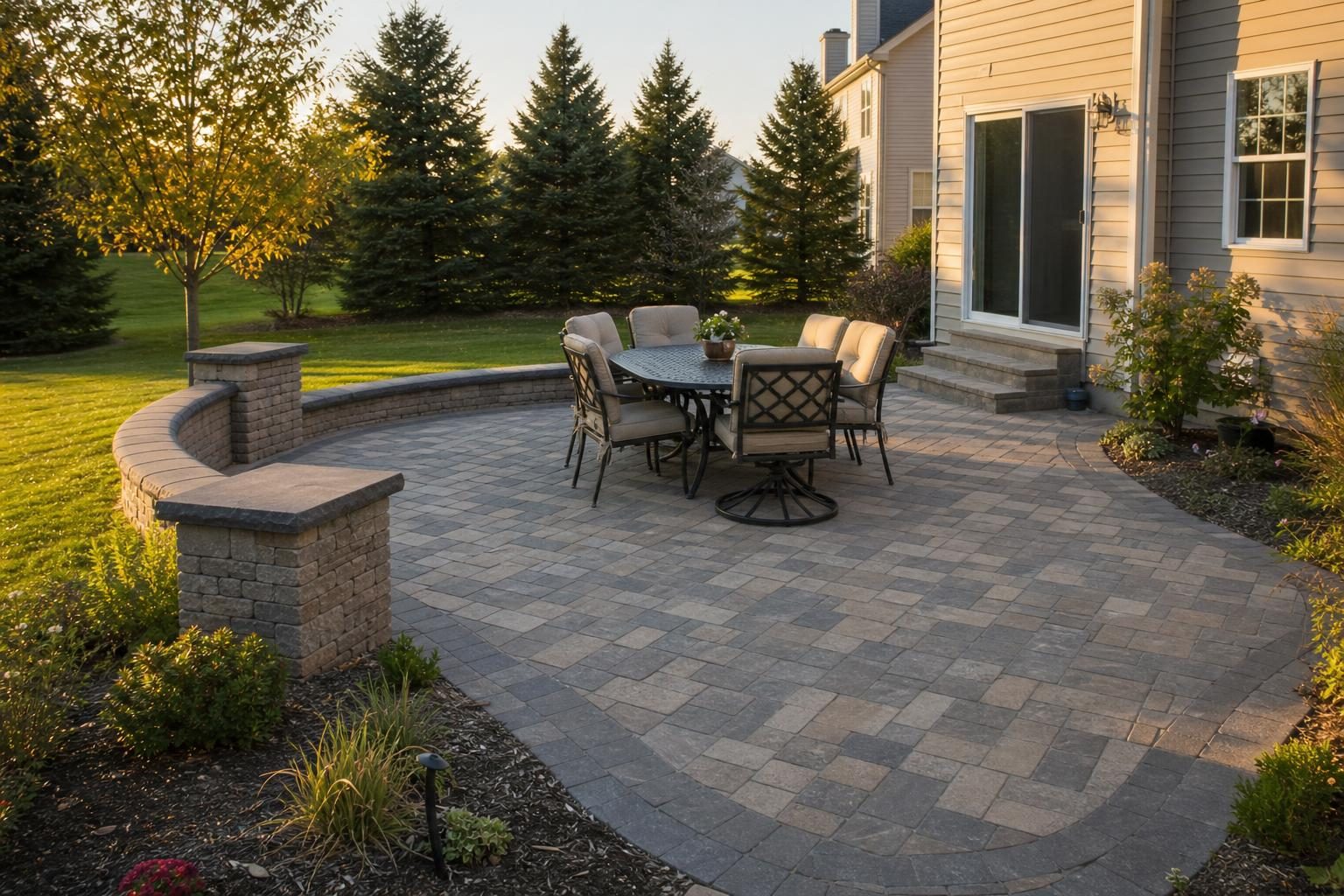
For most yards, the right patio is plain concrete for the lowest-cost solid surface, concrete pavers for design choices and repairs that blend in, natural stone for the most natural look, and gravel when the budget is tight. A typical 12×16 patio runs from well under $1,500 for gravel to $5,000 or more for pavers and $8,000 or more for natural stone. The base, slope and edges you never see decide how long it stays flat.
Quick answer: Rough installed prices are about $3–$8 per sq ft for gravel, $6–$15 for broom-finish concrete, $10–$25 for stamped concrete, $10–$30 for concrete pavers, $14–$35 for brick and $15–$45 or more for flagstone, travertine and other natural stone. Pavers need at least 4 inches of compacted gravel base, often 6–8 inches on clay or in cold climates, plus a solid edge restraint. Every patio should slope about 1/8 to 1/4 inch per foot away from the house. Prices vary a lot by region, soil, access and whether an old patio has to come out.
Patio materials compared
Seven surfaces cover most US patios, and a deck takes over when the ground doesn’t cooperate. Ranges are rounded installed prices on a properly built base; big metro areas often sit at or above the top.

| Material | Installed cost per sq ft | Typical lifespan | Upkeep | Climate notes | Best for |
|---|---|---|---|---|---|
| Gravel or decomposed granite | About $3–$8 | Base lasts if drained; surface needs top-ups | Medium to high: rake, top up, pull weeds | Drains well anywhere; washes out on slopes | Casual seating, fire pit areas, tight budgets |
| Poured concrete, broom finish | About $6–$15 | Often 25 years or more on a good base | Low: clean, fill cracks, optional sealer | Needs air-entrained mix and no salt early in freeze-thaw areas | Lowest-cost solid surface, modern homes |
| Stamped or colored concrete | About $10–$25 | Slab similar to plain; look depends on resealing | Medium: reseal every 2–5 years | Surface color can fade in full sun; can scale with deicers | A stone or brick look for less than many pavers |
| Concrete pavers | About $10–$30 | Units last decades; joints and edges need attention sooner | Medium: joint sand, weeds, optional sealing | Handles freeze-thaw well with a deep enough base | Design options, easy spot repairs |
| Clay brick | About $14–$35 | Decades; color is fired through | Medium: joint sand, moss in shade | Use paving brick rated for severe weather in cold areas | Traditional homes, walkways |
| Flagstone, bluestone and other natural stone | About $15–$45+ | Decades for dense stone | Low to medium: joints, sealing for porous stone | Dense stone does best; dark stone gets hot | Natural, garden-style patios |
| Travertine | About $15–$30; pool decks often $25–$40+ | Decades if sand-set and kept from salt | Medium: seal, clean open holes | Best in warm climates; avoid de-icing salt | Pool decks, warm-climate patios |
Poured concrete
Plain broom-finish concrete is the most affordable hard surface and the easiest to keep clean. It will crack at some point, which is why a good installer plans where the cracks go with control joints rather than promising they won’t happen. The concrete patio cost guide breaks down each finish and what a 12×16 or 20×20 slab costs.
Stamped concrete
Stamping presses a stone, slate, brick or wood texture into colored concrete while it is still soft. Owners who are happy years later chose a skilled installer, color mixed through the slab and regular resealing. See the stamped concrete patio guide for patterns and upkeep, and paver patio vs stamped concrete if those are your two finalists.
Concrete pavers
Concrete pavers, also sold as paver stones or patio pavers, are factory-made units laid over compacted gravel and a thin sand bed. The paver industry group CMHA describes them as a semi-flexible surface that can move slightly without cracking, and individual units can be lifted and reset when an area settles. Our guide to paver patio vs concrete patio compares the two side by side, and how to choose paver colors and finishes helps you pick a blend that suits your house.
Natural stone, flagstone and travertine
Flagstone and bluestone give an irregular, natural look and can be dry-laid on compacted gravel or mortared onto a concrete slab. Mortared stone needs a sound, properly jointed slab underneath, or the mortar joints crack as the slab moves. Travertine is a porous limestone popular around pools because light shades stay cooler underfoot, but it should not be used where de-icing salt is spread. The types of pavers guide compares concrete, clay, travertine, flagstone, porcelain and permeable units for heat, slip and fading.
Brick
Clay brick holds its color for decades because the color runs through the whole unit. In cold climates, ask for paving brick rated for severe weather rather than wall brick.
Gravel
Gravel and decomposed granite are the cheapest patio surfaces and drain well, which makes them good for fire pit circles and casual seating. They need edging to stay in place, and chair legs sink into deep, loose stone. For layer depths, see the walkway gravel depth guide. The patio and walkway materials guide compares how each surface wears over time.
Where a deck fits
A patio is usually the better value on flat or gently sloping ground right outside a low door. A deck usually wins when the back door sits several feet above the yard or the ground falls away, because building a patio there means fill and a retaining wall. Read patio vs deck for the full comparison and the deck installation cost guide for deck pricing.
How to choose: a decision checklist

Work through these questions in order. Most homeowners are down to one or two materials by the fifth.
- How will you use it? List what goes on it: a dining table, a grill, lounge chairs, a fire pit. Cramped patios are a common regret, so mark out the furniture with a hose or string first.
- How big is the step down from the door? Under about 18 inches, a patio at grade is simple. Over about 3 feet, price a deck alongside a patio with a wall.
- What is your real budget, including tear-out and extras? Removing an old slab, regrading, steps and seat walls can change the total more than the surface material. If pavers are out of reach, a well-built concrete patio beats a cheap paver job with a thin base.
- How hard are your winters? In freeze-thaw areas, pavers tolerate ground movement well with a deep base, while concrete needs an air-entrained mix and gentle deicing. Avoid travertine where salt is used.
- How hot and sunny is the spot? Dark stone and dark pavers get very hot in full sun. Light colors stay cooler underfoot.
- How much upkeep will you accept? Plain concrete asks the least. Pavers need joint sand and weed care. Stamped concrete needs resealing every few years.
- Do you need design help first? If the patio connects to steps, walls, a kitchen or a slope, a design pass can save money. Our patio designer vs patio contractor guide explains when that is worth paying for.
What a patio costs
The table shows rough total-project ranges for two common sizes. Small patios cost more per square foot because many contractors have a minimum charge.

| Material | Typical cost per sq ft | 12×16 (192 sq ft) | 20×20 (400 sq ft) |
|---|---|---|---|
| Gravel or decomposed granite | $3–$8 | $600–$1,500 | $1,200–$3,200 |
| Concrete, broom finish | $6–$15 | $1,200–$2,900 | $2,400–$6,000 |
| Stamped or colored concrete | $10–$25 | $1,900–$4,800 | $4,000–$10,000 |
| Concrete pavers | $10–$30 | $2,500–$5,800 | $4,500–$12,000 |
| Clay brick | $14–$35 | $2,700–$6,700 | $5,600–$14,000 |
| Natural stone | $15–$45+ | $2,900–$8,600+ | $6,000–$18,000+ |
Estimate your paver patio cost
Enter your patio size, paver grade and site conditions to see a rough installed range; it is a planning range, not a quote.
Paver Patio Cost Calculator
Estimate patio cost ranges using size, paver tier, prep complexity, and demolition assumptions.
Patio cost estimate
- Estimated area
- –
- Low estimate
- –
- Mid estimate
- –
- High estimate
- –
- Estimated range per sq ft
- –
These are planning ranges, not quotes, and they vary by region, season, soil and access. For pavers specifically, the paver installation cost guide covers walkways, premium units and permeable systems.
What moves the price
- Base and excavation. Paver patios usually need 7 to 9 inches of digging, more on clay. Soft spots, fill dirt and haul-off add cost, and this is the line cheap bids cut first.
- Demolition. Breaking out an old slab and paying disposal often adds a few dollars per square foot.
- Site and access. Slopes, steps down from the door and backyards a truck or skid steer cannot reach mean more hand labor.
- Shape and pattern. Curves, herringbone, borders and multiple colors add cutting time. Simple rectangles cost least.
- Extras. Steps, seat walls, lighting, drainage and gas or electrical lines are usually priced separately.
The what affects patio cost guide walks through each factor and how to read an estimate.
Installation: what a good patio job looks like

Every patio depends on the same foundation: firm soil, a compacted gravel base, a slope that sheds water and edges that hold. The patio installation guide covers layout and process in more detail.
Excavation and base depth
Topsoil, roots and soft spots come out rather than being covered. For pavers, industry construction guidance calls for at least 4 inches of compacted crushed-stone base under patios and walkways. Many experienced installers go to 6 to 8 inches on clay, in poorly drained yards or where hard freezes cause frost heave. The base goes down in thin layers, each compacted with a plate compactor. Concrete patios usually sit on about 4 inches of compacted gravel, deeper on poor soil.
Bedding and joint sand
Pavers sit on about an inch of coarse concrete sand screeded flat. Thicker sand is not a fix for an uneven base. After the pavers are laid, the surface is compacted again and the joints are filled. Polymeric sand, which contains binders that harden when wetted, resists washout and discourages ants and weeds. The joints must be full, the surface blown completely clean before misting, and the weather dry; leftover dust causes a milky haze.
Edge restraint
Pavers stay tight only if the edges are held, usually by plastic or aluminum edging spiked into the base, a concrete curb, or a border course set in concrete. The base should extend past the outer row so the restraint sits on stone, not soil. Weak edges let a patio spread and sink at the perimeter.
Slope and drainage
The finished patio should fall away from the house, usually about 1/8 to 1/4 inch per foot. On a 12-foot-deep patio that means the far edge sits roughly 1.5 to 3 inches lower. Downspouts should be piped past the patio, since running water strips joint sand and undermines slabs. If the yard already sends water toward the house, fix that first; our drainage solutions guide covers the options.
Concrete-specific details
Four inches is the usual thickness for people, furniture and a grill, with 5 to 6 inches and reinforcement under a hot tub or outdoor kitchen. The NRMCA guidance on joints puts control-joint spacing at 24 to 36 times the slab thickness, roughly 8 to 10 feet for a 4-inch patio, with panels close to square and joints cut at least a quarter of the slab’s depth. An isolation joint should separate the patio from the house, steps and walks. In freeze-thaw areas, ask for air-entrained concrete and keep deicing salt off it the first winter.
Red flags during installation
- Pavers laid on a couple of inches of sand over dirt, or no plate compactor on site.
- No edge restraint, or edging spiked into soil past the end of the base.
- A finished surface that holds water or tilts toward the door.
- Concrete poured with no control joints, or water added at the truck to make it easier to spread.
Walkways, fire pits, outdoor kitchens and patio covers

Features around a patio are cheaper to plan before the base goes in, especially anything that needs gas, water or power under it.
Walkways and paths
Paver walkways often cost as much per square foot as a patio, or more, because a narrow path has edges and cuts along its whole length. The walkway and pathway installation guide covers layout and materials. A front walk often meets the driveway, so if both need work, see our driveway guide and price them together.
Fire pits
A built-in paver or masonry fire pit often runs roughly $1,000 to $5,000 installed, with gas toward the top because of the gas line and trenching. Many towns adopt the International Fire Code rule that a wood-burning recreational fire stay at least 25 feet from structures and combustible material; the City of Pueblo’s recreational fire rules are a typical example. Your fire department sets the actual rule. Read the fire pit installation guide for layout and seating, and gas vs wood fire pits for the fuel decision.
Outdoor kitchens
A simple grill island with a counter often lands around $5,000 to $12,000, while a full kitchen with refrigeration, a sink and gas and electrical lines commonly runs $15,000 to $40,000 or more. The slab under it may need to be thicker, and utility lines go in before the surface. The outdoor kitchen guide covers layout, materials and what bids should include.
Pergolas, patio covers and privacy
An open wood pergola over a 12×12 patio usually costs about $3,000 to $8,000 installed, solid aluminum covers about $20 to $45 per square foot, and motorized louvered roofs $55 to $125 or more. Covers attached to the house need a ledger in the wall framing, proper flashing and usually a permit. See the pergola and patio cover cost guide. If neighbors overlook the space, screens, plantings and layout changes are compared in outdoor privacy solutions for backyards and patios.
Problems, repairs and when to replace

The cause of the damage tells you whether a few hundred dollars of repair will do or whether the patio needs to come out.
Cracking
Fine, stable cracks in concrete are normal shrinkage. The National Ready Mixed Concrete Association notes that most early random cracks are unsightly but rarely affect a slab’s service life. Pay attention when cracks are wider than about a quarter inch, when one side sits higher than the other, or when new ones appear every season.
Settling and sinking
Sunken pavers usually mean the base was thin, poorly compacted or washed out by water. They can be lifted, the base topped up and recompacted, and the same pavers relaid, often for about $5 to $15 per square foot. An intact sunken slab can often be raised with foam or slurry. Either fix fails again if the water that caused it isn’t fixed.
Heaving
Frost heave and tree roots push sections up. In cold climates, a deeper, well-drained base is the cure, which usually means rebuilding the affected area. Have an arborist look before large roots are cut.
Weeds and ants
Most weeds between pavers grow from windblown seeds rooting in dirt that collects on top of the joints, not from the soil below. Sweeping and refilling low joints help more than fabric under the base. Ants that mine bedding sand cause small dips; polymeric sand and a proper base reduce the problem.
Efflorescence
A white haze on new concrete pavers is efflorescence, a harmless salt deposit from inside the concrete that usually fades on its own within weeks to months. Use a cleaner made for pavers if it lingers, and don’t seal over it.
Repair or replace?
Repair when damage is isolated and the base is solid. Replace when settling or cracking covers a large share of the patio, repairs keep failing in the same spots, or the surface slopes toward the house and can’t be corrected in place. Full replacement often runs about $8 to $20 or more per square foot for concrete and $15 to $35 or more for pavers, including removal. The guide to signs it is time to replace a patio has a quick test and repair costs.
Maintenance and sealing calendar
Keep water moving off the surface, keep joints full and deal with stains while they are fresh.

| Material | Spring | Summer | Fall | Winter | Sealing |
|---|---|---|---|---|---|
| Broom-finish concrete | Rinse, check joints and new cracks | Clean grease and rust stains promptly | Clear leaves that stain; fill cracks before freeze | Sand or a gentle deicer; no salt the first winter | Penetrating sealer every few years; optional in mild climates |
| Stamped or colored concrete | Clean; check whether water still beads | Reseal when water soaks in and color dulls | Clear leaves | Plastic shovel; avoid harsh deicers | Every 2–5 years, same sealer type as before |
| Concrete pavers and brick | Top up joint sand; pull weeds; reset sunken units | Treat oil and grease spots quickly; sweep joints | Clear leaves; check edges after summer storms | Plastic shovel or raised blade | Optional, every few years; wait until any efflorescence clears |
| Flagstone and travertine | Refill joints; check for loose stones | Wipe up spills on porous stone | Clean grit out of travertine holes | No de-icing salt on travertine | Porous stone every few years; dense stone often unsealed |
| Gravel | Rake level; pull weeds | Top up thin spots | Rake leaves before they rot in the stone | Shovel lightly or let snow melt | None |
Sealing is optional for most pavers. It can deepen color, help with stains and lock joint sand, but wet-look sealers can make the surface slicker and every sealer has to be reapplied. Look at a sealed sample before you commit, since it changes the color. Permeable pavers should not be sealed; vacuum or sweep their joints instead so water keeps draining.
Hiring a patio or paver contractor

Concrete patios are usually built by concrete flatwork contractors, paver and brick patios by hardscape installers, and mortared stone by masons. Our guide to finding hardscape contractors explains who builds what. For pavers, ask whether the crew lead holds the industry’s concrete paver installer certification, run by CMHA (formerly ICPI).
Questions to ask
- How deep will the compacted base be, what stone will you use, and how will you compact it?
- Where will water go, and what slope will you set away from the house?
- What edge restraint will you use, and does the base extend past it?
- For pavers: what bedding sand and joint material, and who cleans the surface before the joints are set?
- For concrete: what thickness, mix, reinforcement and joint layout? Is it air-entrained?
- What settling, cracking or color problems does your warranty cover, and for how long?
- Can I see a patio you built at least three to five years ago?
What the quote must include
A good quote lists dimensions and square footage, demolition and haul-off, excavation depth, base material and compacted depth, bedding layer, paver or concrete product and color, pattern and borders, edge restraint, joint material, slope and drainage work, steps or walls, permits, cleanup, schedule, payment terms and warranty. Use what a hardscape estimate should include as a line-by-line checklist when you compare bids.
Red flags
- A price with no base depth, or “2 inches of base” for a paver patio.
- A large deposit up front, cash only, or pressure to sign today.
- No written contract, no proof of license where required, or no insurance certificate.
- A promise that concrete will never crack or pavers will never need attention.
Problems homeowners run into

The same stories come up again and again in homeowner forums.
- The patio felt small the day the furniture arrived. There was no room to walk behind dining chairs or open the grill lid.
- Water ran toward the house. A slab or paver patio pitched the wrong way sent rain to the back door. Fixes short of replacement rarely looked good.
- A milky film on brand-new pavers. Polymeric sand dust left on the surface was wetted and glued to the paver faces.
- Weeds despite polymeric sand. Owners expected joint sand to stop weeds for good and were disappointed. Sweeping and refilling low joints worked better.
- Stamped concrete that needed more care than expected. Regular resealing, color fading in full sun, slick spots when wet and repairs that never matched were the common complaints.
- An extension that never matched. New concrete next to an old slab stood out for years. Owners who added a deliberate border band were happier.
- Too hot or too slick underfoot. Dark stone and dark pavers got too hot for bare feet, and honed travertine felt slick when wet. Test samples in the sun, and wet.
Frequently asked questions
What is the cheapest patio material?
Gravel or decomposed granite, often about $3–$8 per sq ft installed. Among solid surfaces, plain broom-finish concrete is usually cheapest at about $6–$15 per sq ft.
How deep should the base be for a paver patio?
At least 4 inches of compacted crushed stone, plus about an inch of bedding sand. On clay, poorly drained soil or in cold climates, 6 to 8 inches is common.
Do pavers need to be sealed?
No. Sealing is optional. It can enrich color and help with stains, but it has to be reapplied every few years and won’t fix a weak base. Never seal permeable pavers.
How long does a patio last?
Decades, if the base is well built. Concrete commonly lasts 25 years or more, and paver units often outlast their joints and edges, which need attention along the way.
Do I need a permit for a patio?
Many at-grade patios don’t need one, but rules vary. Some towns limit impervious coverage, and covers, gas lines, electrical work and steps often require permits. Check with your building department and HOA before you sign.
Can pavers go over an existing concrete patio?
Sometimes. Thin pavers can be set over a sound, well-drained slab, but the new surface raises the height at the door and needs a way for water to escape. Over a cracked or sinking slab, the problems come back through, so removal is usually the better choice.
Patio and paver guide library
Every patio and paver guide on the site, grouped by decision.
Choosing a material
- Paver patio vs concrete patio — cost, cracking, repairs and looks side by side.
- Paver patio vs stamped concrete — how the two decorative options age and repair.
- Patio and walkway materials — concrete, pavers, stone and gravel compared.
- Types of pavers — concrete, clay, travertine, flagstone, porcelain and permeable units.
- How to choose paver colors and finishes — matching your house, hiding dirt and staying cool.
- Patio vs deck — why the step down from your door makes the first decision.
Costs
- What affects patio cost — size, material, base, access and extras explained.
- Concrete patio cost — prices by finish and size, plus base, slope and joints.
- Stamped concrete patio — cost tiers, patterns, resealing and common regrets.
- Paver installation cost — patio and walkway prices and what is in each square foot.
- Deck installation cost — wood and composite deck prices and the safety details.
- Pergola and patio cover cost — open pergolas, solid, insulated and louvered roofs.
Planning and installation
- Patio installation — layout, base, grade and the order the work happens.
- Walkway and pathway installation — circulation, materials and drainage for paths.
- Walkway gravel depth — base and surface depths that keep gravel firm.
- Patio designer vs patio contractor — when to pay for design before you build.
Features and comfort
- Fire pit installation — placement, seating space and surrounding surfaces.
- Gas vs wood fire pits — convenience, cleanup and cost tradeoffs.
- Outdoor kitchens — layout, utilities, materials and comparing bids.
- Outdoor privacy solutions — screens, plantings and layout fixes for exposed patios.
Repair and replacement
- Signs it is time to replace a patio — telling cosmetic wear from base failure, with repair costs.