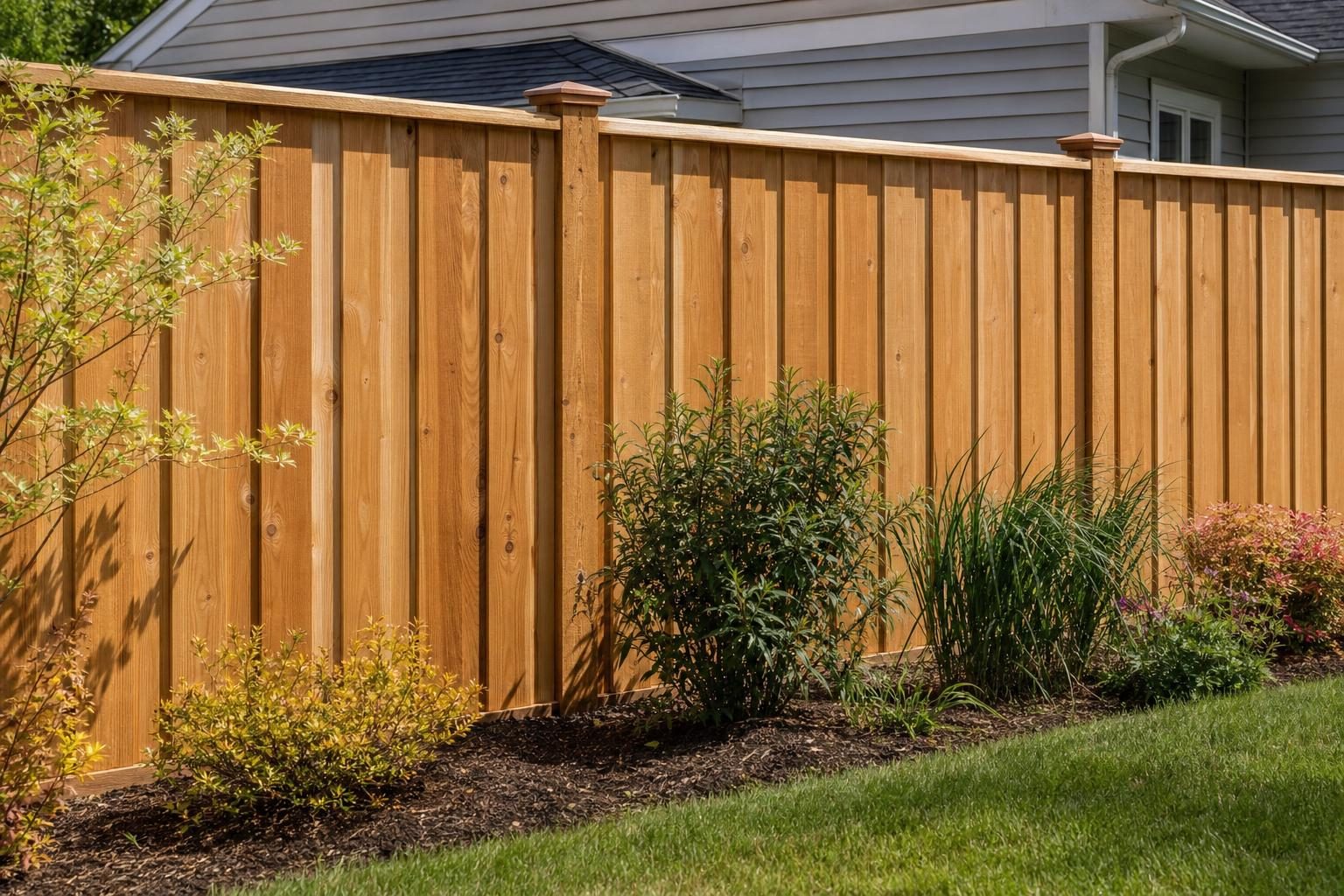
A wood privacy fence costs less upfront and is easy to repair board by board, but it needs stain or sealer every few years and its posts eventually rot. A good vinyl privacy fence costs more to install and needs little more than washing, but cheap vinyl can crack, yellow, or blow out in wind, and damaged panels are harder to match. Which one is the better deal depends mostly on how long you’ll stay, your climate, and whether you’ll actually keep up with maintenance.
Quick answer: Choose pressure-treated wood if budget comes first, cedar if you want a natural look and are willing to stain it or let it go gray, and quality vinyl if you plan to stay 15 years or more and want the lowest upkeep. Expect roughly $25–$45 per foot installed for 6-foot pressure-treated wood, $35–$65 for cedar, and $35–$65 for vinyl. Whatever you choose, the posts and how they’re set matter more than the boards.
Part of our Complete Fence and Privacy Guide: materials, costs, rules, installation and plant screens in one place.
Wood vs vinyl at a glance
| Wood (pressure-treated or cedar) | Vinyl (PVC) | |
|---|---|---|
| Installed cost, 6 ft privacy | About $25–$45/ft treated pine; $35–$65/ft cedar | About $35–$65/ft |
| Typical lifespan | Roughly 10–25 years, limited by posts and upkeep | Often 20–30+ years for quality product |
| Maintenance | Clean and re-stain or seal every 2–5 years; replace warped boards | Wash once or twice a year; little else |
| Repairs | Easy: swap a board or rail with lumber-yard parts | Need matching parts from the same product line |
| Wind | Boards can crack or posts lean; repairs are piecemeal | Panels can pop out of posts in strong gusts |
| Look | Natural, can be stained any color, weathers to gray | Clean and uniform; some find it plasticky |
| Weak spots | Rot at ground level, warping, insects | Cracking on impact (worse in cold), mildew film, cheap grades yellowing |
Prices are rounded US ranges that vary by region, height, slope, and site access. For a deeper breakdown of fence pricing, gates, and permit rules, see our fence installation cost guide.

Upfront and lifetime cost
On a 150-foot backyard run, a pressure-treated wood privacy fence usually comes in around $3,750 to $6,750 before gates, while cedar and vinyl both land around $5,250 to $9,750. Homeowners comparing quotes often find wood at roughly half to two-thirds of the vinyl price in their area, though cedar narrows that gap.
Over time, the numbers move. Professional staining or sealing commonly runs a few dollars per linear foot each round, so 150 feet might cost several hundred to over a thousand dollars every few years if you hire it out. Doing it yourself costs a weekend and the stain. Wood boards and posts also get replaced individually as they fail.
Vinyl’s maintenance cost is close to zero: a hose, a soft brush, and mild soap. Its risk is concentrated in a few events, like a storm that pops panels, a mower that cracks a rail, or a product line that gets discontinued before you need parts.
A rough rule: if you’ll be in the house less than about eight to ten years, wood usually costs less overall. If you’ll stay much longer and won’t keep up with staining, quality vinyl often comes out ahead.
Wood: species and styles

Pressure-treated pine
The budget choice. It’s strong and widely available, but it’s often installed wet and shrinks, twists, and checks as it dries. Wait for it to dry, often a few months, before staining. Posts should be rated for ground contact; the American Wood Protection Association sets the use categories that appear on lumber tags, and fence posts fall in the ground-contact group. Penn State Extension notes that treated posts typically last about 10 to 25 years depending on soil and treatment quality, and several times longer than untreated wood.
Cedar
Western red cedar is the most common upgrade. It’s lighter, more stable, and naturally decay resistant, and it weathers to a silver gray if left unfinished. That resistance lives in the heartwood: a USDA Forest Products Laboratory note on decay resistance explains that heartwood resists decay while sapwood does not, and today’s second-growth lumber is generally less durable than old-growth. In practice, many builders pair cedar boards with pressure-treated or steel posts, because cedar posts in wet soil can rot surprisingly fast.
Redwood
Beautiful and decay resistant when it’s mostly heartwood, but pricey and hard to find outside the West. Lower grades with lots of light-colored sapwood don’t hold up much better than other softwoods.
Board-on-board vs shadowbox vs side-by-side
- Side-by-side (stockade style): Boards butted edge to edge. Cheapest, but gaps open up as boards shrink.
- Board-on-board: Boards overlap, so shrinkage doesn’t create see-through gaps. Full privacy and looks finished on both sides, but uses more lumber and catches more wind.
- Shadowbox: Boards alternate on each side of the rail with a gap. Looks the same from both sides and lets air through, which helps in breezy spots, but you can see through at an angle.
Vinyl: what separates good from cheap

Most vinyl complaints trace back to thin, low-grade product. Two fences that look identical in a showroom can perform very differently after a few winters. What to ask about:
- Wall thickness. Better privacy systems commonly use posts around 0.13 to 0.15 inches thick, with thinner rails and pickets. Ask for the numbers in writing.
- UV protection. Quality vinyl uses UV inhibitors, typically titanium dioxide in the outer layer, to resist yellowing and chalking. Early and bargain vinyl was known for cracking and discoloring.
- Reinforced bottom rails. An aluminum or steel insert in the bottom rail stops sagging and helps panels stay locked in during wind.
- Standards and warranty. Ask whether the product is tested to the ASTM standard for vinyl fence profiles and what the warranty really covers: many cover the material, not the installation, and some exclude wind or impact damage.
- Big-box vs fence supplier. Identical model numbers are usually the same product, but some stores carry private-label lines with different specs. Compare thickness and reinforcement, not just the price per panel.
- Parts availability. Ask how long the line has been made and whether replacement panels will be available. Matching a discontinued profile or color later can be difficult.
Wind, sun, and cold
Wind
A solid 6-foot privacy fence is basically a wall catching wind, whatever it’s made of. Wood usually fails by posts leaning or boards cracking. Vinyl often fails by rails popping out of the posts in a big gust; some systems are designed that way so the posts survive and panels can be reseated. If panels keep blowing out along the same run, rail stiffeners and deeper, concrete-set posts are the usual fix. In windy areas, shadowbox wood, a lattice top, or closer post spacing reduces the load.
Sun and heat
Strong sun is hard on both. Wood dries, grays, and checks without finish. Low-grade vinyl yellows or turns chalky. There are scattered reports of concentrated reflections from energy-efficient windows softening nearby vinyl; window makers say it’s rare, but if a neighbor’s large windows face your fence line, it’s worth noticing. Darker vinyl colors absorb more heat than white or tan.
Cold
Vinyl stiffens in cold weather, and a hit from a snowblower, a thrown chunk of ice, or a ball can crack it more easily in January than in July. Wood shrugs off impacts but suffers in places with lots of freeze-thaw and wet soil, where posts rot or heave.
Humid and shady yards
Both materials grow mildew or algae on shaded, damp sides. On vinyl it shows up as a green or gray film that washes off; on wood it shows as dark, blotchy staining and can speed up decay. If part of your fence line stays wet, plan for more cleaning there.

Problems homeowners run into
- Wood fences going gray and blotchy in a few years when they’re never sealed. Some owners like the silver look; others find it mottled and wish they’d stained it early.
- Posts rotting off at the ground while the boards still look fine, often where concrete stopped below grade and held water against the wood.
- Treated pine twisting and pulling fasteners as it dries, leaving waves in a fence that started straight.
- Vinyl panels blowing out after storms, especially with thin rails and no reinforcement.
- Cracked vinyl rails from string trimmers, mowers, and cold-weather impacts, and trouble finding matching replacements.
- “Too shiny” vinyl that some homeowners and neighbors feel looks out of place next to plantings.
- Mismatched expectations about upkeep: people who chose wood for the price but never budgeted for staining.
Composite, aluminum, and living screens
Composite fencing blends wood fiber and plastic. It doesn’t rot or need stain and looks more like wood than vinyl does, but it’s heavy and usually the most expensive of the privacy options, often $50 to $90 per foot installed. Many systems use metal posts, which also removes the rot problem. If you’re weighing composite for a deck too, our deck installation cost guide covers how those boards hold up.
Aluminum fencing is nearly maintenance-free and handles slopes well, but it’s see-through. It works when you need a boundary or pool barrier and are willing to add privacy with plants.
Living screens can do some or all of the work. A row of evergreens takes years to fill in but softens a fence line and blocks views above fence height. Our evergreen screen ideas, privacy landscaping guide, and privacy ideas for small yards cover plant choices and spacing. For patios and side yards where a full fence won’t fit, see outdoor privacy solutions.
How to decide

- Check the rules first. HOAs often specify material and color, and towns set height limits and require the finished side to face out.
- Be honest about upkeep. If you won’t stain wood every few years, either plan to let cedar weather naturally or choose vinyl or composite.
- Think about how long you’ll stay. Short stay favors wood; long stay favors quality vinyl.
- Match your climate. High wind favors shadowbox wood or well-reinforced vinyl; harsh cold makes vinyl more prone to impact cracks; wet soil makes post choice critical.
- Get comparable bids. Ask each installer for post size, depth, spacing, board or panel specs, and warranty in writing. Our guide on how to compare landscaping quotes helps line them up.
- Consider resale and neighbors. Either material in good condition reads as a plus to buyers; a leaning, faded, or cracked fence reads as a project. Our article on whether landscaping increases home value covers how buyers see outdoor upgrades.
Questions to ask the installer
- For wood: what species and grade, are posts rated for ground contact, and when should I first stain it?
- For vinyl: what brand and product line, what post and rail wall thickness, is the bottom rail reinforced, and how long will parts be available?
- How deep are posts set, in what, and how is concrete finished at ground level?
- What does the warranty cover on materials versus workmanship, including wind damage?
Red flags in a fence bid
- Vinyl quoted with no brand, product line, or wall thickness.
- Wood quoted as “treated” without saying the posts are ground-contact rated.
- Pressure to sign today, or a big deposit before materials are ordered.
- A price far below other bids, which often means thinner vinyl, wider post spacing, or shallower holes.
Frequently asked questions
Is vinyl fence cheaper than wood in the long run?
Often, if you stay long enough. Vinyl costs more to install but needs almost no paid maintenance. Over 15 to 20 years, the cost of repeated staining and board or post replacement on wood can close the gap or reverse it, especially if you hire out the upkeep.
How long does a wood privacy fence last?
Commonly about 10 to 25 years. Pressure-treated posts in well-drained soil and cedar boards that are kept sealed sit at the long end; untreated sapwood, wet soil, and no maintenance sit at the short end.
Does vinyl fence crack in cold weather?
Vinyl gets stiffer in cold temperatures, so a hard impact is more likely to crack it in winter. Normal temperature swings don’t usually damage good-quality vinyl, but thin, low-grade products are more vulnerable.
Which is better for privacy, board-on-board or shadowbox?
Board-on-board gives fuller privacy because the overlapping boards hide gaps as wood shrinks. Shadowbox looks solid straight on but can be seen through at an angle; its advantage is better airflow in windy spots.
Can you paint or stain a vinyl fence?
It’s possible with paints made for vinyl, but it adds the maintenance vinyl was chosen to avoid, and darker colors can make vinyl absorb more heat. Many manufacturers’ warranties don’t cover painted fences, so check first.