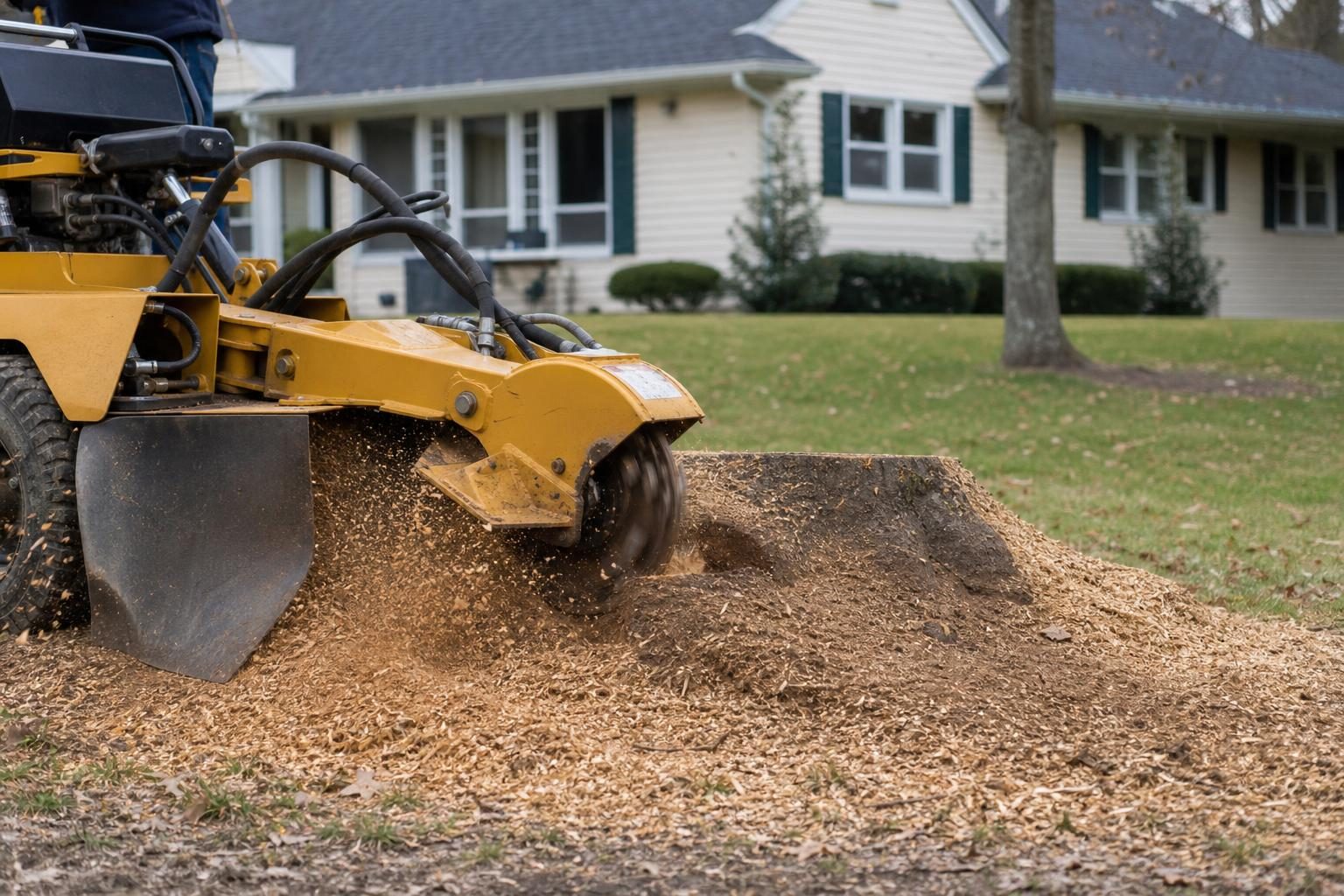
For most yards, the best way to remove a tree stump is to have it ground out. A professional grinder chews the stump and its main surface roots into chips in under an hour, usually for $100 to $400. Stump dissolver products and letting a stump rot are cheap, but they take months to years, not weeks.
This guide compares the options honestly, explains what grinding really costs, when renting a grinder makes sense, and what to do with the hole and the pile of chips afterward.
Quick answer: Grinding is the fastest, most reliable option for most stumps. Pros typically charge about $2–$5 per inch of diameter with a $100–$150 minimum, so a single average stump runs about $150–$400. Full extraction is only worth it if you’re building or planting right on that spot. Chemical stump removers only speed up rotting and still take a year or more. Call 811 before any grinding or digging.
Part of our Complete Tree Care Guide: pruning, removal, stump grinding, costs and hiring an arborist in one place.
Your three options compared
There are really three ways to get rid of a stump: grind it, pull it out, or let it rot (with or without help). Here’s how they stack up.
| Method | How long it takes | Rough cost | Best for |
|---|---|---|---|
| Professional grinding | 15–90 minutes per stump | $100–$400 per stump; less per stump for several | Most lawns and beds where you want the stump gone fast |
| DIY grinding (rental) | Half a day to a full day | About $100–$450 per day plus transport and fuel | Several small-to-medium stumps, a capable DIYer with a truck |
| Full extraction (excavator or digging) | A few hours plus fill | $300–$1,000+ per stump | Building a patio, foundation, or driveway on the spot; small shrub stumps by hand |
| Chemical stump remover | Usually 1–3 years before it breaks apart | $10–$30 per product, plus a drill bit | Out-of-the-way stumps where time doesn’t matter |
| Natural decay | Several years to a decade or more | Free | Wooded or back-corner spots; can be disguised with a planter |
Costs are rounded national ranges and vary by region, stump size, wood species and access.
Stump removal cost
Most grinding companies price by the stump’s diameter, measured across the widest point at ground level (including the flare where roots spread out). South Dakota State University Extension notes that this per-inch pricing is standard, and that chip removal and backfilling are usually not part of the base price.

| Stump diameter | Typical professional grinding cost |
|---|---|
| Under 12 in | $100–$150 (usually the company’s minimum charge) |
| 12–24 in | $100–$250 |
| 24–36 in | $150–$400 |
| Over 36 in | $300–$700+ |
| Each additional stump, same visit | Often noticeably less than the first |
| Chip removal and topsoil backfill | Commonly $50–$200 extra, if offered |
| Surface root grinding | Sometimes extra, priced by the foot or hour |
Prices go up for hard woods like oak, very old dry stumps, stumps on slopes, and backyards the machine can’t reach easily. Most companies have a minimum charge, which is why one small stump costs nearly as much as a medium one. If a tree is coming down anyway, having the stump ground in the same visit is usually the cheapest route. Our tree removal cost guide covers how to get that written into the quote.

How stump grinding works
A stump grinder has a heavy spinning wheel lined with carbide teeth. The operator sweeps it side to side across the stump, lowering it a few inches at a time, until the wood is chewed below ground level. What’s left is a hole filled with a mix of wood chips and soil.
- Depth. A standard grind goes about 6 to 12 inches below grade. That’s enough for lawn. If you plan to plant a shrub or tree there, or lay pavers, ask for a deeper grind and get the depth in writing.
- Surface roots. Big trees often have roots running along the surface for several feet from the trunk. Grinding those is usually a separate charge, so mention them up front if they trip your mower.
- What stays behind. Grinding does not remove the whole root system. Deeper roots decay slowly over the next several years, which is why the ground can settle.
- Utilities. Shallow gas, water, sewer, irrigation and cable lines often run near trees. Grinding counts as digging in many states, so call 811 a few business days ahead. It’s free, and utilities mark their lines. Private lines like irrigation and landscape lighting aren’t marked, so point those out yourself.
Stump dissolvers: what to really expect
“Stump dissolver” is a hopeful name. Most stump remover granules are potassium nitrate, a fertilizer. You drill holes in the stump, pour in the granules with hot water, and wait. The nitrogen helps fungi and bacteria break down the wood faster, but it doesn’t melt anything.
University of Illinois Extension explains that potassium nitrate mainly dries the wood out (traditionally so it burns more easily), and that chemical treatments speed decay only modestly. SDSU Extension describes a similar do-it-yourself version using any slow-release fertilizer, and estimates one to three years before the stump is soft enough to break apart with a spade or axe.
Realistic expectations:
- Small, already-dead stumps respond best. Large, freshly cut hardwood stumps can look almost unchanged after a year.
- Drill wide, deep holes (about 1 inch wide and 8 to 10 inches deep, a few inches apart), keep the stump moist, and cover it with a tarp or mulch to hold moisture.
- Some homeowners report seeing little difference after several seasons. Treat a dissolver as a “no rush” option.
- Burning a treated stump is often suggested online, but stumps can smolder underground along roots for days, and many towns don’t allow open burning. It’s not worth the risk in most yards.

Rent a grinder or hire a pro?
Renting looks cheaper until you add it up. Rental stores typically charge about $100 to $450 per day depending on machine size, plus a deposit, fuel and a way to tow or load it. Homeowner-size machines are much slower than the large hydraulic grinders professionals use.
- Hire a pro for one or two stumps, any stump over about 24 inches, hardwood stumps, stumps near the house, fences or utilities, or if you’ve never run one before.
- Consider renting if you have many small-to-medium stumps, you’re comfortable with heavy equipment, and you can transport a machine that may weigh several hundred pounds.
Safety matters here. Grinders throw chips and rocks hard enough to break windows and injure bystanders. Wear eye and ear protection, long pants, and steel-toe boots. Clear rocks from around the stump, keep kids and pets well away, and never reach near the wheel while it’s spinning. Rental staff can walk you through the controls, but ask for a demonstration before you leave the store.
After grinding: the hole, the chips and replanting

The job isn’t quite done when the grinder leaves. You’ll have a mound of chips mixed with soil, often several wheelbarrow loads from one large stump.
What to do with the chips
Wood chips are great mulch for paths and around shrubs. They’re not great as the soil under new grass. As wood breaks down, it ties up nitrogen, which can leave new grass or plants pale and weak. Purdue Extension recommends replacing the stump area with soil and using a slow-release fertilizer if you’re planting turf. Use the extra chips in beds; our mulch depth guide shows how thick to spread them.
Filling the hole
- Rake out as many chips as you can, down to the bottom of the grind.
- Fill with screened topsoil, firming it in layers as you go.
- Mound the fill an inch or two above the surrounding grade, because it will settle.
- Seed or sod. Seed works fine on small patches; our sod vs. seed guide helps you choose.
- Expect to top up the spot once or twice over the next year or two as roots underneath rot away.
For the difference between topsoil and amended soil for the fill, see our soil amendment vs. topsoil guide.
Can you plant a new tree in the same spot?
You can, but it’s easier a few feet away. The old root mass rots under the new tree, which can cause settling and uneven soil. If it has to be the same spot, ask for a deep grind (at least 12 to 18 inches), remove all the chips, and refill with good soil before planting. Our planting installation guide covers prepping a planting hole properly.
When full extraction makes sense
If you’re putting a patio, walkway, shed footing or driveway right where the stump is, rotting roots underneath can cause dips and cracks later. In that case, pull the stump and main roots with an excavator. Our guide to excavation companies explains what that work involves.
Stumps that keep sprouting
Some trees, like maples, willows, poplars, locusts, sweetgum and many fruit trees, send up suckers from the stump or roots after they’re cut. Grinding usually takes care of it, but shallow roots can still sprout for a season or two.
- Cut or mow sprouts as soon as they appear. Repeated cutting drains the roots’ energy.
- On a freshly cut stump, Illinois Extension suggests applying a herbicide labeled for stumps (glyphosate or triclopyr) to the outer ring of living wood right after cutting. Follow the label exactly.
- Don’t spray suckers coming up near a tree you want to keep. Roots of the same species can be connected, and herbicide can travel.

Problems homeowners run into
- A sinking spot in the lawn. Months after grinding, the patch sinks into a dip as chips and roots decompose. Removing chips and over-filling with soil prevents most of it.
- Grass that won’t grow over the stump. Usually caused by seeding directly into a mix of wood chips. Replace the top several inches with topsoil.
- “Grinding” that left the stump at ground level. Some quotes only grind flush. Ask for the depth in writing.
- A mountain of chips nobody hauled away. Cleanup is often extra. Decide in advance whether you want the chips.
- Damaged irrigation or shallow lines. Sprinkler lines and landscape lighting wires are often wrapped around stumps. Flag them before the grinder arrives.
- Dissolver disappointment. Many homeowners use stump remover and still have a stump a year later. Plan to finish with a grinder or an axe once it softens.
Questions to ask a stump grinding service
- How do you price: per inch, per stump, or by the hour? What’s your minimum?
- How deep will you grind, and will you grind the surface roots?
- Do you haul away chips and backfill with topsoil? What does that cost?
- Will you call 811, or should I?
- Can your machine fit through my gate? (Many compact grinders need around 3 feet.)
- Are you insured if a rock goes through a window or the grinder damages a line?
To line up several bids, see our guide on comparing landscaping quotes.
Frequently asked questions
What is the best way to remove a tree stump?
For most homeowners, professional stump grinding. It’s fast, fairly inexpensive, and leaves the area ready for soil and grass the same day. Extraction is better only when you’re building on the spot.
How much does stump grinding cost?
Usually about $2 to $5 per inch of diameter, with a minimum around $100 to $150. A single average stump typically costs $150 to $400. Several stumps in one visit lower the price per stump.
Do stump dissolvers actually work?
They help wood rot somewhat faster, but slowly. Expect a year or more before a treated stump is soft enough to break up, and large hardwood stumps may take longer. They don’t dissolve stumps in weeks.
How deep do stump grinders go?
Typically 6 to 12 inches below the soil surface, which is enough for lawn. Ask for 12 to 18 inches if you’re replanting in the same spot.
Is it OK to leave a tree stump?
Often, yes. Stumps away from the house can be left to rot or used as a planter base. The downsides are tripping and mowing hazards, sprouting, and, in some areas, attracting wood-boring insects.
Do I need to call 811 before stump grinding?
Yes, in most cases. Many states treat stump grinding as digging, and utility lines often run near trees. The call is free, and it protects you from a costly or dangerous strike.