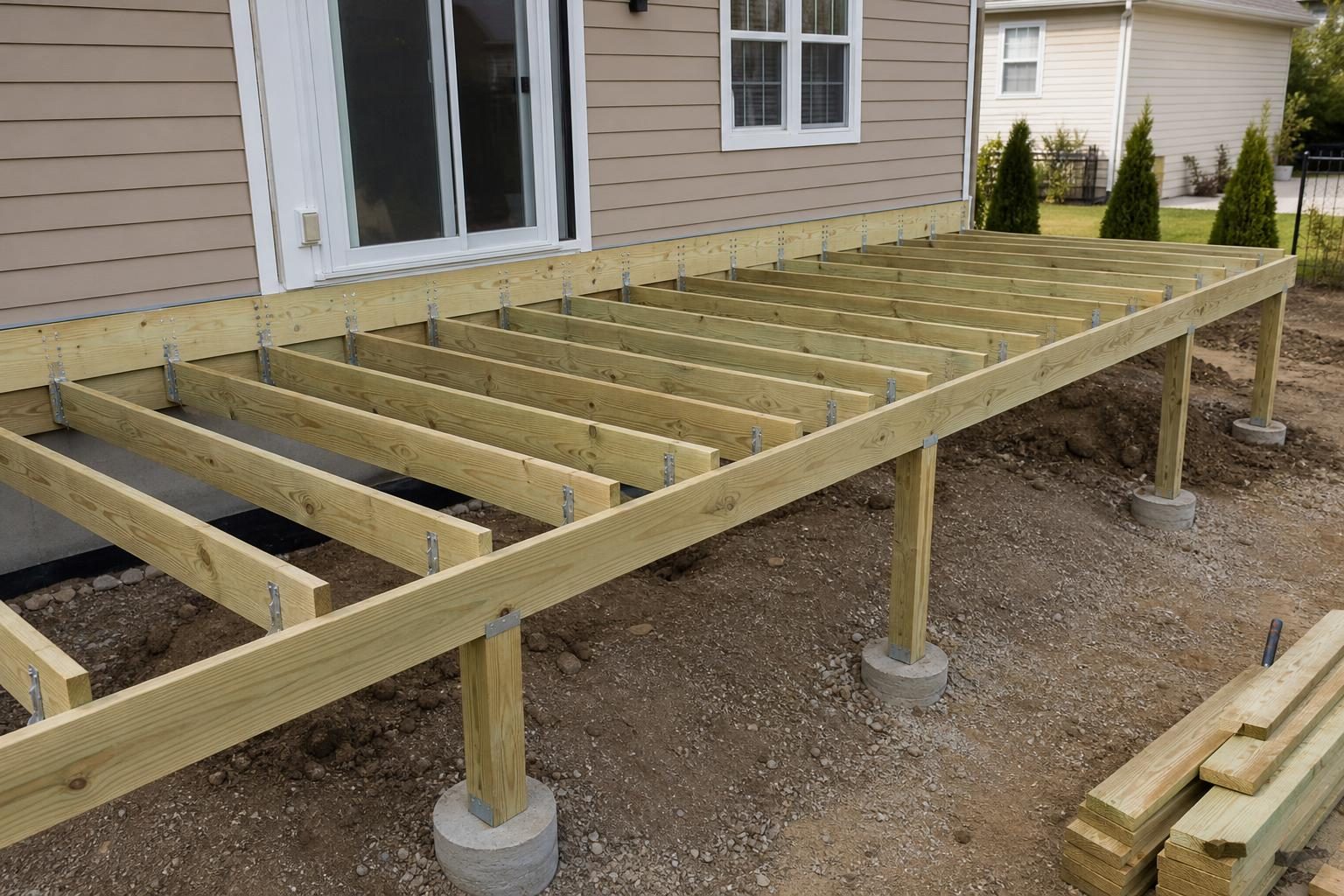
A professionally built deck usually costs about $25 to $45 per square foot in pressure-treated wood and roughly $45 to $75 or more per square foot in composite or PVC, installed. For a common 16×20 deck, that puts most homeowners somewhere between about $8,000 and $24,000, before upgrades like premium railings, lighting, or a tall second-story frame.
The boards are what you see, but what keeps you safe is underneath: footings, the ledger connection to your house, its flashing, and the railings. This guide covers what a deck costs and what to check so the money goes into a deck that lasts.
Quick answer: Budget roughly $25–$45 per square foot for a simple, low pressure-treated deck, $35–$55 for cedar, $45–$75 for composite, and $55–$90 for PVC, installed. A 12×12 deck often runs about $3,600–$10,800 and a 16×20 about $8,000–$24,000 depending on material. Height, stairs, railings, and footings move the price as much as the boards do. Whatever you pick, insist on a permit, footings below your frost line, a properly bolted and flashed ledger, and railings at least 36 inches tall.
Part of our Complete Patio and Paver Guide: materials, costs, installation, repair and hiring in one place.
Deck cost per square foot by material
Most deck builders quote either per square foot or as a lump sum built from framing, decking, railing, stairs, and permit lines. The ranges below are rounded US installed prices for a simple, single-level deck a few feet off the ground with basic stairs. They include framing and labor. Your local numbers can land well above or below these depending on region, labor market, and site access.
| Decking material | Typical installed cost per sq ft | What to know |
|---|---|---|
| Pressure-treated pine | $25–$45 | Lowest upfront cost. Needs cleaning and sealing every year or few years. Prone to checking, splitting, and warping. |
| Cedar (or redwood in the West) | $35–$55 | Nicer look and naturally rot-resistant heartwood, but softer and still needs regular finishing. |
| Composite | $45–$75 | Often about double the cost of the same deck in pressure-treated wood. Low maintenance, but heavier and slower to install. |
| PVC (cellular vinyl) | $55–$90 | Lightest and most moisture-proof synthetic. Usually the priciest boards. Expands and contracts noticeably with temperature. |
| Tropical hardwood (ipe and similar) | $50–$100+ | Very dense and long-lasting, but hard to work and needs predrilling. Few crews specialize in it. |
One thing that surprises many homeowners: even a composite or PVC deck almost always sits on pressure-treated wood framing. Choosing synthetic boards changes the surface, not the structure, so framing quality matters just as much on an expensive deck as on a budget one.
Lumberyard prices look much cheaper because they leave out footings, labor, hardware, flashing, railing, and permits. Framing labor alone often adds $9 to $12 per square foot, according to HomeAdvisor’s deck cost data.
Cost examples by deck size
Small decks cost more per square foot because stairs, the ledger, permits, and setup are the same no matter the size. These rounded totals assume a simple rectangle under about 4 feet high with one short set of stairs and standard railing.
| Deck size | Area | Pressure-treated | Composite |
|---|---|---|---|
| 10×10 | 100 sq ft | $3,000–$5,000 | $5,000–$8,000 |
| 12×12 | 144 sq ft | $3,600–$6,500 | $6,500–$10,800 |
| 12×16 | 192 sq ft | $4,800–$8,600 | $8,600–$14,400 |
| 16×20 | 320 sq ft | $8,000–$14,400 | $14,400–$24,000 |
| 20×20 | 400 sq ft | $10,000–$18,000 | $18,000–$30,000 |
Homeowners comparing quotes often report composite bids around $55 to $75 per square foot once aluminum railing and stairs are included. Second-story, multi-level, or railing-heavy decks can run well past these ranges.

What drives the price
Two decks with the same square footage and the same boards can differ by thousands of dollars. These are the usual reasons.
- Height. A deck more than about 30 inches off the ground needs guardrails, more bracing, longer posts, and often bigger footings. Second-story decks also need scaffolding or lifts.
- Stairs. A few steps to the yard is inexpensive. A tall run of stairs with a landing, handrails on both sides, and its own footings can add a few thousand dollars.
- Railings. Railing is priced per linear foot and is one of the biggest swing items. Wood or basic composite railing is at the low end. Aluminum, cable, and glass systems can cost several times as much per foot.
- Footings. Cold climates need footings that reach below the frost line, which can mean digging 3 to 4 feet or more. Rocky soil, hand-digging in tight yards, or helical piles add cost.
- Ledger attachment and flashing. Bolting a ledger to the house means removing siding, installing flashing, and fastening into solid framing. Brick veneer, stucco, cantilevered floors, or engineered floor joists can force a freestanding design instead, which needs an extra beam and row of footings.
- Demolition. Tearing out and hauling away an old deck often runs about $5 to $15 per square foot. Rot discovered behind the old ledger can add repair work to the house itself.
- Design and extras. Diagonal or picture-frame decking, curves, benches, lighting, and skirting all add labor and framing.
- Permits and drawings. Permit fees are often a few hundred dollars, but some areas also want stamped drawings or a site plan.
Safety details people overlook

Deck failures are rarely about the boards. They usually happen at connections: where the deck meets the house, where posts meet footings, and where railings attach. The American Wood Council’s DCA 6 prescriptive deck guide is the reference many building departments use, and it is free to read. Here’s what to look for in plain terms.
Ledger fastening
The ledger is the board bolted to your house that carries one side of the deck. It should be fastened with half-inch through-bolts, lag screws, or approved structural screws in a staggered pattern, never with nails alone. It should attach to the house’s solid rim joist, not over siding and not to brick or stone veneer.
Flashing behind and above the ledger
Water that gets behind a ledger rots the house framing slowly and invisibly. Fine Homebuilding’s ledger flashing guide shows the layered approach pros use: membrane on the wall, flashing that laps over the top of the ledger, and siding that sheds water onto it. Plain galvanized flashing can corrode against modern treated lumber, so ask what material your builder uses.
Lateral load connection
Beyond holding weight up, an attached deck has to resist being pulled away from the house sideways. Current residential code calls for hold-down hardware connecting the deck joists to the house floor framing. Many older decks don’t have it, so if you are replacing boards on an existing deck, this is worth adding.
Footing depth below the frost line
Footings must bear on undisturbed soil below your local frost depth so the deck doesn’t heave in winter. That can be 12 inches in mild climates and 42 inches or more in places like Minnesota. Your building department will tell you the number.
Railing height and strength
Most residential codes require guards at least 36 inches tall where the deck surface is more than 30 inches above the ground, with openings small enough that a 4-inch sphere can’t pass through. A railing that wobbles when you lean on it is a warning sign no matter how tall it is.
Framing lumber rated for the job
Treated lumber comes in different ratings. Many builders now use ground-contact-rated lumber for joists, beams, and ledgers because they are hard to replace, and add joist tape on top to keep water out of fastener holes.
Permits and inspections
In many places a deck needs a permit if it is attached to the house or more than 30 inches above the ground, and some cities require one for any deck. Our permit guide for landscaping projects explains how to check your local rules. A typical permit process looks like this:
- Submit a plan. Usually a site plan showing setbacks to property lines, plus a framing plan with joist sizes, spacing, beam spans, footing sizes, and the ledger detail.
- Footing inspection. The inspector checks the holes before concrete is poured, confirming depth and that the bottoms are clean and undisturbed.
- Framing inspection. Done before the decking goes on, so the inspector can see the ledger, flashing, hangers, and hold-downs.
- Final inspection. Railings, stairs, handrails, and anything left over get checked once the deck is complete.
Skipping the permit can come back at you when you sell. Buyers’ inspectors can flag an unpermitted deck, and sellers may be asked to permit it after the fact, repair it, or lower the price. A contractor who suggests skipping the permit to save money is not doing you a favor.
Lifespan and maintenance
| Material | Typical lifespan | Routine care |
|---|---|---|
| Pressure-treated | About 10–20 years for the boards with good care | Wash and reseal or restain every 1–3 years, replace split boards |
| Cedar | About 15–20 years with regular finishing | Clean and refinish every 1–3 years |
| Composite / PVC | 25+ years for the boards; check the warranty terms | Wash a couple of times a year to prevent mildew and stains |

The framing usually sets the real lifespan. A deck with synthetic boards on poorly protected joists can outlive its frame, which is why joist tape, good flashing, and properly rated lumber matter. The North American Deck and Railing Association’s deck safety resources include a free homeowner checklist for a yearly look at railings, stairs, connections, and rot. Spring is a good time to walk it.

Deck or patio?
On flat ground, a patio is usually cheaper per square foot and lasts longer with less upkeep. A plain concrete patio often costs well under half of a composite deck, and a paver patio sits in between. Decks win when the back door is several feet above the yard, the lot slopes, or you want a level surface without major grading. Our patio vs deck guide walks through the trade-offs in more detail.
If you want shade over the deck later, plan for it now. A pergola or patio cover puts extra load on posts and footings, and it’s much easier to size the structure for that up front.
Problems homeowners run into
- Rot found during tear-out. When an old deck comes off, homeowners often find the ledger was never flashed and the house rim joist or sheathing behind it has rotted. That repair isn’t in the deck price unless the bid says so.
- Ledger mounted over siding. Some decks were bolted straight through vinyl siding with no flashing, leading to wet, moldy framing inside the basement wall.
- Composite that gets hot. Dark composite and PVC boards in full sun can get uncomfortably hot for bare feet. Lighter colors, shade, or a cover help.
- Sagging or wavy boards. Synthetic decking installed on joists spaced too far apart, especially on diagonal layouts, can sag between joists over time. Diagonal patterns usually need 12-inch joist spacing.
- Wood that checks and splinters. Pressure-treated boards often split and cup within a few years if they aren’t sealed. Many owners underestimate how much time ongoing maintenance takes.
- Big gaps between bids. Quotes for the same deck can differ by 50 percent or more, usually because one bidder priced better footings, flashing, or railing and another left them out.
Questions to ask and red flags in bids

Questions to ask a deck contractor
- Will you pull the permit, and who is responsible for scheduling inspections?
- How will the ledger be fastened and flashed, and what flashing material do you use with treated lumber?
- How deep will the footings go, and what is the frost depth here?
- What lumber rating will you use for joists, beams, and the ledger? Do you use joist tape?
- What joist spacing will you use with my decking, and does it meet the manufacturer’s instructions?
- How do you handle rot discovered behind the old deck, and how is that priced?
- Is the railing included, what system is it, and how tall will it be?
- Will the decking manufacturer’s warranty be valid with your installation method?
Red flags
- No permit, or a suggestion to skip it.
- Vague answers about how the ledger attaches, or plans to use nails into the house.
- A bid with no line for footings, flashing, or railing that looks far cheaper than the others.
- Footings that are just posts set in a shallow hole or blocks sitting on the dirt for an attached, raised deck.
- A large deposit before materials are delivered, with no written schedule.
- No proof of insurance or local license where one is required.
For a broader framework on comparing quotes line by line, see how to compare landscaping quotes, and for general hiring questions, questions to ask before hiring a landscaper.
Frequently asked questions
How much does a deck cost per square foot?
Roughly $25–$45 per square foot installed for pressure-treated wood, $35–$55 for cedar, $45–$75 for composite, and $55–$90 for PVC. Small, tall, or complex decks run higher per square foot. Prices vary by region, so get at least three local bids.
Is composite worth the extra cost?
It can be if you plan to stay a long time and don’t want to seal a deck every year or two. Composite usually costs about twice as much as pressure-treated upfront, but it saves on staining and board replacement. If you might move in a few years, a well-built pressure-treated deck is often the better value.
Do I need a permit to build a deck?
Usually yes if the deck attaches to the house or is more than about 30 inches off the ground, and some cities require one for every deck. Expect footing, framing, and final inspections. Check with your local building department before signing a contract.
Is a freestanding deck cheaper than an attached one?
Not usually. A freestanding deck skips the ledger and flashing, but it needs an extra beam and row of footings near the house. It’s often the right choice when the house has brick veneer, stucco, or framing that can’t safely take a ledger.
Can I put new boards on my old deck frame?
Sometimes, if the framing is sound, but check carefully first. Older decks often lack ledger flashing, lateral hold-downs, and proper joist spacing for synthetic boards. Have the ledger and posts inspected before spending money on new decking.