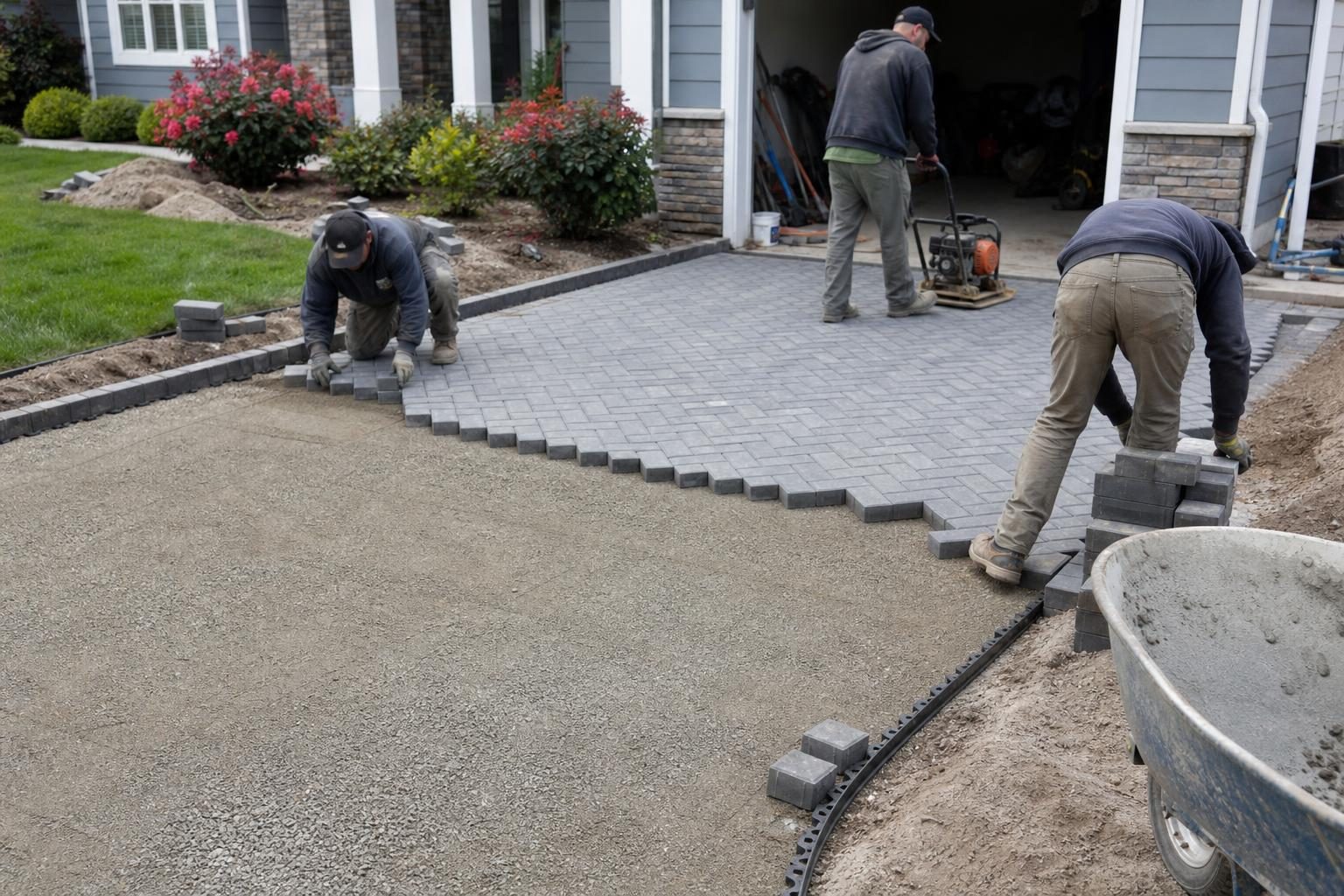
A paver driveway can outlast and outshine a poured slab, but only if it’s built like a road, not like a patio. That means a deeper compacted base, thicker pavers, a herringbone pattern that locks against turning tires, and a solid edge restraint. Expect to pay roughly $15 to $35 per square foot installed for concrete pavers, which is about two to three times the price of plain concrete or new asphalt.
Here’s what makes a driveway different from a patio, what it costs, and how pavers handle snow, salt, and oil.
Quick answer: A paver driveway needs at least 6 inches of compacted gravel base, and 8–12 inches is common on clay soils and in freeze-thaw climates. Many installers use 80 mm (3⅛-inch) pavers for driveways, laid in a 45° or 90° herringbone pattern with a strong edge restraint. Budget about $15–$35 per sq ft for concrete pavers, more for clay brick, permeable, or stone. A two-car driveway of about 600 sq ft often lands between $9,000 and $21,000, depending on region, tear-out, and site conditions.
Part of our Complete Driveway Guide: types, costs, installation, repair and hiring in one place.
How a paver driveway differs from a patio

A driveway carries two-ton cars that turn, brake, and park in the same spots every day. That changes almost every layer.
A thicker base
Industry construction guidance calls for a minimum of 6 inches of compacted aggregate base under a residential driveway, compared with 4 inches for a patio or walkway. Experienced installers in cold or wet regions often go to 8–12 inches, especially on clay soil, where water and frost do the most damage. The base goes down in thin lifts, each one compacted. For a driveway, a heavier plate compactor or a roller is worth asking about, because a small walk-behind compactor may not reach full density through a deep base.
Thicker pavers
Industry guidance sets 60 mm (2⅜ inches) as the minimum paver thickness for residential driveways, and 80 mm (3⅛ inches) for streets and parking areas. In practice, many hardscape contractors recommend 80 mm units for driveways that see heavier vehicles, plow trucks, or freeze-thaw cycles, and permeable paver driveways call for 80 mm units as a minimum. The extra thickness resists rocking and cracking under turning tires.
Shape and pattern
Long, thin pavers and large slabs are not built for vehicles. Paver guidance limits driveway units to a length no more than about four times their thickness, which rules out most large-format patio slabs. A 45° or 90° herringbone pattern gives the strongest interlock because each paver is locked by its neighbors in two directions, so it resists the twisting forces of turning wheels. A running bond laid in the direction of travel is the weakest choice for a driveway and tends to shift and open up over time.
Stronger edges
Driveway edges get driven over, so a light plastic edging spiked into a shallow base is often not enough. Common driveway restraints are a buried concrete edge or curb, or heavy-duty edging secured with long spikes into a base that extends past the paver edge. Where the driveway meets the street, many towns require a concrete apron, so check local rules before pricing an all-paver entrance.
Paver driveway cost vs concrete and asphalt
Rounded US installed prices for a new driveway on a properly prepared base. They vary a lot by region, soil, tear-out, and access, so use them for budgeting only.
| Driveway type | Typical installed cost per sq ft | About 600 sq ft (two-car) |
|---|---|---|
| Gravel | $2–$6 | $1,200–$3,600 |
| Asphalt (new) | $6–$12+ | $3,600–$7,200+ |
| Plain broom-finish concrete | $6–$12 | $3,600–$7,200 |
| Concrete with paver border or apron | Concrete price plus about $20–$40 per linear foot of border | Often $5,000–$11,000 |
| Concrete pavers | $15–$35 | $9,000–$21,000 |
| Clay brick pavers | $20–$45 | $12,000–$27,000 |
| Permeable pavers | $20–$45 | $12,000–$27,000 |
| Natural stone on a vehicular base | $30–$60+ | $18,000–$36,000+ |
What pushes a paver driveway toward the top of its range: removing an old concrete or asphalt driveway, poor soil that needs deeper excavation or geotextile fabric, slopes, curves, borders and inlays, and drainage work such as trench drains or piping downspouts away.
The concrete-and-paver combination is a popular middle ground. A poured concrete field with a paver border, a paver apron at the garage or street, or paver ribbons gives much of the look for a fraction of the cost. The trade-off is that you have two materials that move differently, so the joint between them needs to be detailed carefully. For a deeper side-by-side, see our concrete driveway vs pavers cost guide, the asphalt driveway cost guide, and our comparison of asphalt vs concrete driveways. If you’re leaning toward a slab after all, our walkthrough of the concrete driveway installation process shows what to expect.
Driveway paver installation, step by step

- Layout, permits, and utility locate. Mark the driveway, confirm apron and setback rules with your town, and call 811 before any digging.
- Tear-out and excavation. Remove any old surface and dig to the depth of the base plus bedding sand plus paver thickness. For a driveway, total excavation is often 10–16 inches.
- Prepare the subgrade. Compact the native soil. On soft or wet clay, a geotextile fabric is laid over the soil to keep the base stone from pushing down into it.
- Build the base in lifts. Spread crushed stone in layers of a few inches, compacting each one, until you reach the planned depth and slope. Driveways should shed water away from the garage and house.
- Set the edge restraint. Install the curb or heavy-duty edging on the compacted base.
- Screed the bedding sand. About 1 inch of coarse concrete sand, screeded flat. Thick sand is not a fix for a low base.
- Lay the pavers. Start from a straight reference line and work in herringbone. Make the edge cuts last.
- Compact and fill joints. Run a plate compactor over the surface, sweep joint sand in, compact again, and repeat until joints are full. Polymeric sand is common on standard pavers; permeable pavers use small clean stone instead.
A typical two-car paver driveway takes a professional crew about one to two weeks, longer with tear-out, drainage work, or bad weather. Unlike concrete, there’s no curing wait. You can usually drive on it as soon as the joints are filled, though polymeric sand needs dry weather to set.
Snow, salt, and oil stains
Snow plowing and shoveling
Pavers can be plowed and shoveled, but the surface needs to be flat and well compacted so a blade doesn’t catch a raised edge. Owners and plow operators commonly suggest raising the blade slightly, using a poly or rubber cutting edge or plow shoes, and setting snowblower skid shoes so the scraper doesn’t ride directly on the pavers. Grass pavers and open grids are much easier to damage with a plow than solid pavers.
Deicing salt
Dense, low-absorption concrete pavers generally hold up well in salt-heavy regions, and the pavers themselves don’t crack like a slab when the ground freezes. Even so, some manufacturers exclude deicer damage from their warranties, so read the warranty for the product you choose before winter. Shovel first and use deicers sparingly.
Oil and fluid stains
Fresh drips are much easier to remove than stains that have soaked in for weeks. Blot or cover a fresh spill with an absorbent such as cat litter, then use a degreaser or poultice made for pavers. Pressure washing rarely lifts embedded oil and can blow out joint sand. Sealing can make future stains easier to clean, but never seal over an existing stain, because it locks it in. If a paver is badly stained, the simplest fix is often to pull it and set a new one.
Permeable pavers and stormwater credits

Permeable interlocking pavers have wider joints filled with small, clean stone, so rain soaks through the surface into a deep base of open-graded stone instead of running into the street. The Concrete Masonry & Hardscapes Association’s permeable paver overview explains how the system reduces runoff and filters pollutants, and the US EPA has studied permeable pavers alongside porous asphalt and pervious concrete as stormwater tools.
What to know before choosing permeable pavers for a driveway:
- The base is different and usually deeper. It uses layers of washed, open-graded stone, often 12 inches or more in total, and the industry’s permeable paver construction tolerances guide calls for 80 mm pavers at minimum on driveways.
- It costs more up front. Expect a premium over standard pavers for the extra excavation and stone.
- It needs upkeep. Joints clog with sediment over time and need periodic vacuuming or sweeping and a refill of joint stone to keep draining.
- Credits are local. Some cities and counties with stormwater utility fees offer ongoing fee credits or rebates for permeable driveways, often with a minimum area, an application, and a maintenance commitment. Check with your local stormwater utility before you build, since rules and amounts vary and change.
If water already pools on your property, our guide to drainage cost vs property protection helps you decide how much to invest.
Lifespan and repairs
A well-built paver driveway can last for decades. The pavers themselves rarely wear out. What needs attention is the joint sand, which should be topped up when it drops, and any spot where the base was weak or water got in.
Repairability is the big advantage. If a section settles, a tree root lifts it, or a utility company needs to dig, the pavers can be pulled up, the base corrected and recompacted, and the same pavers relaid. As the CMHA’s homeowner guide to pavers vs concrete points out, that kind of repair blends in, while a patched concrete slab almost always shows. Keep a few boxes of spare pavers, since colors and product lines change.

Problems homeowners run into
- Ruts in the tire tracks. Grooves where the wheels run are the most common driveway-specific complaint. They almost always trace to a base that was too thin or not compacted enough, or bedding sand that was too thick. On an older driveway, the fix is lifting the pavers in the tracks, rebuilding the base, and relaying. On a new driveway, ruts within the first year or two should be a warranty call.
- Pavers shifting where cars turn. Running bond patterns and pavers without strong edge restraint tend to creep and open up at the turn into the garage or the curve near the street.
- Sinking near the garage or downspouts. Water dumping onto the driveway washes out joint and bedding sand. Downspouts should be piped away or into a drain.
- Edges breaking down. Tires that run off the side can crush a light plastic edging and push the outer row out of line.
- Weeds and joint sand loss. Joints slowly lose sand to washout, pressure washing, and plowing. Low joints let windblown seeds take root. Regular sweeping and a top-up of joint sand fix most of it.
- White haze. Efflorescence on new concrete pavers is a harmless natural deposit that usually fades on its own.
Questions to ask and red flags
Questions to ask a contractor
- How deep will the compacted base be on my soil, and will you use fabric?
- What compaction equipment will you use, and how thick is each lift?
- What paver thickness are you quoting, 60 mm or 80 mm, and why for my driveway?
- What pattern will you lay, and how will the edges be restrained?
- How will water drain away from the garage, and where will the downspouts go?
- What does your workmanship warranty cover for settling and ruts, and for how long?
- Can I see a paver driveway you built at least five years ago?
Red flags
- A driveway quote with the same base depth as a patio, or no depth at all
- Large-format patio slabs or thin pavers proposed for parking areas
- Running bond laid in the direction of traffic
- Light edging with no plan for the edges that cars will run over
- Pressure to sign quickly or a large cash deposit before materials are delivered
To compare installers, see our guides on how to choose a paving company and finding hardscape contractors near you. If you’re adding a matching walkway or patio, our paver installation cost guide covers patio and walkway pricing.
Frequently asked questions
Are paver driveways worth it?
They’re worth it if you value appearance and easy, invisible repairs and plan to stay long enough to benefit. They cost much more up front than concrete or asphalt. If budget is the main concern, a concrete driveway with a paver border or apron gets you part of the look for less.
Can you drive on pavers right after installation?
Usually yes. Unlike concrete, pavers don’t need to cure. Once the pavers are compacted and the joints are filled, the driveway can normally take traffic. If polymeric sand was used, follow the product’s dry time before heavy use or rain.
Do paver driveways crack in winter?
Individual pavers rarely crack, and the joints let the surface flex with freeze-thaw movement instead of breaking like a slab. Heaving and dips can still happen if the base is shallow or holds water, which is why cold-climate driveways get a deeper base.
What is the best pattern for a paver driveway?
A 45° or 90° herringbone is the strongest choice for vehicles because each paver interlocks in two directions. Borders and accents can use other layouts, but the main field where cars drive and turn is best in herringbone.
How do you get oil stains out of driveway pavers?
Act fast. Absorb fresh oil, then scrub with a degreaser or use a poultice made for pavers. Old, deep stains may not come out completely, and replacing the stained paver is often the cleanest fix.
How long does a paver driveway last?
With a good base and routine joint maintenance, many decades. Because pavers can be lifted and relaid, a paver driveway can often be repaired in sections rather than replaced all at once.