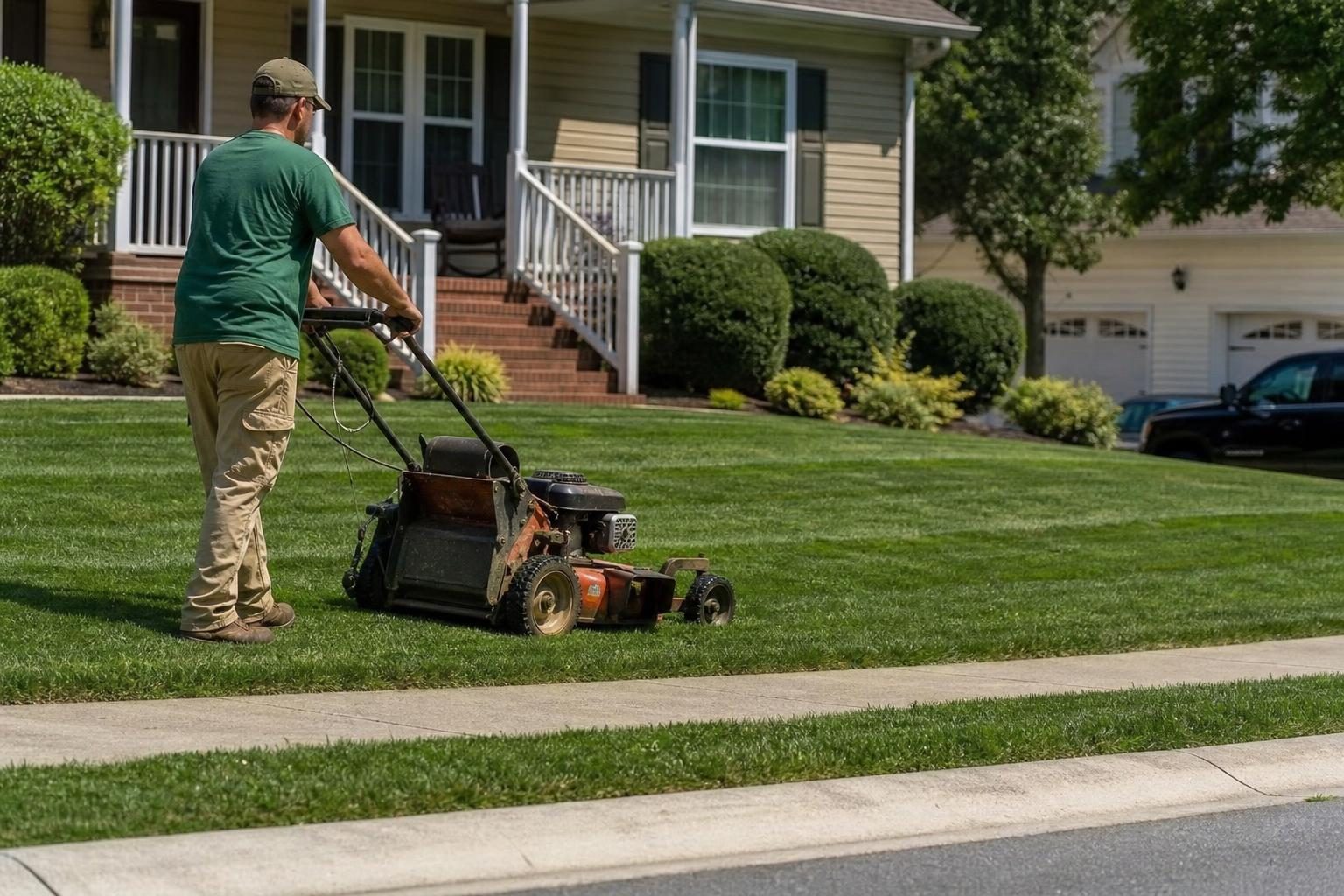
Lawn care cost depends on what you are actually buying. Mowing alone usually runs about $40–$70 per visit for a typical suburban lot under half an acre, while a fertilizer and weed control program commonly adds roughly $300–$700 a year. Add-ons such as aeration, leaf cleanup and grub control can raise the yearly total quickly.
This guide breaks down mowing prices by lot size, what a treatment “round” includes, typical add-on costs, contracts versus pay-per-visit, and how to compare lawn companies without getting stuck in a plan you did not want.
Quick answer: Expect roughly $40–$60 per mow for a quarter-acre lot, $50–$75 for up to half an acre and $60–$120 for up to an acre. Yearly mowing totals depend on how many weeks your grass grows: often $1,100–$1,800 in the North and $2,000–$3,000 in the South. A five-to-eight-round fertilizer and weed control program usually costs $50–$100 per round for an average lot. Prices vary widely by region, lot size, slope and access, so get two or three written quotes.
Part of our Complete Lawn Guide: seed vs sod, grass types, costs, care calendar and hiring in one place.
Lawn mowing cost by lot size
Most companies price mowing per visit based on lawn size, then adjust for slope, obstacles, gates and how much trimming there is. A standard visit usually includes mowing, string-trimming around obstacles, edging hard surfaces and blowing clippings off paved areas. Bagging clippings and hauling debris often cost extra.

| Lawn size | Typical price per mow | Notes |
|---|---|---|
| Small (under 5,000 sq ft) | $30–$50 | Many companies have a minimum charge around $30–$45 |
| Up to 1/4 acre | $40–$60 | The most common suburban lot |
| 1/4 to 1/2 acre | $50–$75 | More if there are many beds, trees or slopes |
| 1/2 to 1 acre | $60–$120 | Riding or stand-on mowers keep this from scaling linearly |
| 1 to 2 acres | $100–$250+ | Often priced by the hour or by the acre |
| First cut or overgrown lawn | $75–$150+ | Long grass takes extra passes and cleanup |
Rounded US ranges compiled from national pricing guides; your local market may be higher or lower. Some independent operators charge by the hour instead, often in the range of $35–$70 per hour for a one- or two-person crew.
Weekly vs every other week
Weekly service usually has the lowest price per visit. Biweekly can cost a little more per cut because the grass is longer and takes more time, and in peak spring growth some companies add long-grass fees. Biweekly still costs less overall, but cutting off too much at once can stress the lawn. If you go biweekly, ask whether the price changes during fast-growth months.
What a full year of lawn care costs
The biggest factor in your yearly bill is how many weeks your grass grows. A northern lawn may need 24 to 28 cuts a year; a lawn in the Gulf states or the desert Southwest may need mowing 40 weeks or more.
| Service level (1/4-acre lot) | Typical yearly cost | What it usually includes |
|---|---|---|
| Mowing only, northern season | $1,100–$1,800 | About 24–28 weekly visits |
| Mowing only, southern season | $2,000–$3,000 | About 40–45 visits |
| Treatment program only | $300–$700 | 5–8 fertilizer and weed control rounds |
| Mowing plus treatment | $1,500–$3,700 | Both, sometimes with a bundle discount |
| Full-service maintenance | $2,500–$6,000+ | Mowing, treatments, aeration, cleanups, bed care |
These are planning numbers, not quotes. Lots with steep slopes, narrow gates, heavy tree cover or lots of beds land at the high end. For how lawn care fits into other ongoing yard costs, see landscaping costs explained.
Fertilizer and weed control programs

Treatment companies sell programs in “rounds” or “applications,” usually five to eight a year. A typical cool-season program looks something like this:
- Early spring: crabgrass pre-emergent, often with light fertilizer.
- Late spring: fertilizer plus broadleaf weed control (dandelions, clover).
- Early summer: fertilizer, sometimes with grub prevention as an add-on.
- Summer: spot weed control, light or slow-release feeding.
- Early fall: fertilizer and weed control.
- Late fall: “winterizer” fertilizer.
Per round, expect roughly $50–$100 for an average suburban lawn and more for larger properties; southern programs with longer seasons often run more rounds and cost more. If you start mid-season, most companies simply begin at the next round in the calendar.
Round counts matter less than timing. Purdue’s turfgrass program advises cool-season lawns to be fertilized lightly in spring, very little in summer and most heavily in fall. That means an eight-round program is not automatically better than a four- or five-round one. Homeowners often report asking for fewer rounds and getting similar results for less money.
Add-on services and prices
| Service | Typical cost | Worth knowing |
|---|---|---|
| Edging and trimming | Usually included; $5–$20 if billed separately | Confirm it is in the mowing price |
| Bagging clippings | $5–$20 per visit | Leaving clippings returns nutrients; bag only when needed |
| Spring or fall cleanup / leaf removal | $150–$600+ | Heavy tree cover and haul-away push it higher |
| Core aeration | $100–$250 | See our lawn aeration guide for whether you need it yearly |
| Aeration plus overseeding | $150–$450+ | Seed type and amount drive the price |
| Grub control (preventive) | $60–$150 | Often sold separately from the base program |
| Lime or soil amendment | $50–$150 per application | Only useful if a soil test calls for it |
| Shrub trimming, bed weeding, mulch | Often $40–$75 per labor hour plus materials | Usually quoted separately |
Mulch and bed care can be a big part of a full-service bill; our mulch depth guide explains how much you actually need each year.

Contract vs pay-per-visit
Pay-per-visit gives you flexibility. You can pause during a drought, skip a week, or switch companies without a cancellation fight. It can cost a little more per visit, and you may lose your spot on the schedule in busy months.
Seasonal or annual contracts lock in a rate and a place on the route, and some include a discount for prepaying. The trade-off is the fine print. Many treatment programs automatically renew each year unless you cancel, and prepaid plans may have partial-refund rules.
Clemson’s Home & Garden Information Center recommends getting a written service agreement, not accepting a contract over the phone, and asking up front whether the contract auto-renews and how cancellation works. Federal rules on subscription cancellations have changed back and forth in recent years, so the terms in your contract and your state’s auto-renewal laws are what really protect you.
DIY vs hiring: the real comparison
Doing it yourself is cheaper in cash but not free. For a quarter-acre lawn, a rough first-year comparison:
Over a few seasons, DIY mowing typically saves well over $1,000 a year compared with weekly service. Treatment programs are a closer call: homeowners often find that bagged products cost nearly as much as an independent company’s rounds, and that the hard part of DIY is remembering the timing. A common middle ground is mowing yourself and hiring out treatments and aeration.
- Equipment: a good walk-behind mower ($300–$600), string trimmer ($100–$250), blower ($100–$250) and broadcast spreader ($50–$150). Battery tools cost more up front but less to maintain.
- Yearly running costs: fuel or batteries, blades, oil and tune-ups, often $50–$150.
- Products: four applications of fertilizer and weed control for 10,000 square feet commonly run $150–$300 a year in bags from a garden center.
- Time: usually one to two hours a week in season, plus a few weekend afternoons for treatments and cleanup.

Problems homeowners run into
- Billing after cancelling. One of the most common complaints in public reviews of treatment companies is a crew still showing up and billing after a homeowner thought they had canceled by phone. Cancel in writing and keep a copy.
- Surprise add-ons. Grub treatments, lime, “disease control” and aeration sometimes appear on the bill as extras the homeowner did not expect.
- Auto-renewal they forgot about. A program that renews every spring at a new rate.
- Mow-and-go crews. Scalping at too low a height, missed edges, clippings left on the driveway, or gates left open with pets inside.
- Price creep. Low first-year prices that rise once you are on the route, or long-grass fees on biweekly accounts.
- Wrong product for the grass type, or burned stripes from uneven fertilizer application.
- Sales pressure. National chains in particular are often described as pushing extra services on every visit.
How to compare lawn companies
Questions to ask a lawn care company
- What exactly is included in each visit or round, and which products do you apply?
- How many rounds are in the program, and can I choose fewer?
- What height do you mow my type of grass, and do you change it in summer?
- Does the contract renew automatically? How do I cancel, and is there a fee?
- Do you re-treat weeds for free between rounds if they come back?
- Who applies pesticides, and can I see your state applicator license?
- Do you notify me before treatments, and how long should kids and pets stay off the lawn?
- What happens to my price if you skip a week for rain or drought?
Check the license
In most states, anyone who applies weed killers or insecticides for hire must hold a commercial pesticide applicator license or work under someone who does. Penn State Extension suggests homeowners verify applicator certification and liability insurance that covers pesticide applications, and be wary of pressure tactics or “secret formula” claims. Your state department of agriculture usually has an online lookup.
Red flags
- No written agreement, or terms only explained over the phone.
- No proof of license or insurance for pesticide work.
- Refusing to name the products used.
- Diagnosing a pest or disease over the phone without seeing the lawn.
- Pressure to sign today to “lock in” a price.
For general hiring tips, see questions to ask before hiring a landscaper, how to compare landscaping quotes and our landscape maintenance services guide. If you are weighing a lawn against lower-upkeep options, our artificial turf cost guide and low-maintenance landscaping guide are good next reads.
Frequently asked questions
What is the average lawn care cost per month?
For weekly mowing on a quarter-acre lot, expect roughly $160–$260 a month during the growing season. Adding a treatment program typically adds $30–$70 a month when spread over the year.
Is it cheaper to pay for lawn care by the season?
Often slightly, especially with prepay discounts. But read the cancellation and refund terms before prepaying, and confirm whether the plan renews automatically.
Why do quotes for the same lawn vary so much?
Companies measure differently, include different services, and price in overhead such as insurance and licensing. A very low quote may skip edging, use a minimal product, or come from someone not licensed to apply pesticides.
Do I need a fertilizer program every year?
Not necessarily. Many lawns do well with two to four well-timed feedings, mostly in fall for cool-season grass. A soil test from your extension office is a cheap way to see what your lawn actually needs.
Should I tip my lawn care crew?
Tipping is not expected for routine visits, but many homeowners give a seasonal tip to a crew that does consistently careful work.