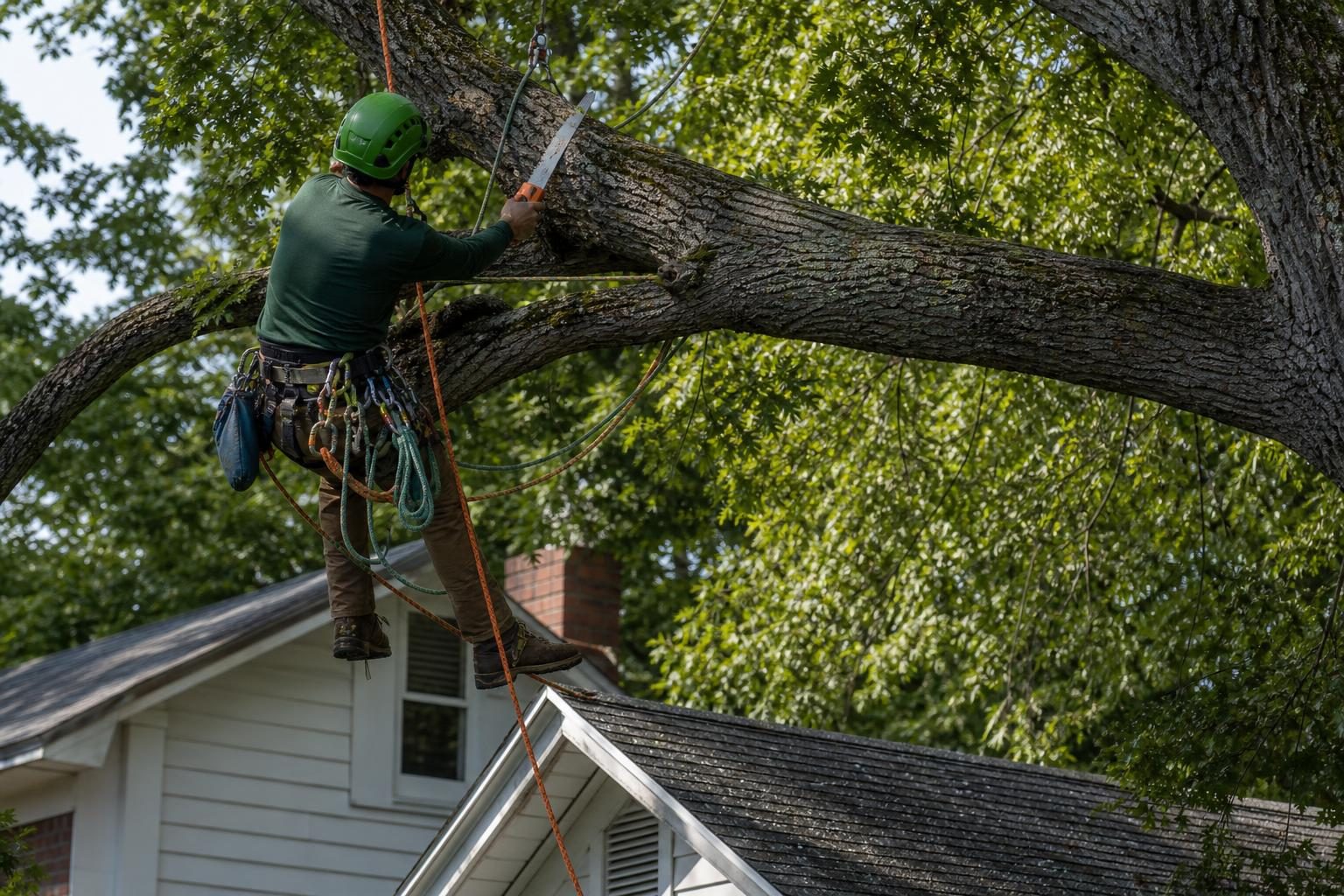
Most homeowners pay about $250 to $800 to have one tree professionally trimmed. Small ornamental trees can come in under $250, while large oaks, pecans or pines near a house often run $1,000 to $2,000 or more per tree. Height, access and how much work the tree actually needs set the price, and quality varies far more than most people expect.
Below: realistic prices, what good pruning looks like, timing rules for oaks, power lines, and how to read a quote.
Quick answer: Budget roughly $150–$450 for a small tree, $300–$900 for a medium tree and $700–$2,000+ for a large one, with crane, power-line and multi-tree jobs priced separately. Hire an insured, preferably ISA-certified arborist, get the work described in writing (what will be cut, how much, and why), and walk away from anyone who offers to “top” your trees.
Part of our Complete Tree Care Guide: pruning, removal, stump grinding, costs and hiring an arborist in one place.
Tree trimming cost by size
Tree services price by the job, so these rounded national ranges are a starting point, not a menu. They assume a single tree with normal access and cleanup included. Prices vary by region, site and access, and crews in high-cost metro areas often charge more.
| Tree height | Typical examples | Rough cost per tree |
|---|---|---|
| Small (under 25–30 ft) | Crepe myrtle, dogwood, Japanese maple, young fruit trees | $150–$450 |
| Medium (30–60 ft) | Mature fruit trees, red maple, birch, mid-size pine | $300–$900 |
| Large (60–80 ft) | Mature oak, pecan, sycamore, silver maple | $700–$2,000 |
| Very large (80 ft+) | Old oaks, tall pines, cottonwoods | $1,200–$3,000+ |
| Crane or bucket-truck jobs | Limbs over a roof, no room to climb safely | Often priced by the hour or half day, with minimums |
| Cabling or bracing (add-on) | Supporting a weak fork on a tree you’re keeping | A few hundred dollars and up, per tree |
Several trees in one visit usually cost less per tree, because the crew only sets up once. Many companies also have a minimum charge, so a single small tree may cost close to that minimum no matter how quick it is.

Cost by tree type, including oaks and palms
- Oaks. Mature oaks are often large, wide-spreading and close to homes, so oak trimming commonly falls in the upper ranges. Cost guides put a typical oak at several hundred dollars, with big ones well over $1,000. In oak wilt regions, the season you schedule in also matters (see below).
- Pecans, sycamores and silver maples. Big, fast-growing and prone to dropping limbs, so they often need deadwood removal and end-weight reduction. Expect large-tree pricing.
- Pines and other conifers. Usually need less pruning, mostly deadwood and clearance, but tall pines are costly to climb.
- Palms. Trimmed for dead fronds and seed pods, often yearly. Short palms can be inexpensive; tall ones need climbing or a lift.
- Small ornamentals and fruit trees. Cheapest per tree, but they reward regular, light pruning by someone who knows the species.

What pushes the price up or down
- Distance to the house, fence or pool. Limbs that can’t be dropped have to be roped down piece by piece.
- Access. Backyard trees behind a narrow gate mean hand-carrying brush to the chipper.
- Tree condition. Lots of dead or broken limbs take longer and are riskier to climb around.
- The scope. A light deadwood clean-out costs much less than reducing the crown or raising it over a driveway.
- Power lines. Work near energized lines needs specially trained crews or a utility disconnect.
- Cleanup choices. Keeping the chips or firewood can lower the price.
- Season. Crews are busiest after storms and in spring; winter is often easier to book.
What good pruning looks like

You’re not just paying for branches to come off. You’re paying for the right branches to come off in the right way. The professional standard in the U.S. is ANSI A300, and the International Society of Arboriculture explains the homeowner version on its TreesAreGood pruning page. The key points:
- Every cut has a purpose. Common goals are cleaning (removing dead, diseased or broken branches), thinning (selectively removing some live branches to reduce weight), raising (lifting low limbs over a walk or driveway) and reducing (shortening limbs back to a suitable side branch for clearance).
- Cuts go just outside the branch collar. The collar is the slightly swollen ring where a branch joins the trunk. Cutting flush against the trunk, or leaving a long stub, makes it much harder for the tree to seal the wound.
- Big limbs come off in three cuts so the bark doesn’t tear down the trunk.
- Not too much at once. A widely used rule is to remove no more than about a quarter of the live canopy in a season, and less on mature trees. Older trees recover slowly from heavy pruning.
- Small cuts beat big ones. Regular, light pruning and early structural pruning on young trees avoid the need for large cuts later.
- No topping. Topping, or cutting the whole crown back to stubs, is singled out by ISA as one of the most damaging things you can do to a tree (see its Why Topping Hurts Trees brochure). It starves the tree, invites decay, and the fast regrowth is weakly attached and prone to breaking.
- No over-thinning. Stripping all the interior branches and leaving foliage only at the tips (often called lion-tailing) looks tidy but puts the weight at the ends of the limbs and makes them more likely to break.
- No climbing spikes on trees being kept. Spikes are for removals; they wound living trees.
When to trim, and the oak wilt rule
For most trees, the dormant season (late fall through late winter, after leaves drop) is a good time for routine pruning. The branch structure is easy to see, and the tree is not pushing new growth. Dead, broken or hazardous limbs can be removed any time of year.
Oaks are a special case wherever oak wilt is present. This fungal disease is spread by sap beetles that are drawn to fresh wounds, and it can kill oaks, especially red oaks. Guidance differs by region:
- In Minnesota and much of the upper Midwest, University of Minnesota Extension advises avoiding pruning or wounding oaks from April through July, with winter the safest time.
- In Texas, the Texas A&M Forest Service advises avoiding wounds to oaks from February through June and painting any fresh oak wound immediately, year-round.
Ask your local extension office or state forestry agency for your area’s window. A good arborist will bring this up unprompted.
Planning a bigger yard calendar? See our winter yard planning guide, which is a natural time to book pruning.

How often trees need trimming
- Young trees: light structural pruning every year or two for the first several years, to build a strong central trunk and well-spaced branches. This is cheap and saves money later.
- Mature shade trees: commonly every three to five years, depending on species, growth rate and what’s underneath. Fast growers and trees over roofs or driveways may need more frequent attention.
- Fruit trees: usually pruned yearly in the dormant season.
- After storms: broken and hanging limbs should come down promptly, whatever the schedule.
A long-neglected tree may need only a light clean-out, not heavy cutting.
Trees near power lines
Never prune near overhead power lines yourself, and don’t let a general landscaper do it. Responsibility usually splits like this:
- Main lines between poles are typically the utility’s responsibility. Utilities run their own clearance programs, often at no cost to you, though they prune for line clearance rather than looks.
- The service drop (the line from the pole to your house) is often the homeowner’s responsibility to keep clear. Many utilities will temporarily disconnect it so your tree service can work safely; some do this free with advance notice, and some charge. National Grid’s tree FAQ is a typical example of how utilities divide this.
Call your utility before booking any work near lines. Rules vary by company and state.

What a written quote should say
“Trim trees, $1,200” isn’t a quote you can hold anyone to. A good written estimate lists:
- Which trees, identified by location and species.
- The goal for each tree: clean deadwood, thin, raise over the driveway to a stated height, reduce away from the roof by a stated distance.
- Roughly how much will be removed, or the smallest and largest branch size to be cut.
- A statement that work follows ANSI A300 standards, with no topping and no climbing spikes.
- Cleanup: brush chipped and hauled, wood hauled or left, lawn raked.
- Equipment that will be on the lawn or driveway, and who’s responsible for damage.
- Price, payment terms and an expected date.
- Proof of liability and workers’ compensation insurance.
Lay several bids side by side using the same scope. Our guide on how to compare landscaping quotes walks through doing that fairly.
Problems homeowners run into
- Huge price spreads. Homeowners commonly report quotes for the same trees that differ several-fold. One quote may be a detailed plan with cabling; another may be a quick deadwood pass. Compare scope before price.
- Sticker shock on big trees near the house. Large oaks and pecans over a roof can cost thousands each. Phasing the work, starting with the riskiest tree, is a common and sensible approach.
- Too much taken off. Trees left with bare interiors and tufts at the ends, or a canopy cut by half, because the crew thought more cutting meant more value.
- Bargain crews and poor cuts. A price far below everyone else’s can mean flush cuts, stubs, torn bark or no insurance.
- Unclear cleanup. Logs left on the lawn or ruts from equipment, because nobody wrote it down.
Hiring checklist and questions to ask

- Decide what you want: safety, clearance from the roof, more light for the lawn, or general health.
- Get two or three bids from tree care companies, not general yard crews.
- Check for an ISA Certified Arborist using ISA’s find an arborist search.
- Ask for certificates of insurance sent directly from the insurer.
- Get the scope in writing, with goals per tree.
- Pay a reasonable deposit at most, and the balance when the work is done.
Questions worth asking:
- What will you remove from each tree, and why?
- How much of the canopy will come off?
- Will you use climbing spikes? (The answer for trees you’re keeping should be no.)
- Is anyone on the crew an ISA Certified Arborist, and will they be on site?
- For oaks: is this a safe time of year here for oak wilt?
- What’s included in cleanup, and what happens to the wood?
More general advice is in our questions to ask before hiring a landscaper.
Red flags
- Offering to “top” or “hat-rack” your trees, or recommending heavy cutting to “make it safer.”
- No proof of insurance, or “we’ll send it later.”
- Cash only, or full payment before work begins.
- Climbing spikes on trees that are staying.
- No written scope beyond “trim trees.”
- Pushing you to remove healthy trees, or quoting oak work in the high-risk oak wilt season without comment.
- Uninvited door-to-door offers right after a storm.
If a tree really is past saving, our tree removal cost guide and stump removal guide cover the next steps.

What you can safely do yourself
Pruning small branches you can reach from the ground with hand pruners, loppers or a pole pruner is a reasonable homeowner job, especially on young trees and shrubs. Learn the branch collar and three-cut method first.
Leave it to a professional when:
- You’d need a ladder and a chainsaw at the same time.
- Limbs are larger than a few inches across or hang over the roof, a fence or a car.
- The branch is anywhere near a power line.
- The tree is dead, cracked, leaning or has large hanging limbs.
Between visits, simple care helps trees stay healthy: mulch a wide ring (not piled against the trunk; see our mulch depth guide), avoid string-trimmer damage to bark, and water during long dry spells. If you’re budgeting for the whole yard, see our lawn care cost guide too.
Frequently asked questions
What is the average cost of tree trimming?
Most single-tree trimming jobs land around $250 to $800. Small trees cost less, and large trees near buildings can run $1,000 to $2,000 or more. Prices vary a lot by region and by how much work each tree needs.
How much does oak tree trimming cost?
A mature oak commonly costs several hundred dollars to trim, and large or hard-to-reach oaks can exceed $1,500. In oak wilt areas, schedule in the safe season for your region, usually winter.
Will the power company trim my trees for free?
Utilities usually clear trees around main lines at their own cost, but they trim for clearance, not appearance. The line to your house is often your responsibility, though the utility may disconnect it so a tree service can work safely.
Is topping a tree ever okay?
Not as a way to make a tree smaller or safer. Professional standards reject topping because it weakens and often kills trees. If a tree is too big for its space, reduction pruning or removal and replanting are better choices.
Does homeowners insurance pay for tree trimming?
Routine trimming is maintenance, so it’s generally not covered. Insurance mainly comes into play when a tree damages a covered structure. Check your own policy.