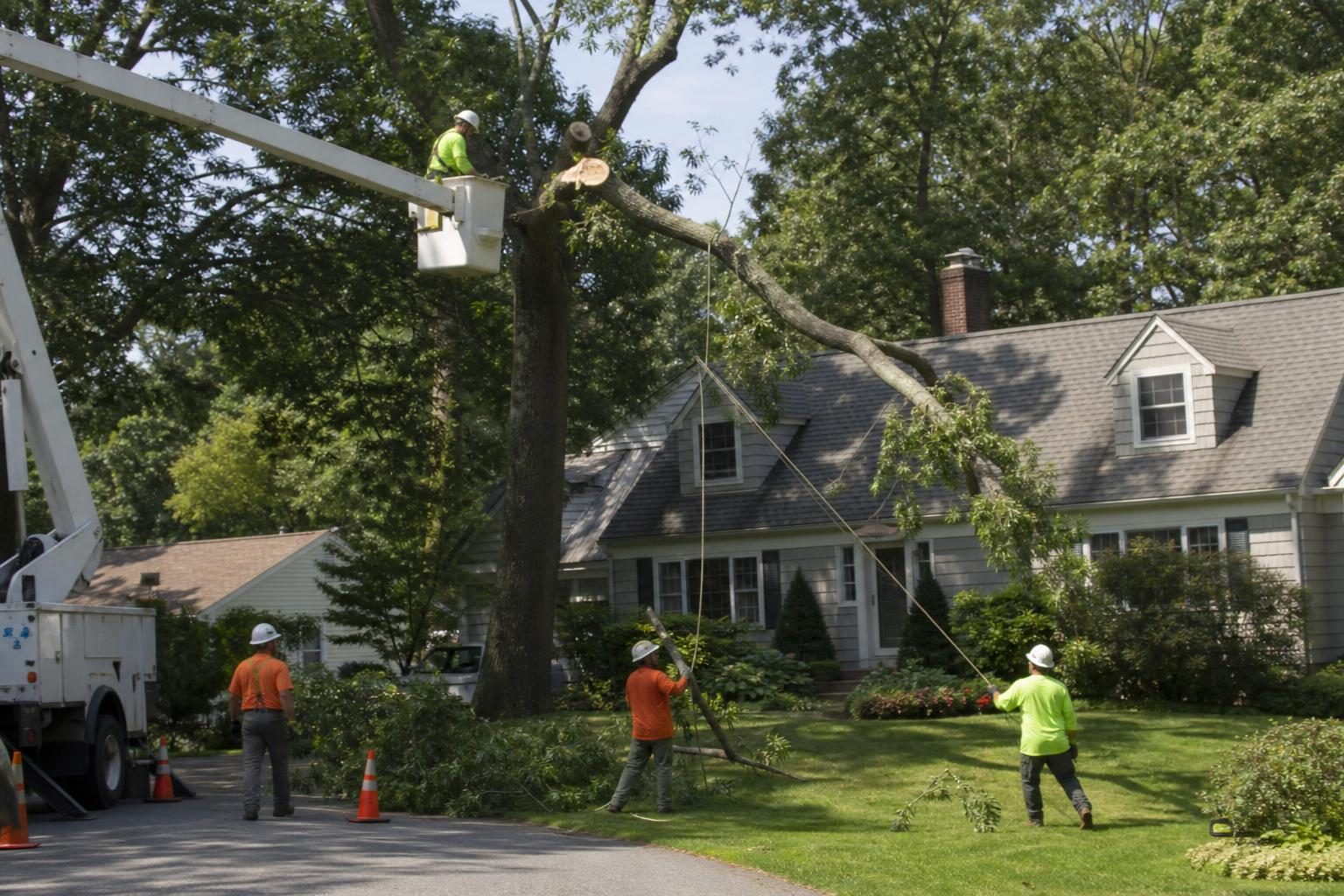
Most homeowners pay somewhere between $400 and $2,000 to have a single tree cut down and hauled away. Small, easy trees can come in under $500, and big trees leaning over a house or tangled in power lines can run $3,000 to $6,000 or more. The tree’s size matters, but what drives the price most is how hard it is to take down safely.
This guide walks through realistic price ranges, what a fair quote should include, how insurance and permits fit in, and how to spot the companies that end up costing you more.
Quick answer: Budget roughly $200–$700 for a small tree, $500–$1,800 for a medium tree, and $1,200–$3,500 for a large one, with crane, power-line and storm jobs going higher. Stump grinding is usually extra ($100–$400 per stump). Get at least three written quotes from insured, preferably ISA-certified crews, and make sure each one spells out cleanup, wood hauling and the stump.
Part of our Complete Tree Care Guide: pruning, removal, stump grinding, costs and hiring an arborist in one place.
Tree removal cost by size
Tree services price by the job, not a fixed menu, but height and trunk diameter give you a useful starting point. Diameter is measured about 4.5 feet off the ground (often called “diameter at breast height”). The ranges below are rounded national figures for removing the tree and cleaning up the brush. They vary a lot by region, site and access, so treat them as a sanity check rather than a price list.
| Tree size | Typical examples | Rough cost range |
|---|---|---|
| Small (under 30 ft, trunk under 12 in) | Ornamental cherry, young maple, large shrub-trees | $200–$700 |
| Medium (30–60 ft, trunk 12–24 in) | Mature fruit trees, crabapple, mid-size pine | $500–$1,800 |
| Large (60–80 ft, trunk 24–36 in) | Mature oak, maple, sweetgum | $1,200–$3,500 |
| Very large (80 ft+, trunk over 36 in) | Old oaks, tall pines, cottonwoods | $2,000–$6,000+ |
| Crane-assisted removal | Big trees over houses or with no drop zone | $2,500–$8,000+ |
| Stump grinding (add-on) | Per stump, priced by diameter | $100–$400 |
| Log and wood haul-away (if not included) | Trunk sections removed from site | $100–$500 |
“Cost to cut down a tree” and “tree removal” are not always the same thing. A lower price sometimes means the crew fells the tree and leaves the trunk in rounds on your lawn. Always compare quotes on the same scope.

What drives the price up (or down)
Two trees of the same height can be priced thousands of dollars apart. The Purdue Landscape Report points to the same handful of factors that arborists mention again and again:
- Distance to the house, fence or garage. If the tree can’t simply be dropped, a climber has to take it down piece by piece and lower each section on ropes. That takes more people and more hours.
- Power lines. Branches near energized lines need a line-clearance trained crew, and sometimes a utility shutdown. Never let anyone (including you) prune near a live line.
- Crane jobs. When the canopy is over the roof or the tree is too weak to climb, a crane lifts sections out. Crane time is billed by the hour with minimums, which is why these jobs start in the thousands.
- Access. Backyard trees behind a narrow side gate mean hand-carrying every branch to the chipper. Soft lawns, septic fields and steep slopes can also keep trucks out.
- Dead or hazard trees. Dead wood is brittle and unpredictable, so many climbers won’t tie in to it. A tree that was climbable two years ago can turn into a crane job once it’s rotted.
- Emergency and storm work. A tree on the roof at night, or after a regional storm when every crew is booked, costs more. Some of that is real (hazard, overtime). Some of it is opportunism, which is why a second quote still matters.
- Number of trees. Setting up the truck, chipper and crew is a big fixed cost, so removing two or three trees in one visit is usually cheaper per tree.

What a removal quote should include
Most disputes about tree work come from what the quote didn’t say. A clear written estimate should spell out:
- Which trees, identified by location or tagged in person
- Whether branches are chipped and hauled away, or chips are left for you
- Whether the trunk wood is hauled away, cut into rounds, or cut to firewood length and left on site
- Whether the stump is ground, how deep, and whether the grindings are removed (usually this is a separate line, or not included at all)
- Lawn and landscape protection, and who pays for ruts or damaged plantings
- Permit handling, if your city requires one
- Total price, payment terms and any conditions that could change the price
Chips can be useful, too. Many homeowners keep a pile for paths and beds; our mulch depth guide covers how to use them. If you also want the stump gone, read our stump removal guide before you sign, so you know what depth and cleanup to ask for.
Permits, protected trees and HOAs
Many cities regulate tree removal even on private property. The rules depend on the city: some protect any tree over a certain trunk diameter (thresholds around 12 to 24 inches are common), others protect specific species such as oaks, and some require a permit even when the tree is dead. Fines for removing a protected tree without a permit can run into the thousands per tree.
- Check with your city or county planning or urban forestry office before you schedule work. Hazard exceptions often exist, but you usually need an arborist’s letter.
- Check your HOA rules. Many associations require approval for removing trees, especially in front yards, and some require a replacement tree.
- Street trees between the sidewalk and curb are often city property. Don’t touch them without permission.
- Trees on the property line are a neighbor conversation first. Get agreement in writing before work starts.
Our landscaping permit guide explains how to find your local rules.
Insurance: theirs and yours

The tree service’s insurance
Tree work is one of the most dangerous trades. If an uninsured worker gets hurt on your property, or an uninsured crew drops a limb through your roof, you can end up paying. Ask for a certificate of insurance showing both general liability and workers’ compensation, and call the insurance agent listed to confirm it’s current. A good company will have the insurer send the certificate directly to you.
Also check credentials. An ISA Certified Arborist has passed an exam on tree biology and safe work practices, and you can verify a certification on the ISA’s TreesAreGood search. Certification isn’t required for a simple removal, but it’s a good sign the company understands trees and safety.
Your homeowner’s insurance after a storm
Homeowners are often surprised by how limited tree coverage is. According to Consumer Reports, insurers generally pay to remove a tree when it falls on a covered structure, such as your house or garage, and that removal coverage is often capped at around $500 to $1,000. A tree that falls in the yard without hitting anything usually isn’t covered unless your policy has a special endorsement. Removing a healthy tree you simply don’t want is never covered.
- Photograph the damage before anything is moved, unless it’s an immediate safety issue.
- Call your insurer early and ask what the tree removal limit is on your policy.
- If a neighbor’s healthy tree falls on your house, your own policy usually handles it. If the tree was visibly dead and they were warned, their liability coverage may come into play.

Problems homeowners run into
These are the situations homeowners describe most often when a tree job goes sideways:
- Wildly different quotes for the same tree. Spreads of two or three times are common. Usually the difference is in scope (stump, hauling, crane), insurance, or how badly the company wants the job.
- Storm pricing. After major storms, some homeowners get five-figure quotes for a single tree on the roof. Several who pushed back or got another quote saw the price drop substantially.
- No written price in an emergency. Crews that start work before agreeing on a price can bill far more than others would have charged. Even in a hurry, get a number on paper or in a text.
- Scope creep. A crew arrives and says another tree has to come down for access, or the wood haul costs extra. Ask about these possibilities up front.
- Surprise stump. Many homeowners assume the stump is included and find out it isn’t when the crew leaves.
- Lawn damage. Heavy trucks and dropped logs can rut a lawn or crush beds. Ask how they’ll protect the turf and who repairs damage.
Step-by-step hiring checklist
- Decide whether it really has to come down. A sick-looking tree can sometimes be pruned or treated. An independent arborist assessment is worth it for a large, valuable tree.
- Check permits and HOA rules before you collect quotes.
- Call your utility if branches touch the line running to your house. Some utilities will disconnect and reconnect service for tree work at no charge.
- Get at least three on-site quotes. Photo quotes are guesses. Walk the job with each estimator.
- Make every quote cover the same scope: brush, logs, stump, chips, lawn repair.
- Verify insurance and credentials by calling the insurer directly.
- Sign a written agreement with the price, scope, start date and payment terms. Pay a reasonable deposit at most, never the full amount up front.
- Walk the site when they finish before making the final payment.
Our general guide to comparing landscaping quotes has a side-by-side method that works well for tree bids.

Questions to ask a tree service
- Can you send a certificate of insurance for liability and workers’ comp straight from your insurer?
- Is there an ISA Certified Arborist on staff, and will they be on site?
- How will you take this tree down: felling, climbing and rigging, bucket truck, or crane?
- What happens to the brush, logs and chips?
- Is stump grinding included? How deep, and do you remove the grindings?
- Do I need a permit, and will you pull it?
- What could change the price once you start?
- How will you protect the lawn, driveway, beds and fences?
Many of these overlap with our questions to ask before hiring a landscaper.
Red flags
- Door-knockers after a storm. Reputable tree companies are busy after storms and rarely canvass neighborhoods. Out-of-town “storm chasers” may be uninsured and gone before problems show up.
- No proof of insurance, or a certificate they “will get to you later.”
- Cash only, or full payment up front.
- Offering to “top” a tree. Topping (cutting the whole crown back to stubs) weakens and often kills trees. A company that recommends it doesn’t follow professional standards.
- Climbing spikes on a tree you’re keeping. Spikes are fine for removals but wound living trees.
- Pressure to remove healthy trees, or a price far below every other bid with no explanation.

Ways to pay less
- Schedule in the off-season. Late fall through winter is often slower for tree crews in many regions, and bare branches make deciduous trees easier to work on. Avoid booking right after a storm if the tree isn’t urgent.
- Bundle work. Remove several trees, or combine removal with pruning, in one visit.
- Keep the wood. Having the trunk left in rounds or firewood lengths can lower the price.
- Keep the chips. Many crews will dump chips for free rather than hauling them.
- Don’t wait on a dying tree. A tree that’s still sound enough to climb is cheaper to remove than one that needs a crane.
- Plan the replacement. If the tree was screening a view, our evergreen screen ideas can help you replace privacy without planting something that outgrows the space.
For how tree work fits into a bigger yard budget, see landscaping costs explained.
Frequently asked questions
How much does it cost to cut down a big tree near a house?
Expect roughly $1,500 to $4,000 for a large tree that has to be taken down in sections near a house, and $3,000 to $8,000 or more if a crane is needed. Access, power lines and the tree’s condition matter more than height alone.
Is stump grinding included in tree removal?
Usually not. Most tree services quote it separately, and some subcontract it. Ask for it as its own line item, with the grinding depth and whether the chips are hauled away.
Will homeowner’s insurance pay to remove a fallen tree?
Often, if the tree fell on a covered structure such as your house, and usually only up to a limit around $500 to $1,000. Trees that fall in the yard without hitting anything are usually not covered. Check your own policy and call your insurer.
Do I need a permit to remove a tree on my own property?
It depends on your city. Many places require permits for trees over a certain diameter or of protected species, sometimes even dead ones. Call your local planning or urban forestry office before scheduling.
Can I cut down a tree myself?
Small trees in open ground with a clear drop zone are a reasonable DIY job for someone experienced with a chainsaw. Anything near a structure, over 30 feet, leaning, dead, or near power lines belongs with a professional crew.
What’s the cheapest time of year to remove a tree?
In many areas, late fall and winter are slower for tree companies, which can mean better availability and pricing. Avoid scheduling non-urgent work right after a big storm, when demand spikes.