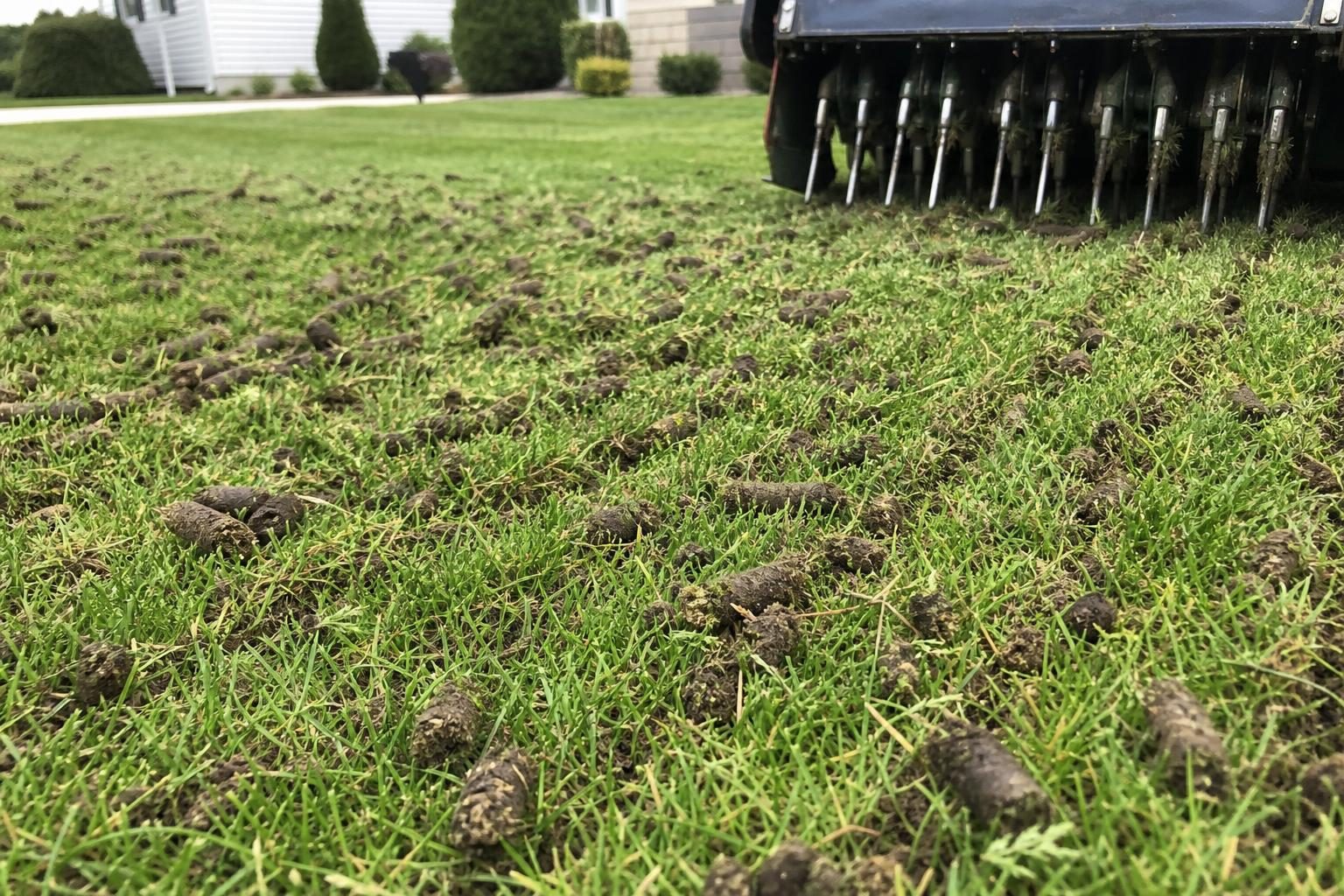
Lawn aeration means pulling small plugs of soil out of the lawn so air, water and roots can get into ground that has been packed hard by feet, mowers, pets and rain. Done at the right time with a core aerator, it is one of the most useful things you can do for a thin, tired lawn. Done at the wrong time, or with the wrong tool, it is mostly a waste of a Saturday.
This guide explains what core aeration really does, how it compares with spike and liquid aeration, when to aerate your type of grass, what it costs to rent a machine or hire it out, and how to look after the lawn afterward.
Quick answer: Core aeration (hollow tines that pull out plugs) is the method university turf programs recommend for compacted lawns. Aerate cool-season grass in early fall or mid-spring, and warm-season grass in late spring to early summer while it is actively growing. Most home lawns need it every one to three years, or yearly for clay soil and heavy traffic. Hiring a pro usually costs about $100–$250 for an average suburban lot; renting a machine runs about $60–$120 plus your time. Flag sprinkler heads first, water the day before, and leave the plugs on the lawn.
Part of our Complete Lawn Guide: seed vs sod, grass types, costs, care calendar and hiring in one place.

What aeration actually does
Healthy soil is roughly half solid particles and half open pore space filled with air and water. Every pass of a mower, every game of catch and every heavy rain on bare clay squeezes those pores shut. A compacted layer only a fraction of an inch thick near the surface can be enough to slow water infiltration and starve roots of oxygen. The result is shallow roots, thin patches and runoff.
Core aeration physically removes small cylinders of soil, usually about 1/2 to 3/4 inch wide and 2 to 3 inches long. Each hole gives the surrounding soil room to relax, lets water and fertilizer move down instead of sideways, and creates channels where new roots grow. The plugs left on top also break down and mix soil back into the thatch layer, which helps microbes digest it. The UMass Extension turf program calls core cultivation the most important tool for managing soil compaction in turf.
What aeration does not do: it will not fix a lawn that is struggling because of deep shade, the wrong grass type, poor drainage caused by grading, or a buried layer of construction debris. If water pools in the same low spot every storm, read about signs you need regrading before blaming compaction.
Core vs spike vs liquid aeration
You will see three things sold as “aeration.” They are not equal.
| Method | How it works | What extension research says | Best use |
|---|---|---|---|
| Core (plug) aeration | Hollow tines pull out plugs of soil and drop them on the surface | The recommended method for relieving compaction and managing thatch | Almost every home lawn that needs aerating |
| Spike (solid-tine) aeration | Solid spikes or spiked shoes poke holes without removing soil | Several extension programs warn it can press soil tighter around each hole, especially in clay | Little benefit on compacted soil; at most a quick open-up on sandy soil |
| Liquid aeration | Spray product, often soap-like surfactants and humates | Colorado State Extension found no sign these products have been scientifically tested and says there is no chemical substitute for core cultivation | May act as a wetting agent; not a replacement for coring |
Spike aerators and spiked “aerator sandals” are cheap and easy, but pushing a solid spike into dense soil just moves that soil sideways instead of removing it. Iowa State Extension advises homeowners to avoid spike-type devices and use a hollow-tine core aerator instead.
Liquid aeration is sold as a tidier option with no plugs. Colorado State University Extension concluded that the idea of a diluted spray changing soil density is not supported by any evaluation they could find. If a company quotes liquid aeration, ask what it is meant to do that coring does not.

Signs your lawn needs it
- The screwdriver test. A day after a good rain or watering, push a long screwdriver into the lawn in several spots. If it slides in to the handle easily, compaction is not your main problem. If you have to lean on it in moist soil, the ground is compacted.
- Water runs off or puddles even though the soil is not saturated, or sprinklers create runoff onto the sidewalk within minutes.
- Thin or bare paths where people, dogs or mowers travel the same line every day.
- The lawn feels hard underfoot, almost like walking on a patio, especially in summer.
- Thatch over about half an inch. Cut a small wedge of turf and look at the spongy brown layer between green blades and soil. Around 1/2 inch or less can be managed by aerating; much more than an inch usually needs dethatching first.
- New-build lot. Lawns on construction-site soil, where heavy equipment drove over subsoil, are often the most compacted of all.
When to aerate by grass type
The rule is simple: aerate when the grass is growing strongly enough to fill the holes, with at least three to four weeks of good growing weather ahead. Clemson’s Home & Garden Information Center gives the same split most extension programs use: fall for cool-season lawns, late spring through summer for warm-season lawns.
| Grass type | Examples | Best window | Second choice | Avoid |
|---|---|---|---|---|
| Cool-season | Kentucky bluegrass, tall fescue, perennial ryegrass, fine fescue | Late August to late September (early fall) | Mid-spring, once the lawn is actively growing | Midsummer heat and drought; dormant winter grass |
| Warm-season | Bermudagrass, zoysiagrass, St. Augustinegrass, centipedegrass | Late spring to early summer, after full green-up | Midsummer with good irrigation | Early spring before green-up; fall as grass slows toward dormancy |
| Transition zone | Mixed fescue and bermuda or zoysia lawns | Match the dominant grass | — | Aerating fescue in summer heat |
One timing catch for spring: aerating punches through the barrier left by a crabgrass preventer. If you aerate in spring, do it before applying pre-emergent, or accept that weed seeds may sprout in the holes. That is one reason many turf programs prefer fall for cool-season lawns, when fewer weeds germinate. For seasonal timing of other chores, see the fall landscaping checklist.
How often?
There is no single schedule. Lawn companies commonly recommend every year, while extension guidance ties frequency to soil and traffic: once every one to three years for a lawn on loose, well-drained soil with light use, and once or even twice a year for heavy clay, new construction lots, or yards with daily kids and dogs. If the screwdriver test passes and the lawn is thick, you can skip a year.
Lawn aeration cost: DIY rental vs hiring
Prices vary by region, lot size, slope, access and how compacted the ground is. These rounded ranges are a starting point for comparing quotes, not a promise.
| Option | Typical cost | Notes |
|---|---|---|
| Pro core aeration, small lot (under 5,000 sq ft) | $75–$150 | Many companies have a minimum charge around $75–$100 |
| Pro core aeration, average lot (5,000–10,000 sq ft) | $100–$250 | Often quoted as a flat rate |
| Pro core aeration, large lot (around 1/2 acre or more) | $200–$450+ | Larger lots cost less per square foot |
| Aeration plus overseeding | $150–$450+ | Depends heavily on seed type and amount |
| Spike or liquid aeration | Often $50–$150 | Cheaper, but see the method comparison above |
| Rent a walk-behind core aerator | About $55–$85 for 4 hours; $80–$120 per day | Plus deposit, truck or trailer, seed, and fuel |
Should you rent or hire?
Renting makes sense if you have a truck or trailer, a helper, a mid-size flat lawn and a free afternoon. A rental core aerator typically weighs 150 to 250 pounds, so loading it and steering it around trees and beds is real work, especially on clay or slopes. Homeowners on larger properties often say a yearly overnight rental beats owning a machine they would have to store and maintain.
Hiring makes sense for small lots, where the minimum service charge is close to the rental fee anyway, for hilly yards, and when you also want overseeding. Pros usually run heavier machines that pull deeper plugs. If you already pay a crew for mowing or treatments, ask for aeration as an add-on; see our lawn care cost guide for how these services bundle.

Step-by-step: aerating the right way
- Call 811 a few days ahead. It is free, and buried cable, gas service lines and low-voltage wiring are sometimes only a few inches down.
- Flag everything shallow. Mark sprinkler heads, valve boxes, shallow irrigation lines, invisible dog fence wire and landscape lighting cable. A walk-behind aerator can crack a sprinkler head in one pass. If you have lights, see our guide to low-voltage vs solar landscape lighting for where cable usually runs.
- Mow a little shorter than usual a day or two before, and clear sticks, toys and hoses.
- Water the day before. About an inch of water the day before (or aerating a day after a soaking rain) lets the tines go deep. Dry soil gives you shallow nubs; soggy soil clogs tines and smears the holes. A marking flag that will not push about three inches into the lawn is a sign the ground is too dry.
- Make two passes. Go over the lawn once, then again at an angle or perpendicular. Aim for holes roughly 2 to 4 inches apart; most machines need two passes to get there.
- Spend extra passes on the worst spots, such as dog paths and the strip along the driveway.
- Overseed and fertilize if planned right after aerating (see the next section).

Aerating and overseeding together
Fall core aeration and overseeding are a natural pair for cool-season lawns. Seed that falls into or near the holes lands on loose soil with good moisture, which helps germination far more than seed thrown on hard ground. Spread seed right after aerating, then keep the surface lightly moist until the new grass is established. If you are trying to decide between patching thin areas and starting over, our guide to sod vs seed helps.
Warm-season lawns such as bermuda and zoysia usually fill in with their own runners after aerating rather than being overseeded.
What to do after aeration
- Leave the plugs. They break down in one to three weeks, faster in sandy soil and slower in clay. Mowing, rain and a light raking speed things up. Do not bag or rake them away; they return soil and microbes to the thatch.
- Water if the weather is dry. Aerated turf dries out faster for a couple of weeks, and new seed needs steady moisture.
- Hold off on pre-emergent if you just overseeded, since most crabgrass preventers also stop grass seed. Follow the label waiting period.
- Fertilize if it fits your schedule. Fall is when cool-season lawns benefit most from nitrogen.
- Expect a rough, spotted look for a week or two.

Problems homeowners run into
- Plugs only half an inch long. The soil was too dry or the machine too light. Water deeply and try again rather than paying for a shallow job.
- Broken sprinkler heads and cut wires. A common and avoidable expense. Flag before the crew arrives and walk the yard with them.
- Aerating at the wrong time. Spring aeration of bermuda before green-up, or summer aeration of fescue in a heat wave, stresses grass instead of helping it.
- Paying for liquid or spike aeration expecting the results of coring.
- Weeds in the holes after spring aeration done after the crabgrass preventer went down.
- Feeling pushed into yearly aeration. Door-hanger offers and program add-ons often assume every lawn needs it every year. Use the screwdriver test to decide.
Questions to ask and red flags
Questions to ask a lawn company
- Is this core aeration with hollow tines, and how deep do your plugs usually go?
- How many passes will you make, and roughly how far apart will the holes be?
- Do you flag sprinkler heads, or should I, and who pays if one is broken?
- What will you do if the soil is too dry or too wet on the scheduled day?
- If I add overseeding, what seed variety and how many pounds per 1,000 square feet?
- Is this a one-time job or part of an auto-renewing program?
Red flags
- Liquid or spike aeration presented as the same as core aeration.
- Scheduling cool-season aeration in the heat of midsummer.
- No mention of sprinkler heads or underground utilities.
- Pressure to sign a multi-year plan on the spot.
For more on comparing written estimates, read how to compare landscaping quotes and our questions to ask before hiring a landscaper. If you are thinking about broader help, the landscape maintenance services guide explains what ongoing programs usually include.
Frequently asked questions
Is lawn aeration worth it?
For compacted or heavily used lawns, yes. It is one of the few practices that directly fixes compaction. For a thick lawn on loose soil that passes the screwdriver test, the benefit is small, and you can skip it.
Should I pick up the plugs after aerating?
No. Leave them to break down. They usually disappear within a few weeks after mowing and rain, and they help break down thatch.
Can I aerate a wet lawn?
Moist is ideal; soggy is not. If soil sticks to your shoes or the tines clog, wait a day or two. Working saturated clay can smear the holes and add compaction.
How long after aerating can I mow?
You can mow as soon as the lawn needs it, usually within a few days. If you overseeded, mow only once new grass reaches normal mowing height, and keep mower passes light while the seedlings establish.
Do I need to aerate a new sod or seeded lawn?
Not in the first season. Let it root in first. If the soil under it was compacted during construction, it is better to loosen and amend it before installation; see our sod and lawn installation guide.