Professional fence installation in the US usually runs about $15 to $45 per linear foot for chain link and pressure-treated wood, $35 to $65 for cedar or vinyl privacy fencing, and $50 or more for composite, aluminum, and wrought iron. A typical 150-foot backyard fence with one gate runs from about $2,500 for chain link to $10,000 or more for cedar, vinyl, or metal.
Material is only part of the bill. Slopes, rocky soil, old fence removal, and how well the posts are set decide both the price and whether the fence still stands straight in ten years.
Quick answer: Budget roughly $15–$30 per foot for 4-foot chain link, $25–$45 for a 6-foot pressure-treated wood privacy fence, $35–$65 for cedar or vinyl privacy, $35–$70 for aluminum, and $50–$90 for composite, installed. Add $300–$1,200 per walk gate, $1,000–$3,000 or more for a double drive gate, and $3–$8 per foot to remove an old fence. Before anyone digs, confirm your property line, check height limits and HOA rules, and make sure 811 has marked buried utilities.
Part of our Complete Fence and Privacy Guide: materials, costs, rules, installation and plant screens in one place.
Fence cost per linear foot by material
These are rounded installed prices, including posts, concrete or gravel, rails, infill, hardware, and labor on reasonably flat, diggable ground. They vary a lot by region, crew availability, and site access, and published cost guides disagree widely, so treat them as a starting point for comparing bids rather than a quote.
| Fence type | Typical height | Installed cost per linear foot | Notes |
|---|---|---|---|
| Galvanized chain link | 4 ft | $15–$30 | Cheapest way to contain pets; no privacy |
| Vinyl-coated or 6 ft chain link | 5–6 ft | $25–$45 | Black or green coating blends in better |
| Pressure-treated pine privacy | 6 ft | $25–$45 | Lowest-cost privacy; needs sealing or stain |
| Cedar privacy | 6 ft | $35–$65 | Board-on-board sits at the high end |
| Vinyl privacy | 6 ft | $35–$65 | Quality of the vinyl varies widely |
| Vinyl or wood picket | 3–4 ft | $20–$45 | Front yards and pool-adjacent styles |
| Aluminum ornamental | 4–5 ft | $35–$70 | Common for pool fences; see-through |
| Composite privacy | 6 ft | $50–$90 | Heavy panels, often on metal posts |
| Wrought iron or welded steel | 4–6 ft | $60–$120+ | Often custom fabricated |
Going from 6 feet to 8 feet usually adds roughly a quarter to a third to the price, where your local rules allow it at all. If you’re still deciding between the two most popular privacy materials, our wood vs vinyl privacy fence comparison covers lifespan, upkeep, and wind performance in detail.

Gates and a 150-foot backyard example
Gates are priced separately, and they’re where cheap installs fail first: they need a heavier, deeper post and a rigid frame.
| Gate | Typical installed cost |
|---|---|
| Chain link walk gate | $200–$500 |
| Wood or vinyl walk gate (3–4 ft) | $300–$900 |
| Aluminum walk gate | $400–$1,200 |
| Double drive gate (10–12 ft opening) | $1,000–$3,000+ |
| Automated driveway gate | $5,000 and up |
Here’s what a common 150-foot backyard run with one walk gate tends to cost, before removal of an old fence or permit fees:
| Material | 150 ft + one walk gate |
|---|---|
| 4 ft galvanized chain link | About $2,500–$5,000 |
| 6 ft pressure-treated privacy | About $4,100–$7,600 |
| 6 ft cedar privacy | About $5,600–$10,600 |
| 6 ft vinyl privacy | About $5,600–$10,600 |
| 4–5 ft aluminum | About $5,700–$11,700 |
| 6 ft composite | About $7,800–$14,400 |
Add roughly $450 to $1,200 to tear out and haul away 150 feet of old fence, more if the old posts are set in big concrete plugs.

What drives the price up
- Slope. On a hill, panels are either stepped (each section level, dropping down like stairs) or racked (rails angled to follow the ground). Stepping is simpler but leaves triangle-shaped gaps under each panel that dogs and small kids can squeeze through. Racking keeps the bottom close to the ground but only works on gentle-to-moderate slopes and with materials that allow it. Either way, sloped runs take more labor. Our sloped yard guide covers grading options that sometimes make fencing easier.
- Rocky, rooty, or hard soil. A crew that hits rock or old tree roots may need a jackhammer, a rock auger, or core drilling. Many contracts charge extra per hole for this, so ask how they price it. Old stumps right on the fence line may need grinding first; see our guide to stump removal.
- Old fence removal. Pulling posts set in concrete is slow work; some crews offset the new posts instead.
- Post depth and frost. In cold climates, posts need to go deeper to resist frost heave, which means more digging and more concrete.
- Corners, gates, and height. Corner and gate posts are heavier and deeper, so a short fence with many corners costs more per foot. Board-on-board, lattice toppers, and 8-foot sections add material and time.
How the posts should be set
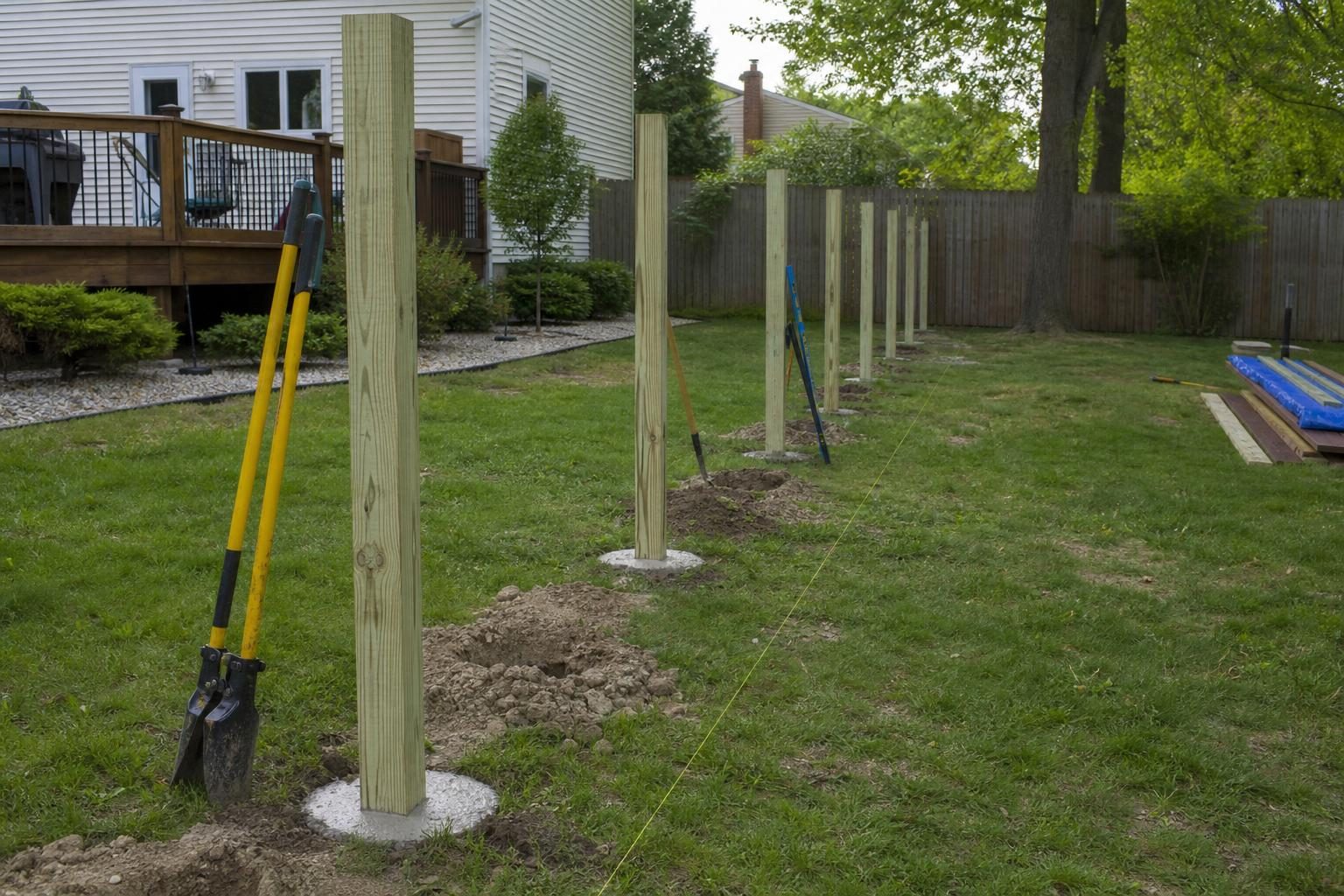
Almost every fence complaint comes back to the posts. Penn State Extension’s fence planning guide describes line posts set roughly 3 feet deep, with corner and gate posts larger and set deeper, around 4 feet, and deeper still in sandy or chronically wet soil. It also notes that a pressure-treated post typically lasts about 10 to 25 years depending on soil and treatment quality.
What good post setting looks like:
- Ground-contact rated lumber. Wood posts should carry a tag rated for ground contact (the industry use category for fence posts is UC4A). Above-ground lumber looks the same but rots much faster when buried.
- Below the frost line where it freezes. Frozen soil grips a post and can lift it a little each winter. Holes that are wider at the bottom than the top, or smooth-sided forms, resist that lifting better than a narrow carrot-shaped hole.
- Concrete that sheds water. Homeowner and pro forums are full of posts that rotted off right at ground level because concrete stopped below grade and formed a cup that held water against the wood. The better practice is gravel under the post end for drainage, then concrete brought up slightly above grade and crowned so water runs away from the post.
- Gravel versus concrete. Tamped gravel drains well and many fence builders prefer it for wood line posts, but it gives less support, so gate and corner posts generally still get concrete. In very wet or windy sites, ask your installer what they recommend for your soil, not just what they always do.
- Steel posts as an option. Galvanized steel posts behind wood boards avoid post rot entirely.
Permits, height limits, HOAs, and neighbors

Permits and height
Rules are set by your city or county, and they vary. Many towns require a fence permit, and plenty don’t but still enforce height limits. A common pattern is about 6 feet in back and side yards and 3 to 4 feet in front yards, with tighter limits near corners so drivers can see traffic. Height is often measured from finished grade on your side. Our landscaping permit guide explains how to look up your local rules.
Good side out
Many codes and HOAs require the finished side of the fence to face the neighbors or the street, with posts and rails on your side. Board-on-board and shadowbox styles look finished on both sides, which sidesteps the question.
HOAs
If you have an HOA, get written approval of material, color, height, and style before you sign a contract. Some communities allow only certain colors of vinyl or specific picket styles, and a fence built without approval may have to come down.
Property lines and surveys
Don’t rely on an old fence, a hedge, or a guess. If corner pins can’t be found, a survey usually costs a few hundred dollars and is cheap insurance against building on your neighbor’s land. Many homeowners set the fence a few inches inside their line so they can maintain both sides.
Sharing the cost with a neighbor
Some states have boundary-fence rules. California’s Good Neighbor Fence Act, for example, presumes adjoining owners share reasonable costs of a shared boundary fence and requires 30 days’ written notice before work starts. Other states have nothing like it. Whatever the law says, a short written agreement covering cost split, style, and which side faces whom avoids most disputes.
Call 811 before digging
Fence posts are exactly the kind of digging that hits gas, power, and fiber lines. The free 811 call-before-you-dig service, a Common Ground Alliance initiative, asks you to request marking a few business days before digging. If you hire a contractor, confirm they have a locate ticket and don’t let anyone dig until the lines are marked. Private lines, like sprinkler pipes, landscape lighting, and wiring to a shed, aren’t marked by 811, so point those out.
Problems homeowners run into
- Leaning posts after the first big storm. Usually shallow holes, too little concrete or tamping, or a solid 6-foot fence acting like a sail. Privacy fences catch much more wind than open styles.
- Posts rotting at ground level. Often the concrete-cup problem above, or posts that weren’t rated for ground contact. Some owners report treated posts failing in under ten years in wet soil.
- Sagging gates. A gate post that moves is the most common cause, followed by a missing or backwards diagonal brace. Anti-sag cable kits help on smaller gates, but forum advice for wide gates leans toward steel gate posts.
- Frost heave. In cold regions, posts set too shallow or in narrow holes can rise unevenly, leaving a wavy top line.
- Gaps on slopes. Stepped panels leave openings at the bottom; pet owners often add a kick board, wire mesh, or stone to close them. If you have dogs, see our pet-friendly backyard guide.
- Fence in the wrong place. Built over the line, too tall for code, or with the wrong side facing out, discovered when a neighbor or inspector complains.

Before-you-sign checklist
- Find your property pins or order a survey.
- Look up height limits, permit rules, and any front-yard or corner-lot restrictions.
- Get HOA approval in writing if you have one.
- Talk to neighbors, especially if you want to share cost or replace a shared fence.
- Mark sprinkler lines, lighting wires, and drain pipes yourself.
- Get at least three written bids that list the same height, material grade, post spacing, post depth, and gate count.
- Confirm who files the permit and who calls 811.
For a broader framework, see how to compare landscaping quotes. If privacy is the goal, our outdoor privacy solutions guide covers fences alongside screens and plantings.
Questions to ask and red flags
Questions to ask a fence contractor
- How deep will line, corner, and gate posts be set, and in what (concrete, gravel, or both)? How will the concrete be finished at the ground?
- What size and type of posts will you use? Are wood posts rated for ground contact?
- What is the post spacing, and how will you handle the slope: stepped or racked?
- For vinyl: what brand and product line, what wall thickness, and are bottom rails reinforced?
- How are gates braced, and what hinges and latches are included?
- Does the price include old fence removal, haul-away, permit, and digging in rock?
- Who calls 811, and who pulls the permit?
- What does your workmanship warranty cover, for how long, and does it cover leaning posts?
Red flags
- A price with no post depth, post size, or material grade written down.
- Pressure to sign today, or a “leftover materials” discount from a crew that knocked on your door.
- Large upfront payments or cash only. The FTC’s home improvement scam guide advises getting written estimates, not paying the whole cost up front, and checking licensing and insurance where your state requires it.
- No mention of 811, the permit, or your property line.
- A bid far below the others, which often means shallower posts, wider spacing, or thinner vinyl.
Our list of questions to ask before hiring a landscaper covers licensing, insurance, and contract basics that apply to fence companies too.
Frequently asked questions
What is the cheapest fence to install?
Galvanized chain link is usually the cheapest per foot, followed by pressure-treated wood. For privacy on a budget, a 6-foot pressure-treated board fence is typically the lowest-cost option, though it needs sealing or stain to last.
How long does fence installation take?
Often one to three days for a typical backyard. Concrete may need a day to firm up before panels go on, and rock, slopes, or old fence removal add time.
Is vinyl fence installation more expensive than wood?
Vinyl usually costs more upfront than pressure-treated wood and about the same as cedar. It needs less upkeep over time, so the gap narrows over the life of the fence. Quality varies widely between vinyl products.
Do I need a permit to replace an existing fence?
It depends on your town. Some require a permit for any new or replaced fence, others only for fences over a certain height, and some none at all. Replacement fences generally still have to meet current height and placement rules.
Should fence posts be set in concrete?
Gate and corner posts generally should be. For wood line posts, concrete or tamped gravel can both work; what matters most is drainage at the base and keeping water from pooling against the wood at ground level.
Who pays for a fence between neighbors?
It depends on state and local law and on any agreement you make. Some states presume neighbors share the cost of a boundary fence; in others, whoever builds it pays. Put any shared-cost arrangement in writing.