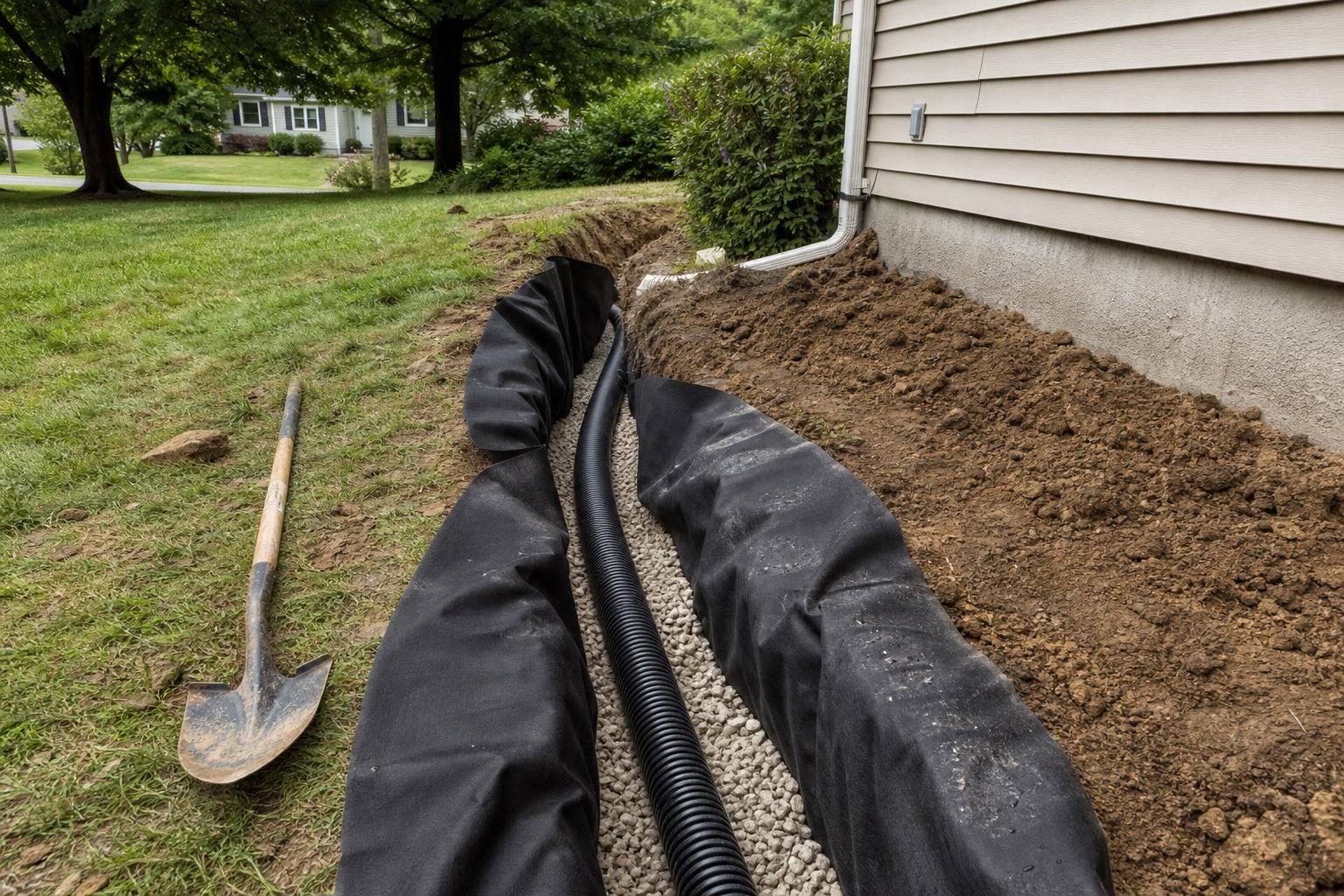
A French drain installed by a contractor usually costs about $15 to $50 per linear foot for a shallow yard drain, and $50 to $100 or more per foot when it has to go deep along a foundation or inside a basement. Most homeowners land somewhere between $1,500 and $6,000 for a typical yard project, with interior basement systems often running well past that.
The bigger question is whether a French drain is the right fix at all. Many wet yards are really caused by downspouts or grading, and those problems are cheaper to solve. This guide covers real-world prices, what drives them, how a drain should be built, and what to check before you sign a quote.
Quick answer: Expect roughly $15–$50 per foot for a shallow exterior French drain, $50–$100+ per foot for deep foundation-depth work, and $40–$100 per foot for an interior basement drain (often $5,000–$10,000+ with a sump pump). DIY materials typically run about $5–$15 per foot plus tool rental. Length, depth, rocky soil, hand-digging and the outlet (daylight, dry well, sump or street) move the price most. Before paying for any drain, extend your downspouts and check your grading. Those cheaper fixes solve many wet-yard problems on their own.
Part of our Complete Yard Drainage Guide: diagnosing water, drains and swales, costs and repairs in one place.
French drain cost per foot
Prices below are rounded national ranges for a typical residential job. They vary by region, soil, access and how much lawn, landscaping or concrete has to be torn up and put back.
| Type of drain | Typical installed cost | Notes |
|---|---|---|
| Shallow yard drain (about 12–24 in deep) | $15–$40 per foot | Soggy lawn areas, side yards, the base of a slope |
| Curtain drain across a slope | $15–$35 per foot | Intercepts groundwater moving downhill toward the house |
| Deep exterior drain along a foundation | $50–$100+ per foot | Higher when digging to footing depth or working around patios and walks |
| Interior basement French drain | $40–$100 per foot | Concrete cut and patched; whole basements often $5,000–$10,000+ |
| DIY materials only | About $5–$15 per foot | Washed stone, pipe, fabric; add $100–$200 a day for a trencher |
| Dry well added at the outlet | $500–$3,000 | Depends on size, soil and whether it is a gravel pit or a plastic or concrete unit |
| Sump pump added to a drain system | $650–$2,000 | Needed when there is no downhill place for water to go |
| Typical 50–100 ft yard project | $1,500–$6,000 | Includes outlet and basic lawn restoration |
For a planning sanity check, a Delaware state flood-adaptation sheet estimated $600 to $2,000 in materials for a 60-foot shallow DIY drain, and $1,000 to $4,000 for a deeper installed one, in 2022 dollars. Contractor prices in high-cost metros often sit above those numbers.
What drives the price

- Length. Per-foot pricing is the norm, but short runs carry a minimum charge for mobilizing a crew and equipment. A 30-foot drain rarely costs half of a 60-foot one.
- Depth. Every extra foot of depth means more soil out, more stone in and more trench safety work. Foundation-depth drains cost several times what a shallow yard drain does.
- Digging conditions. Rock, heavy clay, roots and tight side yards slow everything down. Near gas lines, irrigation or utility easements, crews often have to hand-dig, which is where many quotes jump.
- The outlet. A simple daylight exit downhill is cheapest. A dry well, sump pump or permitted storm connection can add hundreds to thousands of dollars.
- What is in the way. Cutting through a patio, walkway or driveway, rerouting sprinkler lines, and removing or replanting beds all add cost.
- Spoil and restoration. Soil haul-off and reseeding the trench line are not always included. Ask.
- Materials choices. Rigid perforated PVC costs more than corrugated pipe but is easier to clean. Cleanouts and catch basins add parts and labor.
- Permits. Some towns require a permit for drainage work, curb outlets or storm-sewer connections. Fees are usually modest, but the paperwork and inspection add time.
The outlet: where the water goes
A French drain only moves water. If there is nowhere good for that water to end up, the drain fills and stops working. Choosing the outlet is often the most important decision in the whole project.
- Daylight. The pipe runs downhill until it exits at the surface, usually through a pop-up emitter or onto a stone splash pad. It is the cheapest and most reliable option when your lot has enough fall.
- Dry well. An underground gravel pit or plastic chamber that lets water soak in. It works in sandy or loamy soil and struggles in dense clay or where groundwater sits high. A simple percolation test (dig a hole, fill it, time how fast it drains) tells you a lot before you commit.
- Sump pump. When the yard is too flat to daylight, water collects in a basin and gets pumped out. It works, but it adds a pump to maintain and a power dependency.
- Street or storm sewer. Many cities allow a curb outlet or storm connection only with a permit, and some ban winter discharge onto streets and sidewalks because of ice.
Local discharge rules matter. Municipal stormwater guides commonly prohibit sending drain or sump water into the sanitary sewer, onto a neighbor’s property, or within a few feet of a property line. Check with your city or county public works office before you finalize the plan, because a drain that dumps water on the house next door can turn into a legal problem.
What a correctly built drain looks like

Details are where cheap drains fail. The U.S. Department of Energy’s Building America guidance from PNNL lays out a French drain built in a trench at least 14 inches wide, with filter fabric, clean stone and 4-inch perforated pipe. In practice, a solid build has these traits:
- Steady fall. At least 1 percent slope, about 1/8 inch per foot or 1 inch every 8 feet, with more being better. The trench bottom should be checked with a string line or laser so there are no low spots where water sits.
- Washed stone. Clean, angular stone around 3/4 to 1 1/2 inch. Dirty fill or fine pea gravel packs tight and slows water down.
- Fabric that wraps the stone. Non-woven filter fabric lines the trench and then folds over the top of the stone before soil or sod goes back on. Fabric only under the gravel lets silt wash straight in from above.
- Pipe bedded in stone. A few inches of stone below the pipe and several inches over it.
- Perforations, usually down. Most installers and the PNNL guidance put the holes facing down so water rises into the pipe from the trench bottom. A minority prefer holes up on drains that get flushed by roof water. Either way, a pipe fails once silt fills it up to the holes.
- Cleanouts. A capped riser at the high end, and at long runs or bends, lets you flush or snake the line later.
- No trees or shrubs on top. Roots seek out moist stone and pipe.
If you are still deciding whether you need underground drainage or a surface solution, our French drain vs surface drain guide explains which water problems each one actually solves.
Cheaper fixes to try first
A French drain is built for water moving through the soil. A lot of soggy yards and wet basements come from water moving across the surface, especially roof water. Before paying for a trench, check these:
- Downspout extensions. A downspout that dumps right at the foundation can soak the soil around it after every storm. Extensions that carry water at least 4 to 6 feet away, and farther in clay, cost very little. The EPA’s Soak Up the Rain program encourages redirecting downspouts onto lawn or garden areas where water can soak in, as long as it does not create problems for others.
- Clean gutters. Overflowing gutters dump water in a line along the house. Clearing them is free.
- Regrade near the house. Soil that has settled toward the foundation sends water straight at it. Rebuilding a gentle slope away from the walls is often a few hundred to a few thousand dollars. See signs you need regrading.
- A shallow swale. A gentle grassy channel can steer surface runoff around a house or across a yard for less than a buried drain.
- Watch it rain. Walk the yard during a heavy storm. Where water comes from and collects tells you more than any sales pitch.
Our drainage vs regrading guide walks through how to tell which approach fits your yard.
Problems homeowners run into

Homeowner forums and contractor discussions keep circling back to the same handful of disappointments:
- Solving the wrong problem. People install a drain for a wet yard, then find the real source was a downspout, a neighbor’s runoff or soil sloping toward the house. The drain works fine, but the water keeps coming from the same place.
- Clogged with silt. Drains built with dirty stone, no fabric over the top, or downspouts and surface grates piped straight into them fill with sediment and leaves. Fixing that often means digging the whole thing up and replacing the stone.
- No real outlet. Some drains just end in the ground or in a small gravel pocket in clay. They fill during the first big storm and stay full.
- Not enough fall. On flat lots, a trench without consistent slope holds water in low spots. A state flood guide notes that French drains are not recommended for yards that flood often because of a lack of slope.
- Conflicting advice. Homeowners often get three quotes with three different diagnoses, from a simple regrade to a full perimeter drain with two sump pumps. That spread is a sign to ask each contractor to explain where the water comes from.
- Sticker shock on small jobs. Quotes over $5,000 for a single trench along the back of a house are common when hand-digging, utilities or tight access are involved, and some contractors price small jobs high when they are busy.
DIY vs hiring a pro
A shallow yard drain is a realistic DIY project for a fit homeowner with a free weekend or two and a rented trencher. The Delaware guide describes simple drains 8 to 24 inches deep as DIY territory, while deeper drains or those close to a foundation call for a drainage contractor. Homeowners who have done it often describe two weekends of hard labor.
- Good DIY candidate: shallow drain, easy access, clear daylight outlet, soft soil, no hardscape in the way.
- Hire a pro: foundation-depth work, basement seepage, trenches deeper than you can safely dig, rocky ground, a need for a sump or permitted connection, or any doubt about where the water is coming from.
- Always: call 811 a few days before digging so buried utilities get marked. It is free and required in most states.
Quote checklist and questions to ask

A good drainage quote should spell out these items in writing. Our guide to what a drainage estimate should include goes deeper.
- Total length, trench depth and width
- Pipe type and size (rigid PVC or corrugated, 4 inch or larger)
- Stone type and fabric, including whether fabric wraps over the stone
- Planned slope and how it will be checked
- Exact outlet location and type, plus any permit
- Number and location of cleanouts
- Soil haul-off and lawn or landscape restoration
- Who handles utility locates and sprinkler repairs
- Warranty on workmanship and what it covers
Questions to ask a contractor
- Where do you think the water is coming from, and how did you decide that?
- Would extending downspouts or regrading solve part of this for less?
- Where exactly will the water discharge, and is that allowed here?
- How will I clean or check this drain in five years?
- Have you installed drains in soil like mine, and can I see one?
Red flags
- A quote for a drain without any explanation of the water source
- No outlet named, or “it will just soak in” in heavy clay
- Downspouts and surface grates tied straight into the perforated drain
- Pressure to sign the same day or a large deposit before any work
- Pea gravel and no fabric, or fabric only under the stone
When comparing bids, our guide to comparing drainage contractors and estimates can help, and our broader drainage solutions guide covers options beyond French drains.
Frequently asked questions
How much does a 100-foot French drain cost?
A shallow 100-foot yard drain typically runs about $1,500 to $4,000 installed, more with a dry well, sump pump, hardscape removal or rocky soil. DIY materials for the same length are often $500 to $1,500 plus tool rental.
Is an interior basement French drain the same thing?
No. An interior drain runs inside the basement along the footing, under a cut-out strip of floor slab, and usually feeds a sump pump. It handles water that has already reached the foundation, so it is priced and scoped more like basement waterproofing than landscaping.
How long does a French drain last?
A well-built drain with clean stone, fabric wrapped over the top and a clear outlet can work for decades. Poorly built ones can silt up within a few years.
Should the holes in the pipe face up or down?
Most installers and federal building guidance place perforations down so water rises into the pipe from the trench bottom. Some prefer holes up in specific cases. Slope, clean stone and fabric matter far more than which way the holes face.
Can I connect my downspouts to a French drain?
It is better not to tie them into the perforated drain. Roof water carries grit and leaves and can overload the trench. Run downspouts through their own solid pipe to the outlet instead.
Does a French drain need a permit?
Often not for a simple yard drain on your own property, but many towns require permits for curb outlets, storm-sewer connections or work that changes drainage toward neighbors. Check with your local building or public works office first. To weigh drainage spending against the damage it prevents, see our drainage cost vs property protection guide.