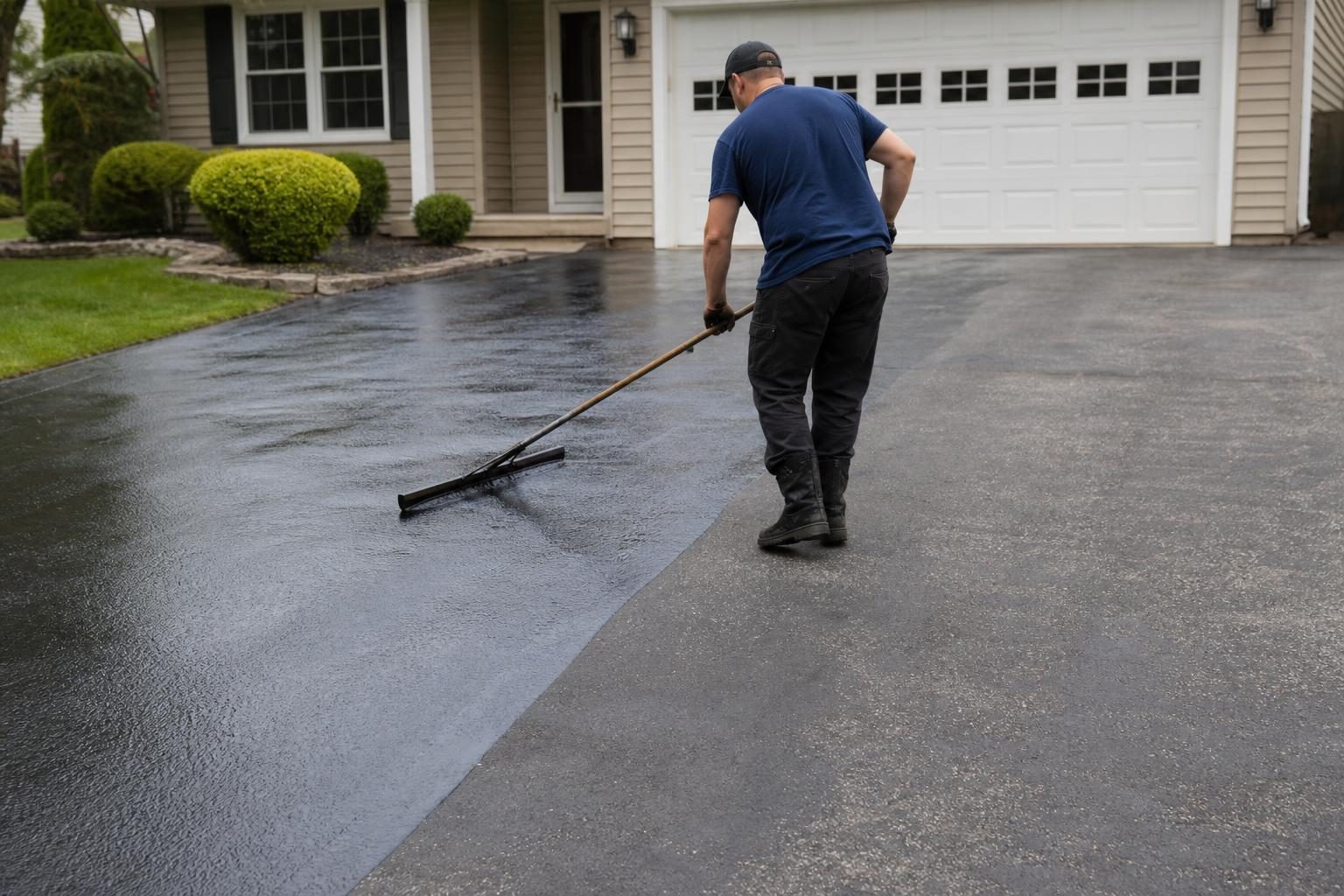
Driveway sealcoating is a thin protective coat brushed or sprayed over an existing driveway. On asphalt it slows the sun and water damage that turns blacktop gray, brittle and crumbly. On concrete, a penetrating sealer helps keep out water and deicing salt. It is maintenance, not repair. It works best on a driveway that is still sound, applied every few years when the surface starts to look dry, and not before.
Quick answer: Seal an asphalt driveway when it turns gray, loses fine grit or develops hairline cracks. That usually means every 2 to 4 years, and not in the first year or more after paving. Use an asphalt-emulsion sealer rather than coal tar. Fill cracks first and wait for a dry stretch with temperatures of 50°F and rising. A professional job on a typical two-car driveway usually runs a few hundred dollars. For concrete, a breathable silane or siloxane sealer every few years is the common choice in snowy climates. Turn away any door-to-door crew offering “leftover sealer.”
Part of our Complete Driveway Guide: types, costs, installation, repair and hiring in one place.
Is sealcoating worth it?
Homeowners argue about this, and both sides have a point. Asphalt is rock held together by a petroleum binder. Sun, oxygen and water slowly dry that binder out. The surface fades to gray, small stones start to loosen (raveling), and fine cracks let water reach the base underneath. A sealcoat puts a fresh layer of binder-rich material over the top, which slows that aging and fills tiny surface voids.
The Asphalt Institute describes sealing as a way to renew old asphalt that has become dry and brittle and to seal small cracks and voids. It also says a well-built, low-traffic driveway generally should not need sealing for roughly 2 to 5 years. Skeptics are right that sealer cannot fix a driveway that is already failing. It will not hold up a sinking area, cure alligator cracking or stop water coming from a downspout.
A fair way to decide:
- Worth it: the asphalt is structurally sound but faded, dry-looking or shedding fine grit, with only scattered hairline cracks.
- Not yet: the driveway is new, or it still looks dark and the last coat is intact.
- Not enough: you see sinking, potholes, interconnected “alligator” cracks or crumbling edges. Those need driveway repair first, and sometimes replacement.
Asphalt sealers: asphalt emulsion vs coal tar
Most driveway sealcoat sold in the US falls into two families, and the difference matters more than brand names.

| Type | What it is | Pros | Cons |
|---|---|---|---|
| Asphalt emulsion | Asphalt binder suspended in water, often with fillers, sand or polymer additives | Low odor, easy cleanup, far lower in PAH chemicals, legal everywhere | Less resistant to gas and oil spills; quality varies widely by product |
| Coal-tar sealer | Refined coal tar or coal-tar pitch mixed into an emulsion | Hard, fuel-resistant finish; long track record | Very high PAH content, strong odor, skin irritation; banned or restricted in a growing number of places |
Why coal tar is restricted. The U.S. Geological Survey has studied coal-tar sealcoat for years. Its fact sheet on human health and aquatic life explains that coal-tar sealcoat wears into fine particles that carry high levels of PAHs. Those particles get tracked into homes and end up in house dust. That raises the potential cancer risk for people living next to coal-tar-sealed pavement, especially young children. Runoff from these surfaces has also proven toxic to aquatic life months after application. Asphalt-based sealers contain far lower levels.
Washington and Minnesota ban coal-tar sealers statewide. Several other states, Washington, D.C. and many cities and counties also restrict them. Coal tar has historically been more common east of the Continental Divide. If you live there, ask your contractor which product they use. Even where it is legal, the Asphalt Institute does not recommend coal-tar products, so an asphalt-emulsion sealer is the sensible default.
Concrete driveway sealers
Concrete driveway sealcoating is a different job. You are not adding a wear layer. You are limiting how much water and salt soak into the slab. In freeze-thaw climates, that water and salt cause scaling, where the top surface flakes off. There are two main types:
- Penetrating sealers (silane, siloxane, or a blend): soak into the pores and make the concrete repel water without leaving a film. They do not change the look much, do not make the surface slippery, and typically last several years. The National Ready Mixed Concrete Association recommends a breathable silane or siloxane sealer for exterior slabs exposed to winter weather. It suggests applying it when the concrete is reasonably dry, with late summer being ideal.
- Film-forming sealers (acrylic, polyurethane, epoxy): sit on top and give a wet or glossy look that enhances color, which is popular on stamped and decorative concrete. The tradeoffs are that they can get slick when wet unless a grit additive is used. They also wear off in tire paths, and they need recoating more often, often every 1 to 3 years.
For a plain broom-finished driveway in a snowy region, a penetrating sealer is the usual choice. For a decorative or stamped concrete surface where looks matter, many owners accept the upkeep of a film-former. Our concrete driveway maintenance and sealing guide goes deeper. Never use asphalt sealcoat on concrete; it looks patchy and peels.

How often to seal, and when not to
Asphalt: every 2 to 4 years is the range most guidance lands on. Busy, sunny or freeze-thaw driveways fall at the shorter end, and lightly used ones at the longer end. Let the driveway tell you. Reseal when the surface has faded and you can see the stones, not because a year has passed.
Do not seal every year. Layers build up when there is no wear to remove the old coat. That thick buildup can crack, flake and peel, and then it looks worse than an unsealed driveway.
New asphalt needs time. Fresh asphalt still contains lighter oils that need to leave the surface. Sealing too soon can trap them and leave a soft surface that scuffs. Advice ranges from a few months to a year or more, and the Asphalt Institute notes many well-built driveways do not need a first seal for several years. Follow your paver’s advice for the specific mix. If you are pricing a new driveway, our asphalt driveway cost guide explains what to budget for upkeep.
New concrete: wait at least the cure period on the sealer label, commonly about 28 days. Industry guidance also says to avoid deicing chemicals during the first winter if you can.
Skip sealing when: the driveway is sinking, potholed or alligator-cracked; water is pooling from a drainage problem; or rain, cold or a hot humid spell is in the forecast.
Weather windows and crack prep
Most sealcoat failures come down to weather and preparation rather than the product itself.
The weather window
- Common manufacturer guidance is 50°F and rising for the day of application and the next day. Warm, sunny, low-humidity days cure best.
- Allow about 24 hours without rain after application. Some products need less and some more, so check the label.
- Avoid cool nights, heavy dew and very humid days, when water-based sealer cures slowly and stays soft.
- Plan to stay off it for at least a day before driving on it, and longer in cool weather. Late spring through early fall is the realistic season in most of the country.
Prep checklist
- Clean. Sweep, edge back grass and weeds, and blow or wash off dirt. Sealer will not bond to dust.
- Treat oil spots. Scrub with a degreaser and use an oil-spot primer. Otherwise sealer peels off those spots.
- Fill cracks first. Clean out cracks wider than a hairline and fill them with a flexible rubberized crack filler. For deep cracks, put sand or backer rod in the bottom first. Let the filler cure before sealing. Our driveway repair guide explains crack filling and patching.
- Patch holes and soft spots properly before sealing. Sealer only covers them up.
- Apply thin coats. Two thin coats wear better than one thick one. Many crews squeegee the first coat into the surface and spray or squeegee the second.
- Mask edges along the garage slab, walks and landscape edging. Sealer stains concrete and stone.
Driveway sealing cost
Prices vary a lot by region, driveway size, condition and how much crack work is included. Published guides range from well under fifty cents per square foot to over a dollar. That gap is mostly because some prices include crack repair and some do not. Use these rounded ranges as a starting point, not a quote.

| Job | Typical range (US) | Notes |
|---|---|---|
| Pro asphalt sealcoat, basic | About $0.20–$0.50 per sq ft | Clean and seal, light crack fill; many crews have a minimum charge |
| Pro asphalt sealcoat with crack repair | About $0.50–$1.50 per sq ft | More crack filling, oil-spot priming, two full coats |
| Typical two-car asphalt driveway | Roughly $250–$700 | Higher for long, sloped or heavily cracked drives |
| DIY asphalt sealer and tools | Roughly $75–$250 | Sealer, squeegee/brush, crack filler, degreaser |
| Pro concrete penetrating sealer | Roughly $1–$2 per sq ft | Includes cleaning; decorative film sealers often cost more |
Prices vary by region, site access and condition, so get two or three written quotes. Our guide to comparing landscaping quotes shows how to line them up fairly. If you are still deciding on a surface, asphalt vs concrete driveways compares long-term upkeep.

DIY vs hiring a pro
Sealing asphalt is an approachable DIY job, but it is messy, heavy work, and timing matters.
DIY makes sense when the driveway is modest in size, fairly flat and in good shape. It also helps if you can pick an ideal weather day and are willing to do the prep properly.
A pro makes sense when the driveway is long or steep or has many cracks. The same goes if you want hot-pour crack sealing, which outlasts most bottled fillers, or if you simply do not want sealer on your shoes, car and garage floor. Pros also tend to use commercial-grade material, but not always. Some homeowners discover their contractor used the same retail-grade pails sold at home centers, so ask.
Problems homeowners run into
- Peeling and flaking within a year or two. This usually comes from sealing over dirt, oil or a damp surface, from too-thick coats, or from years of buildup.
- Tire scuffs and power-steering marks where cars turn. These are common in the first few weeks and usually fade as the sealer fully cures. Marks that persist suggest the sealer never cured properly.
- Cracks reappearing within months. Sealer bridges hairline cracks only. Unfilled cracks reopen, and filled cracks can still move with the seasons.
- Paying for a “sealcoat” that was mostly water. Over-diluted product looks fine on day one and wears off in a season.
- Sealing a failing driveway. Owners who sealed over base failure often found the same cracks back within a year, and the money would have been better spent on repair.
Questions to ask and red flags

Questions to ask a contractor
- Is the sealer asphalt-emulsion or coal tar? Can I see the product name and data sheet?
- How many coats, and is the product diluted? If so, by how much?
- How will you clean, prime oil spots and fill cracks? Is crack filling hot-pour or cold-pour, and is it included in the price?
- What weather limits do you follow, and what happens if it rains before the sealer cures?
- How long until we can walk and drive on it?
- Are you licensed and insured where required, and will you give a written estimate with the square footage?
Our guide to choosing a paving company covers licensing and insurance checks in more detail.
Red flags, including the “leftover sealer” scam
Police departments and state consumer agencies warn about traveling paving and sealing crews every summer. The pattern is consistent:
- A crew knocks unannounced and says it has leftover material from a job down the street.
- The price sounds low, but they want cash or a large payment up front and want to start right now.
- The “sealer” is watered-down or oil-based junk that wears away quickly. In some reported cases it was little more than used oil or fuel.
- Midway through, the price suddenly goes up because the job was “bigger than expected.”
- No written contract, no local address and a vague company name.
Reputable sealcoating companies rarely sell door to door, and many towns require solicitors to carry a permit. If a crew pressures you, say no and get the vehicle description. Report them to local police or your state attorney general’s consumer office.
Frequently asked questions
What is the best driveway sealcoating product?
For asphalt, the best choice for most homes is a quality asphalt-emulsion sealer applied in two thin coats over a clean, crack-filled surface. Prep and weather matter more than the brand. Commercial-grade emulsions with sand or polymer additives generally wear longer than bargain pails. For concrete in a freeze-thaw climate, a silane or siloxane penetrating sealer is the usual pick.
How long does driveway sealer last?
A properly applied asphalt sealcoat typically looks good for about 2 to 4 years, depending on sun, traffic and snow plowing. Penetrating concrete sealers often last several years. Film-forming concrete sealers wear faster where tires turn.
How long after sealing can I drive on my driveway?
Plan on at least 24 hours for most asphalt sealers in warm, dry weather, and longer in cool or humid conditions. Walk on it only after it is dry to the touch, and avoid sharp wheel turns for the first week or two.
Should I seal a brand-new asphalt driveway?
Not right away. New asphalt needs time to cure, and many well-built driveways do not need a first seal for a few years. Ask your paver when they recommend the first coat for the specific mix they laid.
Does sealcoating fill cracks?
Only hairline ones. Anything you can fit a coin edge into should be cleaned and filled with a flexible crack filler before sealing. Wide or interconnected cracks point to a repair job rather than sealing, and on concrete, our guide to signs your concrete driveway needs attention helps you tell which is which.