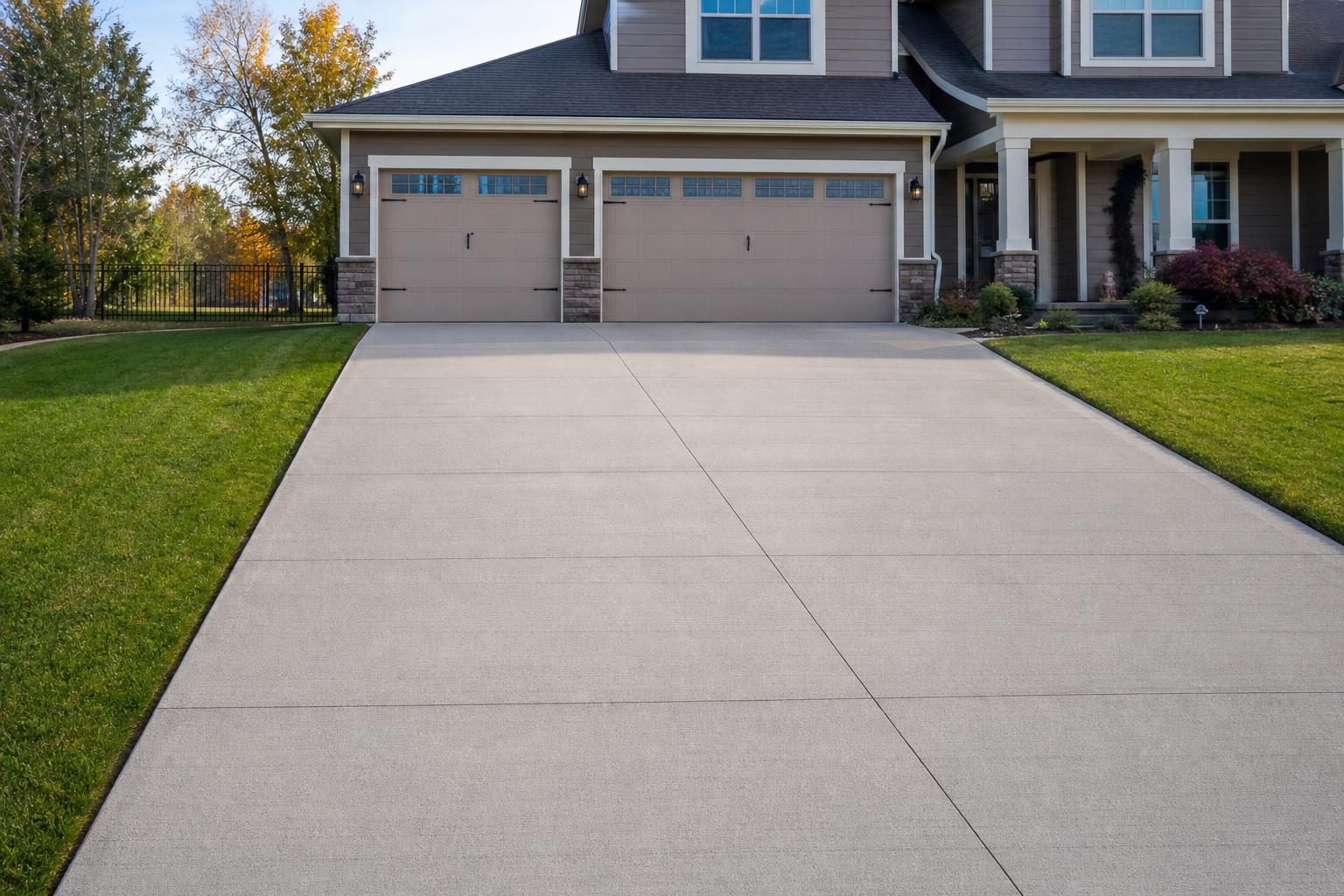
For most homes, the right driveway is plain concrete if you want a long life and little upkeep, asphalt if you want the lowest paved price or live where winters are hard, pavers if looks and easy spot repairs matter more than cost, and gravel if the driveway is long or the budget is tight. A typical two-car driveway of about 600 to 700 square feet runs from roughly $1,200 for gravel to $20,000 or more for pavers. What sits under the surface decides how long any of them lasts.
Quick answer: Rough installed prices are about $2–$6 per sq ft for gravel, $5–$12 for asphalt, $6–$15 for broom-finish concrete, $12–$25 for stamped concrete and $15–$35 for concrete pavers. Concrete often lasts 25–40 years, asphalt 15–25, and pavers 30 years or more with a good base. Gravel is cheapest but needs regrading every year. Whatever you choose, get the compacted base depth, surface thickness and drainage plan in writing. Prices vary a lot by region, soil, access and whether an old driveway has to come out.

Driveway types compared
Five surfaces cover almost every residential driveway in the US. The table gives rounded planning ranges for installed work. Treat them as a starting point, since local labor rates, material prices and site conditions can move any of them by a wide margin.
| Material | Installed cost per sq ft | Typical lifespan | Upkeep | Climate fit | Best for |
|---|---|---|---|---|---|
| Gravel | About $2–$6 new; $1–$2 to refresh | Base lasts for decades if drained; top stone needs regular top-ups | High: regrade once or twice a year, add stone every few years | Anywhere; washes out on steep slopes without good crown and ditches | Long or rural drives, tight budgets, tree roots |
| Asphalt | About $5–$10 to replace; $6–$12+ new on bare ground | About 15–25 years | Medium: crack fill, sealcoat every 2–4 years | Strong in cold, snowy, salted areas; softens in extreme heat | Large drives, cold climates, lowest paved price |
| Concrete (broom finish) | About $6–$12 new; $8–$15 to tear out and replace | Often 25–40 years with good prep | Low: clean, fill cracks, optional penetrating sealer | Excellent in heat; needs air-entrained mix and care with salt in freeze-thaw areas | Long ownership, low maintenance, hot climates |
| Stamped or decorative concrete | About $12–$25 | Slab similar to plain concrete; color and sealer need renewing | Medium: reseal every 2–5 years | Can scale or look worn faster where deicers are used | Curb appeal at less than paver prices |
| Concrete pavers | About $15–$35 (clay, permeable and stone cost more) | Units often 30–50 years; base and joints may need attention sooner | Medium: top up joint sand, pull weeds, optional sealing | Good in freeze-thaw when the base is deep enough | High-end look, spot repairs, permeable options |

Concrete
Plain broom-finish concrete is the default choice in much of the country because it lasts a long time, stays cooler in sun and needs little care. It does crack, and a good installer plans for that with control joints rather than promising it never will. See how long a concrete driveway lasts for what separates a 15-year slab from a 40-year one, and asphalt vs concrete driveways if you are torn between the two most common options.
Stamped and decorative concrete
Stamping, integral color and exposed aggregate turn a plain slab into something closer to stone or brick for less than most paver jobs. The tradeoff is ongoing resealing, color that can fade in full sun, and repairs that rarely match. Our comparison of broom finish vs stamped concrete driveways walks through traction, cost and upkeep.
Asphalt
Asphalt usually costs less than concrete up front, goes in fast and handles plows and road salt well, which is why it dominates in snowy regions. It needs more care: crack filling, sealcoating every few years and, eventually, an overlay or replacement. Thickness is where asphalt jobs go wrong, so the asphalt driveway cost guide covers overlay vs replacement pricing and the compacted thickness to ask for.
Pavers
Interlocking concrete pavers are the premium option. A driveway needs a deeper base than a patio, thicker vehicle-rated pavers and a strong edge restraint, which is why paver driveways cost two to three times as much as plain concrete. In return, damaged areas can be lifted and relaid with the same units. Read the paver driveway guide for base depth, patterns and snow and salt issues, concrete driveway vs pavers cost for the side-by-side math, and types of pavers if you are choosing between concrete, clay and stone units.
Gravel
Gravel is the cheapest way to build a driveway and the easiest to extend, and it tolerates tree roots and frost movement that would crack a slab. The catch is ongoing work: ruts, potholes, stone migrating into the lawn and washouts on slopes. The gravel driveway cost and installation guide covers stone types, depth, tonnage and edging.
How to choose: a decision checklist
Work through these questions in order. Most homeowners are down to one or two materials by the fourth.
- What is your real budget, including tear-out? Removing an old driveway often adds a few dollars per square foot before any new material goes down. If the total for concrete or pavers is out of reach, a well-built asphalt or gravel driveway beats a cheap, thin concrete one.
- How hard are your winters? In freeze-thaw areas that use road salt, asphalt handles plows and salt with less fuss. Concrete works well too, but it needs an air-entrained mix and no deicing salt in its first winter. Pavers need a deeper base. In hot, sunny climates, concrete stays cooler and does not soften.
- Is the driveway steep, long or wet? Gravel washes out on steep grades, and any material fails if water runs under it. Allowed driveway slopes are set locally, and drives steeper than roughly 15% need special planning for traction and drainage. Pooling or runoff toward the garage should be fixed in the design, sometimes with a trench drain or a French drain along the edge.
- How long will you stay? If you plan to sell within a few years, a clean, sound surface matters more than a premium one. Buyers rarely repay the full cost of pavers or stamping. If you are staying for decades, concrete’s low upkeep or pavers’ repairability start to pay off.
- Do HOA rules or curb appeal limit you? Some HOAs and towns restrict gravel, set apron materials or require permits for curb cuts and the section in the public right-of-way. Check before you collect quotes.
- What vehicles will use it? RVs, trailers, delivery trucks and work pickups call for a thicker slab or base. Say so up front so every contractor prices the same driveway.
- How much will you do yourself? Gravel upkeep and asphalt sealcoating are realistic DIY jobs. Pouring concrete, paving asphalt and building a vehicle-rated paver base need pro equipment.
What a driveway costs
The table below shows rough total-project ranges for a typical two-car driveway of about 600 to 700 square feet. The low end assumes good access, sound soil and no tear-out. The high end covers removal of an old surface, extra base work and harder sites. Long, curved or sloped driveways cost more.

| Material | Typical cost per sq ft | About 600–700 sq ft |
|---|---|---|
| Gravel, new build | $2–$6 | $1,200–$4,200 |
| Asphalt overlay on a sound driveway | $2–$5 | $1,200–$3,500 |
| Asphalt, tear-out and replace or new | $5–$12 | $3,000–$8,400 |
| Concrete, broom finish | $6–$15 | $3,600–$10,500 |
| Stamped or decorative concrete | $12–$25 | $7,200–$17,500 |
| Concrete pavers | $15–$35 | $9,000–$24,500 |
Estimate your driveway cost
Enter your driveway size and material to see a rough installed range for your project; it is a planning range, not a quote.
Driveway Cost Calculator
Estimate driveway material plus labor ranges for gravel, asphalt, concrete, or paver installs.
Driveway cost estimate
- Estimated area
- –
- Low estimate
- –
- Mid estimate
- –
- High estimate
- –
- Estimated range per sq ft
- –
These are planning ranges, not quotes; they vary by region, season, soil and access.
What moves the price
- Demolition and removal. Breaking out thick or reinforced concrete and paying disposal fees adds real money.
- Base work. Clay, fill dirt, soft spots and high water tables mean deeper excavation, more stone and sometimes geotextile fabric. This is the line item cheap bids cut first.
- Thickness and reinforcement. Each extra inch of concrete or asphalt adds material. Rebar adds more labor than wire mesh or fiber.
- Finish and pattern. Color, stamping, exposed aggregate and herringbone paver patterns are labor-heavy.
- Access. If trucks cannot reach the work, pumping or hand labor raises the bill.
- Permits and the apron. Work at the street often needs a permit and may have to meet city specs for thickness and material.
- Drainage fixes. Regrading, trench drains at the garage and rerouted downspouts add cost but prevent the most common failures.
For concrete specifically, what affects concrete driveway cost breaks down each driver. If you are deciding whether your old driveway can be saved, replacing an old driveway vs pouring new concrete explains how the budget and prep change between the two.
Installation: what a good job looks like

Every driveway works the same way underneath: a stable, compacted foundation that sheds water. The surface spreads the weight of your car, but the base carries it, and most early failures trace back to parts you cannot see once the job is done.
The steps that matter for every material
- Excavation to firm soil. Topsoil, roots and soft organic material come out. Soft spots are dug out and replaced, not covered.
- A compacted stone base. Concrete usually sits on about 4 to 6 inches of compacted crushed stone, more on soft soil or in cold climates. Asphalt commonly gets 6 to 8 inches. Paver driveways need at least 6 inches, and 8 to 12 inches is common on clay or in freeze-thaw country. The base goes down in thin layers, each compacted with a plate compactor or roller.
- Slope and drainage. The finished surface should fall away from the garage and house. Paved driveways are typically built with about a 2% cross-slope (a quarter inch per foot), while gravel needs a steeper crown of 4–6% to shed water, according to Penn State’s Center for Dirt and Gravel Road Studies.
- Edges. Edges are where driveways break first. Concrete edges are sometimes thickened. Asphalt edges should be full thickness with backfill against them. Pavers need a solid edge restraint so they cannot creep apart.
Material-specific details
Concrete: 4 inches is the common thickness for cars, with 5 to 6 inches for heavier vehicles, weak soil and the apron. Ask for the mix strength in writing, and in freeze-thaw areas ask for air-entrained concrete. Control joints should be cut or tooled to about a quarter of the slab depth. The NRMCA guidance on joints puts maximum spacing at 24 to 36 times the slab thickness, which works out to roughly 10 feet for a 4-inch driveway, with panels close to square. Our step-by-step concrete installation guide has a day-by-day timeline, concrete driveway thickness explains how to match thickness to your vehicles, and why concrete driveways crack covers what joints and base prep can and cannot prevent.
Asphalt: Ask for the compacted thickness, not the loose thickness. Two to three inches is a bare minimum for cars, and 3 inches or more, often in two layers, is common. Paving needs warm weather, so late-fall jobs in cold regions are risky.
Pavers: Driveway pavers are thicker than patio pavers, commonly 80 mm (about 3⅛ inches), laid in a herringbone pattern that locks under turning tires, over about an inch of bedding sand. Base compaction is the step that separates a flat driveway from a rutted one.
Gravel: Build in layers: large crushed base stone, then a compacted top layer of angular stone with fines, shaped into a crown. Round pea gravel and river rock roll and rut under tires.
Red flags during installation
- No visible base work, or stone spread over soft, wet soil.
- Concrete poured in rain, or water added at the truck to make it easier to spread.
- No control joints, or joints spaced far apart on a concrete slab.
- Thin, tapered asphalt edges with no backfill.
- A finished surface that holds water or slopes toward the garage.
Problems, repairs and when to replace

Knowing which kind of damage you have tells you whether a few hundred dollars of repair will do or whether you are patching a driveway that needs to come out.
Cracks
Fine, stable cracks in concrete are normal shrinkage. The National Ready Mixed Concrete Association notes that most early random cracks are unsightly but rarely affect structure or service life. Cracks worth acting on are wider than about a quarter inch, have one side higher than the other, keep growing, or meet in a spider pattern. On asphalt, a single crack can be cleaned and filled, but a web of small interlocking cracks, called alligator cracking, means the base underneath has failed. Crack filler will not fix that. See signs your concrete driveway needs attention for which cracks matter.
Settling and heaving
Sunken concrete slabs can often be raised by mudjacking (roughly $3–$6 per sq ft) or polyurethane foam lifting (roughly $5–$25 per sq ft) if the concrete itself is in good shape. Both fail again if the water or erosion that caused the void is not fixed. Tree roots lifting a slab need an arborist’s input before any roots are cut.
Potholes, ruts and crumbling edges
Asphalt potholes start when water gets through cracks into the base. Cold patch from a bag is a temporary fix. A cut-out, hot-mix or infrared patch lasts much longer. Gravel ruts and potholes usually mean the crown is gone and water is running in the wheel tracks, so regrading fixes more than adding stone.
Pooling and drainage
Standing water is a slope problem, and it is the root cause behind many cracks, potholes and sunken slabs. Fix downspouts that dump onto the driveway, regrade low areas, and consider a channel drain where the driveway meets the garage. Our drainage solutions guide covers the options beyond the driveway itself.
Repair or replace?
Repair makes sense when damage is isolated, the surface is mostly level and the base underneath is still solid. Replacement usually makes more sense when:
- Cracking, settling or alligatoring covers a large share of the surface, or shows up in several places at once.
- Repairs keep failing in the same spots.
- Water drains toward the garage or house and the slope cannot be fixed without removing the surface.
- The driveway was built too thin for the vehicles using it.
The driveway repair guide covers methods and costs for both asphalt and concrete.
Maintenance calendar by material
Maintenance will not save a driveway with a bad base, but it keeps a good one good: keep water off the surface and deal with cracks and stains while they are small.
| Material | Spring | Summer | Fall | Winter | Sealing interval |
|---|---|---|---|---|---|
| Asphalt | Clean, check for new cracks and potholes | Fill cracks; sealcoat on a dry, warm stretch when due | Fill cracks before freeze; clear leaves | Plow with care at edges; avoid piling snow on one spot | Every 2–4 years when graying; not in the first year or more |
| Concrete | Rinse off salt residue; check joints and edges | Clean oil stains promptly; fill cracks | Apply penetrating sealer if due, ideally in dry, mild weather | Use sand or a gentle deicer; no salt in the first winter | Penetrating sealer every few years, optional in mild climates |
| Stamped concrete | Clean and check sealer wear | Reseal when color dulls | Clean leaves that stain | Avoid harsh deicers; plastic shovel edges | Every 2–5 years |
| Pavers | Top up joint sand; pull weeds | Treat oil spots quickly; reset any sunken units | Clear leaves; check edges | Plow with a raised blade or rubber edge | Optional, every few years if sealed |
| Gravel | Rake stone back from the lawn; regrade crown | Fill potholes with fines and compact | Regrade before freeze; clear ditches and culverts | Raise plow blade; plow once ground is frozen | None; top up stone every few years |
On sealcoating asphalt, the Asphalt Institute recommends asphalt emulsion sealers rather than coal-tar products and notes that a well-built, low-traffic driveway often does not need sealing for several years after paving. Sealing every year builds up layers that crack and peel. Our driveway sealcoating guide covers products, weather windows and cost, and the concrete driveway maintenance and sealing guide covers cleaning, stains and when sealer is worth it.

Hiring a driveway contractor

Match the contractor to the material. Concrete driveways are usually built by concrete flatwork contractors, asphalt by paving companies, and pavers by hardscape or paver installers. Ask any company to show recent driveways in your material. Our guide to finding hardscape contractors explains who builds what.
Questions to ask
- What will the compacted base depth be, and how will you compact it?
- What thickness will the finished surface be, and why that number for my vehicles?
- Where will water go, and how will you set the slope?
- For concrete: what mix strength, is it air-entrained, what reinforcement, and where will the joints go?
- For asphalt: how many layers and what compacted thickness?
- Who handles permits and the apron at the street?
- What cracking or settling is covered by your warranty, and for how long?
- Can I see a driveway you built at least five years ago?
What the quote must include
A good quote lists dimensions and square footage, demolition and haul-off, excavation and grading, base material and compacted depth, surface thickness, mix or product, reinforcement, joints or pattern, finish, edges, permits, cleanup, schedule, payment terms and warranty. Use what a concrete driveway quote should include as a line-by-line checklist. Its items apply to asphalt and pavers too.
Red flags
- Door-to-door offers of “leftover” asphalt or sealer, a pattern state consumer-protection offices warn about.
- Cash only, a large deposit up front, or pressure to sign today to lock a price.
- No written contract, no license or insurance proof, or vague answers about base and thickness.
- A promise that concrete will never crack.
For more on vetting, see choosing the right contractor for a concrete driveway and how to choose a paving company.
Problems homeowners run into

The same stories come up again and again in homeowner forums and consumer news reports.
- The driveway was thinner than the contract said. Asphalt measured at the edge came out well under the promised thickness, and cracks followed within a couple of years. Contracts that state compacted thickness, and a quick probe at the edge before the crew leaves, prevent most of these disputes.
- Cracks at corners within a year. New concrete cracked at inside corners near steps or the garage, where relief cuts or isolation joints were missing. Vague estimates made it hard to prove what was promised.
- A new slab that sends water into the garage. A driveway poured too high or sloped the wrong way had no fix short of tearing it out.
- Flaking concrete after the first winter. Surfaces finished with extra water, poured in rain or salted too early lost their top layer.
- Gravel that would not stay put. Loose, round stone or crushed stone without fines rutted, washed downhill and ended up in the lawn. A crown and the right stone fixed it better than more stone.
- Paying for the look, then disliking the upkeep. Some owners chose a surface for its looks and later regretted the resealing, joint sand or stain cleaning. Others picked asphalt for price and later wished for a lighter, cleaner look. Mismatched expectations cause more regret than the material itself.
Frequently asked questions
What is the cheapest driveway material?
Gravel, often about $2–$6 per sq ft new. Among paved options, asphalt is usually cheaper than concrete. Gravel’s extra upkeep narrows the gap over the years.
Which driveway lasts the longest?
Pavers and well-built concrete last longest, often 30 years or more, and asphalt typically 15 to 25. Base, drainage and thickness matter more than the material name.
Is asphalt or concrete better in cold climates?
Both work. Asphalt tolerates plows and road salt better and is easier to patch. Concrete lasts longer but needs an air-entrained mix and no salt in its first winter. The asphalt vs concrete guide covers the tradeoffs.
How thick should a driveway be?
Concrete is commonly 4 inches for cars and 5 to 6 inches for heavier vehicles or weak soil. Asphalt is commonly 2 to 3 inches compacted at minimum, and 3 inches or more is better. Both sit on a compacted stone base, usually 4 to 8 inches deep.
How long before I can drive on a new driveway?
For concrete, about 7 days for cars and about 28 days for heavy trucks. For asphalt, often 2 to 3 days to drive on, with care for a few more weeks. Paver and gravel driveways can usually be used as soon as they are compacted.
Can I put new asphalt or concrete over my old driveway?
An asphalt overlay works on a sound asphalt driveway with a solid base. Over a cracked, sinking or water-damaged base, the old cracks come back through. With concrete, a thin resurfacer can refresh a sound slab, but pouring a new driveway on top of a cracked or sinking one usually carries the old cracks and drainage problems through and can leave the surface higher than the garage floor.
Driveway guide library
Every driveway guide on the site, grouped by decision.
Choosing a material
- Asphalt vs concrete driveway — which fits your climate, budget and upkeep tolerance.
- Concrete driveway vs pavers — cost, lifespan and repair tradeoffs.
- Broom finish vs stamped concrete — whether a decorative finish is worth its cost and upkeep.
- Paver driveway guide — base depth, paver thickness, patterns, snow and salt.
Costs
- Asphalt driveway cost — overlay, replacement and new-build prices, plus thickness.
- Gravel driveway cost and installation — stone, tonnage, layers and building one that stays put.
- What affects concrete driveway cost — the drivers behind a concrete bid, from tear-out to finish.
Installation and build quality
- Concrete driveway installation, step by step — the process from layout to curing.
- Concrete driveway thickness — how thick your slab should be for the vehicles it will carry.
- Why concrete driveways crack — which cracks are normal and how good contractors control them.
- How long a concrete driveway lasts — what makes a slab last decades and what shortens its life.
Repair and maintenance
- Driveway repair — fixing cracks, potholes and sunken slabs, and when to replace instead.
- Signs your concrete driveway needs attention — reading cracks, settling and surface damage.
- Replacing an old driveway vs pouring new concrete — how the two differ in prep and budget.
- Driveway sealcoating — when sealing is worth it, which products to use and cost.
- Concrete driveway maintenance and sealing — routine care, stain cleanup and sensible sealing.
Hiring
- Choosing a concrete driveway contractor — shortlisting, verifying and comparing concrete contractors.
- How to choose a paving company — what a good paver checks before quoting.
- What a concrete driveway quote should include — a line-by-line checklist for comparing bids.
- Hardscape contractors near you — who builds which driveway and how to find a good one.