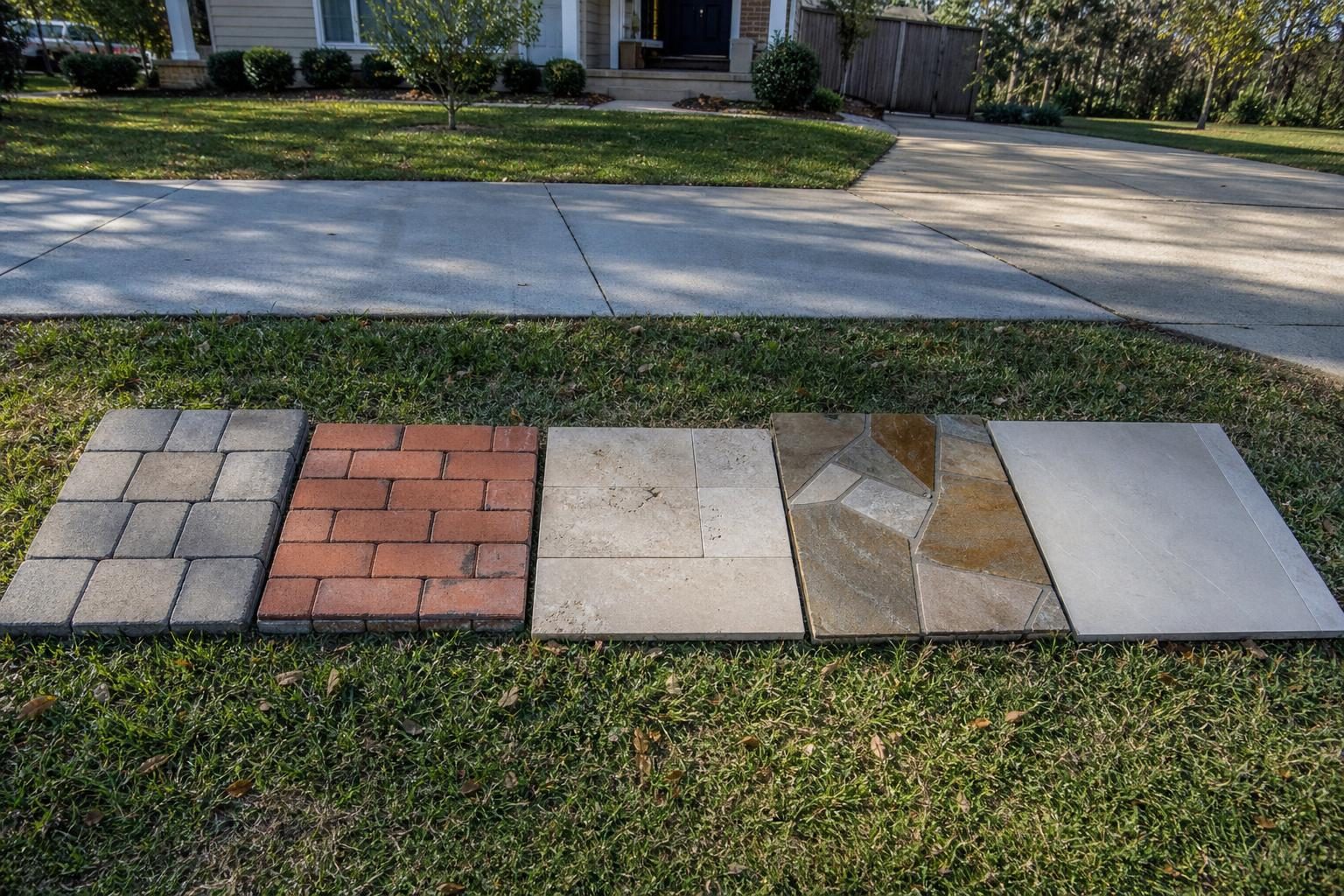
The main types of pavers are concrete pavers, clay brick, natural stone (travertine, flagstone, bluestone, and sandstone), porcelain pavers, permeable pavers, and rubber or composite pavers. They differ less in how they look on day one than in how they age: how fast the color wears, how hot they get in the sun, how slippery they are when wet, and how they handle freezing winters.
Below, each type is compared side by side with rounded installed costs, so you can match the material to your walk, patio, driveway, or pool deck.
Quick answer: Concrete pavers ($10–$25 per sq ft installed) are the best all-around value. Clay brick ($14–$30) keeps its color for decades. Travertine ($15–$30, often $25–$40 around pools in high-cost areas) is the favorite for pool decks because light shades stay cooler underfoot, but it should be avoided where de-icing salt is used. Flagstone and bluestone ($15–$40+) give a natural look, though dark stone gets hot. Porcelain ($15–$35+) resists stains best but needs a careful install. Permeable pavers ($15–$35) handle drainage, and rubber pavers are a budget DIY fix for play areas.
Part of our Complete Patio and Paver Guide: materials, costs, installation, repair and hiring in one place.

Types of pavers compared
The costs below are rounded US ranges for professional installation on a properly built base, including labor and materials. They vary widely by region, site access, demolition, pattern, and base depth. Big metro areas often sit at or above the top of each range. For a fuller cost breakdown, see our paver installation cost guide.
| Paver type | Installed cost per sq ft | Freeze-thaw | Heat in sun | Slip when wet | Fading and staining | Best for |
|---|---|---|---|---|---|---|
| Concrete pavers | $10–$25 | Good when made to the ASTM C936 standard | Medium; dark colors get hot | Generally good texture | Surface color can wear over years; oil stains | Patios, walkways, driveways on a budget |
| Clay brick | $14–$30 | Good if rated as paving brick for severe weather | Red brick gets hot | Good; can grow moss in shade | Color lasts; few stains show | Traditional homes, walkways, patios |
| Travertine | $15–$30 (pool decks often $25–$40+) | Fair; grade and sand-set install matter; avoid de-icing salt | Light shades stay cooler | Tumbled is better; honed or filled can be slick | Holds color; porous, so seal it | Pool decks, warm climates |
| Flagstone, bluestone, sandstone | $15–$40+ | Varies by stone; dense stone does best | Bluestone and dark stone get very hot | Natural cleft is grippy; uneven edges can trip | Sandstone stains easily; bluestone holds up | Natural paths, patios, garden settings |
| Porcelain pavers | $15–$35+ | Very good; absorbs almost no water | Light colors fine; dark gets hot | Check the wet slip rating | Best stain and fade resistance | Modern patios, outdoor kitchens, pool areas |
| Permeable pavers | $15–$35 | Good; water drains through | Similar to concrete pavers | Good; less standing water | Like concrete pavers | Driveways and patios with runoff or drainage rules |
| Rubber or composite | About $5–$15 (often DIY) | Good for flexing; can curl | Gets hot; melts near fire | Soft and grippy | Fades; can’t be refinished | Play areas, hot tub pads, quick DIY covers |
Each paver type up close

Concrete pavers
Concrete pavers are the most common choice because they’re affordable, strong, and come in hundreds of shapes, colors, and textures, including stone and slab looks. Quality units are made to ASTM C936, a standard for strength and freeze-thaw durability referenced by the Concrete Masonry and Hardscapes Association (CMHA, formerly ICPI).
The trade-off is color. Many concrete pavers get their color from pigment in the cement, and as the surface wears, the sand and stone in the mix start to show. Years of power-washing speed that up. Expect a softer, more weathered look over time. A white haze in the first months, called efflorescence, is common and usually fades on its own. Our guide to choosing paver colors and finishes covers blends that age more gracefully.
Clay brick pavers
Clay pavers are fired like brick, so the color runs all the way through. They hold their color for decades and develop a nice worn look rather than a faded one. They’re harder to cut and come in fewer sizes, which can add labor.
One important detail: use real paving brick, not wall brick. Paving brick for cold climates is made to ASTM C902 with a severe-weather rating. The Brick Industry Association’s technical notes explain how clay paving systems should be built. Ordinary building brick laid flat can absorb water and flake apart after a few winters.
Travertine pavers
Travertine is a natural limestone with small holes and a soft, warm look. Outdoor travertine pavers are usually about 1¼ inches (3 cm) thick so they can be set on sand like other pavers. Thinner travertine tile is meant to be set in mortar on a concrete slab.
You’ll see a few finishes. Tumbled travertine has softened edges and a slightly rough surface. Honed is smoother and flatter. Filled travertine has its holes packed at the factory, while unfilled keeps the holes open, which can catch grit and water. Grade matters too: denser premium grades hold up better than economy grades, especially where it freezes.
The big caution: the Marble Institute of America, now part of the Natural Stone Institute, has advised against travertine for exterior paving where de-icing salts are used, because salt crystals can form inside the stone’s pores. In snowy regions, think twice about travertine on a front walk or driveway you’ll be salting.
Flagstone, bluestone, and sandstone
“Flagstone” is a broad term for flat slabs of natural stone. It comes in irregular pieces that fit together like a puzzle, or cut into rectangles (dimensional stone) for a cleaner look. Irregular stone takes more fitting time, so it often costs more to install than the stone itself suggests.
- Bluestone is dense and durable with a gray-blue color, but it soaks up heat. Dark stone in full sun can be uncomfortable barefoot.
- Sandstone comes in warm buff and tan shades. It’s softer and more porous, so it stains and can wear faster unless sealed.
- Dry-laid versus mortared: stone set in gravel and stone dust can shift slightly but is easy to repair. Stone mortared to a concrete slab looks tidy, but mortar joints can crack in freeze-thaw climates.
Porcelain pavers
Outdoor porcelain pavers are usually about ¾ inch (2 cm) thick. They absorb almost no water, so they shrug off stains, spills, and freeze-thaw, and they can mimic wood, stone, or travertine. That makes them popular for outdoor kitchens and modern patios.
They are less forgiving to install. Large thin slabs need a very flat, well-compacted base or an adjustable pedestal system, firm edge restraint, and careful cutting. Slip resistance varies by surface texture. The tile industry’s slip test, developed with the Tile Council of North America, now rates products for different uses, including exterior wet areas, which call for more grip than indoor floors. Ask for the product’s published wet slip rating before using it around a pool.
Permeable pavers
Permeable pavers have wider joints filled with small clean stone so rainwater soaks through into a deeper stone base instead of running off. They suit driveways with puddling problems, homes with stormwater rules, and some areas that offer credits for reducing runoff. The base is deeper and the stone is more expensive, so they cost more than standard pavers.
The joints need upkeep. Plan to sweep or vacuum debris yearly and keep mulch and soil off the surface. Once the joints clog deeply, ordinary cleaning often isn’t enough and a pro with high-suction equipment may be needed. Never seal permeable pavers. If you’re considering them for a driveway, see our paver driveway guide.
Rubber and composite pavers
Rubber pavers, often made from recycled tires, are light, soft, and easy to lay over an existing patio or compacted base. They’re useful under play sets, around hot tubs, or as a quick fix on a budget. They get hot in full sun, can melt from fire-pit embers, fade over time, and some people avoid recycled rubber next to vegetable beds. They’re not a substitute for a long-term patio.
Travertine pavers for pool decks

Travertine is the most requested pool deck paver. Light ivory and beige shades tend to stay more comfortable underfoot than dark stone, and it looks natural next to water. Installed pool decks often run about $25–$40+ per square foot in higher-cost markets, with coping, drainage, and tight access pushing prices up.
Pool owners report mixed experiences, and most of the difference comes down to finish and color:
- Slipperiness: some owners find their travertine grippy even when wet, while others say smoother honed or filled premium stone felt slick. Tumbled finishes usually give more grip.
- Test before you buy: leave samples in full sun for an afternoon, then wet them and walk on them barefoot. Do the same with any concrete or porcelain samples you’re comparing.
- Sealer choice: a glossy sealer can make stone slicker. Ask for a penetrating, non-film sealer and how often it needs reapplying.
- Salt water pools: salt and chlorinated splash-out can wear porous stone over time. A good penetrating sealer and an occasional rinse help.
- Lower-maintenance option: some owners choose porcelain that looks like travertine to avoid sealing and filling holes, accepting the need for a careful install.
Problems homeowners run into
These are the regrets that come up again and again in homeowner and installer discussions:
- Choosing from a photo or one sample. Colors vary by batch, especially in stone. Look at a pallet or a finished project.
- Dark pavers around a pool. Charcoal concrete, bluestone, and red brick can get too hot for bare feet in summer.
- Concrete pavers that faded faster than expected. Surface color wears off over years, and frequent power-washing speeds it up.
- Wall brick used as pavers. It can spall and flake after a few freeze-thaw cycles.
- Travertine on salted walks. Pitting and flaking where de-icers were used.
- Slick surfaces. Smooth honed stone or polished-look porcelain on a wet pool deck or shaded walk.
- Sinking and shifting. Almost always a base or edge-restraint problem, not the paver itself. A thin base under any paver will fail.
- Mortared stone that cracked. Rigid mortar joints over a slab can crack in cold climates.
- No extras saved. Matching the exact color later can be hard. Keep a few spare pavers for repairs.

How to choose: a quick checklist
- Name the job. Driveways need units rated for vehicles and a deeper base. Pool decks need heat and slip performance. Walkways need grip and level joints.
- Check your climate. In freeze-thaw areas, favor concrete pavers made to ASTM C936, paving-rated clay brick, dense stone, or porcelain. Skip travertine where you’ll use de-icing salt.
- Think about sun and bare feet. Choose lighter colors where it’s sunny or around water.
- Decide how much aging you’ll accept. If you want color that lasts, consider clay or porcelain. If you like a weathered look, concrete and stone age naturally.
- Set your maintenance budget. Travertine and sandstone need sealing, permeable needs joint cleaning, and porcelain needs the least.
- Match the house. Brick suits traditional homes, porcelain and large slabs suit modern ones, and flagstone suits natural gardens. Our patio and walkway materials guide covers more options, including gravel.
- Compare with poured concrete. If budget is tight, see paver patio vs concrete patio to decide whether pavers are worth the extra cost.
Questions to ask and red flags
Questions to ask a contractor
- Which exact product, grade, and thickness are you quoting, and can I see a sample or a finished job?
- How deep will the compacted gravel base be, and what edge restraint will you use?
- For stone: will it be sand-set or mortared, and why for my climate?
- Does the price include sealing, joint sand or polymeric sand, cuts, borders, and haul-away?
- How many extra pieces will you leave for future repairs?
- What does your workmanship warranty cover, especially settling?
Red flags
- A quote that names “pavers” or “travertine” without a product, grade, or thickness.
- Thin travertine tile proposed for a sand-set install.
- No mention of base depth, compaction, or edge restraint.
- Pressure to choose a material on the spot without seeing samples outdoors.
- A price far below other bids, which usually means a thinner base.
For help vetting installers, see our guide to hiring hardscape contractors.
Frequently asked questions
What is the most durable type of paver?
Clay brick rated for paving and porcelain pavers are the most color-stable and stain-resistant. Quality concrete pavers are very strong and easy to repair. In practice, the base and edge restraint decide how long any paver lasts more than the material does.
How much do travertine pavers cost?
Installed travertine pavers often run about $15–$30 per square foot, and pool decks in high-cost areas commonly land around $25–$40 or more. Grade, thickness, coping, pattern, and site access move the price.
Which pavers stay coolest around a pool?
Light-colored travertine and light concrete or porcelain pavers generally stay more comfortable than dark stone, red brick, or charcoal concrete. Test samples in full sun before you decide.
Are porcelain pavers good outdoors?
Yes, if they’re rated for outdoor use and installed on a very flat, well-compacted base or pedestals. They resist stains and freezing well. Check the wet slip rating for pool areas.
What are the cheapest pavers?
Standard concrete pavers are usually the lowest-cost long-term option. Rubber pavers cost less up front but don’t last as long.
Can I use any paver for a driveway?
No. Driveways need pavers made for vehicle traffic, usually thicker units on a deeper base. Large thin slabs, thin tile, and rubber pavers aren’t meant for cars. Compare costs in our concrete driveway vs pavers cost guide.