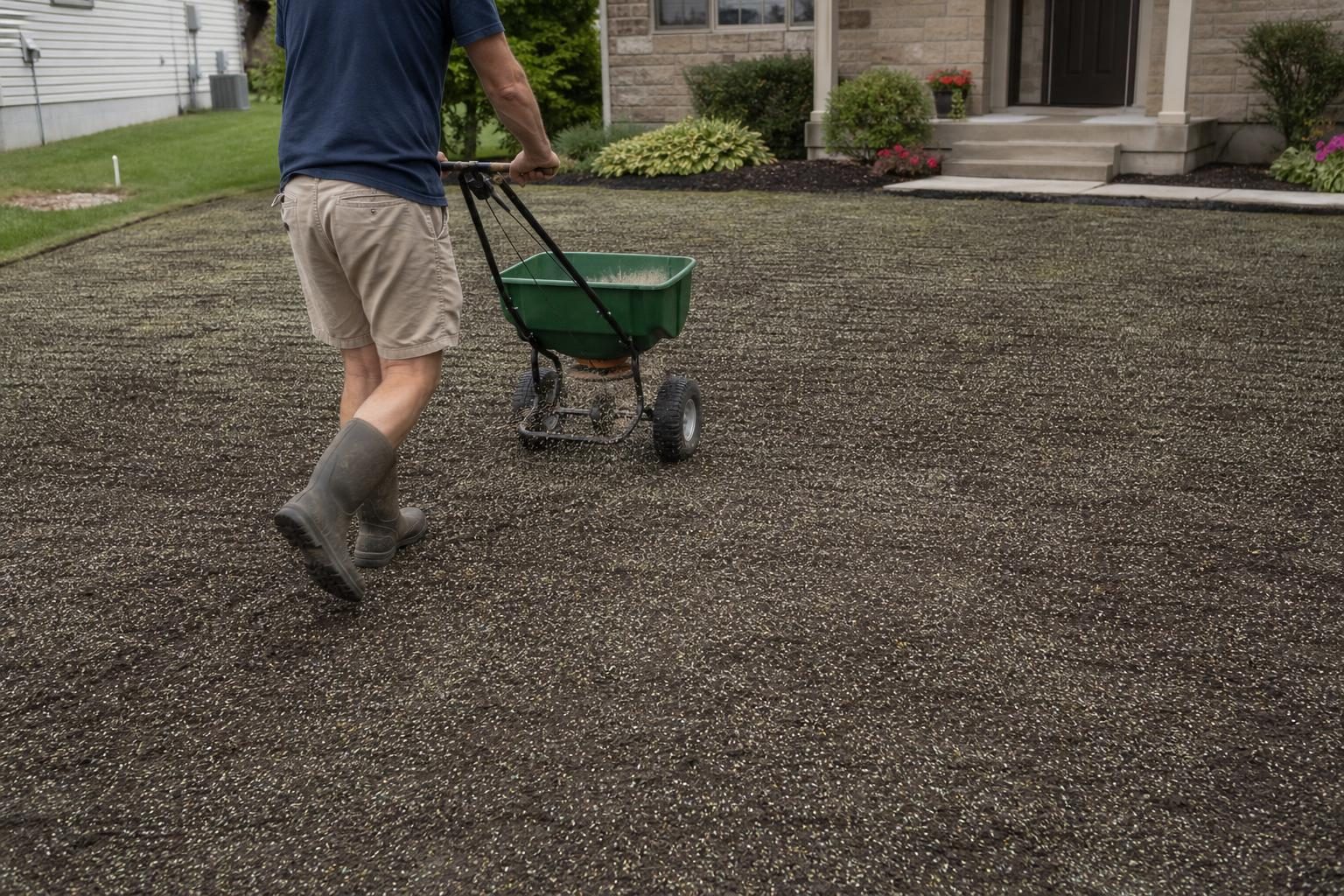
Overseeding means spreading grass seed into an existing lawn to thicken thin areas without tearing anything out. For cool-season lawns the best time is late summer to early fall. The results come down to three things: seed that actually touches soil, the right seed for your grass type, and keeping the surface damp until the new grass is established.
This guide covers timing by region, how to choose and read a bag of seed, seeding rates, starter fertilizer, the watering schedule, the weed-preventer trap, and what overseeding costs to do yourself or hire out.
Quick answer: Overseed cool-season lawns (tall fescue, Kentucky bluegrass, ryegrass, fine fescue) from about mid-August to mid-September in most northern areas, a little later farther south. Mow short, core aerate or slit-seed so seed reaches soil, spread about half the new-lawn rate on the bag, add starter fertilizer where your state allows it, and keep the top half inch of soil damp for two to four weeks. Do not use a regular crabgrass preventer within about two to four months of seeding. Warm-season lawns are handled differently. Pros typically charge about $150–$450 to aerate and overseed a suburban lot.
Part of our Complete Lawn Guide: seed vs sod, grass types, costs, care calendar and hiring in one place.
When to overseed
Cool-season lawns: late summer to early fall
Iowa State Extension recommends overseeding from mid-August through mid-September, because warm soil speeds germination, cool nights favor grass growth, and fewer weeds sprout to compete. In the transition zone and upper South, September into early October usually works. The goal is to give seedlings six weeks or more of good growth before hard frost.
Spring seeding is a fallback, not a first choice. New grass has little time to root before summer heat, and crabgrass germinates right alongside it. If you miss fall, some homeowners in cold climates “dormant seed” just before the ground freezes so seed sits over winter and sprouts in early spring.
Warm-season lawns: a different playbook
Bermuda, zoysia, St. Augustine and centipede spread by runners. They are not overseeded with their own seed in fall. Thin areas fill in when you fix the cause, such as shade or compaction, and feed during the growing season. If you seed bermuda, do it in late spring or early summer once soil is warm.
In the South, “overseeding” often means something else: sowing perennial ryegrass into dormant bermuda for green winter color. NC State Extension notes that winter ryegrass overseeding is research-supported only for bermudagrass lawns. It is typically sown about 30 days before the first average frost at around 5 pounds per 1,000 square feet. The tradeoffs are real: it is hard to stop once started, the rye can slow bermuda’s spring green-up, and leftover rye can linger in clumps. Skip it on zoysia, St. Augustine and centipede.
Choosing seed and reading the label

Match the seed to what is already growing and to the light. Mixing a coarse grass into a fine bluegrass lawn leaves a patchy look for years.
- Full sun, bluegrass lawn: Kentucky bluegrass blend with several varieties, sometimes with some perennial ryegrass for quick cover.
- Tall fescue lawn: turf-type tall fescue. Avoid old pasture types such as K-31 in a fine-bladed lawn.
- Part shade: a mix of bluegrass, perennial ryegrass and fine fescues.
- Heavy shade: fine fescues (creeping red, chewings, hard fescue).
Every bag carries a label that tells you more than the front of the package. Penn State Extension’s guide to turfgrass seed labels suggests these benchmarks:
- Germination: at least 80 percent for bluegrass and fescues and 85 percent for perennial ryegrass.
- Weed seed: no more than 1 percent, and good seed is usually 0.5 percent or less.
- Other crop seed and undesirable grasses: as close to zero as possible. These are how annual bluegrass or coarse grasses sneak into a lawn.
- Test date: recent. Old seed loses viability.
- Inert matter: normally modest. Coated seed carries much more, because the coating counts as inert weight. A 10-pound bag of coated seed holds noticeably less actual seed than 10 pounds of uncoated seed, so compare cost per pound of real, live seed.
- Annual ryegrass: cheap “quick” mixes often lean on it. It sprouts fast, looks good for a season, then dies out.
How much seed to use
Overseeding uses roughly half the rate for a bare-soil lawn. Too little leaves clumps; too much crowds seedlings and invites disease. Measure the lawn rather than guessing, and follow the overseeding rate on your bag when it gives one.
| Grass | Typical overseeding rate (lb per 1,000 sq ft) | Rough days to sprout |
|---|---|---|
| Turf-type tall fescue | 3–5 | 7–14 |
| Kentucky bluegrass | 1–2 | 14–30 |
| Perennial ryegrass | 3–5 | 5–10 |
| Fine fescues | 2–3 | 7–14 |
| Ryegrass over dormant bermuda (winter color) | About 5 for home lawns | 5–10 |
Rates and sprouting times vary with product, soil temperature and moisture. Split the seed in half and spread it in two passes at right angles so you do not leave stripes.
Step-by-step overseeding

- Find out why the lawn is thin. Shade, compaction, grubs, poor drainage or mowing too short will kill new grass too. Fix the cause or pick a grass that tolerates it.
- Mow short. Lower the mower to about 1 1/2 to 2 inches and bag the clippings so seed can reach the ground.
- Deal with thatch. If the spongy layer between grass and soil is more than about half an inch, dethatch or power-rake first. Seed that lands on thatch rarely survives.
- Create seed-to-soil contact. Core aerate in several directions, or use a slit seeder that drops seed into grooves. Iowa State suggests multiple aerator passes to reach 20 to 40 holes per square foot. Our lawn aeration guide covers machines and timing.
- Spread seed and starter fertilizer. Use a calibrated spreader, two passes at right angles. Keep seed off driveways and beds.
- Work it in. Lightly rake or drag the area so seed falls into holes and grooves. A thin topdressing of compost on bare spots helps hold moisture.
- Start watering the same day and stay with it, as described below.
- Keep traffic off for several weeks, including kids, pets and heavy equipment.
Starter fertilizer and phosphorus rules
Starter fertilizers are higher in phosphorus, which supports early root growth. A soil test is the best guide to whether your lawn needs it. Many established lawns already have plenty of phosphorus, and runoff from it feeds algae in lakes and streams.
Several states, including Minnesota, Michigan and New York, restrict phosphorus in lawn fertilizer. They generally allow it when a soil test shows a need or when a new lawn is being established, but the details differ, and some counties and cities add their own rules. If you are unsure whether overseeding counts as establishment where you live, use a phosphorus-free starter or get a soil test. About six weeks after the new grass comes up, a regular fall feeding helps it thicken before winter.
Watering schedule for germination

Watering is where most overseeding projects succeed or fail. Seed that gets wet, starts to sprout and then dries out once is usually dead.
- Until seed sprouts: keep the top half inch of soil constantly damp. That usually means light watering once to three times a day, more on hot, windy days, and enough to dampen the soil without puddles or runoff.
- After most seed is up: water less often but longer, so roots chase moisture deeper.
- After two or three mowings: move toward a normal schedule of roughly an inch of water per week, rain included.
Mixed seed sprouts on different schedules. Ryegrass can be up in a week while bluegrass is still sleeping. Stopping light watering when the first green shows is one of the most common ways to lose the slower grass.
First mow
Mow when the new grass reaches about 3 to 4 inches, with a sharp blade and dry soil so you do not pull seedlings out. Remove no more than a third of the height. Gradually raise the mower to your normal height, about 3 inches or more for most cool-season lawns. If tree leaves fall on the new grass, blow or mulch them lightly so they do not smother it.
Weed preventers and overseeding
Crabgrass preventers work by stopping seeds from sprouting, and they cannot tell weed seeds from grass seed. Common pre-emergent ingredients such as prodiamine, dithiopyr and pendimethalin can stop new grass for roughly two to four months after application, depending on the product and rate. In practice, a spring crabgrass treatment usually means no overseeding until fall, and a fall pre-emergent rules out fall seeding. The label tells you the waiting period.
The main exception is mesotrione, sold to professionals as Tenacity and found in some consumer starter fertilizers with weed preventer. Rutgers turf specialists note that mesotrione can be applied at seeding, and that weeds and sometimes the new grass can look bleached white for one to three weeks before the grass recovers. It controls weeds less thoroughly than standard pre-emergents, and labels warn about fine fescue. Siduron is an older at-seeding option. Broadleaf weed killers and weed-and-feed products are also a problem around new seed; most labels ask you to wait until the new grass has been mowed several times.

Problems homeowners run into
Lawn forums and extension Q&As describe the same disappointments every fall:
- Seed on top of thatch. It sprouts during a damp spell, roots never reach soil, and it dies in the first dry week.
- Washed away. Heavy rain carries surface seed into low spots or off slopes, leaving bare patches above and thick clumps below.
- Birds. Seed left on the surface gets eaten. Raking it in or seeding into aeration holes helps more than anything.
- Quitting watering too early. The first green shoots look like success, so watering stops, and slower grasses never make it.
- Crabgrass preventer earlier in the year. Seed simply never comes up, and people assume it was bad seed.
- Seeding too late. Seedlings go into winter small and weak, and many do not survive.
- Cheap seed. Bargain mixes heavy in annual ryegrass or coarse fescue look good for a season, then thin out or clump.
- Ignoring the cause. Overseeding deep shade or compacted soil without changing anything gives the same thin lawn a year later.
Overseeding cost: DIY vs hiring
Prices are rounded for a typical 5,000 to 10,000 square foot suburban lawn and vary by region, seed type and lawn condition.
| Item | Typical cost | Notes |
|---|---|---|
| Pro core aeration plus overseeding | $150–$450+ | Premium seed, larger lots and dethatching cost more |
| Pro slit seeding | $200–$600 | Better seed placement, fewer passes needed |
| DIY seed for 5,000 sq ft | $50–$200 | Depends on grass type and quality |
| Starter fertilizer | $20–$40 per bag | One bag typically covers about 5,000 sq ft |
| Core aerator rental | $60–$120 per day | Heavy; plan on a truck or trailer |
| Slit seeder rental | $70–$130 per day | Availability varies by rental shop |
| Broadcast spreader | $30–$80 | Reusable for fertilizer every year |
DIY usually costs half to two-thirds of a pro job but costs you a heavy Saturday. Either way, you supply the watering, which can raise a summer-sized water bill for a few weeks. For how overseeding fits into yearly budgets, see our lawn care cost guide. If more than half the lawn is weeds or bare soil, overseeding may not be enough; compare options in our sod vs seed guide and the sod and lawn installation cost guide, or see how a full redo works in our sod and lawn installation guide.
Questions to ask a lawn company
- What seed will you use, and can I see the label?
- Will you aerate or slit-seed, or just spread seed on top?
- Have you applied a crabgrass preventer here this year?
- Is starter fertilizer included, and does it contain phosphorus?
- What watering schedule should I follow, and for how long?
Red flags
- Seed broadcast on unprepared turf with no aeration or slit seeding
- A company that will not name the seed variety or show the bag
- Overseeding scheduled on the same visit as a standard crabgrass preventer
- Spring overseeding pitched as equal to fall for a cool-season lawn
- No watering instructions after the job
Frequently asked questions
Can I just throw grass seed on my existing lawn?
You can, but much of it will not take. Seed needs to touch soil. Mowing short and raking at least gives it a chance; aerating or slit seeding gives it a much better one.
Is spring or fall better for overseeding?
For cool-season grass, fall is better almost everywhere. Spring seeding competes with crabgrass and summer heat, and it rules out a regular crabgrass preventer.
How long before I can walk on or mow overseeded grass?
Keep traffic light for three to four weeks and mow once new grass reaches about 3 to 4 inches. Expect the lawn to look uneven for the first month.
Do I have to aerate before overseeding?
Not always, but it helps a lot on compacted or clay soil. A slit seeder or power rake can also create good seed-to-soil contact.
What is the best grass seed for overseeding?
The same type of grass already in your lawn, in a quality blend with a high germination rate and little or no weed or other crop seed. Shade needs fine fescues; sunny bluegrass lawns need bluegrass blends.
Should I overseed my bermuda lawn with ryegrass?
Only if you want green winter color and accept the extra mowing, watering and spring transition work. Otherwise, letting bermuda go dormant is normal and does it no harm.