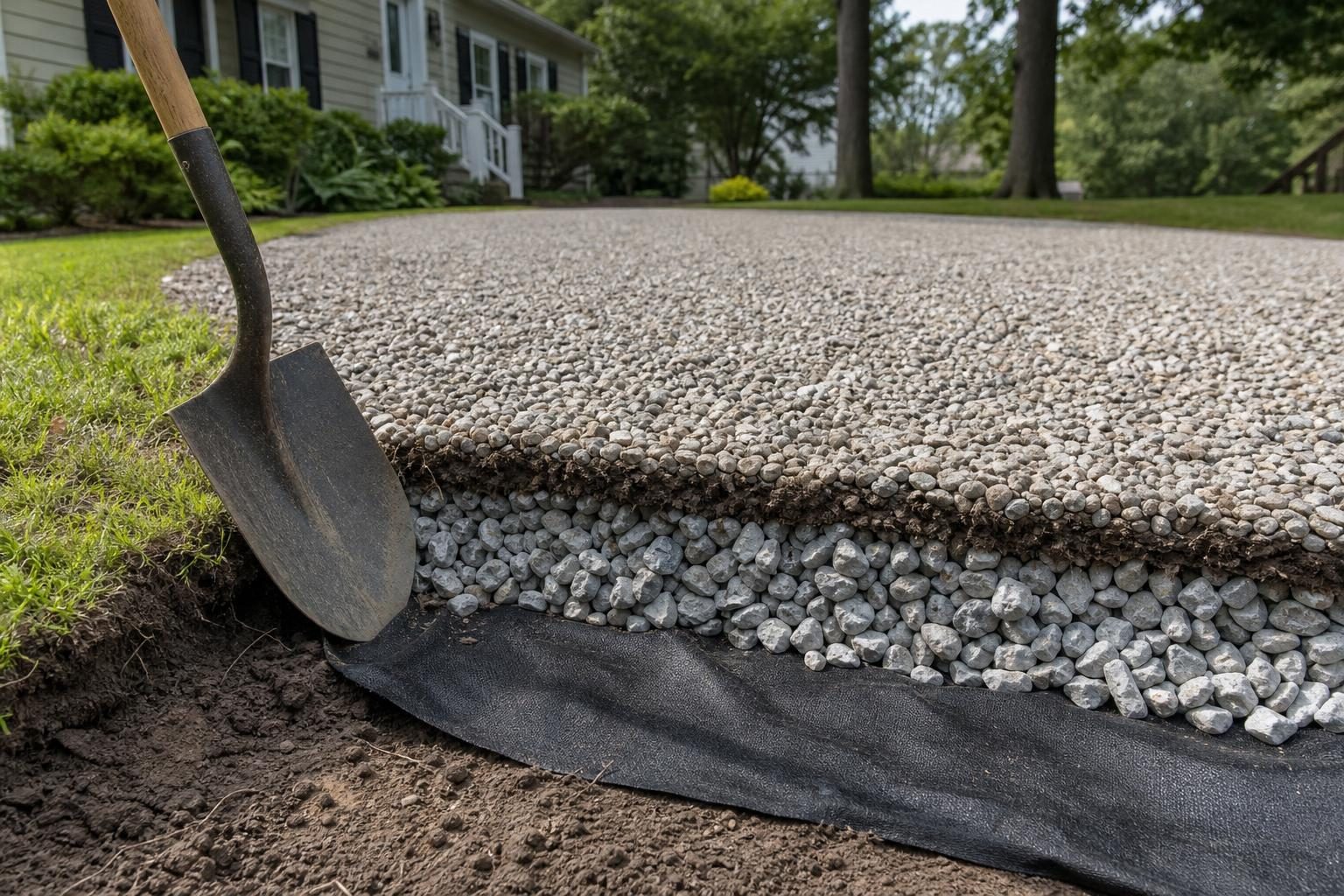
A gravel driveway is the cheapest way to build a driveway that will hold up to cars. It is also the easiest to build badly. Expect roughly $2 to $6 per square foot for a new driveway built with a proper base, and $1 to $2 to refresh an existing one. Whether it lasts depends on layered, angular stone with enough fines to pack, a crown that sheds water, and some routine upkeep.
Quick answer: Build a gravel driveway in layers. Start with firm, crowned subgrade, add geotextile fabric if the soil is soft or wet, then 4–6 in. of large crushed base stone (such as #3) and 2–4 in. of compacted, fine-rich top stone such as crusher run or #411. Skip pea gravel and river rock, which roll and rut. Expect about $2–$6 per sq ft for a new professional build, and $1–$2 per sq ft to refresh an existing driveway. Costs vary by region, delivery distance and site.
Part of our Complete Driveway Guide: types, costs, installation, repair and hiring in one place.
Gravel driveway cost
You pay for the stone and for the trucking and labor to place it. On small orders, delivery can be a big part of the bill, so a nearby quarry often beats a cheaper one farther away.
| Item | Typical US range | Notes |
|---|---|---|
| Common crushed stone (crusher run, #57, #3), delivered | About $25–$75 per ton | Lower for full truckloads near a quarry; small-load fees add more. |
| Decorative or specialty gravel | About $50–$150+ per ton | Colored stone, washed river rock, and pea gravel in some areas. |
| Refresh an existing driveway (2 in. top layer, spread and compacted) | About $1–$2 per sq ft | Assumes the base is still sound. |
| New driveway built from soil (excavation, base, top layer) | About $2–$6 per sq ft | More with fabric, soft soil, long hauls or tight access. |
| Long rural driveway with culverts and ditches | About $5–$8+ per sq ft | Driven by earthwork, pipe and stone volume. |
| Woven geotextile fabric (material) | Often under $0.50 per sq ft | Worth it on soft or wet soil. |
| Metal edging, installed | About $3–$10 per linear ft | Stone or paver borders cost more. |
| Regrading an existing driveway | A few hundred to about $1,000+ | Usually a half to a full day of machine time, plus stone. |
For example, a 12-by-50-foot driveway (600 sq ft) might cost about $600 to $1,200 to refresh, and about $1,200 to $3,600 to build new. If you are pricing stone yourself, see where to buy landscaping materials. The pros and cons of supplying it yourself are in buying materials yourself vs letting the contractor supply them.

The layers of a gravel driveway
The classic mistake is dumping one kind of stone on soil and calling it done. A durable driveway is built like a small road:
- Subgrade. Strip topsoil, sod and roots down to firm mineral soil, because organic soil compresses and holds water. Shape the subgrade with the finished crown built in, and compact it.
- Geotextile fabric, when needed. A woven stabilization fabric laid directly on the soil keeps base stone from sinking into mud and keeps mud from pumping up into the stone. It earns its cost on clay, wet ground and soft spots, and is often optional on firm, well-drained soil. Lay it on the soil, not between stone layers, and overlap the seams.
- Base, about 4–6 in. compacted. Large angular stone such as #3 (roughly 1.5 to 2.5 in.), or a dense-graded base, spreads vehicle weight.
- Optional middle layer, about 3–4 in. #57 stone helps fill a coarse base and drains well.
- Top layer, about 2–4 in. compacted. Angular stone with fine rock dust, such as crusher run or #411, packs into a hard surface that sheds water.
That adds up to roughly 8 to 12 inches of stone on average soil. Use more on clay, wet ground or where heavy trucks drive.
Best gravel for a driveway, and what to avoid
Names vary by region. The same material may be sold as crusher run, crush and run, road base, dense grade, CA-6 or quarry process. Ask for the size range and whether it contains fines, rather than going by the name.
Good choices
- Crusher run (or your local equivalent): Crushed stone from about 3/4 in. down to dust. The fines lock it together, giving the firmest surface, though it can be dusty in dry weather.
- #411: #57 blended with stone dust. It is a popular top layer that packs well and looks a little cleaner.
- #57: Clean and angular, about 3/4 to 1 in. It drains very well. As a top layer it stays loose and migrates, but never gets muddy.
- #3: A base stone only. It is too large to drive on comfortably.
Fines matter more than most people expect. Penn State’s Driving Surface Aggregate bulletin, written for unpaved roads, calls for crushed stone up to 1.5 in. with about 11 to 15 percent fines. Those fines should be crushed rock, not clay or silt. A batch of “crusher run” that is light on fines will not pack and will rut, so look at the pile before you buy.
Gravel to avoid on a driveway
- Pea gravel: Small and round, so it rolls instead of locking. Tires sink, ruts form, and stones end up in the lawn and the garage. If you love the look, use only a thin 1–2 in. layer inside plastic stabilizer grid panels over a compacted base, with firm edging.
- River rock and other round stone: The same problem at a larger size.
- Small clean stone used alone (#8, #89): Stays loose, scatters and sinks.
- Soft decorative chips such as marble: These crush to powder.
Foot paths follow different rules. See our walkway gravel depth guide.
Depth and how much gravel to order
A handy rule for crushed stone is about half a ton per 100 square feet for each inch of depth, measured loose. That closely matches Penn State’s ordering formula for its road aggregate. Compaction shrinks a layer by roughly a quarter, so order for the loose depth.

| Driveway | Area | 2 in. top-up | 4 in. top layer | 6 in. base |
|---|---|---|---|---|
| 10 x 50 ft single | 500 sq ft | About 5 tons | About 10 tons | About 15 tons |
| 20 x 40 ft double | 800 sq ft | About 8 tons | About 16 tons | About 24 tons |
| 12 x 100 ft | 1,200 sq ft | About 12 tons | About 24 tons | About 36 tons |
Density varies by rock type and moisture, so have your supplier check the math.
Crown and drainage
Water is what destroys gravel driveways. Puddles soften the base into potholes, and water running down wheel tracks carries stone away. Penn State’s Center for Dirt and Gravel Road Studies recommends a 4 to 6 percent cross-slope for unpaved surfaces. That is about 1/2 to 3/4 inch of fall per foot of width, two to three times steeper than pavement.
If yard or roof water already crosses the driveway, deal with that first. See our drainage solutions guide and erosion control guide.
- Center crown: On a 12-foot driveway, the middle should sit roughly 3 to 4.5 inches above the edges.
- One-way slope: On a hillside, tilt the whole surface toward the downhill side.
- Keep the edges low. Gravel pushed to the sides, sod, or tall edging can form a curb that traps water on the driveway.
- Give water an exit: a swale or ditch alongside, a culvert at the road ditch, and diverters on long slopes.

Gravel driveway edging
Edging keeps stone out of the lawn and beds and keeps the gravel from spreading under tires.
- Steel or aluminum: Strong and nearly invisible. Stake it well, because tires and plows find loose sections.
- Concrete curb, cobbles or pavers: The most durable and the most expensive option.
- Timbers: Cheap, but they rot and shift within several years.
- Plastic lawn edging: Usually too flimsy for vehicles.
Set the top of the edging level with, or just below, the gravel on the side water drains toward, so it does not dam runoff. Where you skip edging, cut a small vertical step into the soil so the stone has something to rest against.
Installation step by step
- Ask about permits for a new curb cut or road culvert, and call 811 before digging.
- Lay out at least 10 to 12 feet of width per lane, with generous curves.
- Excavate topsoil and soft material.
- Shape and compact the subgrade with the crown built in, and add swales, culverts and diverters.
- Roll out fabric if the soil is soft or wet.
- Place and compact the base in lifts of about 4 inches or less.
- Install edging.
- Spread and compact the top layer while it is slightly damp. Penn State advises letting surface stone dry before traffic to avoid rutting.
- Check the crown with a level and a straight board, then run a hose to see where water goes.
A homeowner can handle a short driveway with a rented compact track loader and plate compactor. For long runs, soft ground or drainage work, hire out the earthwork. See what excavation companies do before a landscape project.

Repairing potholes and ruts
A shovel of stone in a pothole rarely lasts, because the hole marks a spot where water sits. For a lasting repair:
- Work when the surface is damp, not soupy or bone-dry.
- Loosen the bottom, the sides and a little of the surrounding surface, so the new stone bonds.
- Fill with fine-rich stone such as crusher run or #411, not clean stone, and overfill slightly.
- Tamp it hard, then restore the crown so water can drain off.
Over time, wheel tracks compact while loose stone piles up in the center and along the edges. Penn State describes it as an “A” profile turning into a “W”. The fix is regrading. Loosen the surface with a box blade, landscape rake or drag, pull stone back toward the center, and recompact. Plan on doing this once or twice a year, more often on hills and tight turns, with a thin top-up every few years. If one spot keeps failing, rebuild the base or drainage there. Our driveway repair guide covers when patching stops being worth it.
Plowing snow on gravel
- Raise the blade on plow shoes or skid shoes, about 1/2 to 1 inch, so you push snow, not stone.
- Wait for frozen ground early in winter, or leave a thin packed-snow layer.
- Go slow, and lift the blade if you hear it hitting stone.
- Snowblowers: Use a two-stage machine with the shoes raised. Single-stage blowers that touch the ground can throw stones.
- Each spring, rake stray stone back out of the lawn and regrade.
Tightly packed crusher run plows far better than loose #57 or pea gravel.

Problems homeowners run into
- Stone vanishes into the ground when it is placed on topsoil or soft clay with no real base or fabric.
- Ruts and a center hump come back even after many tons of new stone. That is usually clean stone with no fines, no crown, or both.
- Washouts on slopes happen when nothing diverts water off the driveway.
- Pea gravel regret: a soft, rutted surface, and stones tracked indoors.
- Delivery surprises from ordering several small loads instead of full trucks.
- Gravel in the lawn from plowing too low or skipping edging.
Questions to ask and red flags
Questions to ask a contractor
- How deep will you excavate, and where does the topsoil go?
- Will you use fabric on my soil, and why or why not?
- What stone goes in each layer, how many tons, and how deep after compaction?
- How will each layer be compacted?
- What crown or slope will the surface have, and where will the water go?
- Are a culvert, edging or a permit included?
Red flags
- A quote that lists only tons of stone, with no excavation, base or compaction.
- Plans to spread gravel over sod or topsoil.
- Pea gravel or decorative stone pitched as the main driving surface.
- Cash-only deals, or a large deposit for a one- or two-day job.
Weighing gravel against paving? Compare it with our asphalt driveway cost guide. A well-built gravel base can often serve as the base for asphalt later.
Frequently asked questions
What is the best gravel for a driveway?
For most driveways, use angular crushed stone with fines, such as crusher run or #411, compacted over a base of larger stone like #3. The fines bind the stone into a firm surface. #57 makes a good middle layer.
Is pea gravel good for a driveway?
Generally no. It is round, so it rolls, ruts and spreads into the lawn. It can work as a thin layer inside stabilizer grid panels over a compacted base, but crushed stone is easier to live with.
How deep should a gravel driveway be?
Plan on about 8 to 12 inches of total stone for a new driveway: 4 to 6 inches of compacted base and 2 to 4 inches of compacted top layer. A refresh on a sound driveway is usually about 2 inches.
Do I need fabric under a gravel driveway?
On clay, wet or soft soil, use a woven stabilization geotextile, not thin garden weed fabric. On firm, well-drained ground it is optional. Lay it directly on the soil, under the base stone.
How long does a gravel driveway last?
A well-built base can last for decades. The surface needs regrading once or twice a year and a fresh top layer every few years, depending on traffic, slope and climate.