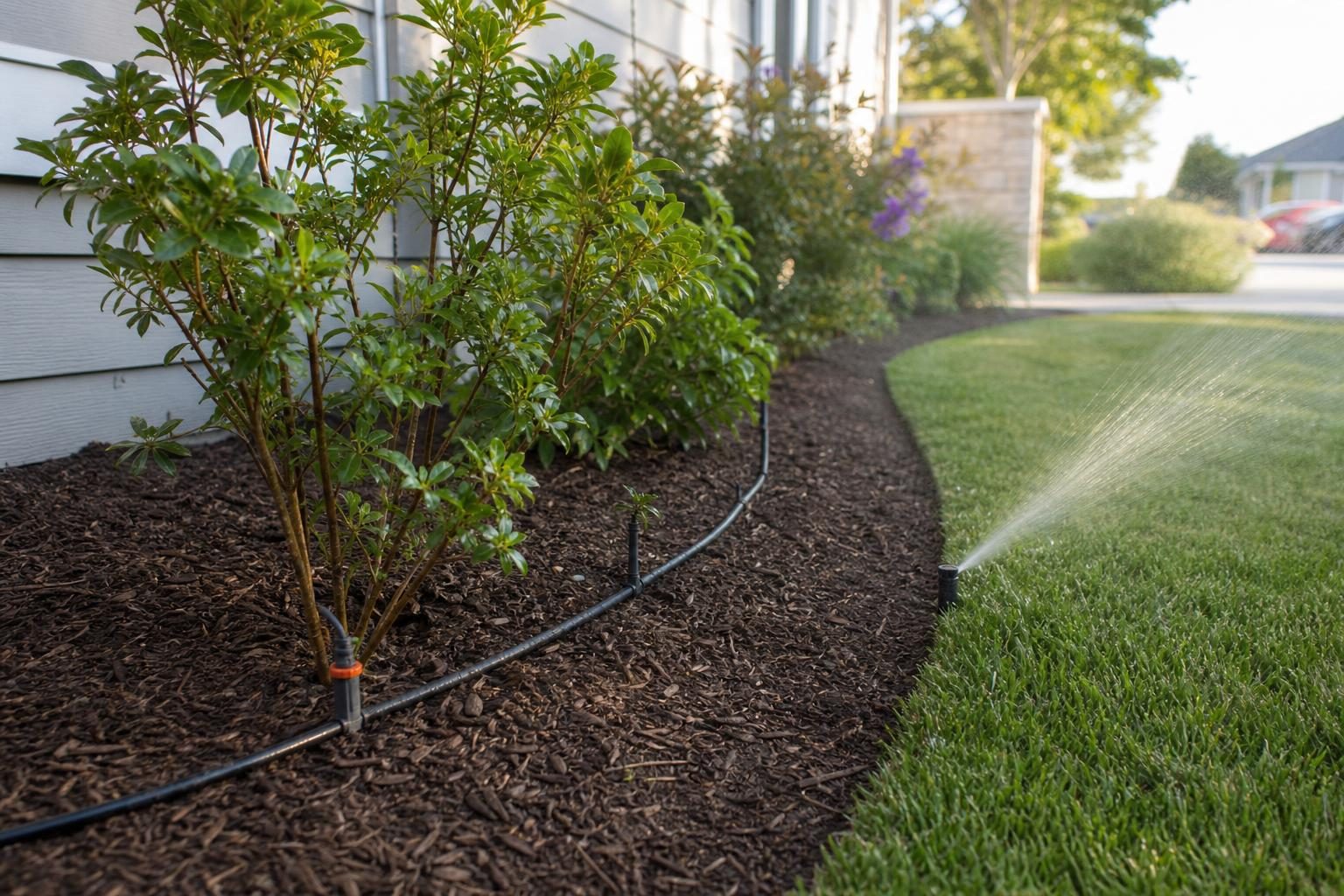
Use sprinklers for lawns and drip irrigation for planting beds, shrubs, trees and vegetable gardens. Sprinklers spread water evenly over large areas of grass, while drip delivers water slowly to the roots of individual plants with much less waste. Most yards end up with both, on separate zones, controlled by one timer.
Part of our Complete Irrigation Guide: sprinklers vs drip, layout, costs, winterizing and repairs in one place.

How each system works
Sprinklers
Spray heads and rotors pop up from the ground and throw water over an area. Spray heads cover short distances quickly and suit small or narrow lawns. Rotors cover larger areas more slowly, which gives water more time to soak in. Rotary nozzles fit on spray bodies and apply water more slowly, which helps on slopes and clay soils.
Drip irrigation
Drip uses flexible tubing with emitters that release water a little at a time right at the soil. Options include individual emitters for shrubs and trees, inline emitter tubing laid in rows or grids for dense beds, and micro-sprays for groundcover. Drip zones need a filter and a pressure regulator at the valve.
Side-by-side comparison
| Factor | Drip irrigation | Sprinklers |
|---|---|---|
| Best for | Beds, shrubs, trees, vegetables, containers | Lawns and large groundcover areas |
| Water efficiency | High; little runoff, evaporation or overspray | Lower; some loss to wind, evaporation and overspray |
| Typical installed cost | Often about $1 to $4 per sq ft of bed, or roughly $500 to $2,000+ per zone | Often about $0.50 to $2 per sq ft of lawn, or roughly $2,500 to $6,000+ for a typical yard system |
| Weed growth | Less, since only plant roots get water | More, since the whole surface gets wet |
| Leaf disease risk | Lower; foliage stays dry | Higher if watering in the evening |
| Visibility of problems | Harder to see clogs or leaks | Easy to see broken heads and dry spots |
| Durability | Tubing can be damaged by shovels, pets and rodents | Heads can be broken by mowers and vehicles |
| Freeze care | Needs draining or blowout in cold climates | Needs blowout in cold climates |
Costs vary widely by region, soil, yard size, water pressure and how many zones you need. Whole-system prices depend on the number of zones and the controller. Our irrigation system cost guide covers the full picture.

When drip is the better choice
- Planting beds, foundation plantings and hedges.
- Trees, especially during their first few years.
- Vegetable gardens and raised beds.
- Narrow strips where sprinklers would spray sidewalks or walls.
- Slopes where spray would run off.
- Regions with watering restrictions, where drip is sometimes allowed on days sprinklers are not. Check your local rules.

When sprinklers are the better choice
- Turf lawns, which need even coverage across the whole surface.
- Large areas of dense groundcover.
- Newly seeded or sodded areas that need frequent, light surface watering.
Drip tubing can technically be buried under lawns (subsurface drip), but it is less common, harder to repair and needs careful design. For most homeowners, rotors or efficient spray nozzles are the practical choice for turf.
Why most yards use both
Lawns and planting beds have very different water needs. Grass has shallow roots and needs more frequent watering. Shrubs and trees need deeper, less frequent watering. Putting both on the same zone means one of them is always getting the wrong amount.
A well-planned system separates them: sprinkler zones for lawn, drip zones for beds, and sometimes separate drip zones for sun and shade. Our irrigation layout guide explains how to split zones.
Converting sprinklers to drip
If you have spray heads watering shrub beds, many can be converted. Common approaches include capping unneeded heads, installing a conversion kit on a spray body with a filter and pressure regulator, or running a new drip line from the zone valve. The cleanest option is converting a whole zone, because drip and spray heads should not run on the same valve; they apply water at very different rates.

Water use and controllers
Drip saves water mainly because almost none of it is lost to wind, evaporation, overspray or runoff. Sprinklers can be made more efficient too: rotary nozzles and pressure-regulating heads reduce misting, and matched-precipitation nozzles help a zone water evenly.
The controller matters as much as the hardware. A weather-based or soil-moisture controller adjusts run times as conditions change, so you are not watering the same amount in April and July. Some water utilities offer rebates for these controllers or for converting spray zones to drip; check with yours before buying.
How often to run each type
Lawn zones usually run for shorter cycles a few times a week. Drip zones run longer, often 30 minutes to an hour or more, but less often, because they apply water slowly and the goal is deep soaking. Splitting sprinkler run times into two shorter cycles helps on slopes and clay soil, where water runs off before it soaks in.
Common mistakes
- Mixing spray heads and drip on the same zone.
- Skipping the filter or pressure regulator on drip zones.
- Placing emitters only at the trunk, so roots never spread out.
- Not adding emitters as plants grow.
- Running sprinklers during the heat of the day or in wind.
- Never checking the system after installation.
What to check in an irrigation estimate
- Number of zones and which areas each one covers.
- Head types (spray, rotor, rotary nozzle) for lawn zones.
- Drip type, emitter flow rates and spacing for bed zones.
- Backflow prevention, filters and pressure regulation.
- Controller type and whether it adjusts for weather.
- Pipe sizes, trenching depth and restoration of lawn after trenching.
- Warranty on parts and labor, and whether a first-season adjustment is included.

See our irrigation estimate checklist for a full list.
Estimate irrigation cost by system type
Use the irrigation calculator to compare rough spray, drip, and mixed-system ranges before choosing the layout that fits your planting and lawn areas.
Irrigation Cost Calculator
Estimate irrigation pricing based on area, system style, number of zones, and controller choice.
Irrigation cost estimate
- Estimated area
- –
- Low estimate
- –
- Mid estimate
- –
- High estimate
- –
- Estimated zone allowance
- –
Frequently asked questions
Is drip irrigation cheaper than sprinklers?
Per zone, drip is often cheaper to install, and it usually uses less water. But a yard with large lawns still needs sprinklers, so the total cost depends on how much lawn versus bed area you have.
Can drip irrigation water a lawn?
Subsurface drip can water turf, but it is more complex to design and repair. Most residential lawns use sprinklers.
How long does drip tubing last?
Quality tubing can last many years when protected from sun and damage, but emitters can clog over time. Check zones a few times a season and flush lines periodically.
Can I add drip to my existing sprinkler system?
Yes, in most cases. The best approach is to convert a whole zone to drip with its own filter and pressure regulator rather than mixing drip and spray on one valve.