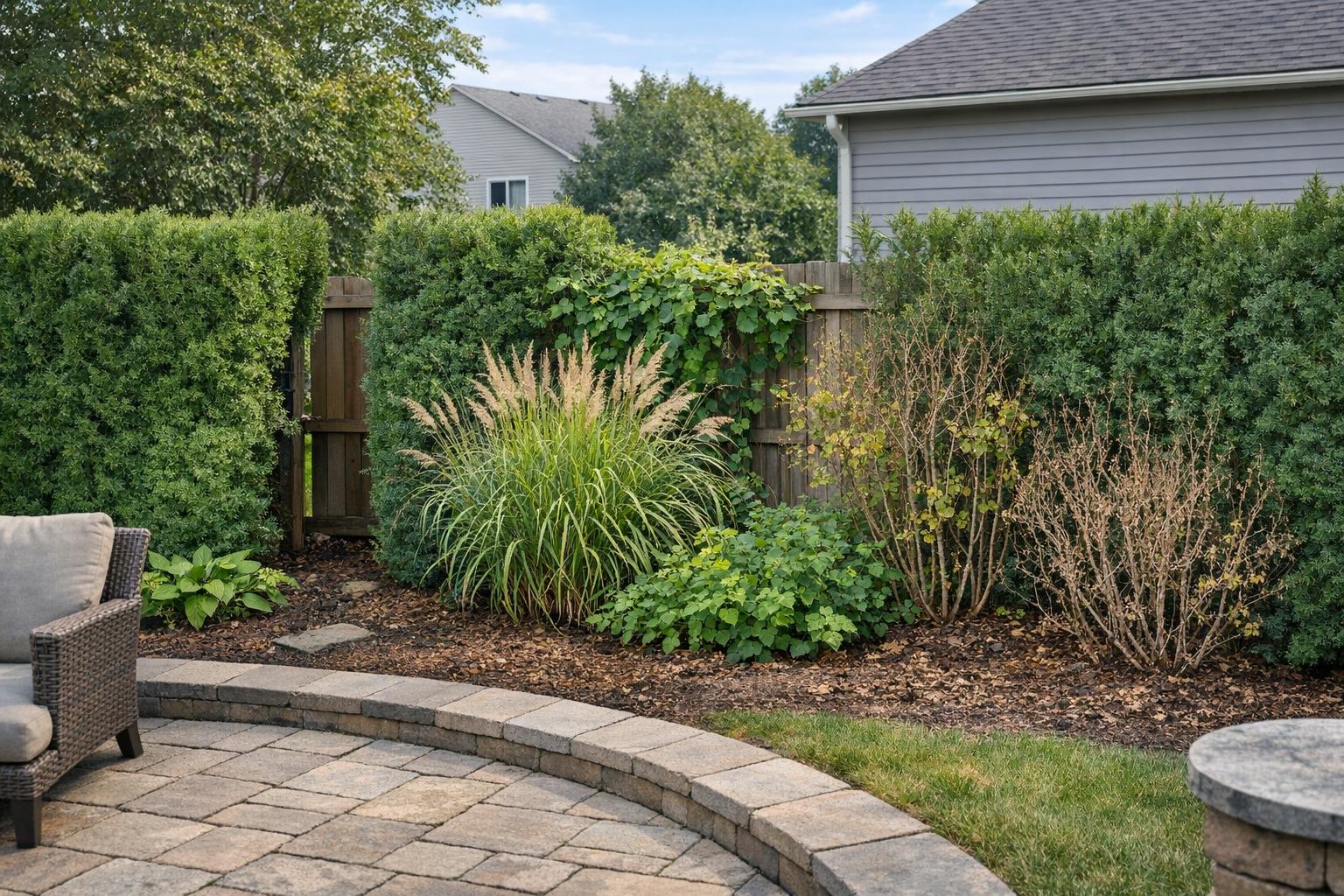
Your privacy landscaping needs an upgrade when it no longer blocks the views you care about, has gaps that keep growing, takes more work every year to keep alive, or crowds your fence, house and neighbors. The fix may be as simple as targeted infill planting or as involved as removing a failing hedge and starting over with a layered screen.
Part of our Complete Fence and Privacy Guide: materials, costs, rules, installation and plant screens in one place.
Warning signs to look for

Sign 1: The screen has thinned out or gone bare at the bottom
Many hedges, especially those sheared hard for years, lose foliage at the base because the lower branches are shaded by the top. The result is a hedge that looks fine from the street but leaves a see-through band at eye level when you are seated on a patio.
If the plant is still healthy, rejuvenation pruning over a couple of seasons and shaping the hedge slightly wider at the bottom than the top can help some species recover. Others, including many conifers, do not regrow from old bare wood, so infill or replacement is the realistic option.
Sign 2: Gaps from dead or declining plants
One missing shrub in a row of identical plants is hard to hide, because a new plant will be much smaller than its neighbors for years. Several dead plants, or browning spreading along the row, often point to a cause: poor drainage, drought stress, root competition from nearby trees, disease or pests.
Before replanting, find out why the originals failed. Planting the same species in the same soggy spot usually produces the same result. If water is the issue, our drainage solutions guide explains common fixes.
Sign 3: Your privacy disappears every winter
If your screen is mostly deciduous shrubs or trees, you may have good cover from late spring to fall and almost none the rest of the year. That might be fine if you only use the yard in summer. If you want year-round privacy for windows, a hot tub or a sitting area, you need evergreens in the mix. Our evergreen screen ideas guide covers options for different heights and spaces.
Sign 4: The plants have outgrown the space
Fast-growing screening plants are often chosen to fill in quickly, but some keep going well past the height and width you wanted. Warning signs include:
- Branches pressing against the fence, siding or roof.
- Shrubs spilling over walkways or the driveway.
- Roots lifting pavers or competing with lawn and beds.
- Pruning that now requires tall ladders or a hired crew several times a year.
- Neighbors complaining about overhang or shade.
When maintenance becomes a recurring expense or a safety issue, replacing overgrown plants with species sized for the space can cost less over time than fighting them.
Sign 5: The screen blocks the wrong things, or not the right ones
Needs change. A neighbor builds a second story, a new deck raises your sightline, or you add a patio in a different part of the yard. A screen placed for the old layout may not block the new problem view at all.
Stand where you actually sit, at seated eye height, and note what you see. Often a short section of taller screening close to the patio does more than a long hedge along the property line.
Sign 6: Maintenance is taking over your weekends
Constant shearing, cleanup of heavy leaf drop, spraying for recurring pests, or hand-watering a struggling screen are all signs the planting is a poor fit for your site or your schedule. A more diverse planting with species suited to your soil and sun usually needs less intervention than a single-species hedge.

Upgrade options and rough costs
Costs vary widely by region, plant size, access and soil, so treat these as general ranges.
| Upgrade | Typical cost range | Best for |
|---|---|---|
| Rejuvenation pruning and feeding | $200–$1,000+ | Healthy hedges that are thin or misshapen |
| Infill planting in gaps | $50–$300+ per plant installed | A few missing or dead plants |
| Layered replanting (trees, shrubs, groundcover) | $25–$100+ per linear foot | Failing or single-species screens |
| Fence or panel plus planting | $40–$120+ per linear foot | Small yards needing immediate privacy |
| Trellis with vines or pergola screening | $500–$5,000+ | Patios and close-in seating areas |
Larger plants give faster results but cost more, may take longer to establish and need careful watering for the first year or two. Smaller plants are cheaper and often catch up surprisingly quickly once established.

How to plan the upgrade
- Define the target view. Note what you want to block, from where, and in which seasons.
- Diagnose the old planting. Check drainage, sun, soil and root competition before replanting.
- Measure the available width. Narrow strips need columnar plants, fences or trellises; wider beds can hold layered screens.
- Mix species. Diversity reduces the risk that one pest or disease wipes out the whole screen.
- Plan for watering. New screens fail most often from inconsistent water during establishment. Drip lines are a common, efficient solution.
For a full overview of options, see our privacy landscaping guide.
What to ask a contractor
- Which species and container sizes they propose, and expected mature height and width.
- Spacing and why, and how long until the screen fills in.
- Whether removal of old plants and stumps, soil amendment and mulch are included.
- How the new planting will be watered, and whether irrigation is part of the bid.
- Plant warranty length and what voids it, such as failure to water.
- Any height limits or setbacks from local rules or an HOA for fences and hedges.
Frequently asked questions
Can an old, bare hedge be saved?
Some broadleaf hedges respond well to gradual hard pruning over two or three years. Many conifers do not regrow from bare old wood, so replacement or infill is usually needed.
How long does a new privacy screen take to fill in?
It depends on species, plant size and growing conditions. Fast growers may give meaningful cover in two to three seasons, while slower plants can take longer.
Should I replace the whole hedge or just fill gaps?
Fill gaps if most plants are healthy and the cause of losses is fixed. Replace if decline is widespread, the species is poorly suited, or the plants have outgrown the space.
Is a fence better than plants for privacy?
A fence gives instant, narrow-footprint privacy. Plants soften the look and absorb some noise but need time and care. Many homeowners combine a fence with planting in front of it.