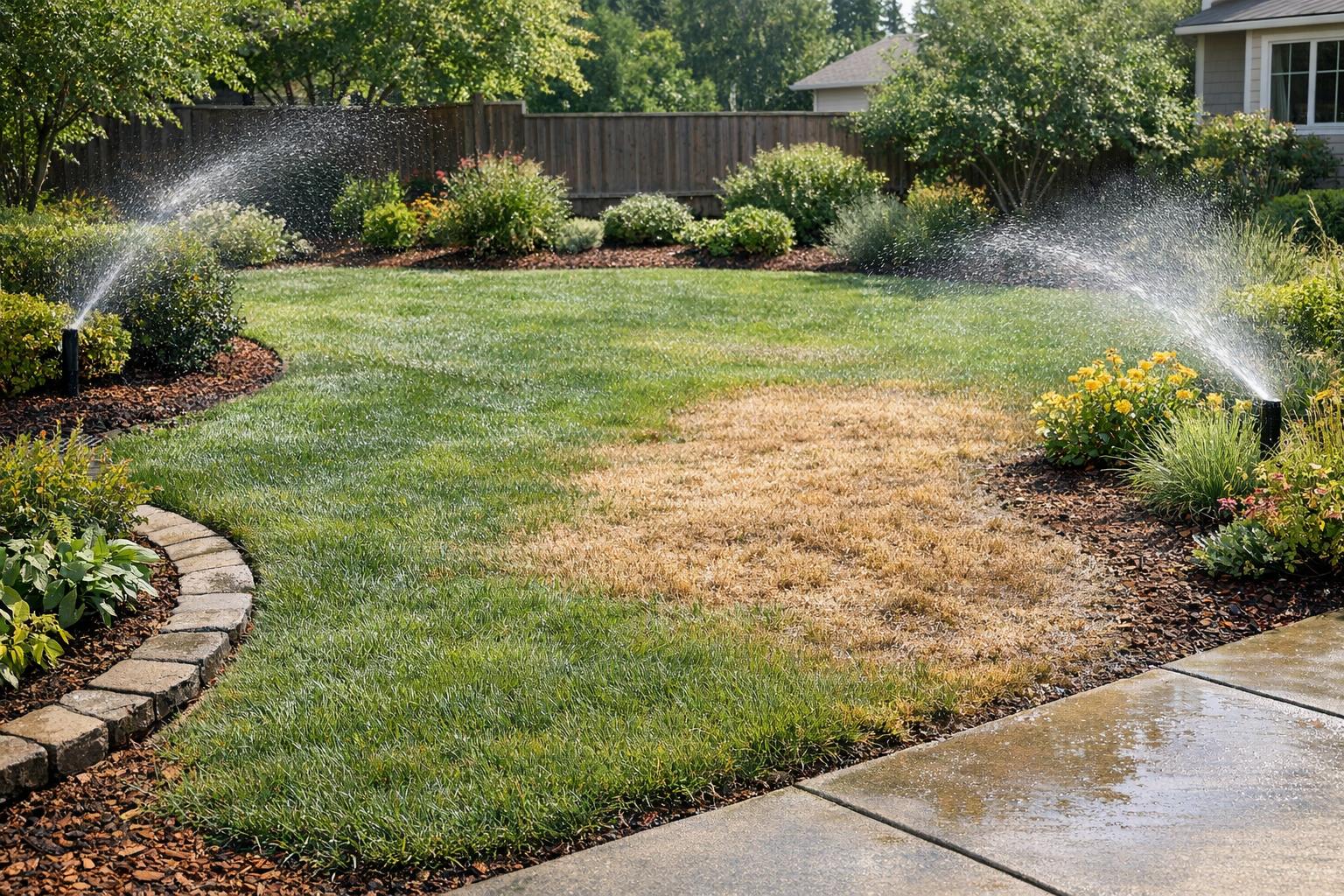
Most sprinkler problems can be repaired. Replacing a whole system makes sense when it is old, poorly designed, leaking in many places or uses outdated parts, and a new system is the answer when you have none or are redoing the landscape. The right irrigation company will tell you which situation you are in and why, not just quote the biggest job.
Part of our Complete Irrigation Guide: sprinklers vs drip, layout, costs, winterizing and repairs in one place.

Common problems that usually just need repair
Many irrigation issues are fixed in a single service visit. Typical repairs include:
- Broken or stuck heads: often from mowers or cars. Replacement heads are inexpensive; most of the cost is the service call.
- Clogged nozzles: cleaned or swapped.
- Misaligned spray: heads watering the sidewalk or house can be adjusted.
- Valve problems: a zone that will not turn on or off often needs a new solenoid or diaphragm.
- Wiring faults: damaged wire between the controller and valves.
- Small pipe leaks: a cracked line or fitting dug up and patched.
- Controller issues: a failed or outdated timer replaced.
Service call rates vary by area. Many companies charge a trip fee or a first-hour minimum, often in the range of $75 to $150, plus parts and additional time. Simple head replacements might add a modest amount per head; valve or wiring repairs cost more.
Signs it may be time to replace
Replacement is worth considering when repair costs keep adding up or the system cannot water properly even when everything works.
- Frequent leaks in different parts of the system, especially with old or brittle pipe.
- Low pressure across many zones that is not explained by one problem.
- Dry spots and soggy spots that adjustments do not fix, a sign of poor head spacing.
- Obsolete parts that are hard to find.
- Lawn and beds watered on the same zones.
- The landscape has changed a lot since the system was installed.
- Missing or failed backflow prevention.
Sometimes the best answer is partial: keep the main line and valves, but redesign zones, upgrade heads and convert beds to drip. Our drip irrigation vs sprinklers guide explains when that conversion makes sense.

When a new system makes sense
- You have no system and hand-watering is not working.
- You are installing a new lawn, beds or a full landscape renovation.
- The existing system is so poorly laid out that repairs will not fix coverage.
A new residential system often costs a few thousand dollars, commonly in the range of about $2,500 to $6,000 for a typical yard, and more for large lots, many zones or difficult soil. Prices vary widely by region and design. Our irrigation system cost guide explains what drives the price.
Repair vs replace vs new: quick comparison
| Option | When it fits | Typical cost scale |
|---|---|---|
| Repair | Isolated broken parts, otherwise working system | Service call plus parts, often under a few hundred dollars |
| Partial upgrade | Good main line, poor zones or heads | Hundreds to a few thousand dollars |
| Full replacement | Old, leaky, poorly designed system | Similar to a new system, sometimes plus removal |
| New system | No system or major landscape redo | Often several thousand dollars |

Seasonal service and maintenance plans
Many irrigation problems are found during spring start-up, when a company turns the water back on, checks every zone and adjusts heads that shifted over winter. In freezing climates, fall winterization blows water out of the lines to prevent cracked pipes and backflow devices.
Some companies sell annual plans that bundle start-up, a mid-season check and winterization, sometimes with discounted repair rates. A plan can be worth it if you do not want to manage the system yourself, but compare the plan price with the cost of booking the same visits individually.
Between visits, you can catch problems early by running each zone for a minute or two once a month and watching for geysers, heads that do not pop up, soggy spots and dry patches.

How to choose an irrigation company
Look for a company that diagnoses before it sells. Good signs include:
- They run each zone and walk the yard with you before quoting.
- They explain what failed and why, and show you the damaged part.
- They hold any license your state requires for irrigation or landscape contracting, and carry insurance.
- Backflow testing is done by someone certified where your area requires it.
- They give written estimates with parts and labor separated.
- They offer a warranty on repairs and new installations.
Be cautious if a company recommends full replacement without testing the system, or will not itemize the estimate. For a general checklist, see our questions to ask before hiring a landscaper.
Questions to ask on the first call or visit
- Do you charge a trip fee, and does it apply to the repair if I go ahead?
- What is your hourly rate, and is there a minimum?
- Can you test every zone and tell me what is working and what is not?
- If you recommend replacement, what specifically makes repair a poor value?
- Do you offer seasonal start-up, winterization or maintenance plans?
- What warranty do you give on parts and labor?
What a good estimate should include
- A description of each problem found, by zone.
- Parts to be replaced, with quantities.
- Labor time or a fixed price for each repair.
- For new or replacement systems: number of zones, head and drip types, controller, backflow device, pipe sizes and lawn restoration after trenching.
- Permit and backflow inspection costs, if required locally.
- Warranty terms.

Our irrigation estimate guide has a full checklist.
Estimate irrigation system cost
Use this calculator to compare repair, retrofit, and new irrigation-system ranges before asking companies for a site visit.
Irrigation Cost Calculator
Estimate irrigation pricing based on area, system style, number of zones, and controller choice.
Irrigation cost estimate
- Estimated area
- –
- Low estimate
- –
- Mid estimate
- –
- High estimate
- –
- Estimated zone allowance
- –
Frequently asked questions
How long does a sprinkler system last?
With maintenance, many systems last a couple of decades or more. Heads and controllers usually need replacing sooner than buried pipe.
Is it worth repairing an old sprinkler system?
If problems are isolated and coverage is good, yes. If leaks keep appearing and coverage is poor, a partial or full replacement may cost less over time.
When is the best time to call an irrigation company?
Early spring start-up and late fall winterization are the busiest times. Calling a few weeks ahead, or scheduling repairs in summer once the season settles, often gets faster service.