
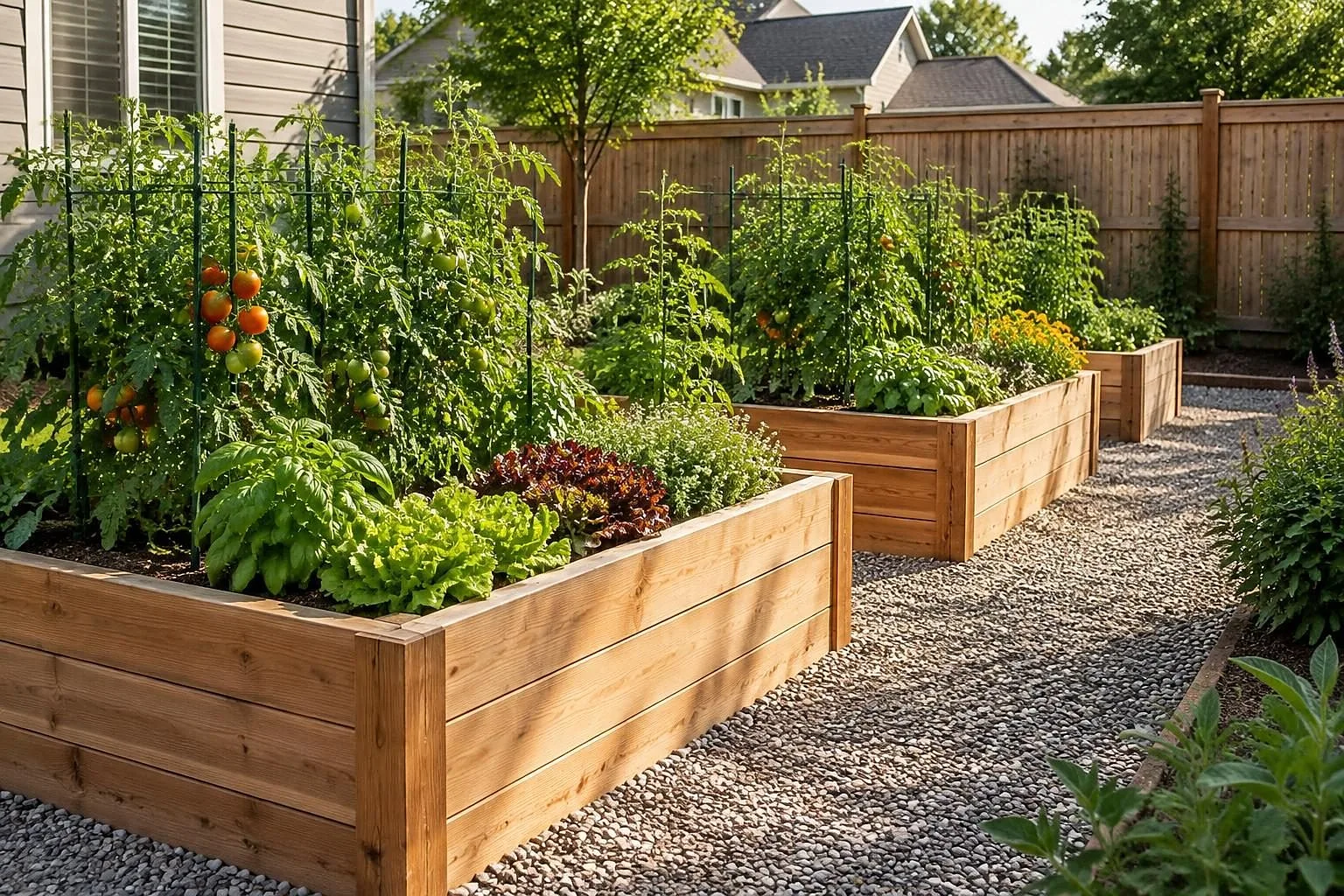
A good raised garden bed is about 4 feet wide, 10 to 12 inches deep for most vegetables, and sits where it gets 6 or more hours of sun within hose reach. The real decisions are which material you can live with for a decade, how tall the bed needs to be, and how much fill you are about to buy.
Quick answer: For most homeowners, a 4 x 8 foot bed about 11 to 12 inches tall is the sweet spot. It fits standard lumber, you can reach the middle from either side, and it holds about 32 cubic feet (roughly 1.2 cubic yards) of soil mix. Cedar looks good and resists rot for roughly a decade or more, galvanized steel lasts longest, and ground-contact treated lumber is the cheapest long-lasting wood. Building one yourself usually costs $160 to $650 with soil; having someone install it often runs $400 to $1,500 per bed, depending on size, material and your area.
Part of our Complete Garden Bed Guide: planning, flower bed design, soil, edging and care in one place.

Materials compared

Every material grows plants. The differences are price, lifespan and looks.
Cedar
Cedar resists rot, is light enough to handle alone and weathers to a soft gray. Thick boards of dense heartwood last longest; thin, knotty or sapwood-heavy boards can fail in a few years. Many gardeners report about 10 years before boards need replacing, longer in dry climates. The catch is price, which has climbed and varies a lot by region. Redwood and cypress are similar alternatives where they are sold locally.
Pine, fir and treated lumber
Untreated pine or fir is the cheapest wood, but it rots fastest. In an Oregon State University study, untreated Douglas-fir beds had heavy decay in the lower boards by the sixth season.
Treated lumber worries many people, so here are the facts. Arsenic-based CCA lumber has not been sold for home use in about two decades. Today’s residential treatments are copper-based (labeled ACQ, CA or MCA). In that same Oregon State Extension study, beds built from copper-treated, ground-contact lumber raised soil copper only within about an inch of the boards over four seasons, and none of the 12 vegetables and herbs tested took up more copper. The treated beds were still mostly sound in year six.
If you use it, buy lumber rated for ground contact, seal cut ends with a cut-end preservative, and skip old railroad ties and salvaged lumber. If you would rather not, cedar, block or metal avoids the question.
Galvanized steel and metal
Metal beds, usually sold as kits, are long-lasting and quick to assemble. The University of Minnesota Extension notes that galvanized steel resists rust for decades, and that zinc is only likely to leach in very acidic soil (pH below 5). It also cautions that some prefabricated metal beds have contained lead, so ask the seller what the coating is. Thin panels can bow on long beds and heat up in strong sun, drying soil at the edges, so look for a thicker gauge and cross-bracing.
Composite boards
Composite boards will not rot, but they often cost more than cedar, can sag over long spans without stiffeners, and vary widely in quality. Read the warranty, not the marketing.
Stone, brick and concrete block
Dry-stacked concrete block is cheap, permanent and easy to resize, though plain looking. Natural stone and wall block look better and cost more. An 8-inch block wall eats growing space, and masonry may raise soil pH near the walls. Beds more than about two courses tall should be built like a small wall, on a leveled gravel base.
How wide, tall and long
Width. Four feet is the standard for a bed you can reach from both sides; you reach 2 feet in from each edge without stepping in. Against a fence or wall, where you can only reach from one side, keep it to about 2 to 2.5 feet. University of Georgia Extension suggests about 3 feet for children and for adults gardening from a wheelchair.
Height. Match it to your purpose:
Length. Lumber comes in 8, 10 and 12 foot lengths, so 8 feet is the efficient default. Longer beds cost more, push outward harder and need a cross-brace or stake about every 4 feet. Two 8-foot beds beat one 16-foot bed and make crop rotation simpler.
Paths. Leave 18 to 24 inches between beds for kneeling and walking, and about 4 feet where a wheelbarrow, mower or wheelchair needs to pass.
- 6 to 8 inches: fine over decent native soil you loosen underneath.
- 10 to 12 inches: enough for most vegetables. UGA puts the minimum at about 10 inches of soil.
- 18 to 24 inches: for poor, rocky or clay soil, beds on pavement, or gardeners who do not want to kneel. About 24 inches works for wheelchair access.
- 30 to 36 inches: for little or no bending. Consider a legged planter box with 10 to 12 inches of soil instead of filling a 3-foot-tall box with dirt.
Where to put it
- Sun: Tomatoes, peppers, squash and other fruiting crops need 6 to 8 hours of direct sun. Lettuce, kale and herbs tolerate partial shade. Watch the spot for a day before building.
- Water: Raised beds dry out faster than ground soil. Place them within easy hose reach, or plan a drip line from the start. Our guide to drip irrigation vs sprinklers explains why drip suits beds so well.
- Drainage: Avoid low spots where water stands. A raised bed drains better inside but will not fix a soggy yard.
- Level ground: A bed on a slope drains unevenly and strains the downhill wall. Dig the high side down rather than propping the low side up.
If you are fitting beds into a tight lot, our small backyard landscaping ideas cover layouts that keep paths usable.
What to fill it with, and how much

Do not fill a raised bed with bagged potting mix alone (it dries out fast and gets expensive) or with heavy native clay (it compacts). The University of Minnesota recommends a blend of roughly half to two-thirds loamy topsoil and the rest plant-based compost. Too much compost can hold excess phosphorus and salts and repel water when dry. Our guide to soil amendment vs topsoil explains how to judge what you are buying.
Before filling, remove sod or smother it, then loosen the native soil with a fork or shovel. Do not put plastic or landscape fabric under the bed; it blocks roots and drainage. If gophers or voles are a problem, lay galvanized hardware cloth (1/2-inch mesh, not chicken wire) across the bottom and run it a few inches up the inside walls.
Worked example: how much soil you need
Multiply length x width x depth, all in feet. Convert inches to feet by dividing by 12.
- 4 ft x 8 ft x 1 ft (12 inches) = 32 cubic feet
- 32 / 27 = about 1.2 cubic yards
- In 1.5-cubic-foot bags: 32 / 1.5 = about 22 bags
- Add about 10 percent for settling: roughly 35 cubic feet, or 24 bags
At 18 inches deep, the same bed needs 48 cubic feet (about 1.8 cubic yards). Three 12-inch beds need about 3.6 cubic yards, where bulk delivery clearly beats bags. Our landscaping calculators do this math for odd shapes, and the guide on where to buy landscaping materials compares bulk yards with big-box bags.
In tall beds, logs, branches and leaves in the bottom third cut the soil bill, but they break down and sink, sometimes within one hot summer, so plan to top up.
What raised beds cost
Rounded US ranges for one 4 x 8 foot bed about 11 to 12 inches tall. Lumber prices, delivery, site access and local labor rates move them a lot.
| Option | Frame | Soil (about 1.2 cu yd) | Typical total |
|---|---|---|---|
| Metal kit, DIY | $100 to $300 | $100 to $260 | $200 to $550 |
| Cedar kit, DIY | $150 to $400 | $100 to $260 | $250 to $650 |
| DIY from treated or untreated lumber | $60 to $150 | $100 to $260 | $160 to $400 |
| DIY from cedar lumber | $150 to $350 | $100 to $260 | $250 to $600 |
| Concrete block, dry-stacked, DIY | $60 to $150 | $100 to $260 | $160 to $400 |
| Hired install, wood or metal | Materials, soil and 2 to 6 hours of labor | $400 to $1,500 | |
| Hired install, stone or tall custom bed | Base prep, masonry, more soil | $1,500 to $3,500+ | |
Bulk garden mix (the low end) often runs $35 to $80 per cubic yard, but a $50 to $150 delivery fee can make bags competitive for one small bed.
DIY or hire? A kit or simple wood bed is a realistic weekend project if you can drive screws and move a lot of soil. The hard part is the hauling: 1.2 cubic yards is more than 20 heavy bags or a long afternoon of wheelbarrow trips. Paying someone makes the most sense for several beds at once, stone or block beds taller than two courses, sloped yards that need leveling, or when you also want drip irrigation installed. For a broader look at bed prep and planting, see our garden bed and planting installation guide.
How to build a wooden bed, step by step

This is for a 4 x 8 foot bed about 11 inches tall using two rows of 2×6 boards, or one row of 2×12.
- Mark and clear the spot. Outline the bed with stakes and string, then strip the sod.
- Level the footprint. Dig down the high side so the bottom boards sit flat on soil. Check with a level along each side.
- Cut the boards. For each layer you need two 8-foot sides and two 45-inch ends (so the outside width comes to 4 feet). Seal cut ends if using treated lumber.
- Add corner posts. Cut four 4×4 posts the height of the bed. Screw boards to the posts with at least two exterior-rated screws per board end, pre-drilling to prevent splitting.
- Brace the middle. Add a stake or post at the midpoint of each long side, or a cross-brace across the center, so the 8-foot walls do not bow.
- Square it up. When both diagonals measure the same, the bed is square.
- Prep the base. Loosen the soil inside. Add hardware cloth now if burrowing animals are a problem.
- Fill in layers. Add mix a few inches at a time, watering each layer lightly so it settles. Stop an inch or two below the top.
- Mulch and water. Add a thin layer of mulch around plants and set up a hose or drip line. Our mulch guide covers what to use in beds and on the paths between them.
Problems homeowners run into
- Underestimating soil. The fill often costs as much as the frame, especially for 18- to 24-inch beds filled with bags.
- Settling. Fresh mix and buried wood shrink. A bed filled to the brim in spring can sit noticeably lower by fall.
- Bowing walls. Long beds without mid-span support bulge, especially after heavy rain or freeze-thaw cycles.
- Beds too wide. A 5- or 6-foot bed gets stepped in, which compacts the soil the bed was built to protect.
- Grass creeping in. Sod left under or along the walls grows back. Clear it first and mulch or gravel the paths.
Hiring someone: questions and red flags
Questions to ask a contractor
- What exact material, board thickness and grade will you use? Is treated lumber rated for ground contact?
- Are the outside dimensions and height written on the quote for each bed?
- What fill is included, how many cubic yards, and where does it come from?
- How do you level the site, remove sod and brace long walls?
- Is hardware cloth, drip irrigation or path material included, or extra?
- Who hauls away sod and leftovers? Is there a warranty on workmanship?
Red flags
- A per-bed price with no dimensions, material or soil volume listed.
- Plans to lay plastic or landscape fabric under the bed on top of soil.
- Reclaimed railroad ties or salvaged lumber of unknown treatment.
- Interior screws or nails, and no corner posts or bracing on 8-foot walls.
- Fill described only as “dirt,” or a bed filled with pure compost or pure potting mix.
- A large upfront deposit for a small, one-day job.
Upkeep and lifespan
Each spring, top up with an inch or two of compost and check corners and screws. Test the soil every two to three years instead of fertilizing by habit, and rotate crop families between beds.
Rough lifespans: untreated pine or fir, about 3 to 6 years; cedar, about 10 years or more depending on board thickness and climate; ground-contact treated lumber, often a decade or longer; galvanized steel, typically 20 years or more; composite, depends heavily on the product, so check the warranty; stone and block, indefinitely if the base was built well.
Frequently asked questions
How deep should a raised garden bed be?
About 10 to 12 inches of soil grows most vegetables, especially if you loosen the native ground beneath. Go to 18 to 24 inches over poor soil or pavement, or for easier reach.
Is cedar or metal better for a raised bed?
Metal usually lasts longer, and kits often cost the same as cedar kits or less. Cedar looks more natural, stays cooler and is easier to customize. Pick by look and budget.
Is pressure-treated wood safe for vegetable beds?
Current copper-based treatments are considered acceptable by extension researchers, and Oregon State found no increase in copper in vegetables grown in treated beds. Avoid old CCA lumber and railroad ties.
Should I put anything in the bottom of a raised bed?
Usually not. Fill directly on loosened native soil, adding hardware cloth only for burrowing pests.
How many bags of soil fill a 4 x 8 raised bed?
At 12 inches deep, about 22 bags of 1.5 cubic feet, or 1.2 cubic yards in bulk. Buy about 10 percent extra for settling.