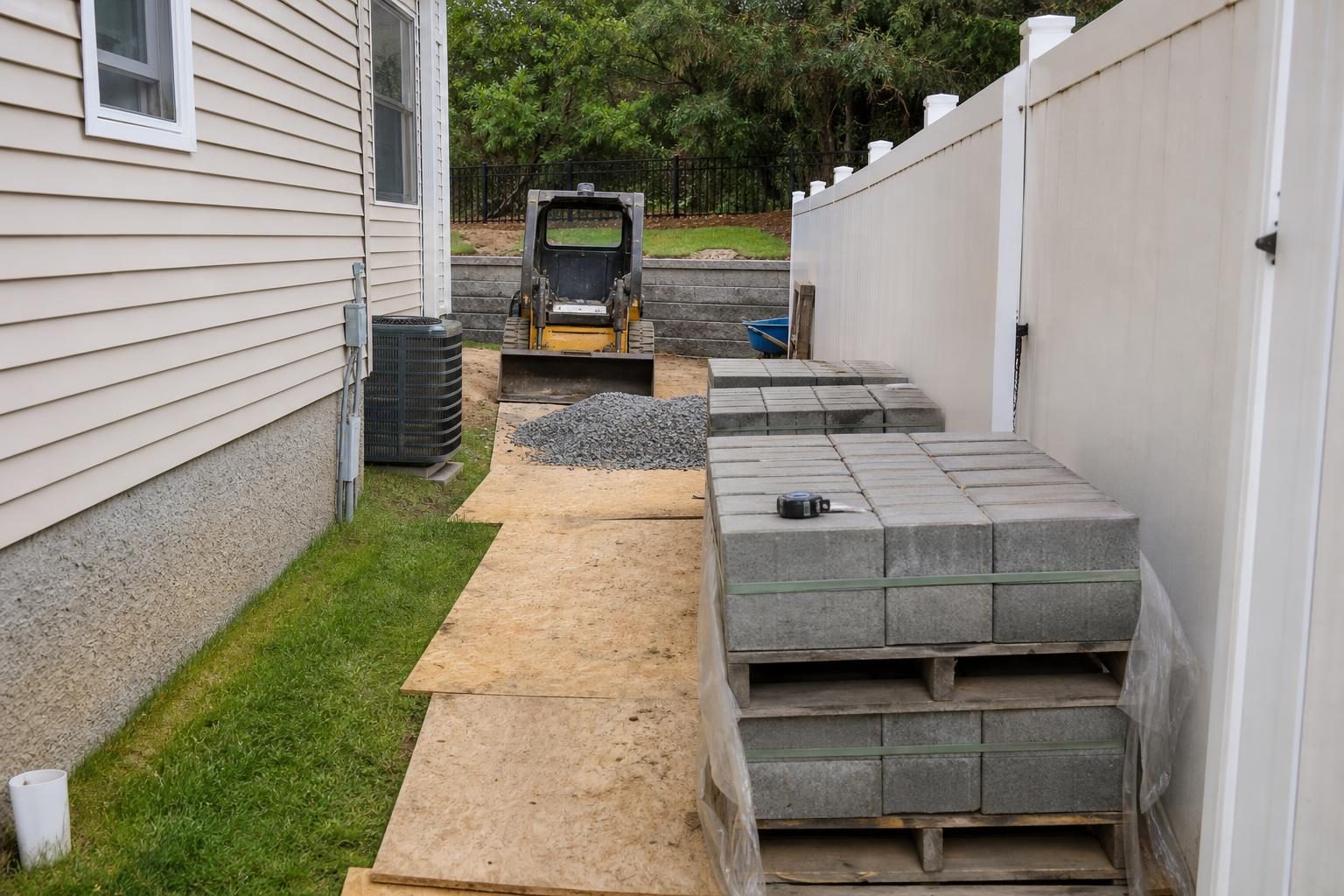
Access and staging can change a retaining wall’s price as much as the wall material itself. If a skid steer and delivery truck can reach the work area and there is room to stockpile block and gravel nearby, the job moves quickly. If everything has to travel by wheelbarrow through a narrow gate or down a slope, labor hours, equipment choices, and schedule all grow, and the estimate reflects it.
Part of our Complete Retaining Wall Guide: wall types, drainage, permits, costs and repairs in one place.
Why access matters so much
A retaining wall moves a surprising amount of material. Even a modest block wall involves excavated soil, base gravel, drainage aggregate behind the wall, and pallets of block that can weigh well over a ton each. Every one of those tons has to get from the street to the wall, and excavated soil often has to go back out. The way that material moves sets the pace of the whole project:
- Open access: trucks drop near the work area, a compact loader carries material, and an excavator digs the trench.
- Limited access: smaller equipment, such as a mini skid steer or tracked carrier, makes more trips with smaller loads.
- Hand-carry access: wheelbarrows, hand trucks, and buckets for everything, which can multiply labor time.

Common access problems that raise cost
- Narrow side yards: many compact loaders need roughly 3 to 4 feet of clear width or more. Gas meters, AC units, and downspouts can block an otherwise usable route.
- Gates and fences: standard pedestrian gates are often too narrow for equipment. Removing and reinstalling a fence panel may be cheaper than hand labor.
- Steps or steep grades: moving loaded equipment up or down a slope adds time and safety precautions.
- Backyards behind the house with no side access: sometimes material must be lifted over the house or fence with a conveyor or crane.
- Soft lawns and irrigation: heavy equipment can rut turf and crush sprinkler lines, so ground protection mats or restoration get added.
- Shared driveways or tight streets: delivery trucks may need permits or limited time windows, and staging may not be allowed on the road.
What staging means and why it needs space
Staging is where materials and equipment sit during the job. A typical retaining wall project needs room for:
- Pallets of block and caps.
- Piles of base gravel and drainage aggregate.
- Excavated soil waiting for reuse or haul-off.
- Equipment parking overnight.
- A dumpster or truck for spoils.
If staging is far from the wall, every trip takes longer. If there is no staging space at all, materials may need to be delivered in several smaller loads, each with its own delivery fee. Driveways are common staging areas, but heavy pallets and equipment can crack thin or older concrete. Ask the contractor whether they use plywood or mats to protect it.
How access shows up in an estimate
Contractors handle difficult access differently. Some add a percentage to labor; others itemize equipment or extra days. Typical ways it appears:

| Access factor | How it may appear on the quote |
|---|---|
| Hand-carry only | Higher labor rate or more labor days |
| Compact equipment instead of full size | Equipment rental line, longer duration |
| Fence removal and reinstallation | Separate line item or allowance |
| Multiple small deliveries | Extra delivery fees |
| Ground protection | Mat rental or restoration allowance |
| Spoils haul-off by hand | Higher disposal or labor cost |
| Crane or conveyor | Fixed equipment and operator charge |
Costs vary by region and site, but it is not unusual for poor access to add a meaningful share, sometimes a quarter or more, to the labor portion of a wall. Our guide to what affects retaining wall cost puts access alongside height, materials, and drainage.

How homeowners can improve access before the job
- Measure the narrowest point of the route from the street to the wall, including gates, and share it with each contractor.
- Clear the route: move trash bins, planters, furniture, and stored items.
- Ask about temporary fence removal and decide who handles it.
- Mark sprinkler heads, valve boxes, and septic or drain lines along the route.
- Call 811 or confirm the contractor will, so buried utilities are marked before digging.
- Talk to neighbors if access or staging may cross a shared area, and get permission in writing if you will use their property.
- Plan parking and staging so trucks are not blocking driveways or violating street rules.
Questions to ask contractors about access
- What equipment will you use, and will it fit through the access route?
- Where will you stage materials, and how will you protect the driveway and lawn?
- Is excavated soil being reused on site or hauled off?
- How many deliveries do you expect, and are delivery fees included?
- Does the price include restoring turf, irrigation, and fencing disturbed by access?
- What happens to the schedule and price if access turns out harder than expected?
Comparing these answers side by side is easier with a structured checklist. See what a retaining wall estimate should include and what to compare between retaining wall contractors.
Common mistakes
- Assuming the bid includes fence removal or lawn restoration without checking.
- Choosing a bid that assumed better access than the site really has, then facing change orders.
- Letting a pallet sit on a thin driveway edge.
- Scheduling the wall after a new patio or lawn is installed along the only access route.

If you are planning several projects, build the retaining wall before finishing patios, sod, and planting nearby. Our guide to phasing a landscaping project covers sequencing.
Estimate how access can affect retaining wall cost
Use this calculator to see how wall size, material, drainage, and difficult access can change the rough cost range before comparing contractor scopes.
Retaining Wall Cost Calculator
Estimate retaining wall pricing with wall size, material type, drainage, and access assumptions.
Retaining wall cost estimate
- Wall face area
- –
- Low estimate
- –
- Mid estimate
- –
- High estimate
- –
- Estimated range per sq ft of wall face
- –
Frequently asked questions
How wide does access need to be for equipment?
It depends on the machine. Many compact loaders need roughly 3 to 4 feet of clear width, and larger machines need more. Ask each contractor for their equipment width.
Can a retaining wall be built without equipment?
Yes, small walls can be built by hand. It takes more labor time, which usually raises cost.
Who is responsible for damage along the access route?
That should be in the contract. Ask whether restoration of lawn, irrigation, and driveway damage is included.
Should I remove part of my fence for access?
Often it is cheaper than hand-carrying material. Get the removal and reinstallation priced before deciding.