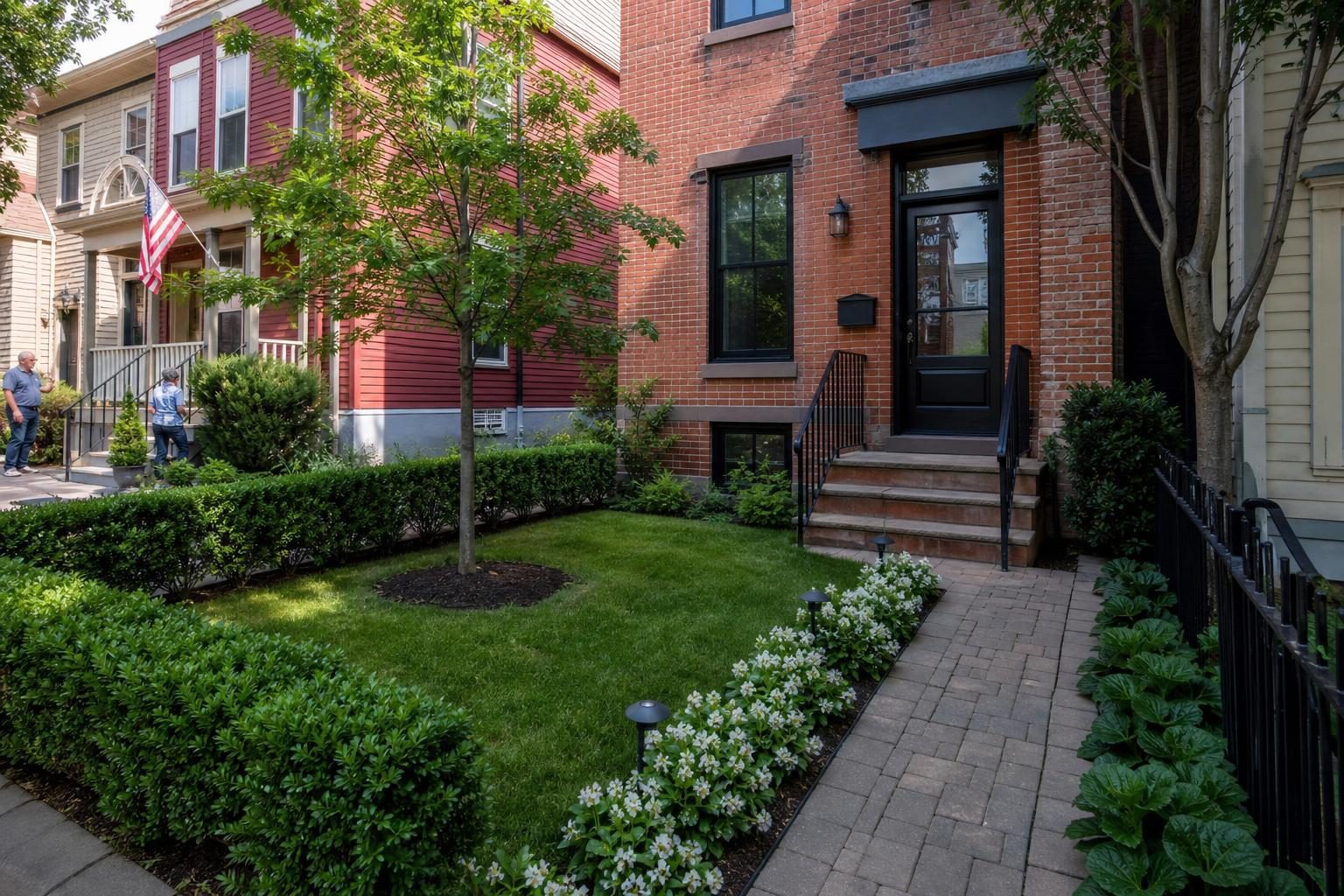
The best small front yard ideas focus on a clear, generous path to the door, a few well-chosen plants repeated in simple groups, and materials that make the space feel larger rather than busier. In a small yard every square foot is visible from the street, so scale, restraint, and low upkeep matter more than adding lots of features.
Part of our Complete Yard Design and Planning Guide: layouts, ideas by yard type, phasing and budgets in one place.
Start with the path to the front door
The walkway is the backbone of a small front yard. A cramped or awkward path makes the whole house feel tight.
- Width: a primary front walk is commonly about 4 feet wide so two people can walk side by side. A 3-foot path can work on very small lots but feels narrow.
- Route: a gentle curve or offset can add interest, but in a short yard a straight path often looks cleaner and is easier to shovel.
- Landing: widen the area at the front steps into a small landing so guests are not standing in planting beds.
- Driveway connection: many visitors arrive from the driveway, not the sidewalk. Make sure that route is obvious and paved.
For material and installation choices, see our walkway and pathway installation guide.

Plant fewer varieties, in bigger groups
A common small-yard mistake is one of everything. Twelve different plants in a 15-foot bed look cluttered from the street. Instead:
- Choose three to five plant varieties and repeat them.
- Group perennials and grasses in odd-numbered drifts.
- Use one or two evergreen shrubs to anchor corners and give winter structure.
- Pick foundation shrubs by mature size, not nursery size, so they do not cover windows in five years.
- Leave enough space between plants and the house wall for air flow and maintenance access.
Reduce or reshape the lawn
A tiny strip of lawn often costs more effort per square foot than any other part of the yard: mowing, edging, and irrigation for a patch you barely use. Options include:
- Shrink the lawn into a simple shape like a rectangle or oval, which reads cleanly and is easy to mow.
- Replace it with planting beds and a mulch or gravel groundcover.
- Use low groundcovers that tolerate light foot traffic where you need some green without mowing.
- Keep a lawn if you value it for kids or pets, but make sure irrigation coverage is efficient.
Our low-maintenance landscaping guide covers lawn alternatives in more detail.

Use materials that make the space feel larger
- Limit hardscape to one or two materials and colors that complement the house.
- Larger-format pavers or simple concrete with clean joints look calmer than small, busy patterns.
- Steel or concrete edging creates crisp lines that make beds look intentional.
- Use a consistent mulch or gravel across all beds rather than mixing several.
- Light-colored surfaces brighten a shaded front yard.
Small front yard ideas by goal
| Goal | Ideas | Rough cost level |
|---|---|---|
| Curb appeal on a tight budget | Fresh edging, new mulch, a few repeated shrubs, painted front door, updated house numbers | Low |
| Less maintenance | Replace lawn with beds and gravel, add drip irrigation, choose slow-growing shrubs | Low to moderate |
| Better entry | Wider walkway, small landing, step lighting, planters at the door | Moderate |
| Privacy from the street | Low fence or hedge, layered planting, small ornamental tree | Moderate |
| Seating area | Small paver patio or porch extension with a bench | Moderate to higher |
Costs vary widely by region, site, and access. A refresh with mulch, edging, and new plants might be a few hundred to a couple of thousand dollars, while a new paver walkway and full replanting can run into the several-thousand range or more.

Add lighting, a focal point, and vertical interest
- Lighting: a few low-voltage path or step lights improve safety and make the yard look finished at night. Avoid lining both sides of a short path with lights, which can look like a runway.
- One focal point: a small specimen tree, a pair of large planters, or a bench gives the eye a place to land. More than one in a small yard competes.
- Vertical elements: narrow upright shrubs, a trellis, or a small ornamental tree draw the eye up and add depth without taking much ground space.
For more on making the approach to the door welcoming, see front entry landscaping ideas.

Practical checks before you plan
- Sun and shade: track how many hours of direct sun each area gets before choosing plants.
- Drainage: make sure soil slopes away from the foundation and that downspouts discharge clear of new beds.
- Utilities and setbacks: call 811 before digging, and check HOA rules or city rules on fence heights and street-side planting.
- Sight lines: keep plantings near the driveway low enough for safe visibility when backing out.
- Snow storage: in cold climates, leave space to pile snow without crushing shrubs.
Doing it in phases
A small front yard is a good candidate for phasing. Start with anything that involves digging or grading, such as walkway replacement, drainage fixes, and irrigation changes. Then plant trees and shrubs, and finish with perennials, mulch, and lighting. That order keeps finished beds from being torn up by later work.
Common mistakes and what to ask a contractor
Frequent mistakes include planting shrubs that outgrow the space, a walkway that is too narrow, too many decorative elements, and burying the base of siding under mulch. When getting quotes, ask the contractor for a simple plan drawing, the mature size of each plant they recommend, the walkway width and base depth, and whether irrigation changes are included. Our broader front yard landscaping guide covers the full planning process.
Frequently asked questions
How do I make a small front yard look bigger?
Use fewer plant types in larger groups, a limited palette of hardscape materials, clean bed edges, and one focal point. Avoid scattering small decorations.
Should I get rid of the lawn in a small front yard?
If you do not use it, replacing it with beds or groundcover can cut maintenance and water use. Keep a simple lawn shape if you want some open green.
What plants work best in small front yards?
Compact or slow-growing shrubs, ornamental grasses, and perennials suited to your sun and climate. Check mature size before buying.
How wide should a front walkway be?
About 4 feet is common for a main entry path. Narrower paths work for secondary routes.