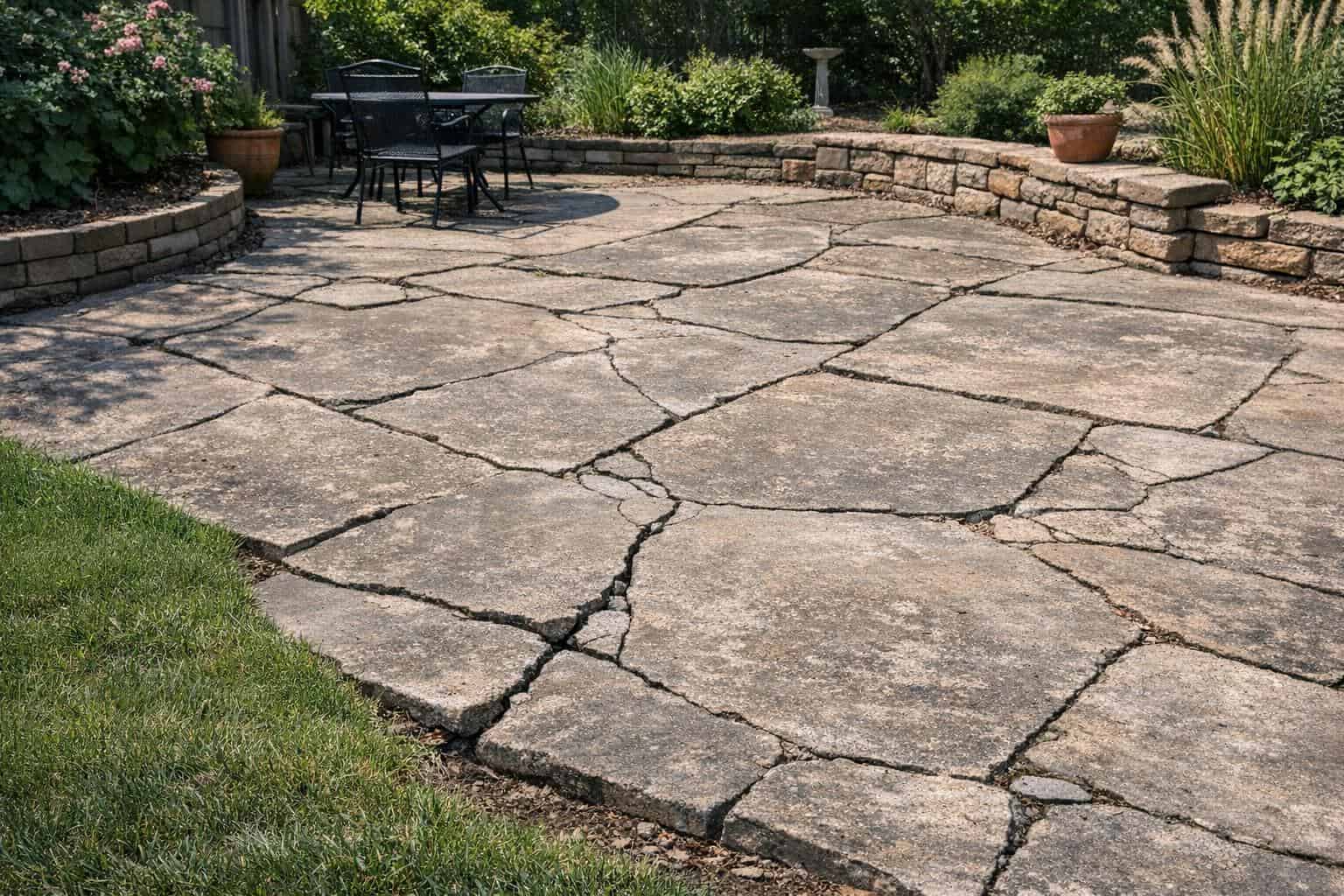
It’s usually time to replace a patio when the problems come from underneath: widespread settling, slabs that tilt toward the house, cracks that keep widening, or a base that washes out. Surface wear, a few hairline cracks or a handful of sunken pavers can usually be repaired for much less. The trick is telling a cosmetic problem from a structural one.
Part of our Complete Patio and Paver Guide: materials, costs, installation, repair and hiring in one place.
Repair or replace: the quick test
Ask three questions before calling anyone:
Localized, stable damage on a patio that still drains correctly is a repair job. Widespread, worsening damage, or anything that sends water toward the foundation, points toward replacement.
- Is the damage limited to one area, or is it spread across the whole patio?
- Is the surface still draining away from the house?
- Is the problem getting worse year over year?

Warning signs for concrete patios
Cracks that are wide, offset or growing
Hairline shrinkage cracks are normal in concrete and often harmless. Pay attention when cracks are wider than about a quarter inch, when one side sits higher than the other, or when you see new cracks every season. Offset cracks are trip hazards and usually mean the base has moved.
Sinking or tilting slabs
A slab that has dropped near the house, or tilted so water flows toward the foundation, is one of the strongest reasons to act. Sometimes lifting the slab with foam or slurry injection can fix this. If the slab is also badly cracked, replacing it is often the better value.
Heavy surface scaling and spalling
Flaking, pitting and exposed stone usually come from freeze-thaw cycles, deicing salts or a weak original finish. Light scaling can be resurfaced. Deep, widespread spalling means the top layer has failed and overlays may not hold.
Warning signs for paver and stone patios
- Widespread sinking or rutting across large areas rather than a few pavers.
- Pavers shifting apart because the edge restraint has failed.
- Sand washing out repeatedly from joints, especially after each storm.
- Weeds and ants returning no matter how often you clean the joints, which can signal a thin or poorly compacted base.
- Cracked or crumbling units across much of the patio, not just one or two.
Pavers have one big advantage: they can be lifted, the base fixed, and the same pavers relaid. That’s a middle option between a small repair and a full replacement.

Signs that apply to any patio
- Water pools on the surface or runs toward the house after rain.
- Trip hazards at edges, steps or the door threshold.
- Tree roots lifting sections, which will keep happening unless the root issue is addressed.
- The patio no longer fits how you live, such as being too small for a table, sitting in full afternoon sun, or blocking a better layout.
That last point matters. Sometimes a structurally fine patio is still worth replacing because the space doesn’t work. If that’s your situation, our guide to signs your backyard layout is not working can help you decide what to change.
Repair options and what they cost
Costs vary by region, patio size, access and material. These are rounded ranges to help you compare.
| Option | Best for | Typical range |
|---|---|---|
| Crack filling and sealing | Small, stable cracks in concrete | $200 to $800 |
| Slab lifting (foam or slurry) | Sunken but intact concrete slabs | $500 to $2,500 |
| Resurfacing or overlay | Sound slab with worn or scaled surface | $3 to $10 per sq ft |
| Paver reset (lift and relay) | Settled pavers on a fixable base | $5 to $15 per sq ft |
| Full concrete replacement | Widespread cracking or failed base | $8 to $20+ per sq ft including removal |
| Full paver replacement | Failed base and damaged units | $15 to $35+ per sq ft including removal |
Demolition and haul-off often add a noticeable amount to replacement. Ask that it be listed as a separate line.

What usually causes a patio to fail
Knowing the cause keeps you from paying for the same problem twice.
- Thin or poorly compacted base. The most common cause of settling in both concrete and pavers.
- Poor drainage. Water under a patio softens the base and drives frost heave.
- Downspouts discharging onto or beside the patio.
- Tree roots growing under the slab.
- No control joints in concrete, leading to random cracking.
- Missing edge restraint on pavers.
If water is part of the problem, fix it during the replacement. Our drainage solutions guide covers the common approaches.

If you decide to replace, consider the material
Replacement is a chance to rethink material. Poured concrete is usually the lowest upfront cost. Stamped concrete adds pattern at a moderate premium. Pavers cost more but can be repaired section by section. Natural stone costs the most. Our comparison of paver vs concrete patios breaks down the tradeoffs.
Questions to ask a contractor
- What do you think caused the damage, and how will the new patio avoid it?
- How deep will the base be, and how will it be compacted?
- What slope will the finished surface have, and which direction will water drain?
- Is demolition, haul-off and disposal included?
- For concrete: what thickness, reinforcement and joint spacing?
- For pavers: what edge restraint and joint sand?
- What does the warranty cover, and for how long?
For a broader checklist, see what a hardscape estimate should include.
Frequently asked questions
Can I pour new concrete over an old patio?
Sometimes, if the old slab is solid, level and drains correctly. Overlaying a cracked or sinking slab usually just transfers the cracks to the new surface. It also raises the height, which can cause problems at door thresholds.
How long should a patio last?
A well-built concrete or paver patio can last decades. Patios that fail in a few years almost always had base, drainage or installation issues.
Is it worth repairing a small number of sunken pavers?
Yes. Lifting a few pavers, adding and compacting base, and relaying them is a common, affordable repair if the rest of the patio is sound.
What time of year is best for patio replacement?
Spring through fall works in most regions. Concrete needs moderate temperatures to cure well, so avoid freezing weeks and extreme heat when possible.