
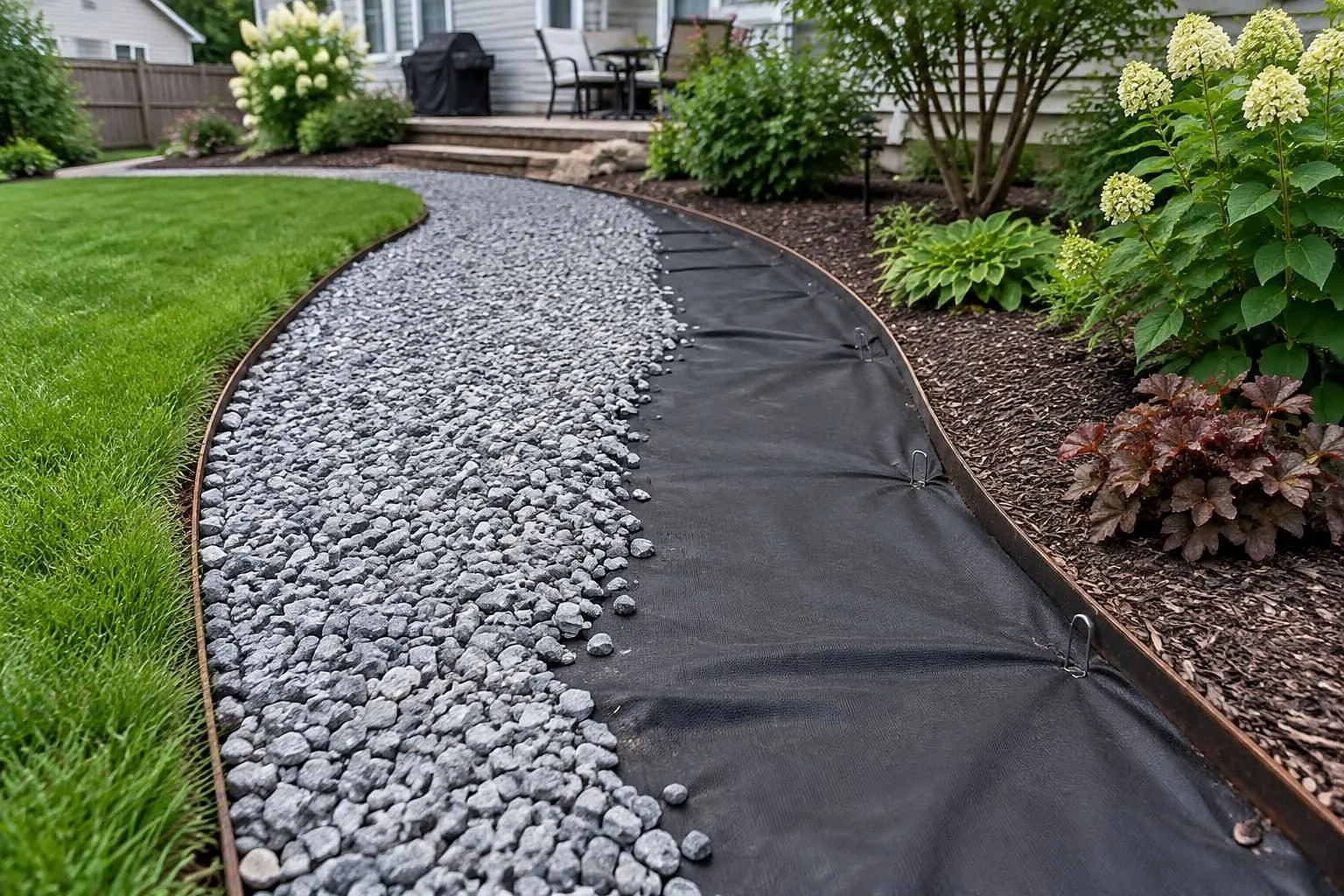
Landscape fabric, also sold as weed barrier or weed block cloth, is useful in some places and a long-term headache in others. It works best under rock, gravel paths and drainage stone where nothing will be planted. It works worst under bark mulch around shrubs and perennials, which is exactly where most people put it.
Quick answer: Use landscape fabric where you want a permanent, plant-free layer: under gravel paths, river rock, dry creek beds and drainage stone, where it keeps stone from sinking into the soil. Skip it in planted beds under wood mulch. There, organic mulch alone controls weeds better over time, because weeds soon grow in the mulch on top of the fabric and roots tangle into it. Expect to pay about $0.10 to $0.60 per square foot for the fabric itself, or roughly $0.50 to $1.50 per square foot installed. Prices vary by product and area.
Part of our Complete Mulch Guide: types, how much you need, prices and care in one place.

What landscape fabric actually does
Landscape fabric is a sheet of woven or bonded plastic fibers, usually polypropylene. Laid on the soil, it does three things:
What it does not do is stop weeds that arrive from above. Seeds blow in, birds drop them, and leaves and dust break down on the surface. Within a season or two there is a thin layer of growing material on top of the fabric, and weeds root right in it. That is the key fact behind every “it worked for a year, then it didn’t” story.
- Blocks light from weed seeds already in the soil, so fewer sprout from below.
- Separates layers. It keeps gravel or rock from working down into the dirt, and keeps mud from pumping up into the stone.
- Lets some water through, unlike plastic sheeting, at least while it is new and clean.
Woven, non-woven and other types
The labels on store shelves are confusing, so here is what the main types are and what each is good for.

| Type | What it looks like | Best for | Watch out for |
|---|---|---|---|
| Woven (slit film) | Tight plastic weave, often black with stripes | Under gravel paths, rock beds and driveways as a separation layer | Less permeable; edges fray when cut |
| Non-woven (needle-punched) | Felt-like, gray or white | Wrapping French drains, dry creek beds, drainage gravel | Plants and weeds can root into it more easily |
| Spun-bond (thin, papery) | Light, smooth, cheap rolls | Short-term use only | Tears easily and breaks down fast in sunlight |
| Perforated plastic | Black plastic with pin holes | Rarely a good choice | Little air or water exchange; the soil underneath suffers |
| Driveway geotextile | Heavy woven, sold by width | Gravel driveways and parking pads over soft soil | Not a weed product; buy by rated strength, not price |
“Heavy duty” is a marketing term, not a standard. Compare the weight or thickness printed on the package and whether the fabric is woven or non-woven. For a walking path, a commercial or contractor grade lasts far longer than thin bargain rolls.
Where fabric works well
Fabric earns its place where nothing will ever be planted and the stone is meant to stay put:
- Gravel paths and patios. It keeps the stone from disappearing into the soil and slows weeds coming up from below. See our walkway gravel depth guide for how much stone to put on top.
- River rock and decorative stone beds. Rock pressed into bare soil slowly sinks and mixes with dirt, and that mixed layer is miserable to clean up later. Fabric keeps the rock clean and makes future removal possible.
- French drains and dry creek beds. Here the fabric is a filter that keeps fine soil out of the drainage stone. Use non-woven fabric labeled for drainage. Our French drain cost guide covers the full build.
- Gravel driveways over soft or clay soil, using a woven driveway geotextile under a compacted base, not thin weed cloth. The gravel driveway guide explains the base layers.
- Under mulched paths or play areas with no ornamental plants. UF/IFAS Extension names unplanted mulched paths as the best place to consider fabric.
- Annual vegetable rows, where fabric is laid in spring and pulled up at season’s end, before roots and debris can lock into it.

Where fabric is a bad idea
The common setup of fabric around shrubs and perennials with bark mulch on top is the one university extension horticulturists warn against most. Here is why.
- Weeds grow on top anyway. Mulch is a perfect seedbed. As it breaks down, it becomes soil sitting on top of the fabric.
- Perennial weeds root through it, and then they are nearly impossible to pull. UNH Extension calls fabric under mulch a maintenance problem over time for exactly this reason.
- The soil underneath gets worse. Decomposing mulch never reaches the soil, and fine particles clog the fabric’s pores, so less water and air get down to the roots.
- Your plants’ roots grow into it. Later, pulling up the fabric tears those roots.
- On slopes, mulch slides off the slick surface and leaves bare, shiny fabric exposed.
Penn State Extension’s account of removing an old fabric bed describes weeds rooted through the cloth, rotting fabric, buckled edging and poor soil underneath. Clearing it took two people two days. The article also quotes a Washington State University horticulturist: landscape fabrics are not effective weed control for permanent landscapes.
What landscape fabric costs
The fabric is the cheap part of most projects. The rock, mulch, edging and labor around it cost far more. Typical ranges, rounded:
| Item | Typical cost | Notes |
|---|---|---|
| Basic weed barrier roll (about 3 x 50 ft) | $15 to $40 | Thin spun-bond at the low end |
| Contractor-grade woven or non-woven | $0.15 to $0.60 per sq ft | Sold in wider, longer rolls |
| Landscape staples or pins | $10 to $25 per 50 to 100 | Use more along seams and edges |
| Driveway geotextile | $0.20 to $0.75 per sq ft | Priced by width and strength rating |
| Fabric installed by a pro | About $0.50 to $1.50 per sq ft | Usually bundled with a rock or path job |
Costs vary by product, region and site access. Example: fabric for a 3 x 40 foot gravel path (120 square feet) runs about $20 to $70 in material plus a pack of staples. The stone on top will cost several times that. If you are comparing ground covers, our mulch vs decorative rock cost guide breaks down the bigger numbers.
How to install it, step by step

These steps are for the right kind of job: a gravel path, rock bed or other unplanted area.
- Confirm nothing will be planted there. If you might add shrubs later, reconsider fabric now.
- Kill or remove existing weeds and grass, especially spreading perennials like bermudagrass, bindweed and nutsedge. Fabric will not stop established perennial weeds, and they will grow through seams.
- Grade and compact the soil. Rake out roots and sharp stones, slope the surface away from the house, and tamp it firm so the fabric lies flat.
- Install edging first. Steel, aluminum, stone or paver edging holds the fabric edges down and keeps stone in place.
- Roll out the fabric with any marked side facing up, as the package directs. Overlap seams by at least 6 to 12 inches; under driveways, suppliers often call for 18 inches or more.
- Pin it down with landscape staples every 2 to 3 feet, closer along seams and edges, so it cannot shift when stone goes on.
- Cover it right away with 2 to 3 inches of rock or gravel. Sunlight breaks fabric down, and any exposed fabric will fray and lift.
- Keep the surface clean. Blow or rake leaves and debris off rock areas a few times a year so seeds have nothing to root in.
Shrubs or trees already growing in a rock bed? Cut an X in the fabric, fold the flaps under, and leave a generous opening around the trunk. A tight collar can girdle the stem as it grows.
Problems homeowners run into
- Weeds coming up through the rock after a year or two. Usually they are growing in debris on top of the fabric, not from the soil. Regular blowing and spot weeding control this; the fabric alone does not.
- Fabric poking through thin rock or mulch. The cover layer was too thin or has thinned out. Exposed fabric looks bad and degrades quickly. Add stone or trim and re-pin the loose piece.
- Pea gravel that won’t stay put. Round gravel rolls on smooth fabric and walks away. A compacted crushed-stone base under it, or switching to angular stone, helps.
- Wanting to add plants later. Every new hole means cutting fabric, and roots that reach the fabric spread sideways along it.
- Removing old fabric. Under rock, you will be sifting stone or starting over. Under old mulch, you will pull up roots, weeds and shreds of fabric for years.
- Cheap fabric under a driveway. Thin weed cloth tears under a compactor and gives no real support. Driveways need a rated geotextile.
- Using black plastic sheeting instead. It sheds water entirely, starves the soil and creates runoff. Avoid it in landscape beds.
Hiring someone: questions and red flags
Fabric usually comes as part of a larger job, such as a rock bed, path or drain. Ask:
- What type and grade of fabric will you use, and why that one for this job?
- How will you deal with the existing weeds and grass before laying it?
- How much overlap at seams, and how often will you pin it?
- What edging holds the fabric and stone in place?
- How deep will the rock or gravel be on top?
- For a drain: is the fabric non-woven and rated for drainage?
Red flags: fabric planned under bark mulch around shrubs as a “no-weed” promise; thin weed cloth under a driveway; no weed removal before install; no edging; an inch of rock over fabric. For more on vetting a crew, see questions to ask before hiring a landscaper.
Alternatives for planted beds
For beds with shrubs, perennials or vegetables, extension services consistently recommend organic mulch instead of fabric.
- Shredded wood or bark mulch 2 to 3 inches deep, kept a few inches back from stems and trunks. Our complete mulch guide covers types, amounts and costs.
- Shredded leaves or pine needles, free if you have trees.
- Cardboard under mulch when you are converting lawn to a bed. It smothers grass for a season, then breaks down into the soil instead of staying as a layer.
- Dense planting. Ground covers and shrubs spaced to fill in shade the soil, so weeds have little room. The garden bed and planting guide walks through layout and spacing.
Mulch needs topping up every year or two, but it improves the soil as it breaks down. Fabric never does.
Frequently asked questions
Should I put landscape fabric under river rock?
Usually yes. It keeps the rock from sinking and mixing with soil, and it makes future changes far easier. It will not stop weeds that sprout in debris on top, so plan to blow the bed clean and pull the occasional weed.
Does landscape fabric go under mulch?
In planted beds, it is better not to. Weeds grow in the mulch on top, the soil underneath gets worse, and plant roots tangle into the fabric. Use a thicker layer of organic mulch instead.
Which side of landscape fabric goes up?
Follow the package. Many brands print “this side up” or put the fuzzier, rougher side down against the soil. With most woven fabric it makes little practical difference.
What fabric should I use for a French drain?
A non-woven geotextile labeled for drainage or filtration. It lets water pass while keeping fine soil out of the gravel. Woven slit-film fabric is less permeable and can slow drainage.
How long does landscape fabric last?
Buried under a few inches of stone and kept out of the sun, quality fabric can last many years. Exposed to sunlight, thin fabric can break down within a season or two. Covering it fully is what matters most.
Is landscape fabric better than plastic for weeds?
Yes. Solid plastic blocks water and air entirely, which harms the soil and sends water running off. If you need a barrier at all, use breathable fabric, and only where nothing will be planted.