
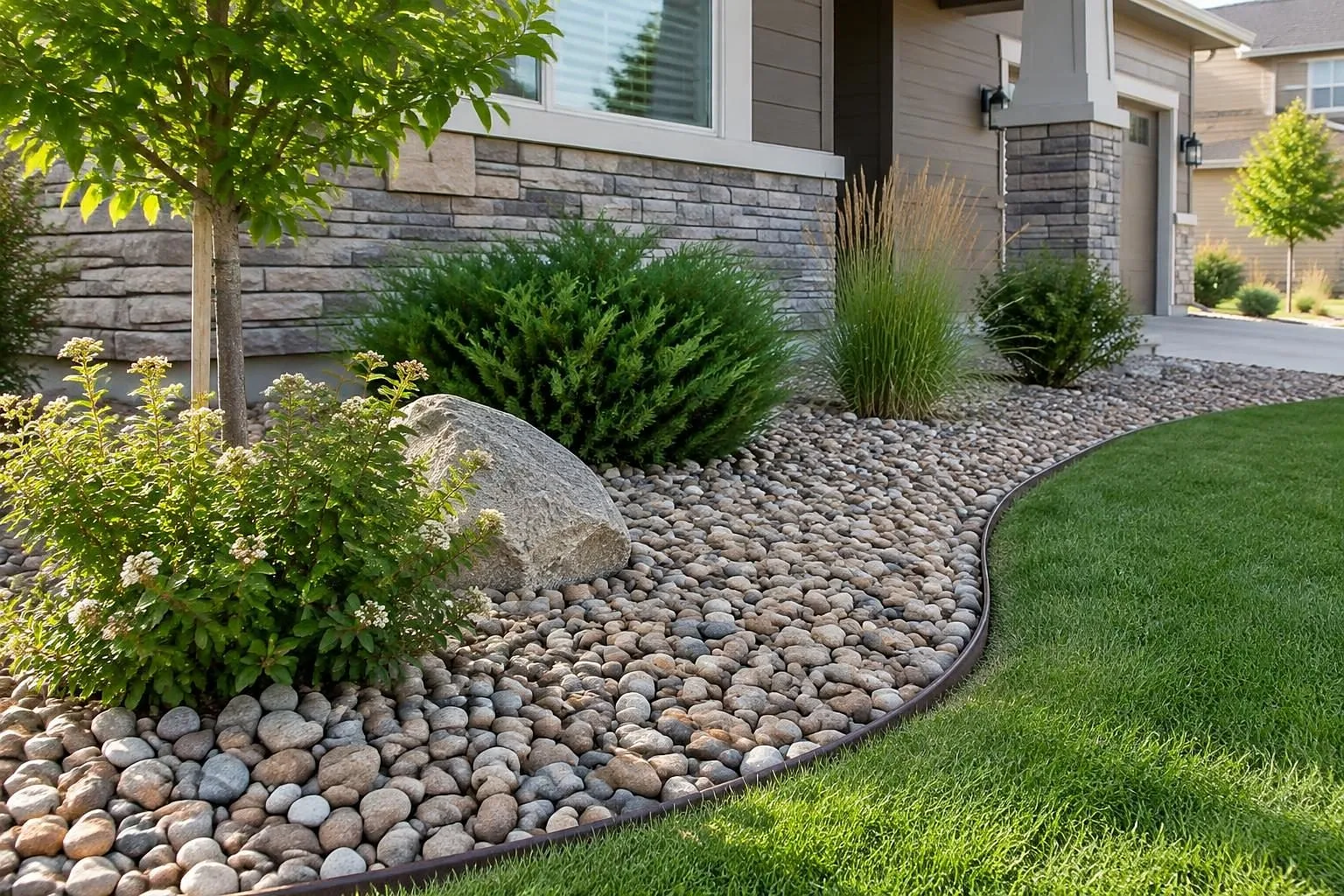
River rock is smooth, rounded stone that has been tumbled by water. In a yard it works best in jobs that suit stone: drainage paths, dry creek beds, strips along a foundation, and borders that never need re-mulching. It works less well packed around thirsty plants or under trees that drop leaves. The real decisions are which size to buy, how deep to lay it, and what goes underneath so it does not sink or turn into a weed bed.
Quick answer: For most beds and borders, 3/4 to 1 1/2 inch river rock laid 2 to 3 inches deep over a firm, edged base is the sweet spot. Larger 1 to 3 inch rock needs 3 to 4 inches, and 3 to 5 inch cobble suits creek beds and drainage areas. Plan on about 1.3 to 1.5 tons per cubic yard; one ton covers roughly 100 to 120 square feet at 2 inches. Bulk river rock usually runs $60 to $150 a ton before delivery, and installed river rock often comes to about $2 to $6 per square foot, more for designed beds with boulders and edging. Prices vary a lot by region and rock type.
Part of our Complete Mulch Guide: types, how much you need, prices and care in one place.

Where river rock works, and where it does not
River rock is permanent, does not blow away, does not rot, and does not need topping up every year. That makes it a good fit for spots where organic mulch keeps washing out or where you simply want the ground covered and left alone. It is also a natural material for anywhere water moves, because rounded stone lets water flow over and between it.
Good places for river rock:
- Drainage paths and downspout outlets. A bed of cobble where a downspout empties slows the water and stops it from digging a trench.
- Dry creek beds and swales. Rounded stone looks like it belongs in a channel, which crushed gravel does not.
- Foundation strips and side yards. A narrow band along the house that never gets planted, as long as the ground slopes away from the wall.
- Slopes that keep shedding mulch. Clemson Cooperative Extension notes that rock stays put and helps with erosion on hillsides and sloped beds.
- Low-water and succulent plantings where the plants actually like a hot, dry surface.
Places to think twice:
- Around shrubs and trees that dislike heat. Stone soaks up sun and holds it. NDSU Extension calls rock mulch a heat trap that causes more drought stress than shredded bark, and names birch, mountain ash and hosta as plants that can suffer under it.
- Under trees that drop a lot of leaves. Leaves settle between stones and are hard to clear without moving the rock.
- Beds you plan to replant often. Digging through rock every spring gets old fast.
- Next to a south- or west-facing wall in a hot climate, where reflected heat can bake plants and the wall itself.
Rock also does nothing for soil. Organic mulch breaks down and feeds the soil, while stone just sits there. If the main goal is healthier plants, wood mulch usually wins; if the goal is a surface that stays put and needs little care, rock earns its place. For a side-by-side look at cost and coverage, see our mulch vs decorative rock guide, and for the organic side, the mulch guide.
River rock sizes and what each is for
Suppliers name sizes differently, so go by the inch range on the ticket, not the marketing name. These are the common ranges and what they suit:
| Size | Often sold as | Best for | Typical depth |
|---|---|---|---|
| 1/4 to 1/2 inch | Pea gravel, river pebbles | Paths, between stepping stones, play areas | 2 to 3 inches over a base |
| 3/4 to 1 1/2 inch | Small or medium river rock | Flower beds, borders, foundation strips | 2 to 3 inches |
| 1 to 3 inch | Medium to large river rock | Larger beds, around drains, downspout pads | 3 to 4 inches |
| 3 to 5 inch | Cobble | Dry creek beds, swales, splash areas | 4 to 6 inches |
| 6 inches and up | Large cobble, small boulders | Accents, creek bed edges, holding banks | Set partly into the soil |
A simple rule: lay rock at least one and a half to two times as deep as the stones are wide, or soil will show between them. Small rock is easier to walk on and fills gaps better but scatters onto lawns more easily. Big rock stays where you put it but leaves larger gaps for leaves and weed seeds.
Color matters more than people expect. Mixed tan, gray and brown rock hides dust and leaf stain. White and very light rock looks crisp on day one but shows dirt, algae and footprints, and it reflects glare onto windows on sunny sides of the house. Premium polished or “beach pebble” stone costs several times more than standard river rock, so it is usually saved for small, visible spots.

How much river rock you need
The math is the same one used for mulch and gravel:
Square feet x depth in inches / 324 = cubic yards. Then multiply cubic yards by about 1.4 to get tons, since river rock usually weighs 1.3 to 1.5 tons per cubic yard.
A worked example: a 10 by 15 foot bed is 150 square feet. At 3 inches deep for 1 to 2 inch rock, that is 150 x 3 / 324 = about 1.4 cubic yards, or roughly 2 tons. Order a little extra, because rock settles into the base and edges never come out exactly to plan.
The same bed would take about 75 half-cubic-foot bags. That is why bags make sense for a downspout pad or a small strip, and bulk delivery makes sense for anything bigger than a few dozen square feet. Bulk yards also load rock straight into a truck or deliver it to the driveway, so plan where the pile will sit and how you will move it (a wheelbarrow holds only a few hundred pounds of stone safely per trip).
What river rock costs
These are rounded ranges from supplier and cost-site data. Your local price depends on the rock type, how far it travels, delivery distance and how hard the site is to work.
| Item | Typical range | Notes |
|---|---|---|
| Bulk river rock | $60 to $150 per ton | Standard mixed colors; local stone is cheapest |
| Premium or polished stone | Several hundred dollars per ton or more | Beach pebbles, single-color, imported |
| Bagged river rock | About $5 to $10 per 0.5 cu ft bag | Easy for small jobs, costly for big ones |
| Delivery | About $50 to $150 per load | Some yards waive it over a minimum |
| Installed, simple bed over prepared base | About $2 to $6 per sq ft | Includes material and spreading |
| Installed, designed bed with edging and boulders | About $8 to $12+ per sq ft | More labor, heavier stone |
| Dry creek bed with grading | Often $1,500 to $5,000+ | Length, boulder size and drainage work drive it |
Labor is often the bigger number. Removing sod, digging out a few inches of soil and hauling it away can cost as much as the stone. Ask whether a quote includes that, plus edging and haul-off. Our guides to landscaping material costs and buying materials yourself vs letting the contractor supply them help when comparing bids.
How to install river rock

Most river rock problems come from skipping prep. The rock is the last and easiest step.
- Mark the area and check drainage. Make sure the ground slopes away from the house at least a few inches over the first several feet. Rock will not fix a low spot; water will just sit under it. If water already pools, read up on drainage solutions first.
- Call 811 before digging if you are going more than a few inches down or setting boulders.
- Remove grass and weeds, roots included. Rock laid over live turf grows grass through it within a season.
- Dig down to depth. Excavate so the finished rock sits about an inch below the lawn or path edge. That keeps stones from rolling into the grass.
- Install edging. Steel, aluminum, stone or concrete edging holds the rock in and keeps the lawn out. Without it, rock spreads and grass creeps in.
- Firm the base. Tamp the soil. Many installers add an inch or two of compacted crushed gravel under larger rock so it does not sink. Landscape fabric is optional; it separates stone from soil, but it does not stop weeds that sprout in debris on top of it (more on that below).
- Spread the rock to depth. Dump in small piles and rake out. Wear gloves and lift with your legs; a ton of rock is a real workout.
- Rinse it down. A hose rinse removes quarry dust and shows any thin spots.
Building a dry creek bed

A dry creek bed is a stone-lined channel that looks like a natural stream with the water turned off. It can carry storm runoff or downspout water across a yard, and it also works purely as a design feature where nothing else grows well. A Master Gardener fact sheet published through University of Arkansas Extension gives a solid approach:
- Follow the existing slope and let the channel curve rather than run straight.
- Make it wider than it is deep, roughly two to one, and widen it at the bends the way real streams do.
- Use the dug soil to build up the banks, and tamp it.
- Mix stone sizes. Small and medium rock down the middle, larger cobble and boulders along the edges and at bends, as if the current could not move them. Bury some boulders partway so they look settled.
- Finish with finer gravel at the low end, like deposited sediment, and plant the banks, ideally with natives that handle both wet and dry spells.
Two practical warnings. If the bed will carry real flow regularly, stones can shift, and the same fact sheet suggests setting them in mortar in that case. And if the water leaves your property or heads toward a street or storm drain, check local rules before redirecting it. Where the goal is moving water away from a foundation fast, a buried drain may be the better tool; our French drain vs surface drain guide covers when each one makes sense.
Problems homeowners run into
River rock has a reputation for being maintenance-free. It is lower-maintenance than mulch, not no-maintenance. These are the complaints that come up again and again:
- Weeds growing on top of the fabric. Dust, pollen and broken-down leaves collect in the gaps. After a couple of years there is a thin layer of soil above the fabric, and weeds root in it. Fabric slows weeds from below; it cannot stop seeds landing on top.
- Leaves that will not come out. Raking pulls rock with the leaves, and a strong blower can scatter small stones. A leaf blower on a low setting in the fall, before leaves break down, works best.
- Rock sinking into the soil. Stone laid straight onto soft ground slowly mixes in, especially where people walk. A compacted base or separation layer helps.
- Stones on the lawn. Without an edge set below grade, rock migrates into the grass, where a mower throws it. That is a safety issue, not just a tidiness one.
- Torn fabric showing through. Thin fabric under a shallow layer of rock tears and pokes out. Either lay rock deep enough to cover it or skip the fabric.
- Removal is brutal. People who later want plants instead often say taking rock out took far longer than putting it in. Decide carefully before covering a large area.
If you want even less upkeep, plan the planting first and use rock where it does a job. Our low-water landscaping guide covers how to keep a dry yard from looking empty.
Hiring someone: questions and red flags
Spreading rock is DIY-friendly. Hiring makes more sense for large areas, heavy cobble and boulders, dry creek beds tied into drainage, or when the old turf and soil need to be dug out and hauled away.
Questions to ask:
- What size and type of rock is in the quote, how many tons, and at what depth?
- Does the price include removing sod, excavating, hauling away soil, and edging?
- What goes under the rock: compacted base, fabric, or nothing, and why?
- How will you make sure the ground slopes away from the house?
- For a creek bed: where does the water end up, and how will the stones stay put in a heavy storm?
Red flags:
- A quote that lists only “river rock, installed” with no tonnage, size or depth.
- Plans to dump rock straight onto existing grass.
- Rock piled against siding or above the foundation line, or sloping toward the house.
- Promises that rock means “no weeds ever.”
For a broader checklist, see questions to ask before hiring a landscaper.
Frequently asked questions
Is river rock better than mulch?
It depends on the spot. River rock lasts for years, stays put on slopes and suits drainage areas. Mulch keeps soil cooler, feeds it as it breaks down and is easier on most shrubs and trees. Many yards use both: rock where water moves or nothing grows, mulch around plants.
How deep should river rock be?
About 2 to 3 inches for 3/4 to 1 1/2 inch rock, 3 to 4 inches for 1 to 3 inch rock, and 4 to 6 inches for cobble. As a rule, lay it at least one and a half to two times as deep as the stones are wide.
Do I need landscape fabric under river rock?
Not always. Fabric helps keep rock from sinking into soft soil and slows weeds from below, but weeds still grow in debris that collects on top. A compacted gravel base does the separation job well under larger rock. If you use fabric, use a sturdy woven type and cover it fully.
Does river rock attract bugs or snakes?
Rock does not attract pests by itself, but gaps between large stones and boulder piles can give shelter to insects and small animals. Keep large rock piles away from doors and foundations, and keep the area free of leaf litter.
Can I put river rock right against my house?
Yes, as long as the ground under it slopes away from the wall and the rock stays below siding and weep holes. Rock is often a better choice than wood mulch against the foundation because it does not hold moisture against the house.
How many square feet does a ton of river rock cover?
Roughly 100 to 120 square feet at 2 inches deep, and about 70 to 80 square feet at 3 inches. Larger stones need more depth, so they cover less area per ton.