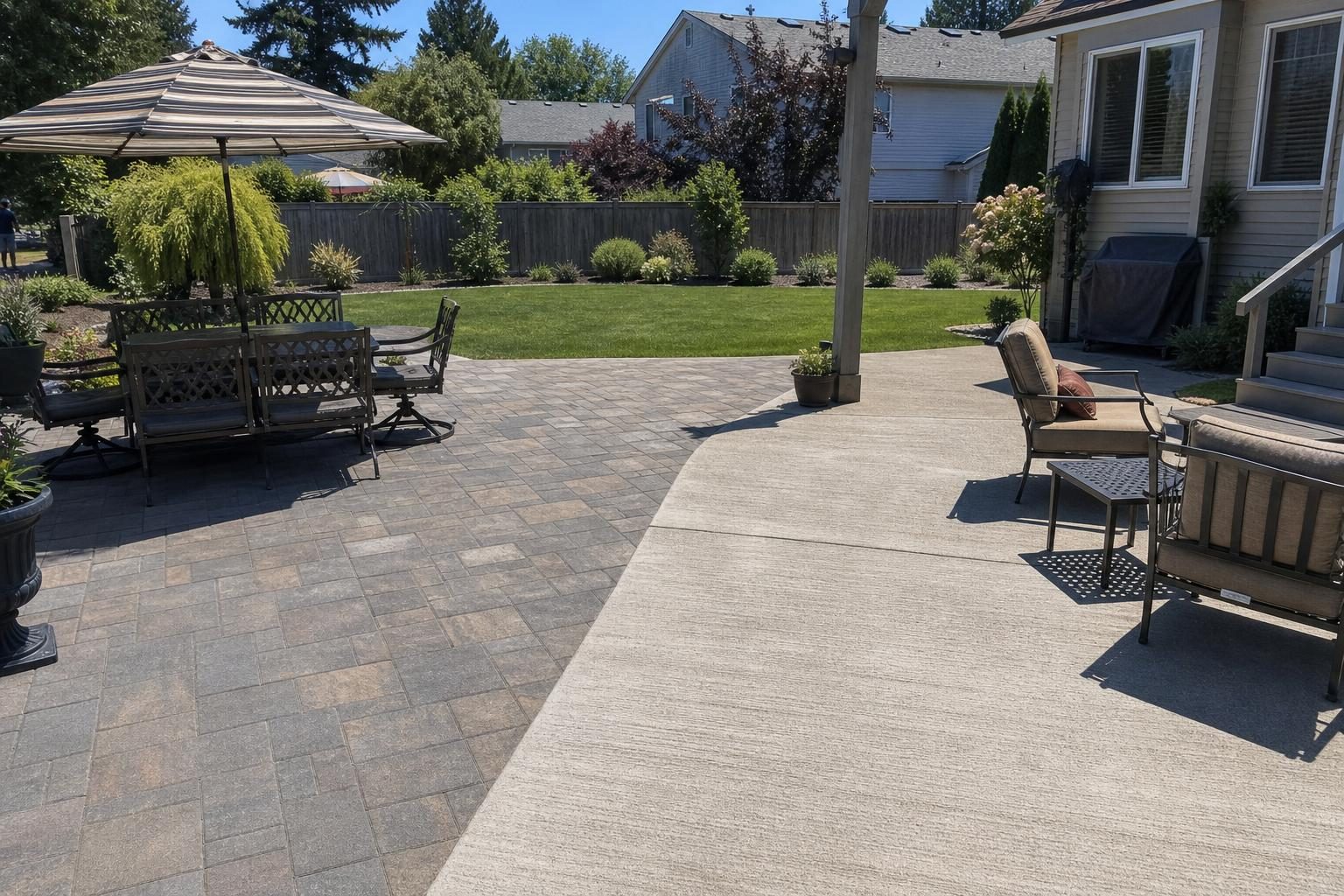
Choose poured concrete if you want the lowest cost for a solid, smooth patio and you are comfortable with some cracking over time. Choose pavers if you want more design options, live with freeze-thaw cycles or shifting soil, or want a surface you can repair one piece at a time. Pavers usually cost more up front, while concrete costs less but is harder to repair invisibly.
Part of our Complete Patio and Paver Guide: materials, costs, installation, repair and hiring in one place.
Paver vs concrete patio at a glance
| Factor | Concrete pavers | Poured concrete |
|---|---|---|
| Typical installed cost | About $15 to $30 per sq ft | About $8 to $15 per sq ft plain; $14 to $25 stamped or colored |
| Installation time | Several days for a typical patio | Often 1 to 3 days, plus curing before heavy use |
| Cracking | Joints flex; individual units rarely crack | Expected over time; control joints guide where |
| Repairs | Lift and reset or replace individual pavers | Patches show; large damage may mean replacing sections |
| Design options | Many shapes, colors, patterns and borders | Broom finish; stamping and color add options |
| Maintenance | Weed and joint sand care; optional sealing | Occasional cleaning; reseal if stamped or colored |
| Freeze-thaw climates | Handles movement well with a proper base | Can crack or scale without good mix, joints and drainage |
Prices vary by region, site access, slope, base requirements and pattern complexity. For a 300-square-foot patio, plain concrete might land around $2,500 to $4,500, while pavers might run $4,500 to $9,000. Our patio cost guide breaks down what moves the price.

Why pavers cost more
Pavers require more base preparation and more labor. A typical installation involves excavating several inches deeper than for concrete, building a compacted aggregate base in layers, screeding a bedding layer, setting each paver by hand, cutting edges, installing edge restraint and filling joints. Complex patterns, curves and borders add cutting and time.
Concrete also needs a good base, forms and reinforcement, but the surface goes down in one pour.

Durability and cracking
Concrete slabs crack. Control joints are cut or tooled so cracks form along straight lines instead of randomly, but settling, tree roots or frost heave can still cause visible cracks. A cracked slab is usually still functional, but it does not look new.
Pavers are separate units, so the surface moves without breaking. If the base settles or roots push up, a section can be lifted, the base fixed and the same pavers relaid. That repairability is the strongest argument for pavers in climates with freezing winters or expansive soils.
Both need a properly compacted base and good drainage. A poorly built paver patio can settle into ruts, and a well-built concrete patio can last decades.
Looks and design flexibility
Pavers come in many sizes, colors and textures, from tumbled cobble to large smooth slabs, and can be laid in herringbone, running bond or mixed patterns with contrasting borders. See our paver color and finish guide.
Plain concrete is clean and simple, which suits modern homes. Stamped concrete can imitate stone or brick for less than pavers, but repairs are hard to match and it needs resealing. If you are weighing that option, read our paver patio vs stamped concrete comparison.
How each one is installed

Paver patio steps
- Mark the layout and check where water will drain.
- Excavate, usually deeper than for concrete, to make room for the base.
- Compact the subgrade, then add and compact crushed aggregate in layers.
- Screed a thin bedding layer, set the pavers, and make the cuts at edges.
- Install edge restraint, fill joints with sand and compact the surface.
Concrete patio steps
- Excavate, compact the subgrade and place a compacted gravel base.
- Set forms with slope built in, and add reinforcement.
- Pour, level and finish the concrete, then cut or tool control joints.
- Cure the slab, keeping it moist or covered as the contractor directs.
Concrete is weather-sensitive on pour day: very hot, cold or rainy conditions can weaken the surface. Pavers are less sensitive once the base is in, which can make scheduling easier.
Maintenance over time
Pavers: sweep regularly, top up joint sand when it washes out, pull weeds from joints, and reset any pavers that settle. Polymeric joint sand reduces weeds and washout. Sealing is optional and can enhance color.
Concrete: clean occasionally, keep water draining away, and avoid de-icing salts on young concrete. Sealing helps resist stains and freeze-thaw damage. Stamped and colored concrete usually needs resealing every few years to keep its look.

Which to choose for your situation
- Tight budget, simple design: plain concrete.
- Freezing winters or clay soil: pavers usually handle movement better.
- Want a decorative look on a budget: stamped concrete, accepting resealing and harder repairs.
- Want to add features later: pavers are easier to expand or cut into for lighting or gas lines.
- Need very smooth surface for furniture or wheelchairs: concrete or large-format pavers.
- Utility lines run under the patio: pavers can be lifted for access and relaid.
What to check in either estimate
- Excavation depth and base material and thickness.
- For pavers: paver product, thickness, pattern, edge restraint and joint sand type.
- For concrete: slab thickness, reinforcement, joint spacing and finish.
- Slope and drainage direction, away from the house.
- Removal of existing surface and soil disposal.
- Permit responsibility, if required.
- Workmanship warranty and what it covers.
For a full list, see our hardscape estimate guide.
Estimate the patio cost range
Use this calculator to test patio size, paver tier, demolition, layout complexity, and detail level before comparing paver and concrete patio bids.
Paver Patio Cost Calculator
Estimate patio cost ranges using size, paver tier, prep complexity, and demolition assumptions.
Patio cost estimate
- Estimated area
- –
- Low estimate
- –
- Mid estimate
- –
- High estimate
- –
- Estimated range per sq ft
- –
Frequently asked questions
Do pavers last longer than concrete?
Both can last decades with a good base. Pavers are easier to repair, so the surface often looks better over time in areas where ground movement is common.
Do pavers add more home value than concrete?
A well-built patio of either type can add appeal. Pavers are often seen as more upscale, but the condition and design matter more than the material.
Can pavers be laid over an existing concrete patio?
Sometimes, using thinner pavers over sound, well-draining concrete. It raises the surface height, which can cause problems at doors and steps. A contractor should check the slab first.
How soon can I use a new patio?
Pavers can usually be walked on right after installation. Concrete can usually take foot traffic after a day or two, but needs more time before heavy furniture or grills.